A schedule of investments is the list, at the period end, of everything a fund holds: each issue by name and title, the number of shares or principal amount held, and its value, grouped by type of investment and by industry, country or region, with each subtotal shown as a percentage of net assets. For a registered fund its form is set by Rule 12-12 of Regulation S-X, and its total must agree with the investments line on the balance sheet. The example on this page takes the schedule apart column by column and names the record each column comes from, because that is where schedules go wrong: not in the arithmetic, but where two records that should agree do not. Botminds' Fund Financial Statements drafts the schedule from the administrator's trial balance and holdings, and its agents tie every line, subtotal and total before the reporting manager signs off.
Holdings in the example are illustrative; the fund totals and the forward-contract break come from the solution's fictional sample data, the Quillfield Strategic Income Fund at August 31, 2026, with net assets of $1,291,503,798.
Seven parts of a schedule of investments, and the record each must agree with
Name of issuer and title of issue (Column A)
What the rule asksEach issue listed separately; rate and maturity; for variable rates the reference rate, spread and period-end rate; any payment-in-kind rate
The record it comes fromSecurity master: issuer, coupon, maturity, reference rate and spread
Category headings and subtotals
What the rule asksBy type of investment and by industry, country or region, each subtotal with its percentage of net assets
The record it comes fromThe fund's classification policy, applied to the security master; net assets from the balance sheet
Balance held (Column B)
What the rule asksNumber of shares, or principal amount of bonds and notes, at the close of the period
The record it comes fromHoldings sub-ledger, agreed to the custodian's confirmation
Value (Column C)
What the rule asksValue of each item at the close of the period; the column is totaled
The record it comes fromPricing and valuation: vendor prices and, for Level 3, the valuation committee's memos, as booked in the trial balance
Symbols and footnotes
What the rule asksNon-income producing, restricted, significant unobservable inputs, on loan or held against options
The record it comes fromIncome history, legal and acquisition records, the Level 3 list, securities lending records
Cost
What the rule asksNot a column: aggregate cost of each category shown in brackets on the balance sheet; tax cost in a note
The record it comes fromTax lots in the holdings sub-ledger, and the tax-basis cost for the note
Total of Column C
What the rule asks"The total of Column C shall agree with the correlative amounts shown on the related balance sheet"
The record it comes fromThe investments line of the statement of assets and liabilities
What is a schedule of investments?
It is the statement that shows investors what the fund owns, issue by issue. The SEC's own description is functional: holdings information is "designed to enable shareholders to make more informed asset allocation decisions by allowing them to monitor better the extent to which their investment portfolios overlap", and can "expose any deviation from the fund's investment objective (i.e., style drift)" (SEC, 87 FR 72758, 2022).
In a registered fund's statements it is Schedule I, "Investments in securities of unaffiliated issuers", filed "in support of caption 1 of each balance sheet" (Rule 6-10(c)). Other schedules support the other captions: investments in affiliates (Rule 12-14), securities sold short (12-12A), options written, futures, forward currency contracts and swaps (12-13 to 12-13C). The SEC has said US GAAP requires one for every pooled vehicle within the scope of ASC 946 (91 FR 63870), so a private fund audited under the custody rule carries one too.
A schedule of investments example, line by line
The excerpt below follows Rule 12-12's layout for a bond fund. Each category is headed by type and industry, each line gives the issue's rate and maturity, and each subtotal carries its share of net assets. The symbols at the end of a line are not decoration; each one is a separate disclosure the rule requires and a separate record the reporting team must check.
An illustrative excerpt: five lines of a bond fund's schedule
| Issue (Column A) | Principal (Column B) | Value (Column C) | % of net assets |
|---|---|---|---|
| Corporate bonds · Utilities: Harrow Utilities Corp., 5.10%, due 3/15/2031 | $18,500,000 | $18,712,750 | 1.45% |
| Corporate bonds · Financials: Kestrel Bank plc, SOFR + 1.35% (5.66% at 8/31/2026), due 6/1/2029 | $12,000,000 | $12,054,000 | 0.93% |
| U.S. government: U.S. Treasury note, 4.00%, due 2/15/2034 | $40,000,000 | $39,412,500 | 3.05% |
| Private loans · Transportation: Dunmore Logistics LLC term loan, 9.25% (of which 2.00% paid in kind), due 11/30/2028 (restricted; Level 3) | $6,250,000 | $5,987,500 | 0.46% |
| Miscellaneous securities (see footnote) | — | $9,850,000 | 0.76% |
Three details in those five lines come straight from the rule. The floating-rate note shows its reference rate and spread with the period-end rate, because for variable rate securities the schedule must "indicate a description of the reference rate and spread" and either the end-of-period rate or the reference rate in a note. The private loan shows its payment-in-kind rate, because "For securities with payment in kind income, disclose the rate paid in kind." And the miscellaneous line is allowed only within limits: an amount "not exceeding five percent of the total of Column C" may be grouped, provided the securities "are not restricted, have been held for not more than one year" and have not been reported by name before (Rule 12-12, notes 1 and 4).
What must a schedule of investments show beyond name, quantity and value?
Four symbols and their footnotes, each tied to a different record. Rule 12-12 requires a mark on each issue that is non-income producing, each restricted security, each issue "whose value was determined using significant unobservable inputs", and each issue held against open options, used for short sales or on loan. The restricted-securities footnote is the heaviest: acquisition date, carrying value per unit, cost, and "the aggregate value of all restricted securities and the percentage which the aggregate value bears to net assets" (notes 7–10).
The marks and footnotes a reviewer checks on every schedule
- Non-income producing
Common shares count as income producing only if at least one dividend was paid in the last year; debt with a missed payment loses the status. Source: the income history.
- Restricted securities
Symbol on each issue; acquisition date, carrying value per unit and cost in a footnote; aggregate value and its share of net assets. Source: legal and acquisition records.
- Significant unobservable inputs
Symbol on each issue valued with them. Source: the valuation committee's Level 3 list, which must match the fair value note.
- On loan or held against options or short sales
Symbol on each issue affected. Source: securities lending and collateral records.
- Repurchase agreements
Each shown separately with the counterparty, the date, the amount to be received, the repurchase date and the collateral. Source: the repo confirmations.
- Short-term debt of one issuer
May be aggregated, with the range of rates and maturities shown. Source: the holdings sub-ledger by issuer.
The Level 3 symbol is the one auditors read most closely, because it has to agree with a second place in the statements: the fair value hierarchy disclosure in the notes. A security that moved into Level 3 during the year and kept last year's symbol, or a Level 3 table whose total differs from the sum of marked lines, is a break between two parts of one set of statements. A financial statement review checklist asks whether the disclosure is present; only a tie-out asks whether the two numbers agree.
Does the schedule of investments have to agree to the balance sheet?
Yes, and the rule says so in as many words: "Column C shall be totaled. The total of Column C shall agree with the correlative amounts shown on the related balance sheet" (Rule 12-12, note 6). The forward currency schedule carries the same instruction for its unrealized appreciation and depreciation column: "Column E shall be totaled and shall agree with the total of correlative amount(s) shown on the related balance sheet" (Rule 12-13B, note 4).
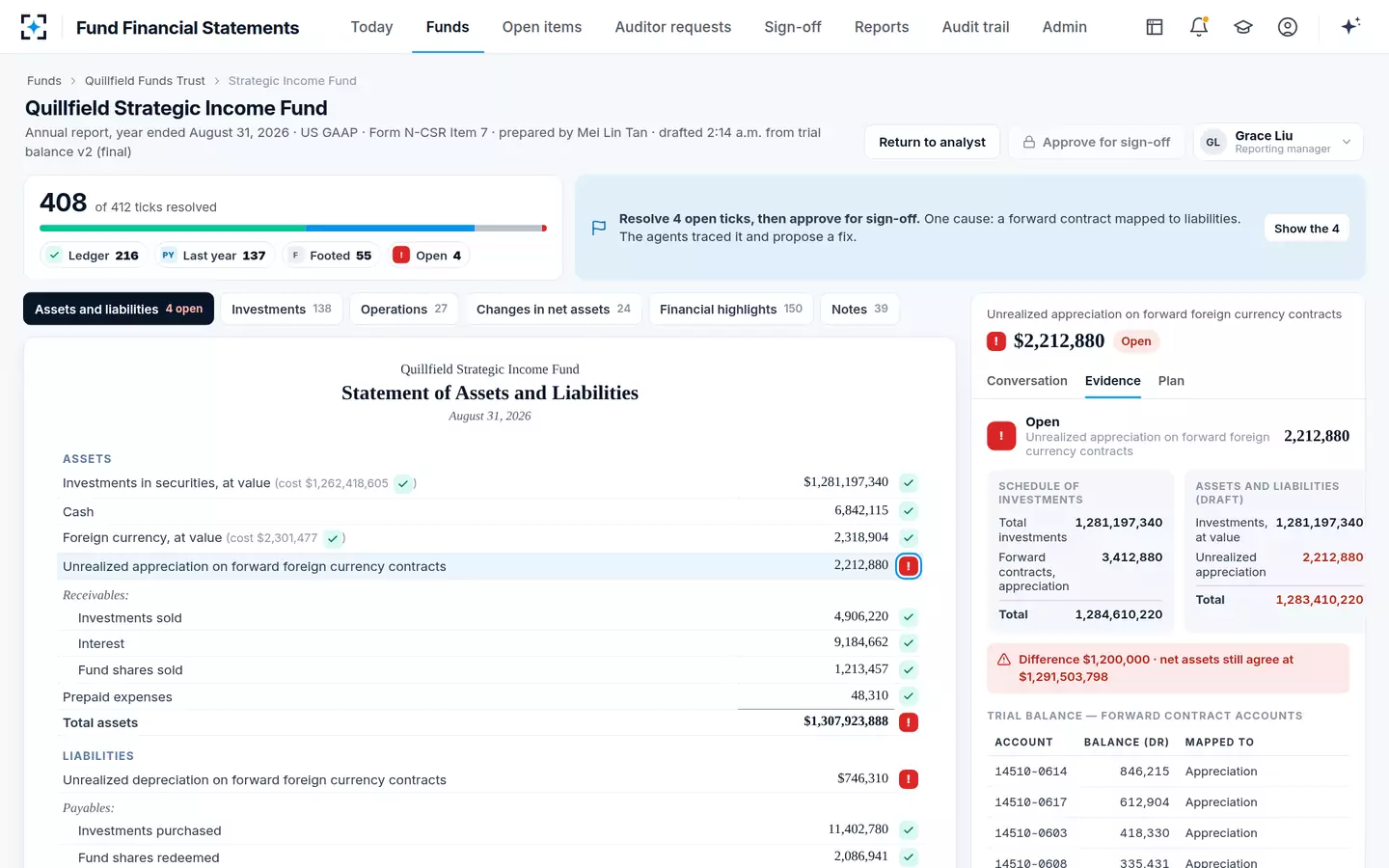
The plural matters. A forward schedule supports two balance sheet captions, an asset for appreciation and a liability for depreciation (Rule 6-10(c), Schedule VI, captions 3(b) and 9(d)). Take the sample fund. Its forward schedule shows appreciation of $3,412,880 and depreciation of $1,946,310. Its draft balance sheet showed $2,212,880 and $746,310. The net is $1,466,570 on both, so a check that compares net amounts passes, and so does a check on net assets. The gross lines are each $1,200,000 short, because one contract with a gain sat in a liability account.
One forward contract in the wrong account: the net agrees, the gross does not
$1,466,570
net unrealized gain on forwards, identical on the schedule and the draft balance sheet
$1,200,000
missing from both total assets and total liabilities
$0
difference in net assets of $1,291,503,798, so a net-asset check passes
The evidence behind one red tick: schedule beside balance sheet
Derivatives, short positions and affiliates get schedules of their own
A fund with derivatives files more than one schedule, and each has its own columns and its own total to agree. The table below sets out the four most common; each is "For management investment companies only" in Regulation S-X, and each total supports a named caption on the balance sheet.
The supporting schedules beside the schedule of investments
| Schedule | Columns the rule requires | Total agrees with |
|---|---|---|
| Securities sold short (Rule 12-12A) | Issuer and title; balance of short position; value of each open short position | Liability caption 9(a), securities sold short |
| Open futures contracts (Rule 12-13A) | Description; number of contracts; expiration date; notional amount; value; unrealized appreciation or depreciation | Captions 3(a) and 9(c), variation margin |
| Open forward foreign currency contracts (Rule 12-13B) | Currency purchased; currency sold; counterparty; settlement date; unrealized appreciation or depreciation | Captions 3(b) and 9(d), forward contracts |
| Open swap contracts (Rule 12-13C) | Payments received; payments paid; counterparty; maturity date; notional amount; value; upfront payments or receipts; unrealized appreciation or depreciation | Captions 3(c) and 9(e), swap contracts |
| Investments in affiliates (Rule 12-14) | Issuer; balance held; realized gain or loss; change in unrealized; dividends or interest; value | Caption 2, investments in and advances to affiliates |
Each schedule draws on a different system. Forward contracts come from the trade capture or the administrator's derivatives sub-ledger and the counterparty confirmations; futures from the clearing broker's statements; swaps from the collateral and valuation records. The forward schedule must list separately any contracts whose currencies, counterparty or settlement dates differ, so a fund with eight open forwards, like the sample fund, shows eight lines, each of which should agree with a confirmation.
Condensed schedule of investments vs schedule of investments
Three shapes of schedule exist, and they serve different filers. The full schedule under Rule 12-12 lists every issue. Regulation S-X still contains a summary schedule, which must list "the 50 largest issues and any other issue the value of which exceeded one percent of net asset value" (Rule 12-12B, note 4), but since the 2022 tailored shareholder report amendments open-end funds can no longer use it in their statements; the SEC removed "a fund's ability to provide a summary schedule in lieu of providing a complete schedule of portfolio investments as part of the financial statements" (87 FR 72758). The condensed schedule is not an SEC form at all: none of the schedules Regulation S-X lists for management investment companies goes by that name, so for a fund outside Regulation S-X its conditions have to be read in ASC 946's own text.
Three shapes of schedule, and who may use each
Full schedule (Rule 12-12): Every registered management investment company filing financial statements on Form N-CSR, and BDCs.
Shorter forms: Summary schedule: in Regulation S-X (Rule 12-12B), but no longer available to open-end funds for their statements. Condensed schedule: a US GAAP term, used outside Regulation S-X.
Full schedule (Rule 12-12): Every issue, except a miscellaneous line of up to 5% of total value meeting the rule's conditions.
Shorter forms: Summary: the 50 largest issues and any issue above 1% of net asset value. Condensed: thresholds set in ASC 946, not in an SEC rule.
Full schedule (Rule 12-12): Regulation S-X Rule 12-12, public on eCFR.
Shorter forms: Summary: Rule 12-12B, public on eCFR. Condensed: ASC 946, the FASB's own text, read on its site.
Full schedule (Rule 12-12): The total of Column C to the balance sheet; each subtotal's percentage to net assets.
Shorter forms: The same totals to the balance sheet; a shorter list does not shorten the tie-out of the underlying holdings.
A schedule of investments for private equity: what changes
A private equity fund's schedule has fewer lines and harder ones. Most positions are restricted, most are valued with significant unobservable inputs, and several may be controlled companies. Under Regulation S-X, a registered fund or business development company presents controlled and other affiliated investments in a separate schedule, grouping "(1) Investments in majority-owned subsidiaries; (2) other controlled companies; and (3) other affiliates", with each one's realized gains, change in unrealized value and income for the period, and a roll-forward of additions and reductions in a footnote (Rule 12-14, note 1).
For a private fund the same facts are sourced from different records: the capital account and deal files for cost and additions, the valuation committee's memos for value and the Level 3 inputs, and the legal file for restrictions. Two checks catch most errors. The value of each position should agree with the valuation memo approved for that date, not the prior quarter's. And the industry and country groupings should match how the fund describes its strategy, because the schedule is where an investor sees whether the portfolio matches the offering documents. Whether the vehicle presents such a schedule at all turns on its status, set out in the status test for investment company financial statements.
How Fund Financial Statements ties a schedule of investments
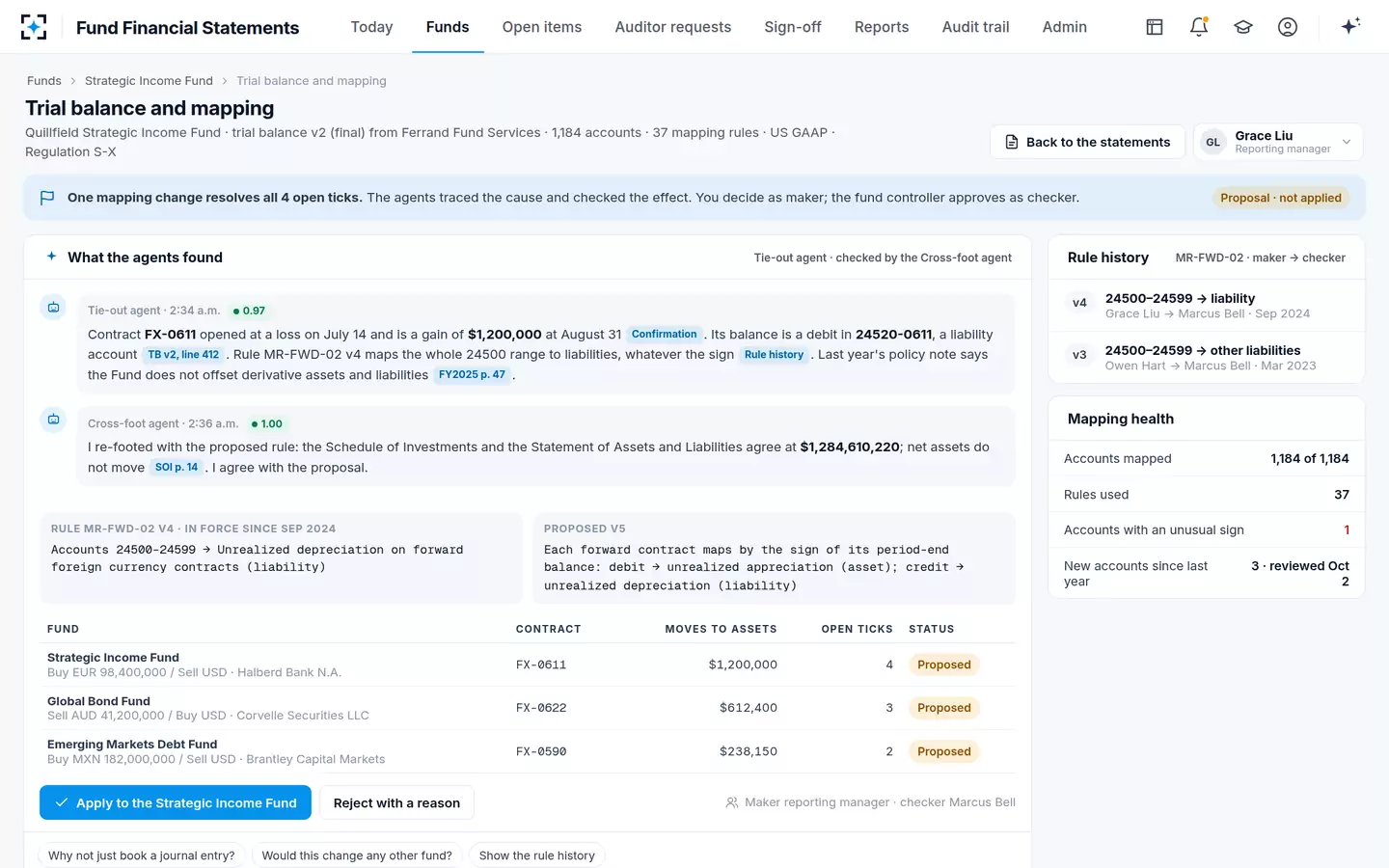
The solution treats the schedule as a set of claims to be proved, each against its source. The Drafting agent builds it from the trial balance, the holdings sub-ledger and the versioned mapping. The Tie-out agent agrees every line to the holdings and the trial balance at a $0 tolerance. The Cross-foot agent re-adds every subtotal and the total in deterministic code, checks each percentage of net assets at a 0.01% tolerance, and compares the schedule's totals with each balance sheet caption.
When the sample fund's forward schedule and balance sheet disagreed by $1,200,000, the Tie-out agent walked the difference to one contract, FX-0611, a gain booked as a debit in liability account 24520-0611 because the mapping rule assigned the whole account range to liabilities whatever the sign. It proposed a new version of the rule mapping each contract by the sign of its balance, showed what the change would move, and found the same cause in two other funds. The reporting manager applied it as maker; the fund controller approved it as checker before anyone signed. The trace, step by step, is in the tie-out tool guide.
From the schedule's difference back to one contract and one mapping rule
Questions people ask
What is a condensed schedule of investments?
It is a shorter schedule of investments that appears in US GAAP statements of funds that do not file under Regulation S-X. No SEC rule defines it, so its conditions have to be read in ASC 946 itself. Regulation S-X's own shorter form, the summary schedule, lists the 50 largest issues and any issue above 1% of net asset value, but open-end funds can no longer use it in their statements.
Is cost shown on the schedule of investments?
Not as a column under Rule 12-12. A registered fund shows the aggregate cost of each category of investment in brackets beside the value on the balance sheet, under Rule 6-03(d), and the tax-basis cost with gross unrealized appreciation and depreciation in a note, under Rule 6-03(h)(2). Restricted securities show cost in their footnote.
How are percentages of net assets calculated on the schedule?
Each subtotal, by type of investment and by industry, country or region, is divided by the fund's net assets at the same date, the figure on the balance sheet's last line. Because net assets include cash, receivables and liabilities, the percentages of a fully invested fund rarely add to exactly 100%, and the difference should equal other assets less liabilities.
Can small holdings be grouped on the schedule?
Up to 5% of the total value can be shown as one "Miscellaneous securities" line, but only for securities that are not restricted, have been held no more than a year, and have not been reported by name before. The schedule must explain in a footnote what the line represents.
Where is the schedule of investments filed now?
For mutual funds and ETFs, the complete financial statements, schedule included, are filed on Form N-CSR and posted online within 60 days of the period end, rather than printed in the shareholder report. Holdings at the first and third fiscal quarter-ends must also be posted online, presented under Regulation S-X's schedules, though they need not be audited.