The tailored shareholder report requirements are the SEC's 2022 amendments that split a mutual fund's or ETF's annual and semi-annual reporting into two layers. Investors receive a concise report for their own series and share class, with the fund's expenses, performance, key statistics, a picture of its holdings and any material changes. The complete financial statements, the financial highlights and three other items moved to Form N-CSR, where they must be posted online within 60 days of the period end and filed within 70. The rule took effect on January 24, 2023 with an 18-month transition, so funds have reported this way since July 24, 2024. For a reporting team the work did not shrink; it split into two documents that must agree. Botminds' Fund Financial Statements drafts and ties the statements that now go on Form N-CSR Item 7, and keeps the figures the short report borrows from them in agreement.
The tailored shareholder report rule in four numbers
60days
to send the shareholder report and post Form N-CSR Items 7–11 online
70days
to file Form N-CSR: within 10 days of sending the report
18months
of transition after the January 24, 2023 effective date
1
report per series and per share class, no longer one book for a whole trust
What are tailored shareholder reports?
They are the short annual and semi-annual reports that open-end funds registered on Form N-1A, mutual funds and ETFs, now send to shareholders. The SEC's summary describes the aim: "concise and visually engaging annual and semi-annual reports to shareholders that highlight key information that is particularly important for retail investors to assess and monitor their fund investments." Information "that may be more relevant to financial professionals and investors who desire more in-depth information will no longer appear in funds' shareholder reports but will be available online, delivered free of charge upon request, and filed on a semi-annual basis on Form N-CSR" (SEC, Release No. IC-34731, 87 FR 72758).
The release was dated October 26, 2022 and published in the Federal Register on November 25, 2022. It also made funds tag their shareholder reports in Inline XBRL, took open-end funds out of Rule 30e-3 (the notice-and-access route for delivery), and changed how investment company advertisements present fees. Two proposals did not survive: a rule that would have let funds stop sending annual prospectus updates to existing shareholders, and changes to prospectus fee and risk disclosure.
Before and after: where a fund's annual reporting now lives
Before the 2022 amendments: One shareholder report, often covering many series and every share class, with complete financial statements inside.
Under the tailored shareholder report rule: A concise report for one series and one share class: expenses, performance, statistics, holdings graphic, material changes.
Before the 2022 amendments: In the shareholder report; a summary schedule of investments allowed in place of the full schedule.
Under the tailored shareholder report rule: On Form N-CSR Item 7(a), with the complete schedule; the summary schedule option removed for these funds.
Before the 2022 amendments: In the shareholder report.
Under the tailored shareholder report rule: On Form N-CSR Item 7(b); expense ratio, net assets and turnover still appear in the short report.
Before the 2022 amendments: Optional notice-and-access delivery under Rule 30e-3.
Under the tailored shareholder report rule: Items 7–11 posted within 60 days and kept up until 60 days after the next period; Rule 30e-3 no longer available to open-end funds.
Before the 2022 amendments: Not required for the shareholder report.
Under the tailored shareholder report rule: The shareholder report tagged in Inline XBRL.
Before the 2022 amendments: Form N-CSR certified by the principal executive and financial officers.
Under the tailored shareholder report rule: Unchanged, and now the statements themselves sit inside the certified filing.
What does the annual shareholder report have to contain?
The annual report has a fixed list of contents under the new Item 27A of Form N-1A, and nothing else. At the start: the fund and class name, ticker, a statement identifying it as an annual shareholder report, a legend, and a statement on material fund changes. Then the content items: an expense example, management's discussion of fund performance, fund statistics, a graphical representation of holdings, material fund changes, changes in and disagreements with accountants, availability of additional information, and optional householding disclosure (87 FR 72758, Table 2).
The SEC chose not to cap its length. "As proposed, the annual report will not be subject to page or word limits under the final rules," it wrote, believing the restrictions on contents "would naturally limit their length." The expense example is shown in two columns, the costs of a $10,000 investment and those costs as a percentage of it, the percentage being "the fund's expense ratio as it appears in the fund's most recent audited financial statements or financial highlights." The fund statistics are four required items, net assets, total number of portfolio holdings, portfolio turnover rate for funds other than money market funds, and "the total advisory fees paid by the fund during the reporting period", followed by any the fund adds.
What moved from the shareholder report to Form N-CSR?
Five kinds of information moved from the shareholder report to new items of Form N-CSR, and must be posted on the fund's website as well. The SEC's table maps each one to its new home.
What moved to Form N-CSR, and where each item now sits
| Information | Before (Form N-1A) | Now (Form N-CSR) |
|---|---|---|
| Financial statements | Items 27(b)(1) and 27(c)(1) | Item 7(a) |
| Financial highlights | Items 27(b)(2) and 27(c)(2) | Item 7(b) |
| Changes in and disagreements with accountants | Items 27(b)(4) and 27(c)(4) | Item 8 |
| Matters submitted to shareholders for a vote | Rule 30e-1(b) | Item 9 |
| Remuneration paid to directors, officers and others | Items 27(b)(3) and 27(c)(3) | Item 10 |
| Basis for the board's approval of the advisory contract | Item 27(d)(6) | Item 11 |
| Complete holdings at first and third fiscal quarter-ends | Form N-PORT, Part F | Website only, under Rule 30e-1(b)(2)(ii); not filed on N-CSR |
The full statements also changed shape. The SEC eliminated, for these funds, the option of a summary schedule of investments in place of the complete one: with the statements no longer in the shareholder report, a shorter schedule online beside the full one would "even be confusing." And it confirmed that a trust need not file separate statements for each series on Form N-CSR; the amendments "do not prohibit funds from preparing and submitting multicolumn financial statements that include multiple series or portfolios." The detail of each column of that schedule is set out in the schedule of investments example.
One report per series, one per share class
The short report narrows to what one investor owns. The rule requires "separate annual reports for each series of a fund", and, in a change from the proposal, a report "that covers the single class of a multiple-class fund in which the shareholder invested", because "there is significant disclosure that varies among share classes, such as expenses and performance data" (87 FR 72758, section II.A.1).
For a fund complex this multiplies documents, not statements. A trust with 64 series and, say, four classes each produces up to 256 short reports twice a year, each with its own expense example, performance discussion and statistics, while its financial statements can still be filed on Form N-CSR in multicolumn form. Every one of those short reports borrows numbers from the statements: the expense ratio, net assets, turnover and the advisory fees paid. A class-level error in the statements now reaches the investor through a document the auditor did not audit.
The two clocks: 60 days to post, 70 days to file
The rule kept the old transmission deadline and aligned the website with it. Funds must send shareholder reports within 60 days of the period end (Rule 30e-1(d)), and the Items 7–11 information must be publicly accessible on the website "no later than 60 days after the end of the fiscal half-year or fiscal year" and kept there until 60 days after the next period ends. The SEC had proposed 70 days for the website and shortened it, so that an investor reading the report's legend would find the content already online. Its conclusion: "Funds will continue to have 70 days to file the complete Form N-CSR with the Commission, as they do today" (87 FR 72758).
The practical effect is that the statements must be final by day 60, not day 70: they have to be online the day the short report goes out, and the short report quotes them. The ten days after are for the filing itself and the officers' certifications. How the season divides between desks is in the Form N-CSR filing deadline guide.
From proposal to the next proposal: the tailored shareholder report rule's calendar
| Date | Step | What it meant for reporting teams |
|---|---|---|
| August 5, 2020 | Proposed (Release No. IC-33963) | Layered reports floated, with a new prospectus delivery rule that was later dropped |
| October 26, 2022 | Adopted (Release No. IC-34731) | Statements and highlights to move to Form N-CSR; one report per series and class |
| January 24, 2023 | Effective | The 18-month transition begins |
| July 24, 2024 | Compliance | Reports sent from this date must follow the new form; Items 7–11 online within 60 days |
| July 21, 2026 | Regulation E-Delivery proposed | Would rescind Rule 30e-3 and allow e-delivery without prior consent |
| September 21, 2026 | Comments due on the proposal | No final rule yet; the 60- and 70-day clocks are unchanged |
Do tailored shareholder reports apply to closed-end funds?
No. The amendments apply to open-end management investment companies registered on Form N-1A, which means mutual funds and ETFs. Closed-end funds and the insurance company separate accounts that are management investment companies report under their own forms and kept the option to deliver shareholder reports by notice and online access under Rule 30e-3. The SEC's 2026 proposal describes the position plainly: after 2022, "Rule 30e-3 therefore currently only applies to shareholder reports delivered by registered closed-end funds and insurance company separate accounts that are management investment companies offering variable annuity and variable life insurance contracts" (91 FR 45884).
What does the 2026 e-delivery proposal change?
It would change how reports are delivered, not what they contain. Proposed on July 21, 2026 as Regulation E-Delivery, it "sets forth conditions for covered entities to deliver covered information to covered recipients electronically without first obtaining their affirmative consent," and the SEC "also is proposing to rescind the rule providing alternative means for registered investment companies to satisfy shareholder report transmission requirements": Rule 30e-3 (91 FR 45884). Comments were due by September 21, 2026. It is a proposal; nothing in it applies until the SEC adopts a final rule.
Under the proposal, an investor who has given an electronic address could be moved to e-delivery unless they opt out, while those who decline, opt out, or never respond would keep receiving paper. The SEC also said that "under Reg E-Delivery, e-delivery would not include the use of a paper postcard with a URL (or QR code or other pathway)". For a reporting team the content and the 60- and 70-day clocks would not move; what would change is the delivery run behind them, mostly for closed-end funds that use notice and access today.
Every family's next deadline, with the short report and the filing as separate dates
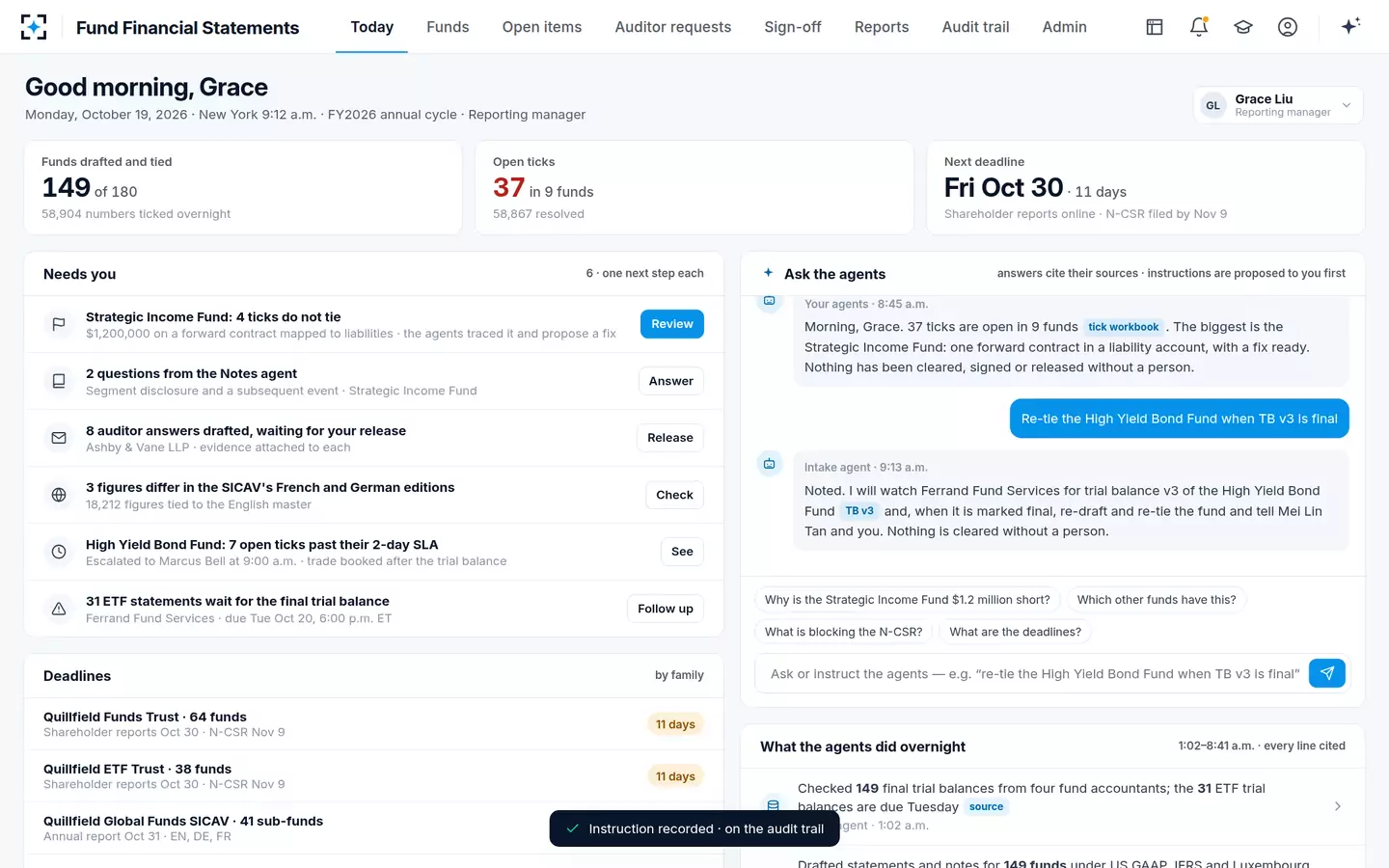
Two documents that must agree, and only one is audited
The rule ties the short report to the statements by instruction, which makes agreement a compliance point. Where a statistic "is included in, or could be derived from, a fund's financial statements or financial highlights," the fund must "use or derive such statistic from the fund's most recent financial statements or financial highlights" (87 FR 72758). The expense example's percentage is the expense ratio from the audited statements or highlights. And the short report itself is tagged in Inline XBRL, so a mismatch is machine-readable to anyone comparing the tagged figure with the Form N-CSR statements.
Figures to tie between the short report and Form N-CSR, class by class
- Expense ratio in the expense example
Equals the ratio of expenses to average net assets in the financial highlights for the same class and period.
- Net assets
Equals the statement of assets and liabilities; for a class, the class's net assets in the capital records.
- Portfolio turnover rate
Equals the highlights figure, computed on 13 month-end values.
- Total advisory fees paid
Agrees with the advisory fees in the statement of operations, presented on the same basis.
- Number of holdings and the holdings graphic
Agree with the schedule of investments at the period end.
- Performance in the discussion
Annual total return agrees with the highlights; index figures sourced and dated.
- Website posting
Form N-CSR Items 7–11 live by day 60, and kept until 60 days after the next period end.
How Fund Financial Statements carries both layers
The solution works on the statements that now sit in Form N-CSR Item 7 and on the figures the short report takes from them. The Drafting agent builds the statements, schedule and highlights per series from each administrator's final trial balance; the Tie-out and Cross-foot agents tie every number to its source and to the other statements; and the reporting manager reviews only what does not tie. Deadline alerts run at ten, five and two days for shareholder reports, Form N-CSR, UCITS annual reports and custody rule deliveries, and the treasurer's Form N-CSR certification unlocks only when every series of the trust is signed.
It does not write the short report's narrative, design its graphics or file with the SEC: composition and EDGAR filing stay with the fund's composition and filing agent, which receives tied statements. What the solution adds to the two-layer world is evidence: each figure the short report borrows is a ticked figure in the statements, with its source a click away for the auditor and the certifying officers.
Questions people ask
When did the tailored shareholder report rule take effect?
The rule was effective on January 24, 2023, with an 18-month transition. Shareholder reports transmitted 18 months or more after the effective date had to comply, which puts the compliance date at July 24, 2024. The Form N-CSR and website requirements followed the same transition.
Are fund financial statements still audited?
Yes. The annual financial statements filed on Form N-CSR Item 7 must be audited and accompanied by the accountant's report, as before; semi-annual statements need not be audited. What changed is where they appear, not the audit.
Can a trust file one set of financial statements for all its series?
On Form N-CSR, a trust may file multicolumn financial statements covering several series or share classes, if the presentation is consistent with Regulation S-X. The shareholder reports cannot be combined: each series and each share class gets its own.
Is there a page limit on tailored shareholder reports?
No. The SEC declined to set page or word limits, relying on the restricted list of contents to keep reports short. It also allowed funds to add statistics after the four required ones, but said a statistic that needs extensive explanation should be considered carefully, and footnotes to statistics are not permitted.
What happens to Rule 30e-3 under the 2026 proposal?
The SEC proposed on July 21, 2026 to rescind it, on the view that it would no longer be needed if Regulation E-Delivery were adopted. It already excludes mutual funds and ETFs and now serves only closed-end funds and certain insurance separate accounts. Comments closed on September 21, 2026; check for a final rule before changing any delivery practice.