Financial statement automation software for investment funds is sold by quote, and outsourced fund reporting is priced inside an administrator's negotiated fee, so neither has a public price a buyer can compare. What a buyer can compare is total cost, built from things they can count: the hours their team spends per fund per report, broken down by task; a rate on those hours; what the auditor's late adjustments and the re-ties they trigger cost; and the licence or service fee on top. This guide works that method on an illustrative 64-series trust, using the estimates Botminds publishes for its Fund Financial Statements solution and hourly rates the SEC itself uses, and marks clearly which numbers are estimates, which are targets and which you must replace with your own.
Five cost lines in fund statement production, and how to price each
Your people's hours
Drafting, tying, re-tying after adjustments, notes, auditor requests, sign-off. The largest line, and the only one you can measure yourself today.
How to price itHours per fund per report × funds × reports per year × a loaded hourly rate
Software
Licence, implementation and the internal time to map charts of accounts and load last year's reports. Vendors quote; none publishes a price.
How to price itQuote for your fund count and frameworks, plus implementation hours
Outsourced reporting
An administrator's or provider's financial reporting fee, usually bundled with fund accounting. Fees are negotiated and not published.
How to price itQuote per fund or per report, and what review stays with you
The audit
Hours the auditor spends on proposed adjustments, re-reviews and requests; reflected in next year's fee negotiation.
How to price itCount last cycle's proposed adjustments and request turnaround
A late fix
A redraft and re-tie under deadline; at worst an amended filing and an explanation to the board.
How to price itHours of last cycle's late re-ties; incidents of amended or corrected reports
What does a fund's annual report cost to produce?
Nobody publishes the answer, and the one government number is not it. For Form N-CSR the SEC estimates 13,052 respondents filing twice a year at 7.75 hours per filing, 202,306 hours in all (91 FR 28694, May 18, 2026). That estimate is for the paperwork of preparing and filing the form; it was made for the Paperwork Reduction Act and does not count producing and tying the financial statements inside it. Read as the cost of the statements it understates the work badly: Botminds' own estimate of the tie-out alone is 10 to 30 hours per fund per report.
The SEC's economic analysis for the 2022 tailored shareholder report rule gives a sense of how the agency prices reporting work. It costed the new Form N-CSR items at "18 hours per filing x 2 filings per year per fund x $381 (blended wage rate for compliance attorney and senior programmer) = $13,716 per fund" initially, and $3,810 a year after, across 11,840 funds (87 FR 72758), and noted that funds already prepared the same disclosure, so the figures "may over-estimate" the cost. Those are rearrangement costs, not production costs. To get a production cost you need your own hours.
Hours first: where one fund's reporting hours go
Start with the hours per fund per report, split by task, because the tasks are what a tool or a provider changes. The split below is Botminds' own estimate for a mid-size bond fund of 300 to 600 numbers, at two to three minutes per number by hand; replace it with a timed sample of your own funds before using it in a business case.
Where a mid-size bond fund's review hours go by hand: 24 hours, half of them tying
Two things in that split drive the business case. Half the hours are tying, the task that is pure comparison and the one a machine with the records can do. And the split is per fund per report: a fund complex multiplies it by every series and both reports a year, and the auditor's adjustments add a second round of tying for every number they touch. The season-long version of the same hours is set out in the Form N-CSR filing deadline guide.
Putting a rate on the hours
Use a loaded rate, not a salary. Two public reference points bracket it. The Bureau of Labor Statistics put the median annual wage of accountants and auditors at $83,680 across all industries in May 2025, $40.23 an hour, before benefits and overhead (BLS, Occupational Outlook Handbook). The SEC, costing fund work in 2026, used "$266 (hourly rate for a senior accountant)" (91 FR 5545), a figure built for its own estimates rather than a market survey.
Worked example: tie-out hours and their cost for a 64-series trust
| Line | Calculation | Result |
|---|---|---|
| Reports a year | 64 series × 2 (annual and semi-annual) | 128 reports |
| Hours by hand | 128 × 24 hours (estimate above) | 3,072 hours |
| Cost at the SEC's senior accountant rate | 3,072 × $266 | $817,152 |
| Wage-only floor at the BLS median | 3,072 × $40.23 | $123,587 |
| Hours at the solution's design target | 128 × 3.8 hours of review | 486 hours |
| Target hours at $266 | 486.4 × $266 | $129,382 |
The difference between the hand and target rows is the headline of most vendor pitches, and it is the least reliable row in the table, because it depends on two estimates. The rows that hold up are the first three, which you can measure this season. If a vendor's case does not start from your hours, it is not your business case.
Build, buy or outsource: three ways to produce fund statements
Every fund complex already uses some mix of the three, and the choice is about which tasks move, not about one or the other. Building means spreadsheets, macros and templates kept by the reporting team. Buying means software for some tasks: typesetting and tagging, drafting from the trial balance, tie-out. Outsourcing means the administrator or a reporting provider prepares the statements, and the fund's own team reviews them.
What each route moves, and what stays with the fund
| Route | What it takes off your team | What stays | What you pay |
|---|---|---|---|
| Build in-house | Nothing by itself; templates and macros speed drafting and footing | All tying, re-tying and evidence; key-person risk on the workbook | Hours, and maintenance of the workbook each rule change |
| Buy document software (typesetting, tagging, filing) | Composition, Inline XBRL tagging, EDGAR submission | Drafting, tying and the evidence behind the numbers | Licence or per-filing fees, by quote |
| Buy drafting and tie-out software | Drafting from the trial balance; tying every number; tracing breaks | Decisions on breaks and mappings, notes judgement, sign-off | Licence and implementation, by quote |
| Outsource to the administrator or a provider | Drafting and the provider's own checks | Review of the provider's work, the certification, the auditor relationship | A fee inside or beside the administration agreement |
Outsourcing deserves a careful line in the model. It moves the preparer's hours but not the reviewer's: the fund's principal executive and financial officers still certify Form N-CSR and remain liable for it, so the team that signs needs to see enough evidence to sign on. A provider's statements that arrive without ticks or evidence are a review job of their own, and in a complex with several administrators, a different review job for each.
Disclosure management software is a different category
Software sold as disclosure management assembles and publishes documents: it links figures to a source workbook, manages wording, typesets and tags. It solves the problem of producing the document consistently. It does not, by itself, prove that the figures in the source workbook agree with the trial balance, the holdings and last year's filing, which is the question the auditor asks. Many fund complexes need both, and a quote for one should not be compared with a quote for the other.
The questions that sort them are concrete. Does the tool read the administrator's trial balance and holdings, or only a workbook you prepare? Does it tie each number with evidence, or link it to a cell? When a figure does not agree, does it say why? A tool that answers "a cell" to the first two is a publishing tool, and the tie-out cost line in the model stays where it was.
The cost of a late fix
A number found wrong in the last week costs more than the same number found wrong in the first. Each proposed adjustment from the auditor means a redraft, a re-tie of every figure it touches, a re-review and a new sign-off, all inside the ten days before the shareholder report must go online. A number found wrong after filing is worse: an amended filing, a conversation with the board and the auditor, and a certification that has to be revisited.
Where the hours go, by hand and at the design target
By hand, 24 hours (estimate)
- Tying · 50%
- Drafting and footing · 25%
- Notes, auditor, collection · 25%
At the target, 3.8 hours
- Tying · 26%
- Notes · 32%
- Auditor · 21%
- Drafting, footing, collection · 21%
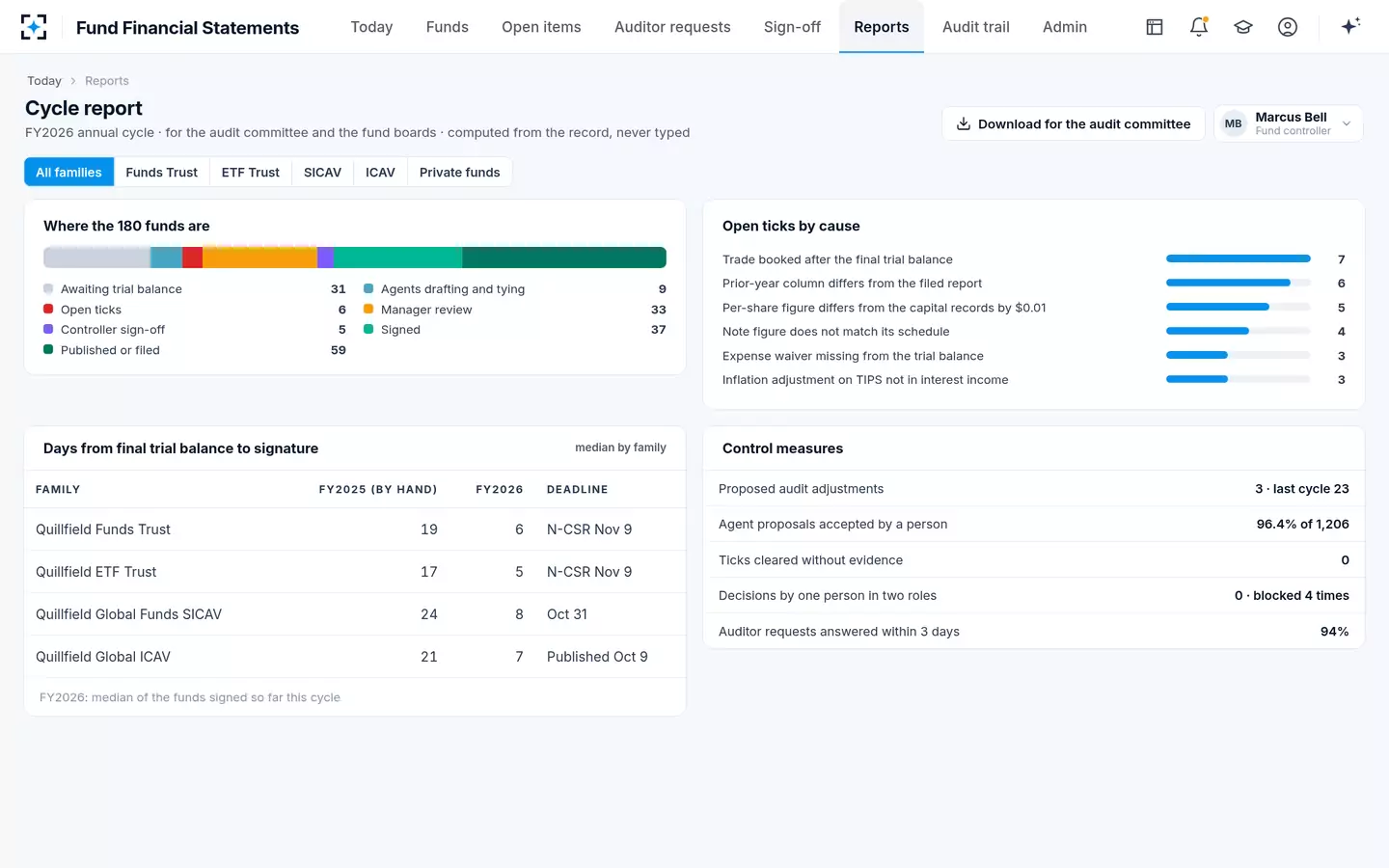
The model should therefore carry a line for late fixes, priced from last cycle: how many proposed adjustments the auditor raised, how many hours each re-tie took, and how many reports were corrected after release. In the solution's fictional sample cycle report, a control measure counts proposed audit adjustments against the prior cycle for the audit committee; whatever tool you use, that count is the best single measure of whether the review is catching things before the auditor does.
The cycle report: where every fund is, and the measures an audit committee asks for
What financial statement automation software should cost you, and what to ask
Ask for a quote that matches the model: priced for your number of funds, frameworks and languages, with implementation hours stated, and with a pilot on your own files before the price is final. Ask what the vendor needs from you, because mapping the chart of accounts and loading last year's filed reports is real internal time. And ask what happens in year two, when a rule changes the statements, as the 2022 amendments did when they moved the full statements to Form N-CSR.
Before signing for financial statement automation software
- Price against your count
Funds and series, reports a year, frameworks, languages; ask what changes the price.
- Implementation in hours
Mapping each administrator's chart of accounts, loading prior filed reports, setting tolerances and checklists; who does each.
- The baseline you will be measured against
Your timed hours per fund by task and last cycle's proposed adjustments, agreed before the pilot.
- Targets stated as targets
Hours per fund and share of numbers tied before sign-off, with how they will be measured on your funds.
- What stays manual
Every decision the tool will not make, in writing: clearing breaks, mapping changes, sign-off, release to the auditor.
- Exit
Your evidence, ticks and trail exportable in a form the auditor can read without the tool.
Buying on a pilot rather than a demonstration is the single most effective control on the cost model, because it replaces the vendor's estimate with your measured hours on your own funds. The steps are in the guide to piloting on last year's report.
Where Fund Financial Statements changes the cost lines
The solution works on the largest line, your people's hours, and on the late-fix line. Its agents draft from the final trial balance overnight, tie every number with evidence and trace breaks across funds, so the team's hours move from tying to deciding. Its design targets are 100% of numbers tied before the fund controller signs and about four hours of review per fund, against Botminds' estimate of 10 to 30 hours of tie-out by hand; on your funds both are to be measured, not assumed.
It does not replace the administrator, the fund accounting platform or the composition and filing agent, so those cost lines stay. Scale is the reason the per-fund arithmetic matters: the SEC counted 13,648 registered funds in its March 2026 statistics (SEC Registered Fund Statistics), and estimates that its filing rule governs 14,298 portfolios belonging to 2,766 registrants (91 FR 61267), so a team's hours per fund are multiplied by every series that closes on the same date.
Questions people ask
How many hours does Form N-CSR take?
The SEC's paperwork estimate is 7.75 hours per filing, twice a year, for preparing and filing the form. It does not include producing and tying the financial statements the form contains, which is where most of a reporting team's time goes. Measure your own hours per fund before relying on any figure.
Should fund reporting be outsourced?
Preparation can be, and often is, part of the administrator's service. Review and certification cannot: the fund's officers certify Form N-CSR and are liable for it. The cost question is how much evidence comes with the outsourced statements, because that decides how many review hours stay with you.
Is financial reporting automation software worth it for a small fund family?
The method answers it: hours per fund by task times funds times reports, priced at your loaded rate, against the quote. A family of five funds with one framework may find the hours too few to justify software; a family with several administrators, frameworks or languages usually finds the tying hours, and the late re-ties, are where the cost sits.
What is the difference between financial reporting automation and disclosure management software?
Disclosure management software assembles, typesets and tags the document from a source workbook. Financial reporting automation for funds, as this guide uses the term, drafts the statements from the trial balance and ties every number to its source with evidence. Many complexes need both; compare quotes for like with like.
How do I build a business case without published prices?
Time two or three funds by task this season, price the hours at your loaded rate, add last cycle's late re-ties and corrected reports, and ask vendors and providers for quotes against that count. Then run a pilot on last year's files so the savings line is measured, not estimated.