A financial statement review checklist, usually called a disclosure checklist, lists every item the accounting framework and the regulator require and asks the preparer to show where each one is met. It is the right tool for completeness: a missing valuation note, a schedule without its restricted-securities footnote, a fee note without the basis of computation. It is the wrong tool for accuracy, because an item can be present, correctly formatted and referenced, and still carry the wrong number. For an investment company's statements the checklist comes from Regulation S-X Article 6 and US GAAP; the numbers are right only if each one traces to the trial balance, the holdings and capital records, and last year's filed report. Botminds' Fund Financial Statements answers the checklist item by item with references and, separately, ties every number to its source, so a reviewer can see which of the two lists a problem fails.
The examples use the solution's fictional sample data: the reporting cycle of Quillfield Capital, 180 funds at their 2026 year-ends.
Two lists, two different failures
A disclosure checklist asks: Does a note state "the methods used in determining the value of investments"?
A numbers tie-out asks: Do the Level 3 values in the note equal the marked lines on the schedule and the valuation memos?
A disclosure checklist asks: Does it give "the rate of fee, and the base and method of computation"?
A numbers tie-out asks: Does rate × base, for each period, equal the advisory fee in the statement of operations?
A disclosure checklist asks: Does it state the regulated investment company status and the tax-cost appreciation and depreciation?
A numbers tie-out asks: Do gross appreciation less gross depreciation equal the net figure, and does tax cost agree with the tax lots?
A disclosure checklist asks: Is each category subtotalled with its percentage of net assets? Are restricted issues marked?
A numbers tie-out asks: Does the total equal the balance sheet? Does each percentage use this period's net assets?
A disclosure checklist asks: Is a comparative column presented where required?
A numbers tie-out asks: Does every figure in it equal last year's filed report, not last year's draft?
A disclosure checklist asks: Is the edition complete, with every statement and note?
A numbers tie-out asks: Does every figure, sign and date match the English master?
What does a financial statement review checklist check?
It checks presence and form: that every disclosure the framework requires appears, in the right statement or note, with the right captions. Each line of a good checklist cites its requirement, and each answer cites where in the draft it is met, or why the item does not apply. That gives an auditor and a signer an index from rule to page, which is valuable on its own: the most common disclosure failure is an omission, and omissions are invisible to anyone reading only what is there.
What a checklist cannot do is test the content of the item it ticks. "Is the restricted securities footnote presented?" is a yes. Whether the aggregate value of restricted securities and its share of net assets in that footnote (Rule 12-12, note 8) are the right figures is a different question, answered only from the holdings and the legal records. A checklist completed by the person who drafted the statements is also a list of what that person believed they did, which is why the person checking the numbers should not be the one who answered the checklist.
An investment company disclosure checklist, built from Regulation S-X
For a registered fund the core of the checklist is in Regulation S-X Article 6, and every line can be traced to its text. The table below gives the items most often missed and the rule that requires each. A US GAAP checklist adds the topics under ASC 946 and the general standards, such as fair value, derivatives and subsequent events; a fund complex usually keeps one checklist per framework and fund family.
Disclosure items for a registered fund's statements, rule by rule
| Item | What the rule requires | Rule |
|---|---|---|
| Valuation methods | "State in a note the methods used in determining the value of investments"; aggregate cost of each category beside the value | Rule 6-03(d) |
| Restricted securities | The policy on acquiring them, the policy on valuing them, and the fund's rights to demand registration | Rule 6-03(f) |
| Income recognition | Dividends on the ex-dividend date; interest accrued daily | Rule 6-03(g) |
| Tax status and tax cost | Status as a regulated investment company; gross unrealized appreciation and depreciation on tax cost; net; aggregate tax cost | Rule 6-03(h) |
| Share transactions | For each class, shares sold and repurchased and the amounts | Rule 6-03(i), Rule 6-09.4 |
| Series effects | Where one series is affected by others, for example by offsetting gains and losses or contingent liabilities | Rule 6-03(j)(2) |
| Swing pricing | Where policies exist: the methods, whether the NAV swung, and the general effects | Rule 6-03(m) |
| Fees and waivers | Rate, base and method of computation; expense limitation agreements and broker offsets stated separately | Rule 6-07.2(c) |
| Affiliated brokerage | Commissions paid to affiliated broker-dealers; sales charges retained by an affiliated underwriter | Rule 6-07.2(e) |
| Borrowings | Average dollar amount of borrowings and average interest rate | Rule 6-07.3 |
Several of those items are numbers dressed as disclosures. The tax note is four figures that must reconcile among themselves and to the tax lots. The share transactions note is a count and an amount per class that must agree with the transfer agent's records and the statement of changes in net assets. The borrowings item is two averages that must be recomputed from daily or monthly balances. A checklist answered "met" for each of them has proved the note exists, and nothing more.
Where the checklist passes and the statements are still wrong
The errors that matter in fund statements are rarely missing items. In the solution's sample cycle, the open differences across 180 funds grouped into a handful of causes, and not one of them is a disclosure a checklist would flag as absent. Each sits in a statement or note that is present and well formed.
Open differences by cause in one sample cycle: none is a missing disclosure
Take the second bar. A comparative column is a checklist item, and it was present. Its figures came from last year's working file rather than last year's filed report, and six of them differed. Or the fourth: the note was there and well formed, but a figure in it did not agree with the schedule it summarised. The most expensive break of the sample cycle, a $1,200,000 forward contract booked to a liability account, passed both the checklist and the administrator's own net-asset check, because every caption was present and net assets agreed. How that break was traced is told in the tie-out tool guide.
How do you check the numbers, not just the disclosures?
With a second list, organised by source rather than by rule. Every number in the statements has one or more places it must agree: the trial balance, the holdings or capital records, last year's filed report, the arithmetic of the statement it sits in, and every other place the same figure appears. A numbers checklist asks for each figure, with evidence, at a stated tolerance.
The numbers checklist: what every figure must agree with
- The trial balance, through the mapping
Each statement line equals the sum of the accounts mapped to it, at a $0 tolerance; the mapping version used is recorded.
- The holdings and capital records
Schedule lines to the holdings sub-ledger and custodian; shares, NAV per share and share activity to the transfer agent's records.
- Last year as filed
Comparative columns and opening balances to the filed report, not to a working file.
- Footing and cross-footing
Every total and subtotal re-added; every figure that appears twice, such as net assets, the forward contracts or the advisory fee, agrees in each place.
- Notes to their schedules
Fair value levels to the marked schedule lines; tax figures to the tax lots; derivative notes to the derivative schedules.
- Per-share and percentages
Highlights to the capital records at $0.01; schedule percentages to this period's net assets.
- Every edition
Each figure, sign, date and rate in a translated edition against the master.
The list has an order. Trial balance first, because a mapping error moves many lines at once. Then the holdings and capital records, because they are the second source the auditor will use. Then last year, then arithmetic, then cross-references. Done the other way round, a team foots a statement whose lines are wrong and re-foots it after each correction.
Checked numbers behave differently: the evidence from audited months
Research on hedge fund returns suggests that knowing a number will be checked changes the number reported. Bollen and Pool studied the pooled distribution of monthly hedge fund returns and found that "The number of small gains far exceeds the number of small losses" — a pattern they attribute "at least in part" to "temporarily overstated returns" (Journal of Finance, 2009).
"The discontinuity is absent in the 3 months culminating in an audit, suggesting it is not attributable to skillful loss avoidance."
Bollen and Pool, Journal of Finance, 2009
The study concerns monthly returns reported by hedge funds to databases, not audited statements, and it does not measure disclosure checklists. Its relevance here is narrower and still useful: a check on the figure itself changed the figures, and the timing of that check mattered. A review that tests presence and leaves the numbers to the year-end audit puts the only real test of the numbers at the end of the season, when every correction is a redraft under deadline.
The fee note: one item that is both a disclosure and a number
Regulation S-X requires a note with "information concerning management and service fees, the rate of fee, and the base and method of computation," and separately "the amount and a description of any fee reductions or reimbursements" under expense limitation agreements and broker offsets (Rule 6-07.2(c)). A checklist confirms the note says the fee is, for example, 0.45% of average daily net assets, with a waiver to cap expenses at a stated level.
A tie-out then recomputes it: the rate applied to the daily net assets for the period, the waiver computed under the cap, the result equal to the advisory fee and the waiver lines in the statement of operations, and the waiver shown "as a negative amount or as a reduction of total expenses" as the rule requires. If the board cut a fee during the year, as in the sample data where a September 17 board meeting cut a Class A distribution and service fee from 0.25% to 0.20% after the period end, the note needs a subsequent-event disclosure, and the solution's Notes agent asked about it with draft wording and the minutes as its source.
The checklist answered item by item, each with its reference
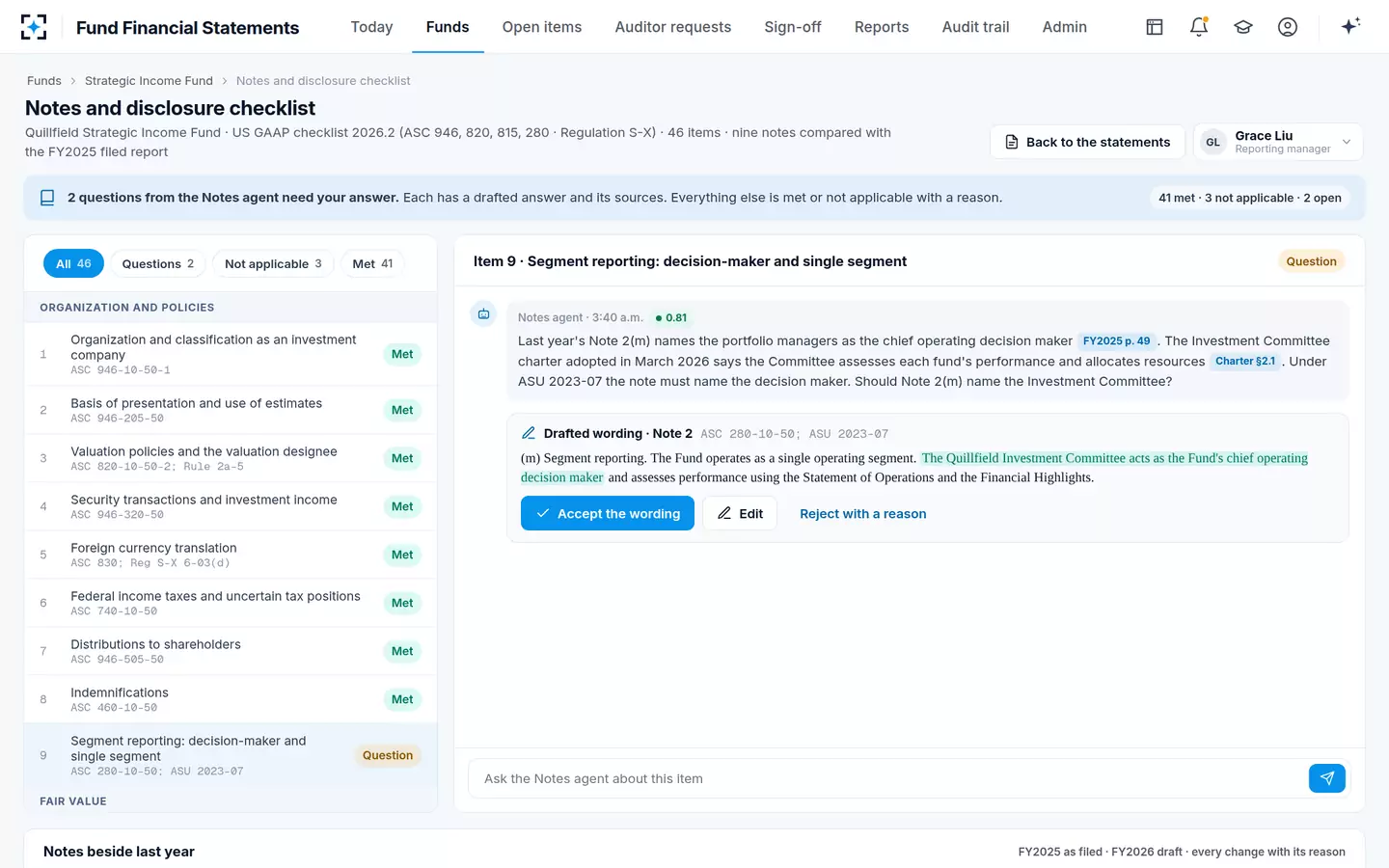
Two lists, one sign-off
The two lists belong to different people and meet at the signature. The preparer answers the checklist and clears differences as maker; a reviewer who did not prepare the fund checks both; the signer signs only when both are complete. The records behind the numbers are not optional either: a registered fund must keep "General and auxiliary ledgers (or other records) reflecting all assets, liability, reserve, capital, income and expense accounts" (Rule 31a-1(b)(2)) and preserve them permanently, the first two years in an easily accessible place (Rule 31a-2(a)(1)), so the evidence for each tick has a durable home.
The order of work follows from the asymmetry between the lists. Numbers first, because a corrected number can make a disclosure wrong, for example a reclassified holding that moves between fair value levels. Then the checklist, against the tied draft. Run the other way, a team answers the checklist twice.
How Fund Financial Statements answers both lists
The solution keeps the two lists separate and links them. The Notes agent compares each note with last year's filed note, answers each checklist item with where it is met and the reference, drafts wording for new disclosures from cited sources such as board minutes and charters, and asks a person when it cannot explain a change; its answers get a second read by an independent model. In the sample cycle it compared 1,341 notes and raised two questions for the reporting manager. It never marks an item not applicable without a person's reason.
The numbers belong to other agents. The Tie-out agent ties every number to the trial balance, holdings, capital records or last year's filed report at a $0 tolerance; the Cross-foot agent re-adds every total and checks every figure that appears in more than one place, in deterministic code. Open differences are grouped by cause across funds, as on the open items screen below, so a reviewer works six causes rather than twenty-eight separate ticks. The cost of running both lists by hand, and with help, is set out in the guide to what a fund report costs.
Open items grouped by the cause the agents traced
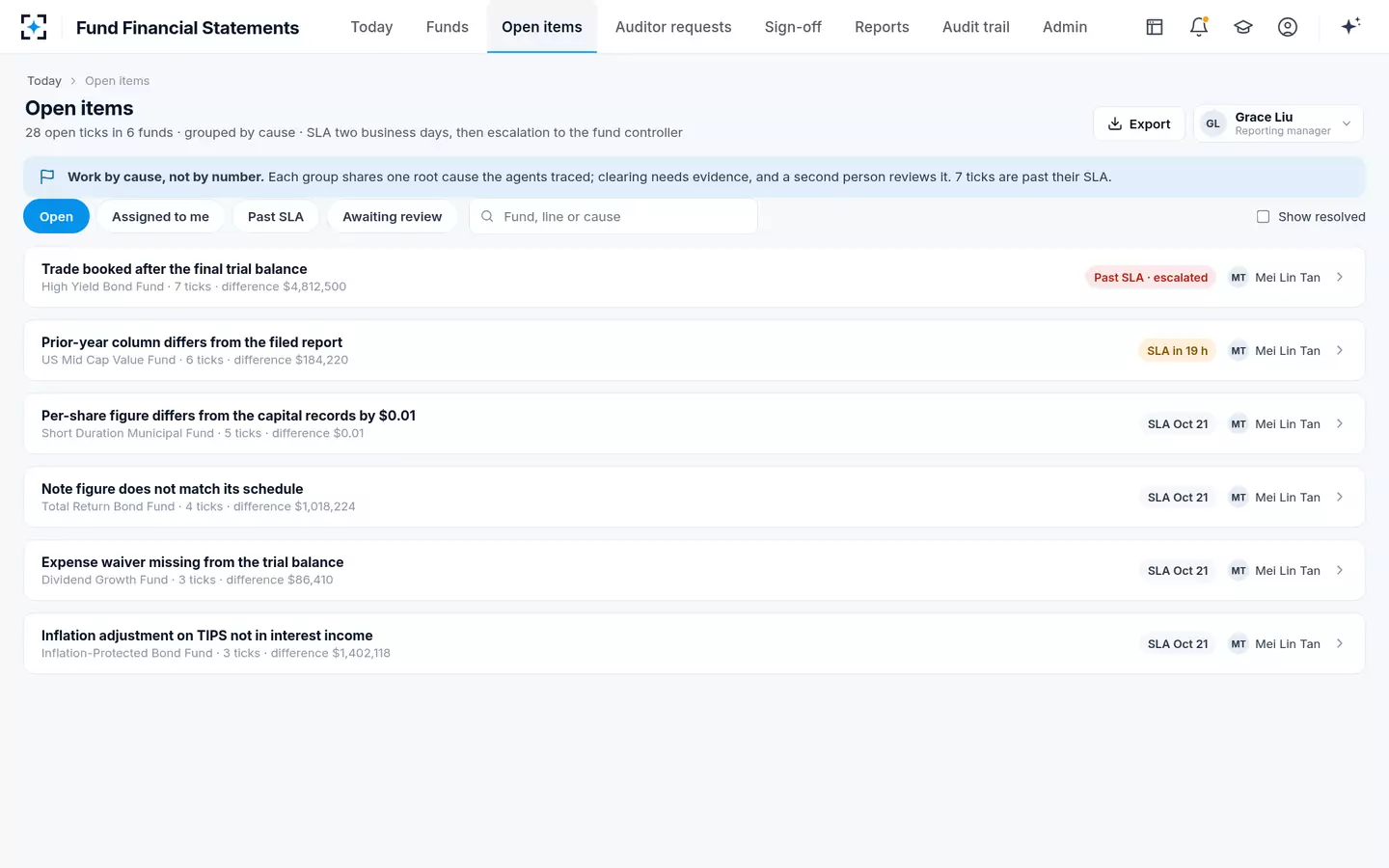
Questions people ask
Is there an official investment company disclosure checklist?
The requirements are official; the checklists in use are compilations of them. For a registered fund they come from Regulation S-X Article 6 and Rule 12-12, the fund's registration form and US GAAP. Keeping one checklist per framework and fund family, with each line citing its rule, makes it auditable.
What is the difference between footing and cross-footing?
Footing re-adds a column to its total. Cross-footing checks across: that rows add to their totals and that a figure appearing in more than one place, such as net assets or the forward contracts, is the same in each. Fund statements need both, because a break can leave every column footing while two statements disagree.
Who should answer the disclosure checklist?
The preparer, citing where each item is met, with a reviewer who did not prepare the fund checking the answers. Items marked not applicable need a written reason, because "not applicable" is the answer most often wrong when a fund starts using a new instrument, such as its first swap or its first restricted security.
When should the checklist be updated?
Every cycle, before drafting starts. Requirements move: the 2022 tailored shareholder report amendments moved the complete statements to Form N-CSR and removed the summary schedule option for open-end funds, and accounting standards add disclosures with their own effective dates. A checklist dated last year is a checklist of last year's rules.
Can a checklist catch a number that is wrong?
Only if the item is itself a comparison, such as "the schedule total agrees with the balance sheet". Most items ask whether something is disclosed. Turning the numeric items into comparisons with evidence is what makes a review test accuracy rather than format.