AI financial statement review means using a language model to read a set of statements and point out what may be wrong. With a general chatbot, that review has a hard limit: it sees only the pages it is given. A fund's statements are right when each number agrees with the trial balance, the holdings and capital records, last year's filed report and every other place it appears, and none of those are in the chat window. The model can comment on wording, spot an obviously inconsistent figure and summarise a note; it cannot tie a number, prove a footing or show an auditor what it checked. Botminds' Fund Financial Statements uses language models differently: its agents read the administrator's records as well as the draft, leave arithmetic to deterministic code, cite a source for every statement they make, and leave every decision to a person.
The examples use the solution's fictional sample data, the Quillfield Strategic Income Fund at August 31, 2026.
Six things a general chatbot misses in a fund's statements
It reads the page, not the books
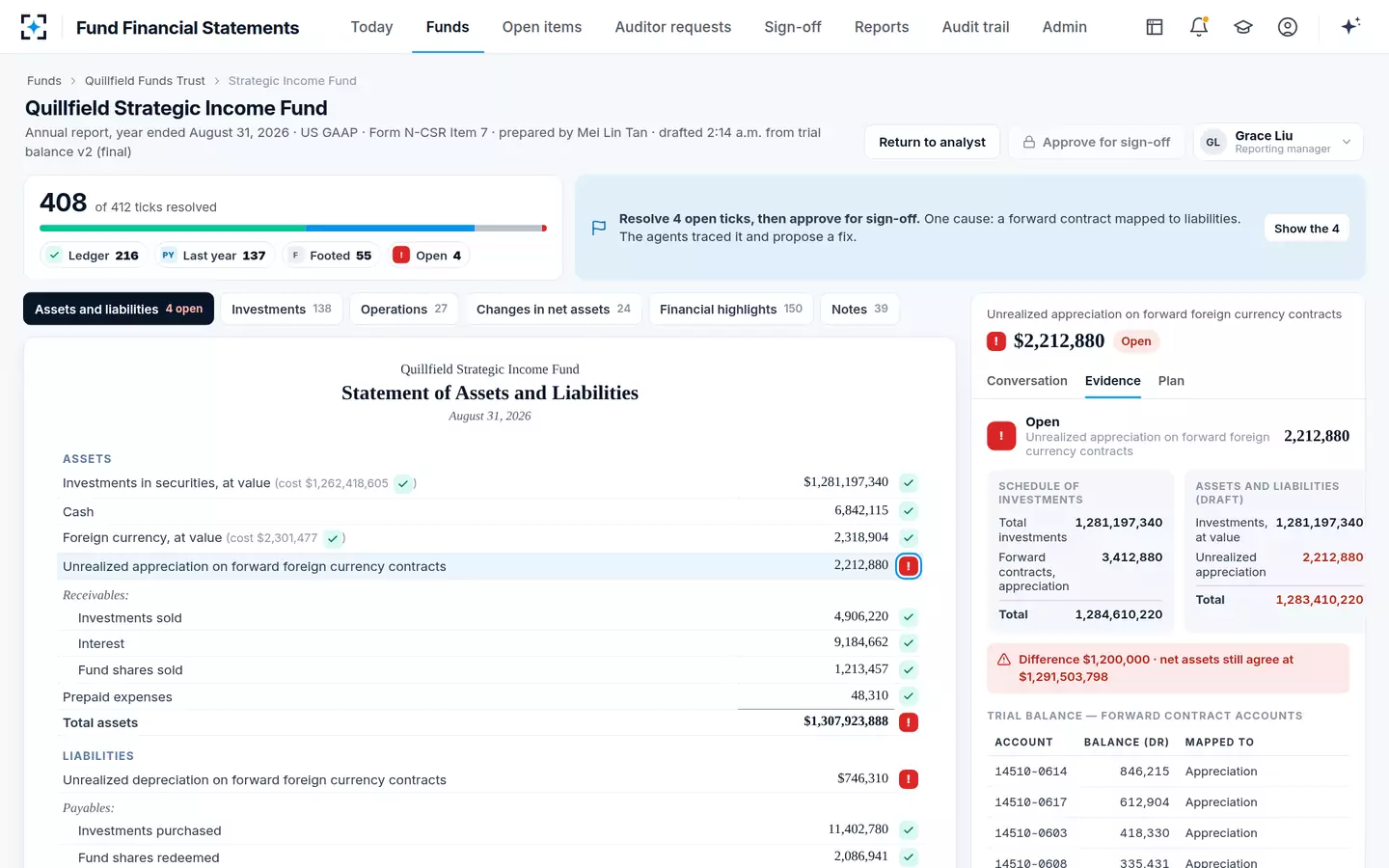
A pasted statement of assets and liabilities shows forward contract appreciation of $2,212,880. Nothing on the page says it should be $3,412,880; that is in the trial balance and the schedule.
The error is in the relation between documents the chat window never saw.
It reads arithmetic instead of doing it
Asked whether a statement foots, a language model predicts text about the sum. It may be right; it cannot show that it computed anything.
Preparers told PCAOB staff about "the lack of consistent output produced by GenAI".
It gives a different answer the second time
The same question on the same draft can return a different list of issues, so last week's "no exceptions" proves nothing about today.
An answer that cannot be reproduced cannot be relied on as audit evidence.
It sounds right when it is wrong
A plausible figure, a rule paragraph that does not exist, a confident "agrees with the schedule" that was never checked.
ESMA warns that such tools can state untrue things fluently.
It does not know what is missing for this fund
Whether the restricted securities policy note or a swing pricing note is required depends on what the fund holds and has adopted, facts outside the draft.
Regulation S-X Rule 6-03(f) and (m) turn on the fund's own facts.
It leaves no trail
A chat transcript is not a tick with evidence. Nobody can show later which record a "looks fine" was based on.
Officers certify Form N-CSR and are liable for its misstatements.
What is AI financial statement review?
The phrase covers three different things, and buyers should separate them. The first is a general chatbot given a PDF of the statements and asked to find problems. The second is a model built into a reporting or audit tool, reading the draft with the tool's rules. The third is a set of agents with read access to the records behind the statements, the trial balance, holdings, capital records and prior filings, that propose and explain while code checks the arithmetic and people decide. All three are called AI review; only the third can test whether a number is right.
The distinction matters because the errors that cost a fund a restatement are relational. In the sample fund, a forward contract with a gain sat in a liability account, so total assets and total liabilities were both $1,200,000 low while net assets agreed and the administrator's own check passed. On the page every caption was present and every column added. Only a comparison of the schedule of investments with each balance sheet caption, and of the caption with the trial balance accounts behind it, finds that.
Can ChatGPT review a fund annual report?
It can read one, and reading is useful: summarising a long note, comparing this year's wording with last year's when both are pasted in, drafting a plain-language explanation. What it cannot do is review the report in the sense an auditor or a certifying officer means, because the evidence that a number is right is not in the report. A chatbot asked "does this schedule agree with the balance sheet?" can compare two numbers on two pages; it cannot know that the balance sheet line should have included a different account.
Evidence that large language models analyse financial statements as well as professionals is thinner than the headlines. A widely shared 2024 working paper on financial statement analysis with large language models (arXiv 2407.17866) has been withdrawn by its authors and should not be cited as a result either way. What regulators have published instead is a set of warnings about reliability, consistency and auditability, from the bodies that inspect auditors and supervise funds.
What do regulators say about AI in financial reporting?
They say the obligations do not change, and the evidence has to hold. The SEC's Division of Examinations, in priorities for fiscal 2027 that speak of "super intelligence (SI)", says registrants are using generative SI tools in research, drafting and other functions, and that examiners will study how these tools shape outcomes and whether firms still meet obligations that do not depend on the technology (SEC, Examination Priorities, Fiscal Year 2027, October 23, 2026). For its own work it aims at tools "supplementing, but not replacing, staff judgment".
PCAOB staff, after outreach to audit firms and preparers, recorded the specific risks. Firms "noted that GenAI output may not always be reliable because GenAI may sometimes generate new content that is false or misleading (so-called “hallucinations”)"; preparers pointed to "the “black-box” nature of some GenAI tools and the lack of consistent output produced by GenAI, which raise questions around the auditability of certain GenAI-created output" (PCAOB staff Spotlight, July 2024). The staff also reported that the firms expect such tools "to augment, but not replace, humans in auditing or in financial reporting".
"An engagement team member who uses a GenAI-enabled tool is still responsible for the results and documentation of the work."
Audit firms, as reported in the PCAOB staff Spotlight on generative AI, July 2024
ESMA, writing about retail investment services, made the same point in plainer terms: tools that generate text can produce statements that are factually wrong while sounding accurate (ESMA public statement, May 30, 2024). None of these bodies says not to use the tools. All of them put the burden of evidence on the person who does.
Why the arithmetic belongs in code
Footing, cross-footing and percentages are calculations with one right answer, and a calculation should be done, not described. A language model generates the most likely next words; asked for a sum, it usually produces the right one and occasionally a confident wrong one, and on a statement of a few hundred figures "usually" means several errors a season. Deterministic code adds the same column the same way every time, and its result can be re-run by an auditor.
In the solution, footing and cross-footing run as code at a $1 rounding tolerance and $0.01 per share, "never as a language model's guess", and a disagreement between the code's check and an agent's reading goes to a person. The language models do the work that is genuinely about language: explaining a break in plain words, comparing notes with last year's, reading German and French editions, drafting an answer to the auditor. Every one of those outputs cites its sources, and an agent whose confidence in a proposal falls below 0.90 asks a person instead of proposing.
What an agent's answer looks like when it has the records
Do AI tools hallucinate numbers?
They can, and in financial statements a hallucinated number is worse than a missing one because it looks like every other number. The PCAOB staff's account of audit firms' concern covers exactly this: content "that is false or misleading". A summary that states a total that is not in the statements, a comparison that reports agreement it did not check, a note reference to a paragraph that does not exist: each reads as fluently as the truth.
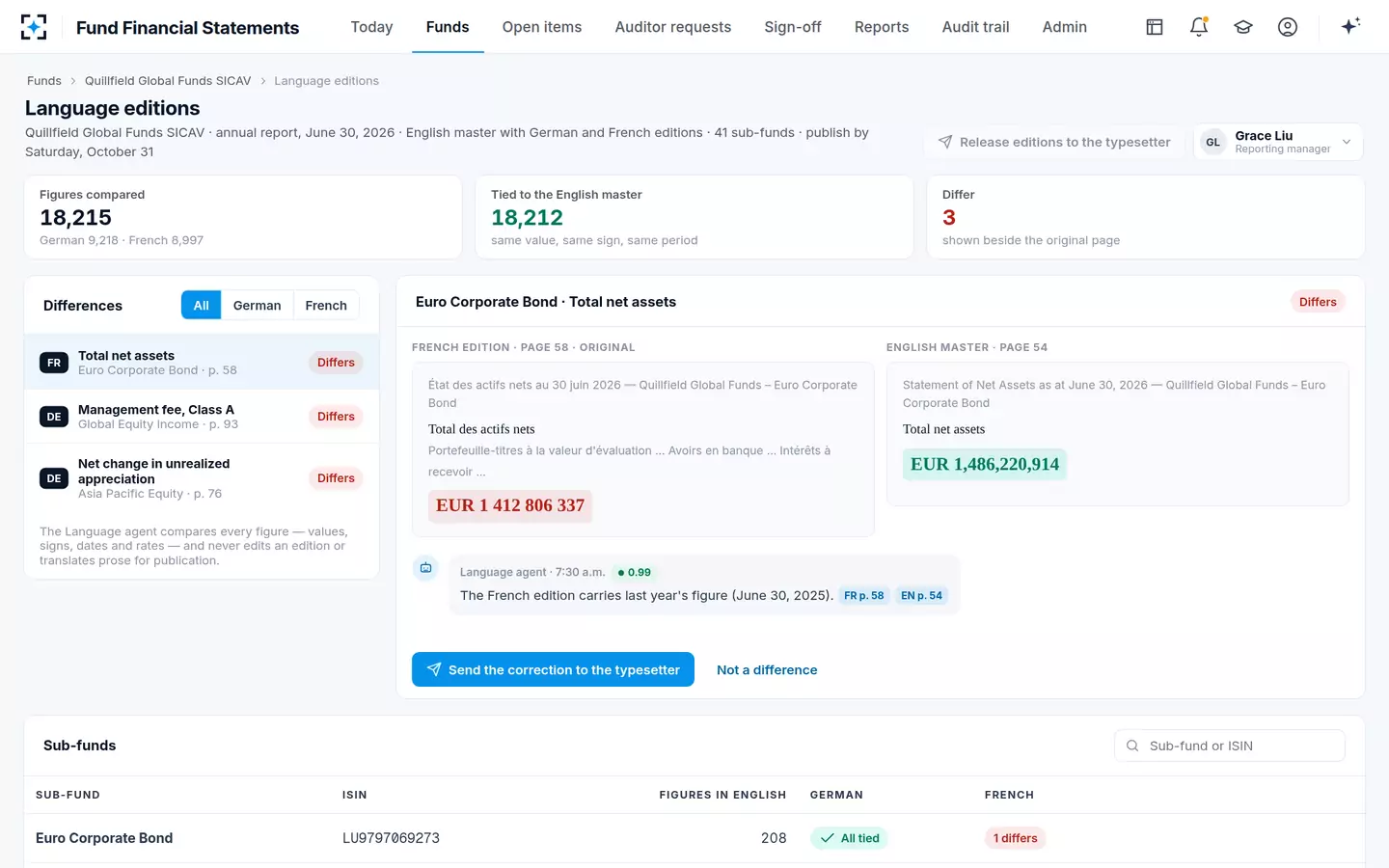
The defence is structural, not a better prompt. Every figure an agent states should be traceable to a record it read, and the comparison should be made by code that can be re-run. In the solution's language editions, for example, the Language agent matches every figure, sign, date and rate in the German and French editions to the English master by position and meaning, reports each difference with both pages side by side, and "never translates prose for publication" or edits an edition. In the sample SICAV it compared 18,215 figures and found three that differed, including a French total carrying last year's net assets.
Language editions: figures compared, never rewritten
Questions to ask any AI financial statement tool
Ask them on your own statements, with last year's report and its records loaded, not on a demonstration file. Each question below has an answer you can check on screen, and a tool that cannot answer one with evidence has told you where its limit is. A structured way to run that test across a whole report is in the pilot guide.
Questions that separate an AI tool that reads from one that checks
- What records does it read besides the draft?
Trial balance, holdings, capital records, prior filed reports, the mapping. A tool that reads only the draft cannot tie.
- Who does the arithmetic?
Footing and cross-footing should be code with a stated tolerance; ask to see the calculation, not a sentence about it.
- Does the same input give the same answer?
Run one fund twice. Differences between runs are a finding about the tool.
- Can every statement it makes be traced?
Each claim should cite the record line, page or rule it rests on, and the citation should open.
- What can it change?
It should be read-only on the books; fixes should be proposals a named person applies and a different person approves.
- What does it do when unsure?
A stated threshold below which it asks a person, rather than a confident answer.
- Where does your data go?
PCAOB staff found firms restricting what can be uploaded to generative tools to keep client data confidential; ask the same of any vendor.
- What will the auditor see?
The trail of ticks, changes and approvals, exportable, with who, when, why and the evidence.
How Fund Financial Statements divides the work
The solution's seven agents each have a narrow job and stated limits. The Intake agent collects final trial balances and will not draft from a preliminary one. The Drafting agent builds statements and notes from the mapping, and never changes a mapping rule or writes a note it cannot source. The Tie-out agent ties and traces, and never clears a red tick. The Cross-foot agent's arithmetic is code. The Notes agent's checklist answers get a second read by an independent model. The Auditor-request agent drafts, and sends nothing. People clear, change, approve, sign, certify and release, each with a reason code.
A chat window and a set of agents with the records
A general chatbot: The pages pasted into it.
Agents with the records, code and people: The draft, the trial balance, holdings, capital records, the mapping and last year's filed report.
A general chatbot: Predicted in text.
Agents with the records, code and people: Computed in code at a stated tolerance; re-runnable.
A general chatbot: Possibly noticed if both numbers are on the page.
Agents with the records, code and people: Traced to the account, mapping rule, transaction or policy, and searched for in every fund.
A general chatbot: A suggestion in a chat reply.
Agents with the records, code and people: A proposal with its effect, applied by a maker and approved by a different checker.
A general chatbot: A transcript.
Agents with the records, code and people: A tick per number with its source, on an append-only trail.
A general chatbot: Whoever pasted the file.
Agents with the records, code and people: The named preparer, reviewer and signer of each fund.
Where a general chatbot does help in fund reporting
A chat window is useful wherever the answer can be checked against something the reader has open. Explaining a rule with the rule's text beside it, summarising last year's note so a new analyst knows what to look for, drafting a first plain-language version of a policy description that a person then compares with the policy: in each case the model saves typing and the person still does the checking. The condition is the same one regulators set: the person using the output is responsible for it, and the data put into it must be data the firm may share.
That division is also why a chatbot's best use in fund reporting is before and after the numbers, not instead of them: explaining a policy, drafting a first version of plain-language text from cited sources, answering a question about a rule with the rule open beside it. The tie-out itself, traced on one number from red tick to signature, is in the tie-out tool guide.
Questions people ask
Can AI prepare financial statements?
Agents can draft a fund's statements from its trial balance and a versioned mapping, and the solution does exactly that overnight. Preparing them in the sense of taking responsibility cannot be delegated: the statements are the fund's, signed by its people, and for a registered fund certified by its principal executive and financial officers on Form N-CSR.
Is it allowed to use AI in fund financial reporting?
The SEC treats the question as one of existing duties: its 2027 examination priorities say staff will check that firms still meet their existing obligations, which do not change with the technology. The same accuracy, books-and-records and certification duties apply whatever tool produced a draft, and none is relaxed because a model helped.
Is it safe to upload fund statements to a public chatbot?
Draft statements are confidential until published, and the records behind them always are. PCAOB staff found audit firms with safeguards on "what information can be uploaded" to generative tools, and some that do not allow them in audit procedures at all. Treat a public chatbot as outside the firm unless your agreement with its provider says otherwise.
Will auditors rely on AI-generated tie-outs?
They will rely on evidence they can inspect and re-perform, whoever or whatever produced it. Ticks that open to the trial balance line, the sub-ledger record or the filed page, with arithmetic that can be re-run, are evidence; a model's statement that numbers agree is not. Under the solution's design the auditor has read-only access to the engaged funds' ticks and evidence.
What is the difference between AI financial statement analysis and review?
Analysis reads published statements to judge a company or fund, the work of an investor or analyst. Review checks a draft before it is published, the work of the preparer and auditor. A chatbot can help with the first from public filings; the second needs the records behind the numbers, which is why it is a different kind of tool.