Shareholder reporting services are the outside providers a fund uses to produce its annual and semi-annual shareholder reports: typically a fund administrator's financial reporting team that drafts the reports and financial statements, a financial printer that composes, prints and mails them, and a filing agent that converts, tags and files Form N-CSR. Since July 24, 2024 each mutual fund and ETF on Form N-1A produces a short tailored report for every share class, so the drafting and tie-out work has multiplied while the documents shrank. None of that moves responsibility: the fund's principal executive and principal financial officers certify every Form N-CSR, and the fund's compliance program must oversee its administrator and transfer agent. The right way to compare a service, an in-house team and AI agents is by what each must never do and who stops it. Botminds' Tailored Shareholder Reports is built around that list: seven agents draft and check, and people approve, rule and certify.
Seven agents, each with a limit, ending at the people who sign
Agent
Intake agentPulls the period's data: trial balance, class expenses, average daily net assets, financial highlights, class and index returns, holdings, supplements, minutes and commentary; checks the period end, class counts and completeness.
Never: drafts on an unfinished period or a non-final index value.
Agent
Drafting agentBuilds each fund's report and every class variant in Item 27A order, and writes the key-factors summary from the portfolio manager's or sub-adviser's commentary, each sentence cited.
Never: adds content Item 27A does not permit; nor invents a reason for performance.
Agent
Recalc agentRecomputes every expense example, cost percentage, total return and growth of $10,000 from raw class data, and sweeps all funds for the same cause.
Never: edits the draft; it proposes a fix with its working.
Agent
Tie-out agentTies every figure to its page in the Form N-CSR financial statements without reading the Recalc agent's working.
Never: marks a figure tied without a page; nor resolves its own disagreement.
Agent
Change watcherReads the year's supplements, minutes and adviser agreements and proposes each candidate material change with its source page.
Never: decides materiality.
Agent
Format and tagging agentChecks order and permitted content, plain English, live links, Inline XBRL tags and Form N-CSR item completeness.
Never: shortens narrative without a person's approval.
Agent
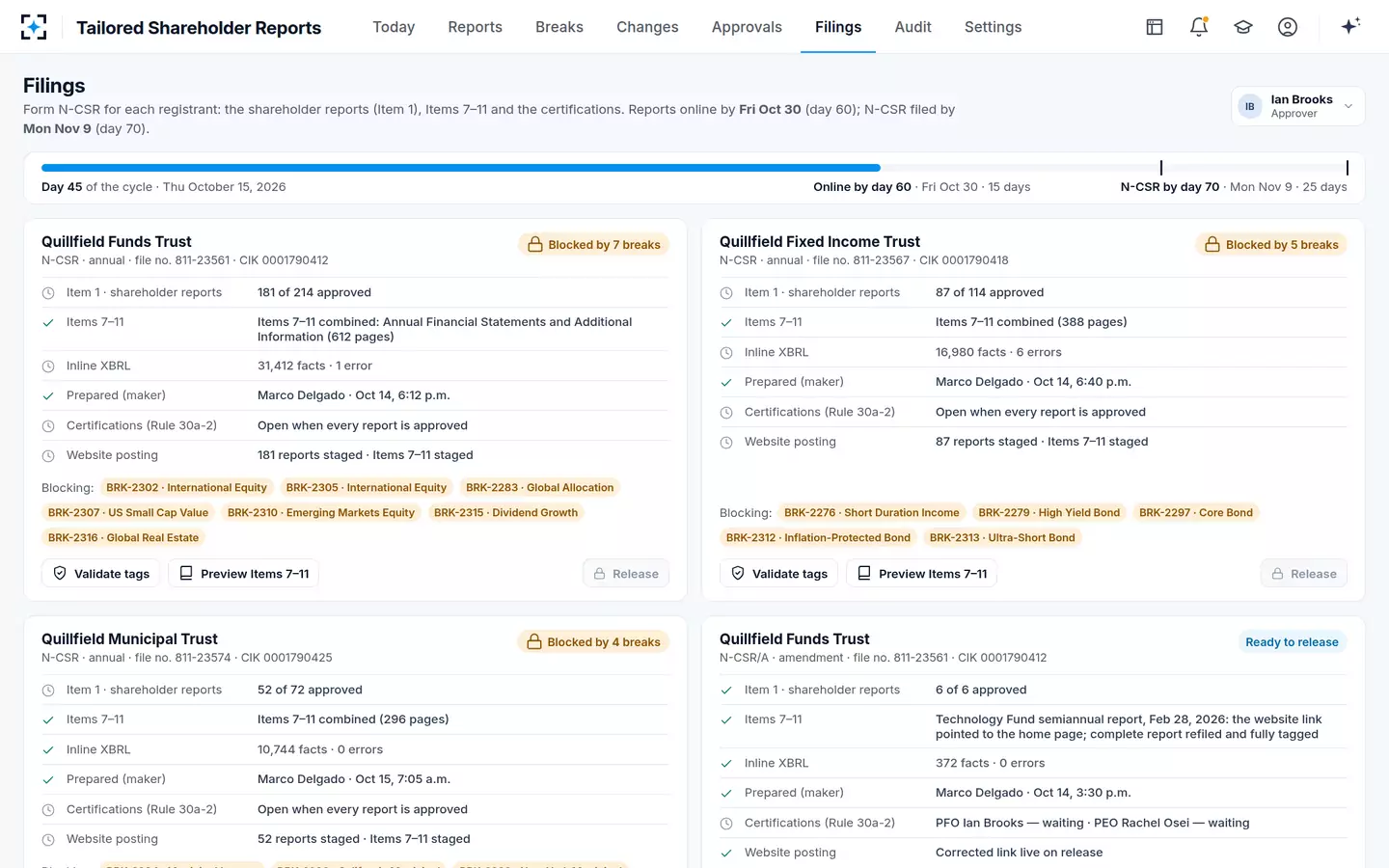
Filing coordinatorRuns the day-60 and filing clocks, routes each item to a checker who did not prepare it, and assembles each Form N-CSR.
Never: posts or files without the treasurer's release and both certifications.
A person decides
Analyst, counsel, treasurer and presidentThe analyst proposes fixes; counsel rules on changes; the treasurer approves and releases; the principal financial and principal executive officers certify.
Who prepares fund shareholder reports? Mutual fund financial reporting, divided
Usually several parties, coordinated by the fund's treasurer. The data comes from fund accounting, often run by the fund's administrator; the financial statements and the class reports are drafted by a financial reporting team, in-house or at the administrator; counsel reviews narrative and changes; a financial printer composes and distributes; a filing agent submits Form N-CSR on EDGAR, often with the Inline XBRL; and the transfer agent supplies the shareholder lists by class. The SEC's adopting release expected some of the rule's costs to be paid "to procure the services of third parties", noting that "some funds utilize outside providers for these compliance responsibilities", and expected smaller funds to hand their tagging to large outside providers (Release 33-11125).
The tailored report changed the shape of the drafting work more than its volume of pages. A fund with four share classes now produces four reports that differ in a handful of figures, and the risk sits in those figures: the expense ratio and dollar cost, returns with and without sales charges, the starting value of the graph. In the solution's sample data, a family of 74 funds produces 400 class reports a cycle, and the sample analyst's complaint sums up the job: the same report with six numbers changed, and the six are where it breaks.
Who is responsible for errors in a shareholder report?
The fund, and two named officers personally certify the filing that contains it. Under rule 30a-2(a) the principal executive officer and the principal financial officer, or whoever performs those functions when the report is filed, each sign a certification (17 CFR 270.30a-2; the semi-annual report season guide shows where it falls in the calendar). The certification text covers the whole Form N-CSR, including every class report filed as Item 1, and states that the signers are responsible for disclosure controls designed so that material information "is made known to us by others within those entities".
Service providers sit inside the fund's compliance program, not outside it. Rule 38a-1 requires each fund to adopt compliance policies that cover its own conduct and also provide for overseeing the compliance of its adviser, principal underwriter, administrator and transfer agent (17 CFR 270.38a-1(a)(1)), approved by the board and reviewed at least annually; how that oversight works for an administrator is a guide of its own. A shareholder reporting service's error is the fund's error, found or missed under the fund's controls. Rule 30a-3 then requires management to evaluate those controls within 90 days before each Form N-CSR filing (17 CFR 270.30a-3).
Can AI draft a shareholder report? The rules do not ask who wrote it
Nothing in Form N-1A, rule 30e-1 or Form N-CSR forbids software from drafting a shareholder report, and nothing relaxes the rules if it does. The content standards in Item 27A apply to the document; the certification applies to the filing; the oversight duty applies to whoever does the work. The SEC's Division of Examinations, in its fiscal 2027 priorities, describes registrants using what it calls super intelligence, "generative SI tools", for drafting and client communications among other work, and says that as the tools become part of daily work it will look harder at how they change outcomes and at whether firms keep meeting duties that never depended on who, or what, did the work (SEC, Fiscal Year 2027 Examination Priorities, 23 October 2026).
For a fund, the practical reading is that a report drafted with such tools must meet every Item 27A instruction a human-drafted one meets, and that the fund should be able to show how the drafting tool is controlled: what it may change, who checks it, and what evidence stands behind each figure. The obligations are, in the Division's word, technology-neutral; the evidence that they were met is not.
What should AI never do in a shareholder report? The limits the rules imply
Six limits follow from the rules themselves, and they apply to any drafter, human, service or agent. Writing them down makes the comparison between options concrete, because each limit needs someone or something to enforce it.
Six limits on any drafter, the rule behind each, and who enforces it
| Never | The rule behind it | Outside service or in-house team | Agents in the solution |
|---|---|---|---|
| Add content Item 27A does not require or permit | Instruction 3 to Item 27A(a); the staff found "extraneous and sometimes lengthy disclosures" | Reviewer's judgment on each report | Permitted-content check on every class report; anything else is a break |
| Write a generic market review or a reason the data does not support | Item 27A(d)(1): key factors only, no "lengthy, generic, or overly broad discussion" | Portfolio manager and counsel review | Every sentence cited to the manager's commentary; unsupported reasons are not written |
| Include a forecast | Item 27A(d)(1) asks what affected performance "during the reporting period"; Instruction 3 closes the list | Counsel review | Forecast sentences left out and marked for the reviewer |
| Draft on an unfinished period or a provisional index value | The certification that financial information "fairly present[s]" the period | Cut-off procedures at the administrator | Intake agent refuses to start until books and index values are final |
| Decide whether a change is material | Item 27A(g); the SEC left materiality to funds' judgment | Counsel | Change watcher proposes with sources; counsel rules with a reason code |
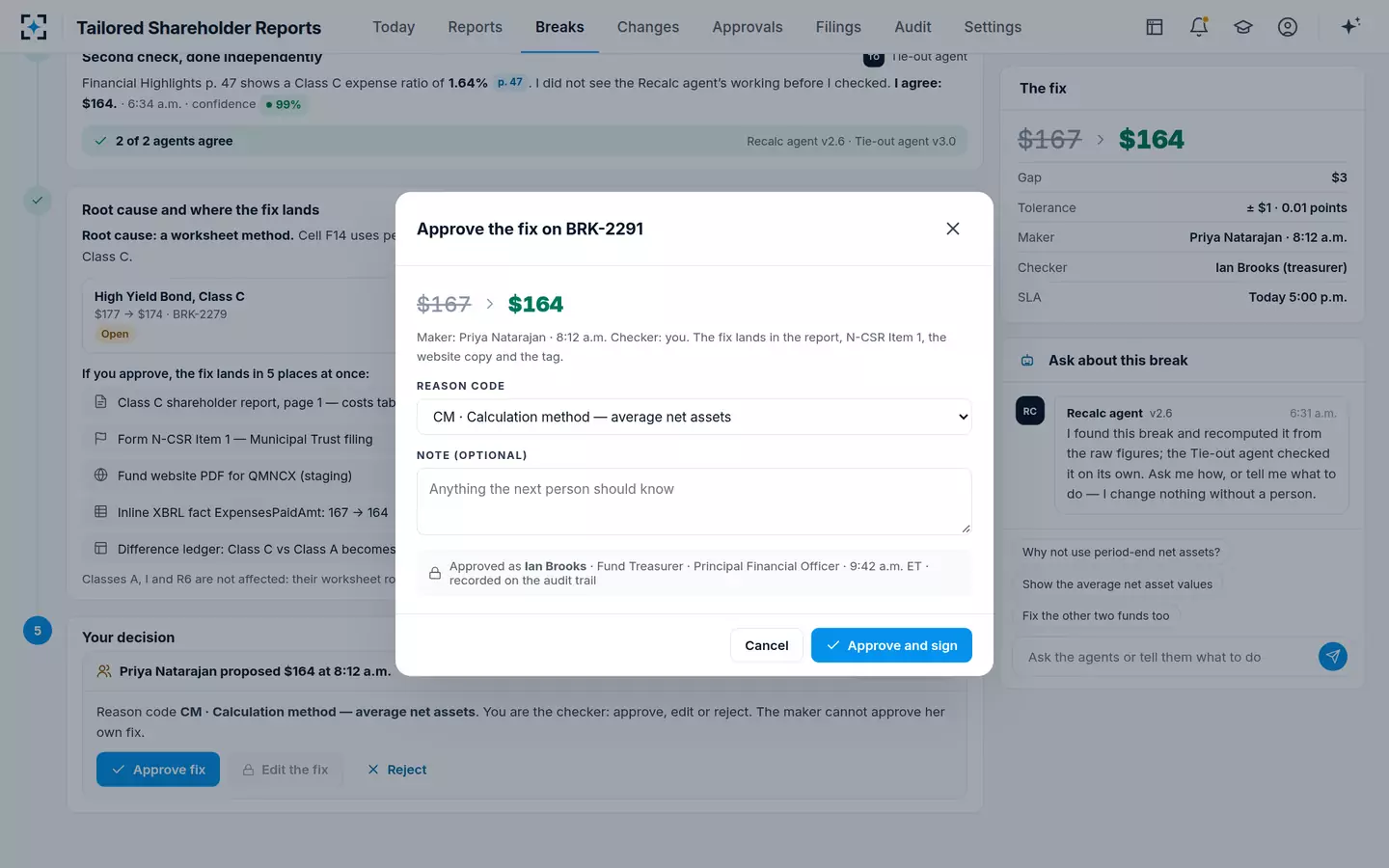
| Approve its own work, post or file | Rule 30a-2 certifications; rule 38a-1 oversight | Separation of duties, if designed in | Maker and checker must differ; filing locked until release and both certifications |
The table shows where the real difference between options lies. A good service or in-house team enforces most of these limits through people's judgment, report by report, and does it well when there is time. Agents enforce the mechanical ones on every report every time, and hand the judgment ones to the person whose job it is. The weak point of the manual model is the last two weeks before day 60; the weak point of an automated one is any limit that is not actually enforced, which is why a buyer should ask to see each limit fail safely in a test.
A fix is proposed by one person and approved by another
Shareholder reporting services, an in-house team or agents: what each is good at
Each option is strong in a different place, and a fund complex often combines them. The comparison below is ours, built from the work the rule requires; vendors don't publish comparable prices or error rates, so it compares what each option does rather than what it costs. The cost side is worked through in financial printer companies, administrators or agents for tailored shareholder reports.
Three ways to staff the work, compared on what the rule asks
| What the work needs | Outside reporting service | In-house financial reporting | Agents beside the team |
|---|---|---|---|
| A report per class, in Item 27A order | Templates run at scale across many clients | Templates owned by the fund's own team | Drafted per fund, every class variant generated and differences explained |
| Every figure tied to the statements | Proof review, often on paper | Proof review by the team | Two independent checks, each figure linked to its page |
| Finding material changes | Relies on the fund to tell it | Counsel and the team read the year's documents | Reads every supplement, minute and agreement; counsel rules |
| Fixes reaching every copy | Change requests through the service | Manual updates to report, filing, website and tags | One approved fix applied to report, Form N-CSR, website copy and XBRL fact |
| Evidence for the certifying officers | The service's sign-offs and the fund's review | The team's working papers | An append-only trail of every action, export for the auditor |
| Printing, mailing, EDGAR filing | Yes, often bundled | Usually bought from a printer and filing agent | No: hands approved files to the printer and filing agent |
What blocks each registrant's filing, and who certifies
Questions to put to any shareholder reporting service, or to agents
The same questions work for a service, a software vendor and your own team, because they test the limits rather than the sales pitch. Ask for a demonstration of each on your own last cycle; replaying last cycle's reports is the way to get the answers in evidence rather than in a slide.
Ten questions for a shareholder reporting service, a tool or a team
- Show me the page behind any figure
Every cost, return and statistic linked to the statement it came from.
- Who checks the figures, and independently of whom?
A second check that does not see the first one's working.
- How do you compute the $10,000 cost line?
Average account value, rounded to the dollar; semi-annual dollars not annualized.
- How do you check the broad-based index and its tags?
Required index qualifies; additional indexes tagged separately.
- How do you find material fund changes?
Which documents are read, and who decides materiality.
- What stops content Item 27A does not permit?
Disclaimers and extra risk text are the staff's named example.
- When a figure is fixed, where does the fix go?
Report, Form N-CSR Item 1, website copy and XBRL fact together.
- Can the person who made a change approve it?
The answer should be no, enforced by the system.
- What evidence do our certifying officers get?
A trail of who did what, when, why and on which document.
- What do you not do?
A clear list: printing, mailing, filing, index choice, materiality.
What Tailored Shareholder Reports does not do
It does not print, mail or file. Approved reports go to the fund's financial printer and website; the released Form N-CSR goes to the fund's filing agent for EDGAR; the transfer agent's files decide who receives which class report by mail or e-delivery. It does not choose the fund's broad-based index, decide whether a change is material, approve a report, release a filing or certify anything. Each of those stays with a named person, and each action the agents take is visible on the audit trail.
That boundary is the answer to the question in the title. A shareholder reporting service may never take decisions the fund's officers and counsel are responsible for, and neither may agents; the difference is that in Tailored Shareholder Reports the boundary is enforced in the software rather than in a contract, and every attempt to cross it, such as a maker trying to approve their own fix, is blocked and logged. To see the limits tested on your own funds, start from Tailored Shareholder Reports.
Questions people ask
What does a fund administrator do for shareholder reports?
Typically it keeps the fund's books, produces the financial statements and highlights, and often drafts the class reports and Form N-CSR for the treasurer's review. Under rule 38a-1 the fund's compliance program must provide for oversight of the administrator's compliance, and the board approves the administrator's policies.
Does using an outside service shift liability for errors?
Not for the fund's disclosure. The fund files the report and its principal executive and principal financial officers certify the Form N-CSR; any contractual remedy against a provider is a separate matter between them.
What is a shareholder reporting analyst?
It is a job title used at fund companies and administrators for the person who prepares shareholder reports and their financial statements for a set of funds. In the tailored-report era the job is mostly class-level figures, tie-outs and corrections across many near-identical reports.
Can agents write the performance discussion?
They can draft it from the portfolio manager's or sub-adviser's commentary, with each sentence linked to its source and each number tied to the statements. Item 27A(d)(1) limits it to the key factors that materially affected performance during the period, so a sentence without a source is left out rather than invented, and a person approves the text.
Do the agents replace the financial printer?
No. The printer composes, prints and mails, and often provides other filing services; the agents prepare and check the content before it reaches the printer and the filing agent, and send approved changes to every copy at once.
Who should own the limits list inside a fund?
The treasurer, with the chief compliance officer. The limits express the fund's disclosure controls, which rule 30a-3 asks management and the certifying officers to evaluate before every Form N-CSR filing.