An appropriate broad-based securities market index is the index a mutual fund or ETF must compare itself with in its prospectus and in the performance section of its tailored shareholder report, and since the SEC's 2022 amendments it has to pass two tests. It must be administered by an organization that is not affiliated with the fund, its adviser or principal underwriter, unless it is widely recognized and used; and it must represent "the overall applicable domestic or international equity or debt markets, as appropriate". A healthcare fund therefore shows the overall US equity market and may add a healthcare index beside it; a growth, value, ESG or small-cap index cannot be the required one. The SEC staff's review of the first reporting cycle listed the index among its recurring issues. Botminds' Tailored Shareholder Reports checks each class report's index against the test and keeps the required index separate from the optional ones, in the text and in the Inline XBRL.
Which index can be the required one: three columns from the release, the form and the staff
Qualifies as the required index
Does not qualify
May be shown in addition
What is an appropriate broad-based securities market index? Two tests in one instruction
An appropriate broad-based securities market index is one that passes Instruction 6 to Item 27A(d)(2) of Form N-1A, which defines it in two sentences. The first is old: the index must be "administered by an organization that is not an affiliated person of the Fund, its investment adviser, or principal underwriter, unless the index is widely recognized and used." The second is the 2022 addition: "A 'broad-based' index is an index that represents the overall applicable domestic or international equity or debt markets, as appropriate." The instruction ends with a computation rule: adjust the index for reinvested dividends, but do not deduct the fund's expenses.
The same definition governs the prospectus, through Item 4(b)(2)(iii). The SEC said it was amending the definition "to require that all funds compare their performance to the overall applicable securities market, for purposes of both fund annual reports and prospectuses" (Release 33-11125). Shareholder reports transmitted on or after July 24, 2024 had to use a qualifying index, and so did registration statements and post-effective amendments filed 18 months or more after the rule took effect.
The required index before and after the 2022 amendments
Before the 2022 amendments: Who runs the index: an unaffiliated organization, unless the index was widely recognized and used.
Since the 2022 amendments: The same, plus breadth: the index must represent the overall applicable domestic or international equity or debt market.
Before the 2022 amendments: Possible, if it passed the administrator test.
Since the 2022 amendments: Not as the required index; only as an additional one.
Before the 2022 amendments: Prospectus and the annual report's performance discussion.
Since the 2022 amendments: Prospectus and every class report with a performance section, beside the fund in the graph and in the returns table.
Before the 2022 amendments: Not tagged in the shareholder report.
Since the 2022 amendments: Tagged in Inline XBRL, on a separate axis from additional indexes.
Broad based index vs narrow based index: one required, others permitted
A broad-based index represents a whole equity or debt market; a narrow-based index represents a slice of one, such as a sector, a style or a size band. The rule requires the first and invites the second. Instruction 7 says a fund "is encouraged to compare its performance not only to the required broad-based index, but also to other more narrowly based indexes that reflect the market sectors in which the Fund invests", and may add another broad-based index or a non-securities index such as the Consumer Price Index "so long as the comparison is not misleading."
The release's own example sets the pattern. A fund that invests mainly in healthcare companies "should show its performance against the overall U.S. equities market, rather than a benchmark consisting of only healthcare companies", and "could also show its performance against an additional, more narrowly tailored healthcare index." The narrow index survives as context; it loses its place as the yardstick. A "broad-based" index need not hold every security in its market, the SEC added; it must reasonably represent it.
Can a growth index be the broad-based index? No, and nor can value, ESG or size
A growth index cannot be a fund's appropriate broad-based securities market index, and the Commission said so in terms:
We similarly do not believe that indexes that include characteristics such as "growth," "value," "ESG," or "small- or mid-cap" represent the overall market, and therefore these indexes would not be appropriate broad-based securities market indexes under the final rules.
SEC, Release 33-11125 (Oct. 26, 2022)
The staff repeated the point in the section of its first-cycle review that lists recurring issues in performance discussions. ADI 2024-14 reminds registrants "that industry-focused indexes, indexes with characteristics such as 'growth,' 'value,' or 'small- or mid-cap', and other indexes that comprise only a subset of the overall applicable market, do not qualify as an appropriate broad-based securities market index, nor would commodity indexes" (ADI 2024-14). A small-cap value fund therefore shows a total US equity market index as its required comparison and may put its small-cap value index on the same graph as an additional line.
What index should a muni fund use? The national market, even for one state
A municipal bond fund may use an index of the national municipal securities market, and a single-state municipal fund may use the same national index. That was the second question the staff answered in its tailored shareholder reports FAQ, and the answer turns on tax treatment: "because income from municipal bonds is generally free from federal income tax (and, in some cases, free from state and local income tax), tax-exempt municipal bonds are distinct from other types of fixed income securities." The staff concluded that "the national municipal securities market may be understood as a standalone overall market as opposed to a subset of the fixed income market more broadly."
The question is not marginal. In March 2026 the SEC's registered fund statistics counted 497 municipal bond mutual funds and 160 municipal bond ETFs (SEC Analytics Office, Registered Fund Statistics), many of them single-state funds with share classes of their own. A California or New York municipal fund that compared itself only with an index of its own state's bonds would be using a subset of the national municipal market as its required index; the staff's reading lets it use the national index as the required one and its state index as the addition.
Can a regional index be a broad-based index? Usually, if it covers the fund's market
Yes, if the region is the fund's market. The release had already said that for a fund investing mainly in one non-US country, "an index representing the overall equity market of the non-U.S. country" would qualify. The staff extended the reasoning to groups: an index of "a group of countries, a group of countries excluding a specific country or countries, or a group of countries with shared characteristics such as emerging markets or developed markets, could qualify" provided it "represents the overall applicable international equity or debt market relative to the fund's investments."
The proviso does the work. A Europe index is broad for a Europe fund and narrow for a global fund. An emerging-markets index is broad for an emerging-markets equity fund; an emerging-markets small-cap index is unlikely to be, because size is again a subset. The test is always the overall applicable market relative to what the fund holds, which is why the choice has to be revisited when a fund's strategy changes.
Multi-asset funds, blended indexes and commodities
Funds that do not invest in one market get some room, but not a blended index as the required one. The release says an appropriate index "may include components that do not directly overlap with the fund's investments", and that multi-asset and alternative strategy funds "could select an index that shares other economic characteristics with the fund, such as an index that has similar volatility to the fund." A fund that holds both equity and debt "could include more than one appropriate broad-based securities market index", and "could also include a blended index", combining equity and debt indexes, "as an additional index to supplement" the required ones.
Commodities are outside the definition altogether. In a footnote to ADI 2024-14 the staff said that "a commodity index is not a 'securities market index' and does not represent 'the overall applicable domestic or international equity or debt markets'." A fund with commodity exposure through futures still needs a securities market index as its required comparison and may add the commodity index. The SEC also declined to publish a list of permissible indexes, "because the indexes that are available for funds to select change over time", so the judgment stays with the fund and its counsel.
Why the SEC cares which line sits above the fund
Because investors react to the index's position, and funds choose the index. A 2022 working paper by the SEC's Office of the Investor Advocate, cited in the adopting release, tested how people respond to benchmark lines on a fund's performance graph in a randomized experiment drawn from a nationally representative internet panel. Participants who saw a single benchmark above the fund put less money in it; a benchmark below the fund made no measurable difference; and "the relative position of the benchmark versus the fund appears to be much more consequential than whether the benchmark presented is narrow or broad" (Chin et al., OIAD Working Paper 2022-01).
Where the index line sits changed how much people invested
The same paper drew the practical conclusion from fund data: the patterns "raise the possibility that funds can pick benchmarks that satisfy the requirements for permissible benchmarks, but are relatively poor performing as compared to other permissible benchmarks." The 2022 definition narrows that choice for the required index. It does not remove it for additional indexes, which is why a reviewer should ask why each additional index was chosen, and whether it would have been chosen in a year when it beat the fund.
Changing the index, and tagging it apart from the others
A fund that changes its required index must explain why and show both for the transition. Instruction 8 to Item 27A(d)(2) says to "explain the reason(s) for the change and compare the Fund's annual change in the value of an investment in the hypothetical account with the new and former indexes." Because the change appears in the performance section, the SEC did not add index changes to the list of material fund changes that trigger the bold cover sentence.
The distinction between required and additional indexes also has to survive into the data. In its first-cycle review the staff found funds giving every index the broad-based tag, including the additional indexes that have a separate tag of their own. In the SEC's Open-End Fund taxonomy the two sit on different axes, one for broad-based indexes and one for additional indexes (OEF Taxonomy Guide, March 2026). A data user comparing funds with their required index relies on that split, and where agents fit beside XBRL tagging software shows how the split is checked before filing.
The national municipal index as the required comparison, in a sample class report
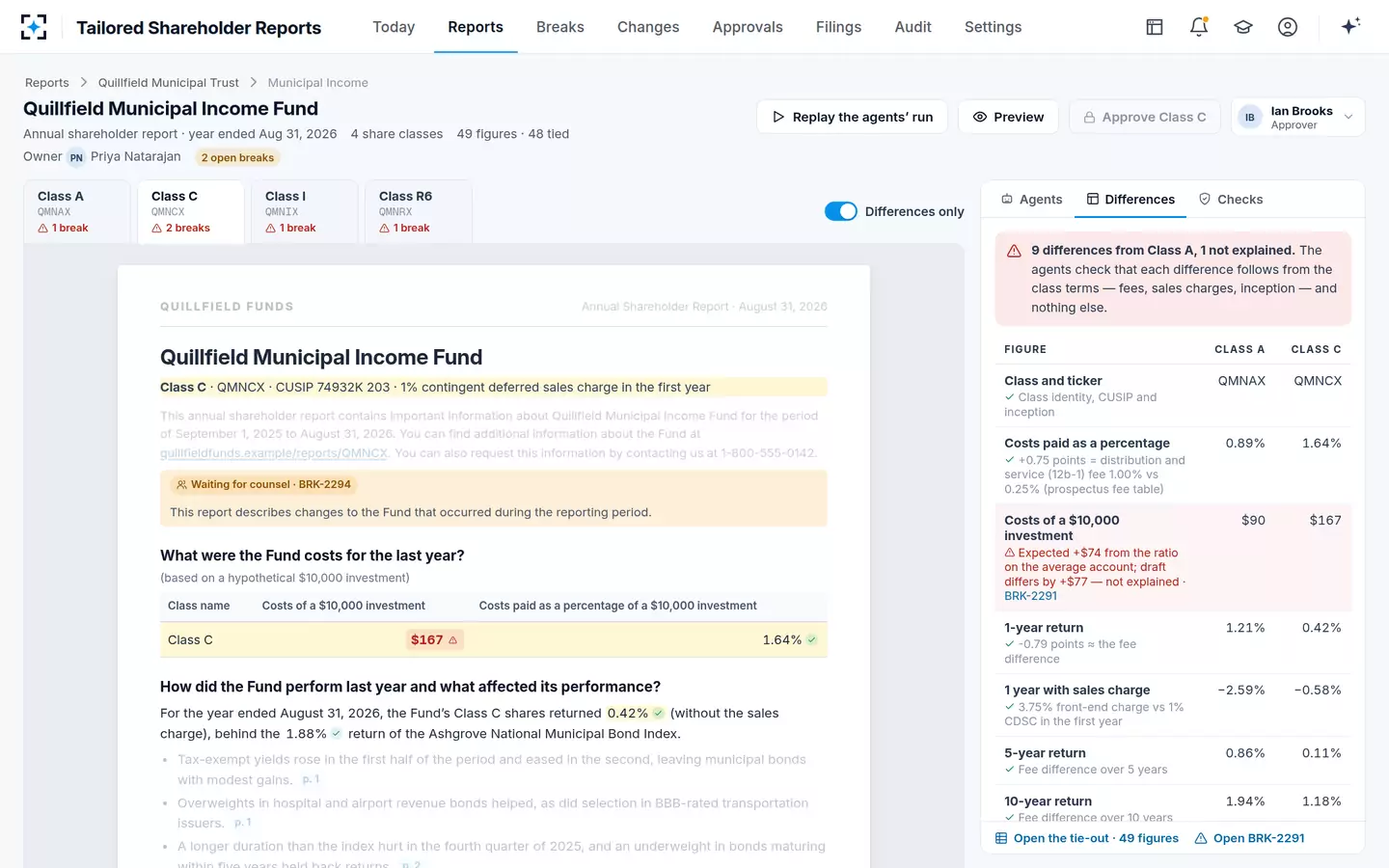
How Tailored Shareholder Reports checks the index on every class report
In Tailored Shareholder Reports the index rules are settings the treasurer approves, applied to every class report. The broad-based index comes first; index values must be final values for the period end, so a vendor's late republication becomes a flag rather than a silent change; and every additional index carries the additional-index tag. On the sample family's home screen, one such republication, an index value reissued on October 14, is shown for the team to resolve before the reports go out.
The agents do not choose indexes. Choosing the required index is a judgment about the fund's market that belongs to the adviser, counsel and the board, and the solution's role is narrower and more mechanical: confirm that what is printed, graphed and tagged matches the approved choice, that the return figures tie to the index file, and that the narrative's comparison uses the same index as the table.
Index rules and the staff's common issues, as settings
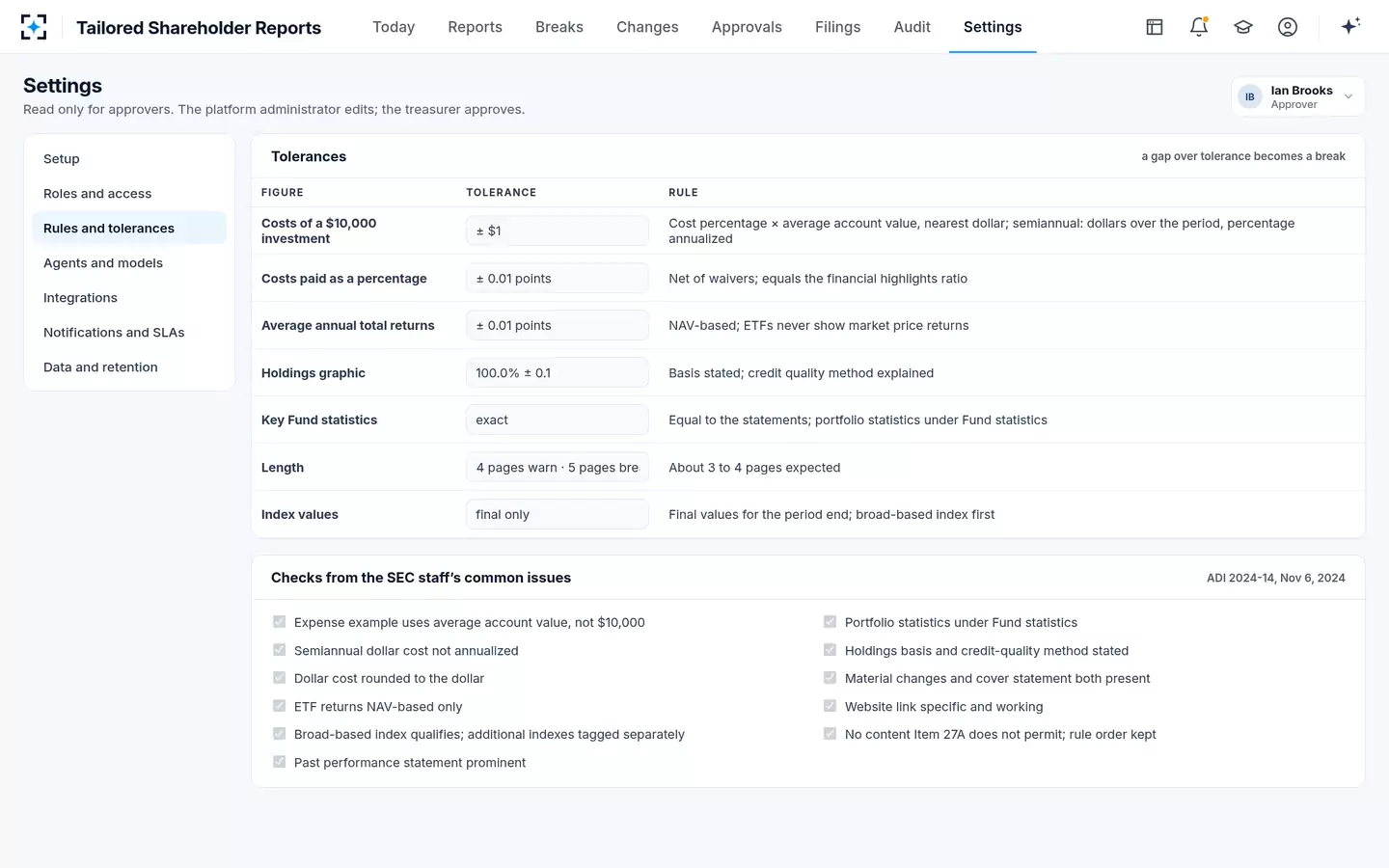
Before the index goes into a class report
- Run by an unaffiliated organization, or widely recognized and used
Instruction 6, first sentence.
- Represents the overall applicable equity or debt market for this fund
Not a sector, style, size or ESG subset.
- Regional or country index matches the fund's market
Broad for a regional fund, narrow for a global one.
- Municipal funds: national municipal index is acceptable
Staff FAQ 2, including single-state funds.
- No commodity index as the required comparison
Staff: not a securities market index.
- Dividends reinvested, no fund expenses deducted
Instruction 6, last sentence.
- Index changed? Reason given and both indexes shown
Instruction 8.
- Same index in the prospectus, the graph, the table and the text
Item 4(b)(2)(iii) and Item 27A(d)(2).
- Additional indexes tagged on the additional-index axis
The staff found funds tagging every index as broad-based.
The index sits inside a fixed report structure, set out in the tailored shareholder reports example, annotated line by line. To see the checks run on your own funds, start from Tailored Shareholder Reports.
Questions people ask
What is the broad based index definition in Form N-1A?
Instruction 6 to Item 27A(d)(2): an index "that represents the overall applicable domestic or international equity or debt markets, as appropriate", administered by an organization not affiliated with the fund, its adviser or principal underwriter unless widely recognized and used. The same definition applies to the prospectus performance table under Item 4(b)(2)(iii).
Can a fund use a blended index?
Only as an additional index. The release says a fund holding both equity and debt may show more than one appropriate broad-based index, and may add a blended index combining them "to supplement" the required index or indexes. The blended line cannot replace them.
Does an index fund that tracks a sector index still need a broad-based index?
Yes. Commenters argued that requiring a narrow-index fund to compare itself with a different, broad index could confuse investors; the SEC adopted the definition anyway and pointed to the permitted additional index, which for such a fund would be the index it tracks.
Does a money market fund need a broad-based index?
No. The performance discussion, including the graph and the index comparison, is required "unless the Fund is a Money Market Fund", which may include some or all of it voluntarily. The staff's ADI likewise describes the index comparison as a requirement for funds other than money market funds.
Who decides whether an index is broad enough?
The fund, applying the test to its own investments, usually through the adviser and counsel with the board aware of the choice. The SEC declined to publish a list of permitted indexes, and staff FAQ answers on regional and municipal indexes are staff views without legal force.
Do ETFs use market-price returns against the index?
No. The returns table in a tailored shareholder report is based on net asset value, and the staff said in ADI 2024-14 that ETFs' additional market-price returns are "not permitted to be included in the shareholder reports".