TSR material fund changes are the changes a tailored shareholder report must describe under Item 27A(g) of Form N-1A: any material change, since the beginning of the reporting period, to the fund's name, its investment objectives, its operating expenses or shareholder fees (including starting or ending a fee waiver or expense reimbursement), its principal investment strategies, its principal risks, or its investment adviser. When the report describes one, its cover must carry a bold sentence: "This report describes changes to the Fund that occurred during the reporting period." The description is required in the annual report and optional in the semi-annual one. In the first cycle the SEC staff found funds doing one half without the other, and the cause is usually upstream: the change sat in a prospectus supplement or a board minute that nobody re-read at report time. Botminds' Tailored Shareholder Reports reads the year's supplements, minutes and adviser agreements, proposes each candidate change with its source page, and leaves the decision on materiality to counsel.
From the year's documents to the bold sentence: who does what
Agent
Change watcherReads every prospectus supplement, board and committee minute and adviser agreement dated in the period, and lists candidate changes against the six Item 27A(g) topics, each with its source page.
Never: decides materiality.
A person decides
Fund counselReads each candidate beside its source and rules: material and described, not material, or material but already disclosed in the last annual report. Each ruling carries a reason code.
Agent
Drafting agentWrites the brief description and the legend pointing to the next prospectus, for every class report of the fund.
Never: adds content Item 27A does not permit.
Agent
Format and tagging agentChecks that the bold cover sentence appears if and only if part (g) has content, in every class report of the fund.
A person decides
Fund treasurerApproves the reports; certifies the Form N-CSR with the principal executive officer.
What counts as a material fund change? Six topics, one judgment
A material fund change, for a tailored shareholder report, is a material change to one of six items described in the fund's registration statement, occurring since the beginning of the reporting period. Item 27A(g) lists them by the prospectus item they come from, which is also the practical way to find them: look wherever those prospectus items were amended or supplemented during the year.
The six Item 27A(g) topics, and where a change to each usually shows up first
| Topic in Item 27A(g) | Prospectus item | Where the change is usually first written down |
|---|---|---|
| (1) The fund's name | Item 1(a)(1) | Board minutes approving the change; a prospectus supplement |
| (2) Investment objectives or goals | Item 2 | Board minutes; a shareholder vote where the objective is fundamental |
| (3) Annual operating expenses, shareholder fees or maximum account fee, including starting or ending a fee waiver or expense reimbursement | Item 3 | Expense limitation agreement with the adviser; a supplement to the fee table |
| (4) Principal investment strategies | Item 4(a) | Board minutes; a prospectus supplement |
| (5) Principal risks of investing in the fund | Item 4(b)(1) | A prospectus supplement, often following a strategy change |
| (6) The investment adviser, including sub-advisers | Item 5(a) | Advisory and sub-advisory agreements; board approval minutes |
The list is a floor, not a fence. The form lets a fund "describe other material changes that it would like to disclose to its shareholders or changes that may be helpful for investors to understand the fund's operations and/or performance over the reporting period." Whatever is described must give "enough detail to allow shareholders to understand each change and how each change may affect shareholders", and must be followed by a legend to the effect of "This is a summary of certain changes [and planned changes] to the Fund since [date]", pointing to the next prospectus and how to get it.
Do fee waivers count as material changes? Yes, starting or ending one
Yes. Starting or ending an expense reimbursement or fee waiver arrangement is named in the third topic, and the SEC added those words to the final rule on purpose: "Because the termination or introduction of an expense reimbursement or fee waiver arrangement can affect the fees that a shareholder pays, in a change from the proposal the final rules clarify that these are changes that should be disclosed" (Release 33-11125).
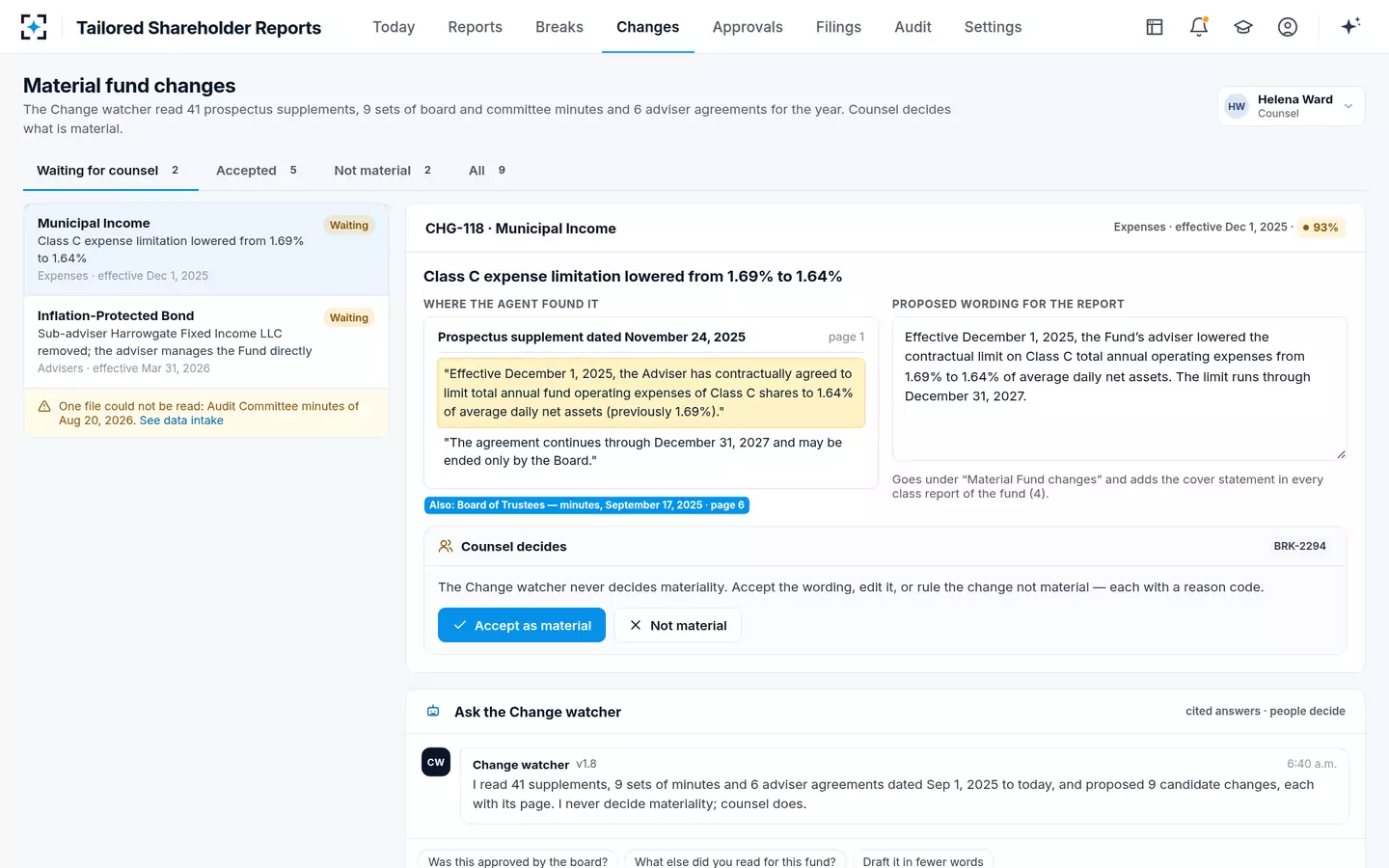
Decreases count as well as increases. The Commission agreed "that a fund should have to disclose any material change in fund fees, even those that do not result in fee increases", and that fee movements "of any kind, and irrespective of how the fees are characterized" are information retail investors find important in deciding whether to keep holding the fund. That is why a lowered expense cap is the commonest candidate in practice: in the solution's sample data, the adviser cut a Class C expense limitation from 1.69% to 1.64% from December 1, 2025, a change that also moves the class's costs paid as a percentage of a $10,000 investment. Examiners are looking in the same place: the SEC's fiscal 2027 priorities name "fund fees and expenses, including any related waivers or reimbursements" as a particular focus for registered funds (SEC Division of Examinations).
Is a portfolio manager change a material fund change?
Not by default. The SEC removed portfolio managers from the proposed list because, "Under many circumstances, shareholders may not consider portfolio manager changes to be material in their ability to understand the fund's operations and performance over the past year". A fund may still describe one, and the release gives the case where it might: a fund with "a single portfolio manager who is well-known in the industry and prominently identified in fund advertisements" might consider the change material.
Two other changes are deliberately handled elsewhere. A change of the fund's broad-based index is explained in the performance section under Instruction 8 to Item 27A(d)(2), so the SEC saw no need to add it to the list; the broad-based index test covers what that explanation needs. A change of accountants has its own part, (h). Neither triggers the bold sentence on its own.
How do you decide if a fund change is material? The SEC's factors
The fund decides, on the facts, using the same concept of materiality it applies everywhere else. The SEC declined commenters' requests to define a material change as one requiring a rule 485(a) post-effective amendment, reasoning that "The concept of materiality is a bedrock feature of the federal securities laws, and funds have extensive knowledge and experience in applying this standard in a wide array of contexts." It then listed factors a fund may weigh:
Factors funds may wish to consider include the nature of the change, whether it reflects a material change in the way the fund is currently being managed, whether it reflects a material change in the fund's risk profile, which section(s) of the prospectus the change affects, and how likely the change would be to influence a shareholder's decision to continue to invest in the fund.
SEC, Release 33-11125 (Oct. 26, 2022)
Two of the SEC's own examples, side by side
Likely material: The risk wording changes because the way the fund is managed changed. The release: "such a change would likely be considered a material change."
Likely not material: A fund heavy in one foreign country updates its country-risk wording after a political change. The release: "such a change would likely not constitute a material change."
Likely material: A change that alters the summary prospectus.
Likely not material: A change that only alters the statutory prospectus: the release notes a summary-prospectus change "is more likely to rise to the level of a material change".
Likely material: Introducing, ending or materially changing a waiver or reimbursement; any material fee movement, up or down.
Likely not material: Movements too small to influence a decision to keep holding the fund; a judgment for counsel, documented.
Where does the material changes statement go? Three places, one change
A described change appears in three places, and they must agree. First, the bold sentence on the cover or at the beginning of the report, under Item 27A(b)(5): "This report describes changes to the Fund that occurred during the reporting period", or a similar clear statement, in bold-face type. Second, the description itself, in part (g), after the holdings graphic and before any change of accountants. Third, the legend that closes part (g), pointing to the next prospectus and to where it can be requested.
The cover sentence was a late addition with a reason. The proposal had folded a reference to changes into the cover legend; the final rule dropped that phrase as "duplicative of the requirement under the final rules to include a separate legend highlighting that a shareholder report describes material fund changes, if applicable." The bold sentence is therefore conditional on content: it belongs on every class report of a fund whose report describes a change, and on none whose report does not.
Are material fund changes required in the semi-annual report? And what about planned changes?
Not in the semi-annual report. Item 27A(a) leaves part (g) off the semi-annual report's required list, though a semi-annual report "may contain" the annual report's other parts; a fund that includes it must follow the same instructions and the annual report's order, cover sentence included. The annual report must describe material changes since the beginning of its period, which means the annual report also picks up changes made during the first half-year.
Planned changes are optional too. The form says a fund "may also disclose, but is not required to disclose, material changes it plans to make in connection with updating its prospectus". The SEC dropped the proposed requirement because tracking changes made after the period end would create "certain operational challenges for funds". And a change already described in the last annual report, for example because it was planned and disclosed then, need not be described again (Instruction 3 to Item 27A(g)).
Leaving out material changes: the two ways funds got it wrong in the first cycle
The staff found both halves of the requirement failing separately. In ADI 2024-14: "We have observed that some funds disclose material fund changes while omitting the required cover page disclosure. Other funds include the cover page disclosure but do not include any disclosures about material fund changes." The first is a template problem, a cover built without the conditional sentence. The second is usually a stale template, a cover sentence carried over from a period that had changes into one that did not, or a description deleted in review without the cover being updated.
Both are mechanical once the judgment is made, which is why they are worth checking mechanically across every class report. The harder failure is the change never found: a fee cap lowered in a supplement in November, filed and forgotten by the time the annual report is drafted in October. That is a search problem across a year of documents, and it is the part people do least reliably under deadline.
A candidate change, its source and the proposed wording, waiting for counsel
Finding the changes: a year of supplements, minutes and agreements
The search is the part that scales with the fund family. In the sample family of 74 funds, the Change watcher read 41 prospectus supplements, 9 sets of board and committee minutes and 6 adviser agreements dated in the period and proposed 9 candidate changes: counsel accepted 5, ruled 2 not material and had 2 waiting on the day shown. One board document could not be read and was reported as missing rather than skipped. Each candidate arrives with the passage it rests on and the topic it falls under, so counsel's time goes to the ruling rather than to the search.
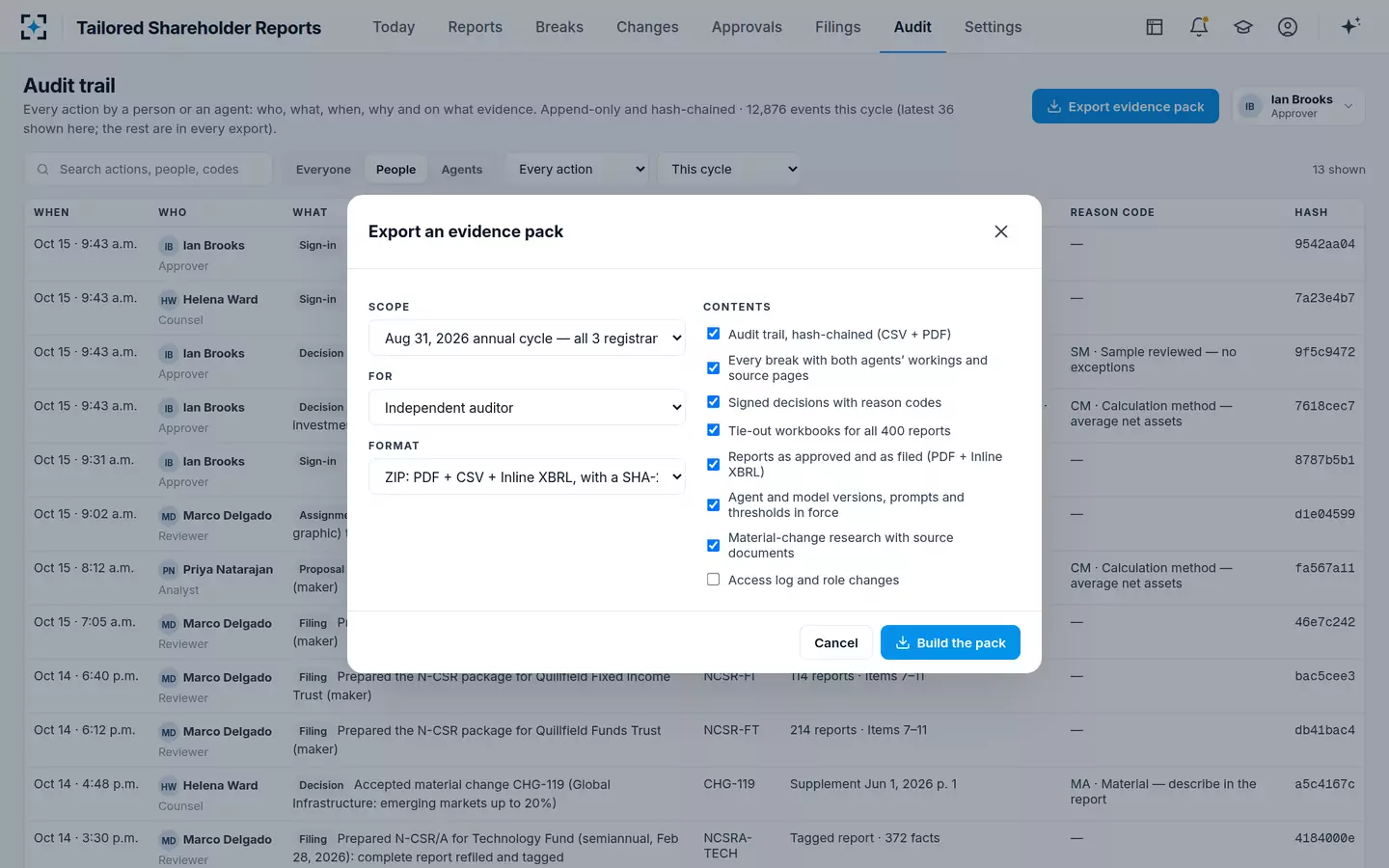
The agent's limit is the point of the design. Materiality is a legal judgment with a fact pattern behind it, and the release's factors, such as how likely a change is to influence a shareholder's decision to stay invested, are not something a text model should settle. The agent's job ends at a complete, cited list; counsel's ruling and reason code go on the audit trail, where an internal auditor or examiner can see who decided what, on which document.
Counsel's rulings on the audit trail, with reason codes
A material fund changes check before sign-off
- Every supplement, minute and adviser agreement in the period read
Including sub-advisory agreements and any document that failed to open.
- Each candidate mapped to one of the six topics, or marked as optional
Name, objectives, fees and waivers, strategies, risks, adviser.
- Counsel's ruling and reason on file for each candidate
Material, not material, or already described in the last annual report.
- Description explains the change and how it may affect shareholders
Brief, plain English, with the effective date.
- Legend points to the next prospectus and how to request it
Instruction 2 to Item 27A(g).
- Bold cover sentence present if part (g) has content, absent if not
On every class report of the fund.
- Fee changes agree with the costs line
A waiver change moves the expense ratio and the dollar figure too.
- Semi-annual: part (g) included only by choice, then in full
Same order, same cover sentence.
To see candidate changes found in your own fund documents, start from Tailored Shareholder Reports; the place of part (g) in the whole report is shown in the annotated report.
Questions people ask
Is a sub-adviser change a material fund change?
It can be. The sixth topic is a change in the fund's investment adviser, and the release describes it as including sub-advisers. Whether a particular change is material is the fund's judgment, but replacing or removing a sub-adviser that manages a significant part of the portfolio is the kind of change the topic was written for.
Does a change in the fund's index need the bold sentence?
Not on its own. A new broad-based index is explained in the performance section, with the reason for the change and both indexes shown, under Instruction 8 to Item 27A(d)(2). The SEC left index changes off the material changes list for that reason.
How long should a material change description be?
Brief: Item 27A(g) asks the fund to "briefly describe" each change and Instruction 1 asks for a "concise description" with enough detail to understand the change and its effect. In practice that means a few sentences per change, with the effective date.
If a change happened after the period end, must it be in the report?
No. The requirement covers changes since the beginning of the reporting period; planned changes connected with the next prospectus update may be included but are not required, and the SEC dropped a proposed duty to track post-period changes.
Does the material change also need a prospectus supplement?
The shareholder report does not replace the fund's prospectus obligations. Many changes on the list are first disclosed in a supplement or post-effective amendment, which is why those documents are where the search for candidates starts; the SEC declined to tie the report's test to rule 485(a) filings.
Who is responsible if a material change is missed?
The fund. The report is filed as Item 1 of Form N-CSR, which the principal executive and principal financial officers certify, and the fund's compliance program under rule 38a-1 covers its service providers, so a missed change is not shifted to whoever drafted the report.