XBRL tagging software providers sell the tools, and often the service, that apply Inline XBRL tags to a filing, validate them against the SEC's taxonomy and EDGAR rules, and produce the submission; for a mutual fund or ETF, that now includes every tailored shareholder report, which must be tagged in Inline XBRL when filed as Item 1 of Form N-CSR. A tagging tool answers whether the tags are well formed. It does not answer whether the tagged expense ratio equals the financial highlights, whether the dollar cost was computed on the average account value, or whether an additional index was tagged as the broad-based one, which is an error the SEC staff found in the first cycle. Those checks belong before and after tagging, against the fund's own statements. Botminds' Tailored Shareholder Reports sits there: it ties each figure to its page, proposes each figure's element and axis, and reads the tagged values back against the approved report, beside the tagging tool or provider a fund already uses.
Where each step sits, from closed books to the filing
1
Closed books and final data
Fund accounting, performance and index returns, custodian holdings, the year's documents.
Fund accounting, administrator
2
Draft and tie out
Each class report drafted in Item 27A order; every figure recomputed and tied to its page; material changes ruled on by counsel.
Agents, then people approve
3
Pre-assign the tags
Each figure mapped to its OEF element and axis: class member, broad-based or additional index, holdings category.
Agents propose; reporting team confirms
4
Tag, validate, render
The XBRL tagging software or filing agent applies the Inline XBRL and runs taxonomy and EDGAR validations.
Your tagging tool or provider
5
Compare tags with the approved report
Every tagged value read back and compared with the approved figure and its page; any mismatch is a break.
Agents, then the reporting manager
6
Certify, release, file
Two officer certifications; the treasurer releases; the filing agent submits Form N-CSR.
PEO, PFO, treasurer, filing agent
Do tailored shareholder reports need XBRL? Yes, Inline XBRL, since July 24, 2024
Yes. The SEC's 2022 rule requires funds "to tag the information in their shareholder reports using Inline XBRL structured data language", and the staff's FAQ sets the date: "The contents of shareholder reports included in Form N-CSR that are transmitted to shareholders on or after July 24, 2024 must be tagged using Inline XBRL" (staff FAQ, question 11). The requirement runs through rule 405 of Regulation S-T and the EDGAR Filer Manual, and Form N-CSR's general instructions require an Interactive Data File "to the extent required by Rule 405 of Regulation S-T" (Form N-CSR).
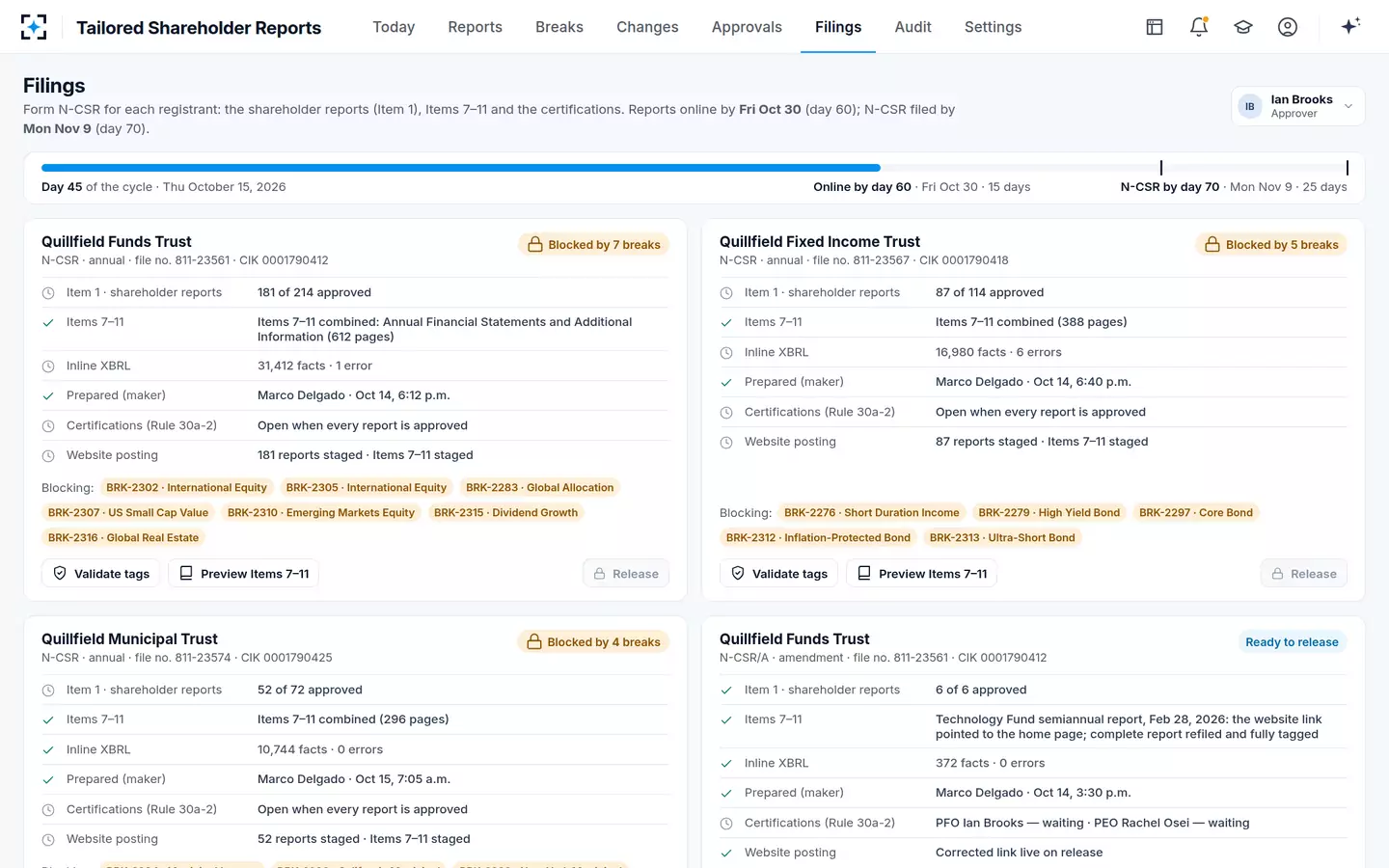
Funds were not new to the format. The release noted they were already "subject to Inline XBRL tagging requirements for other Commission filings--specifically, for the risk/return summary disclosure in their prospectuses" (Release 33-11125). What changed in 2024 is the volume: every class report of every fund, twice a year, with the class-level costs, returns and statistics as numeric facts. In the solution's sample family, the three registrants' annual filings carry 31,412, 16,980 and 10,744 tagged facts.
What is Inline XBRL, and what does the OEF taxonomy ask of a TSR?
Inline XBRL embeds machine-readable tags inside the human-readable HTML document, so the report a person reads and the data a machine reads are the same file. For fund shareholder reports the tags come from the SEC's Open-End Fund (OEF) taxonomy, whose "oef-sr" entry point covers Form N-CSR shareholder reports. The taxonomy's structure follows the rule's: "On a Form N-CSR, each share class will have its own shareholder report", so every fact carries at least a class axis, with members named after the class's EDGAR identifier (OEF Taxonomy Guide, March 2026).
The OEF elements behind the figures most likely to go wrong
| Report line | OEF element or axis | What to check before it is tagged |
|---|---|---|
| Which class the report covers | oef:ClassAxis, one member per class (named from the EDGAR class ID) | Every class report maps to the right class ID; no class missing |
| Costs of a $10,000 investment | oef:ExpensesPaidAmt (dollars) | Ratio × average account value, rounded to the dollar; semi-annual dollars not annualized |
| Costs paid as a percentage | oef:ExpenseRatioPct (percent) | Equals the financial highlights ratio; the right scale |
| The required index | oef:BroadBasedIndexAxis | Only indexes that represent the overall applicable market |
| Any other index | oef:AdditionalIndexAxis | Narrow, blended or second indexes, never on the broad-based axis |
| Fund statistics | oef:HoldingsCount, oef:AdvisoryFeesPaidAmt and related elements | Equal to the statements; advisory fees required in the annual report |
| Material fund changes | oef:MaterialChngDescriptionTextBlock, oef:MaterialChngDate | Present only if counsel ruled a change material; cover sentence agrees |
| Additional information link | oef:AddlInfoWebsite | The address lands on the class materials, and works |
The tagging error the SEC staff found: every index tagged as broad-based
The staff's first-cycle review gave the tagging section a single finding, and it is the kind validation cannot see. "We have observed that some funds are tagging all their indexes as broad-based indexes instead of tagging their additional indexes with the separate tag intended for additional indexes" (ADI 2024-14). Both tags are valid elements of the taxonomy; the error is in which one a given index belongs to, which depends on whether it passes the SEC's broad-based index test.
The consequence is in the data rather than the printed page. A reader of the paper report sees two index lines either way. A data user pulling every fund's required index from EDGAR gets the wrong comparison for every fund that tagged its narrow index as broad-based. The OEF taxonomy keeps the two on separate axes precisely so that the required comparison is machine-identifiable.
What XBRL tagging software providers check, and what they cannot
A tagging tool or provider checks the tags against the taxonomy and EDGAR's rules: valid elements, correct data types and units, well-formed dimensions, required facts present, and a rendering that displays every fact. Those checks matter, and EDGAR runs its own validations on every submission. The taxonomy guide notes that "Data validations specific to OEF may be added, altered, or removed from EDGAR validations", so the rule set moves with each taxonomy year.
Two different questions: is the tag valid, and is the number right?
What tag validation answers: The fact uses oef:ExpensesPaidAmt, in US dollars, in a class context.
What only a tie-out to the statements answers: The value is the ratio times the average account value, rounded to the dollar, and matches the printed report.
What tag validation answers: The fact is a percent, in a valid unit.
What only a tie-out to the statements answers: It equals the class's financial highlights ratio for the period, at the right scale.
What tag validation answers: Each index is a member of a valid index axis.
What only a tie-out to the statements answers: The index on the broad-based axis actually represents the overall applicable market.
What tag validation answers: Each class member is well formed.
What only a tie-out to the statements answers: Every class in the trust has a report, and each report's figures belong to that class.
What tag validation answers: The text block is tagged where it appears.
What only a tie-out to the statements answers: It appears only if counsel ruled a change material, with the bold cover sentence.
The product data offers two examples of the right-hand kind of error: an expense ratio tagged at the wrong scale and an index column left untagged. In the sample cycle, the Fixed Income Trust's filing showed six Inline XBRL errors and the Funds Trust's one. Both were counted on the filings screen and had to be cleared before release.
Who tags the shareholder report? Often someone outside the fund
Often a filing agent or tagging provider, especially for smaller fund groups. The SEC said as much when it costed the rule: "compared to smaller operating companies, smaller investment companies are more likely to outsource their tagging infrastructure to large third-party service providers" (Release 33-11125). Larger complexes may run tagging software in-house within the financial reporting team. Either way, the tags are filed under the fund's name and certified with the rest of Form N-CSR by its principal executive and principal financial officers.
The SEC estimated the setup at 18 hours per fund at a blended $381 an hour, $6,858 per fund or $81.2 million across 11,840 funds, and estimated no ongoing burden on the ground that funds already tagged other filings. That estimate predates the first cycle; it does not separately price the review of the tens of thousands of facts a family like the sample's files each cycle.
Where agents fit: before the tagging tool, and after it
Before tagging, agents make sure the numbers and their roles are right; after tagging, they make sure the tags still say what was approved. Tailored Shareholder Reports ties every figure to its page in the financial statements, recomputes the expense example and returns from raw class data, and proposes each figure's element and axis, such as which index belongs on the broad-based axis, for the reporting team to confirm. The tagging software or provider then does what it does well: apply the Inline XBRL, validate and render.
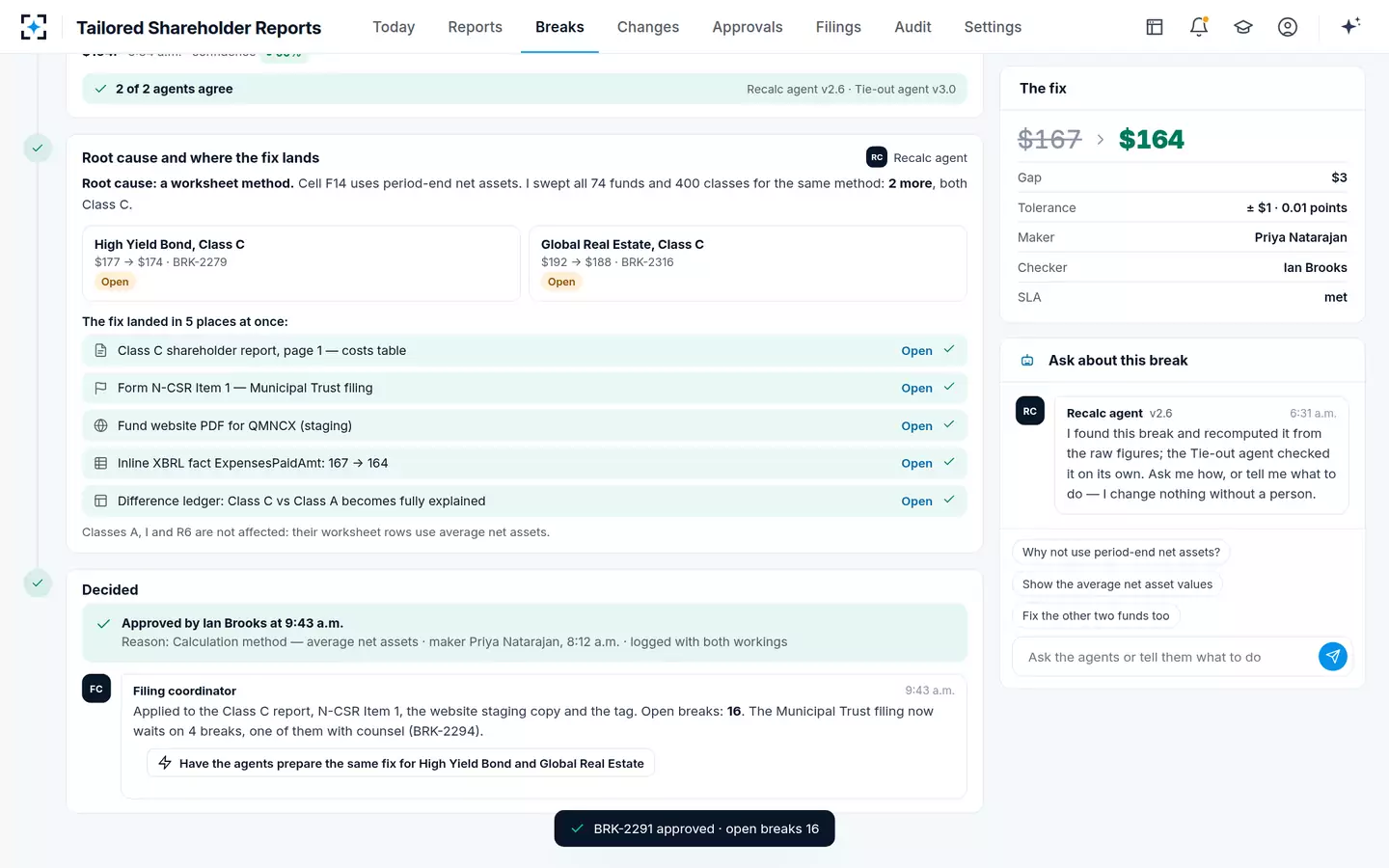
After tagging, the agents read every tagged value back and compare it with the approved report and its source page. A difference becomes a break with both values shown. When a figure is fixed, the approved fix is applied to the report, Form N-CSR Item 1, the website copy and the tagged fact together, which is the point at which manual processes most often drift apart. The $10,000 cost line shows one such fix travelling from the worksheet to the tag.
One fix, applied to the tagged fact as well as the report
Amendments: a corrected report goes back complete and tagged
A correction after filing is where tagging costs repeat. Asked whether a fund amending one class report in a multi-report Form N-CSR may re-tag and re-file only that report, the staff answered that "it would be reasonable in the staff's view for the Form N-CSR/A filing to include a complete version of the amended tailored shareholder report, with all elements of that shareholder report (not only those elements that have been amended) tagged in Inline XBRL" (staff FAQ, question 12). A one-figure error therefore costs a full re-tag of that class report, plus the review that goes with it.
In the sample data, one semi-annual report's website link pointed to the fund family's home page rather than the class materials; the amendment refiles that report complete and fully tagged, 372 facts, with both officers' certifications. Catching the same link before release would have cost a test of the link.
Inline XBRL facts and errors, per registrant, before release
Go-live over one cycle, beside the tool you already have
A fund does not need to change its tagging software or provider to add agents beside it, and the safest start is one reporting cycle. The plan below is illustrative, not a commitment: the order matters more than the durations, and the replay step uses the fund's own last filed cycle as the test.
An illustrative go-live across one semi-annual cycle
- Connect2
- Replay2
- Live season: agents beside the team and the tagging tool10
- Review1
The replay of last cycle is the step that decides the rest: it measures how often the agents agree with the figures the fund filed, and how many of the staff's common issues, the index tags among them, were sitting in last cycle's filings.
Questions to ask XBRL tagging software providers about tailored shareholder reports
- Which OEF taxonomy year do you support, and when do you update?
The SEC posts a new version each year: the 2026 guide is dated March 16, 2026, and 2027 taxonomy files were posted in September 2026.
- How do you separate broad-based and additional indexes?
The staff's one tagging finding in ADI 2024-14.
- How are class members created and checked against EDGAR class IDs?
One report per class; a missing class is a missing report.
- Can you import figures with their source pages, and export tagged values?
So tagged facts can be compared with the approved figures.
- What happens to tags when a figure changes after tagging?
A fix should reach the tag without re-keying.
- How do you handle an N-CSR/A for one class report?
The staff view: the complete report, fully tagged.
- Who owns validation errors, and what is the turnaround?
Inside a 10-day filing window after transmission.
- What do you not check?
Values against the financial statements, index eligibility, materiality.
To see the tie-out and tag comparison on your own filings, start from Tailored Shareholder Reports.
Questions people ask
What is the OEF taxonomy?
The SEC's Open-End Fund taxonomy, the set of Inline XBRL elements and axes funds use to tag prospectus risk/return summaries and, through its "oef-sr" entry point, the shareholder reports in Form N-CSR. The SEC staff publishes a taxonomy guide with each version; it describes the technical structure and does not interpret the rules.
What are the XBRL tagging requirements for a tailored shareholder report?
The whole report included in Form N-CSR Item 1 must be tagged in Inline XBRL under rule 405 of Regulation S-T and the EDGAR Filer Manual, for reports transmitted on or after July 24, 2024. Each class report is tagged with its class member, and required and additional indexes are tagged separately.
Is an XBRL tagging service the same as a filing agent?
Often the same firm offers both, but they are different jobs: tagging applies and validates the Inline XBRL, while the filing agent submits the Form N-CSR to EDGAR on the fund's behalf. Either way the fund is the filer, and its officers certify the filing.
Do the agents replace XBRL tagging software?
No. Tailored Shareholder Reports proposes each figure's element and axis and compares tagged values with the approved report, but a fund keeps its tagging tool or provider to apply the tags, validate them and produce the submission.
What happens if a tag disagrees with the printed figure?
The filing is internally inconsistent, and the tagged value is what data users and the SEC's systems read. In the solution, any such mismatch is a break that blocks release until a person approves the fix, which is then applied to the report, the filing, the website copy and the tag together.
Do the financial statements in Form N-CSR Items 7–11 need XBRL too?
The tailored shareholder report requirement covers the report in Item 1. The SEC considered requiring all of Form N-CSR to be tagged and listed it among the alternatives in the release; funds should confirm the current scope of rule 405 with their filing agent or counsel before each cycle.