The SEC tailored shareholder reports final rule, adopted on October 26, 2022 (Release No. 33-11125), requires every mutual fund and ETF registered on Form N-1A to send each shareholder a short annual and semi-annual report for the share class they own, written in plain English in an order the form prescribes, and to tag it in Inline XBRL. The full financial statements, which used to fill most of a report averaging well over a hundred pages, moved to Form N-CSR, a fund website and delivery on request. Open-end funds lost the option of mailing a notice with a link instead of the report. The rule took effect on January 24, 2023, and reports transmitted on or after July 24, 2024 had to comply. What it created is a volume problem: one document per class, each tied to the same financial statements. Botminds' Tailored Shareholder Reports drafts and ties out each class report and its Form N-CSR items for the fund treasurer who certifies them.
The rule by the SEC's own numbers
11,840
mutual funds and ETFs on Form N-1A that the SEC expected to be affected, December 2021
89%
of those funds relied on rule 30e-3 notice-and-access, which the rule took away from them
18months
from the effective date to compliance: January 24, 2023 to July 24, 2024
$22.3M
a year in printing, mailing and processing savings, the SEC's estimate
What does the tailored shareholder reports final rule require?
It requires a fund to replace its old annual and semi-annual reports with "concise and visually engaging" reports that highlight information "particularly important for retail shareholders to assess and monitor their fund investments on an ongoing basis", in the words of the SEC's fact sheet. The content is set by a new Item 27A of Form N-1A: a cover, the costs of a $10,000 investment, a short performance discussion with a ten-year graph and a returns table against an appropriate broad-based index, fund statistics, a holdings graphic, material fund changes, any change of accountants, and where to find more online.
Four structural choices sit behind that list. Each report covers one class of one series. The report may contain only what Item 27A requires or permits. Everything else that used to be in it, chiefly the financial statements, is filed on Form N-CSR and posted online. And the report is tagged in Inline XBRL, so its figures are machine-readable. Each of those choices has its own guide in this series; the annotated tailored shareholder reports example walks the parts in order.
The fund shareholder report before and after the rule
Before July 24, 2024: About 134 pages for the average annual report and 116 for the semi-annual, by SEC staff analysis.
From July 24, 2024: About 3 to 4 pages, the SEC's estimate; no page or word limit.
Before July 24, 2024: Often many series and every class in one book.
From July 24, 2024: One report per class of one series.
Before July 24, 2024: In the report.
From July 24, 2024: In Form N-CSR Items 7–11, on the website within 60 days, and sent free on request.
Before July 24, 2024: Most funds could mail a notice with a link under rule 30e-3.
From July 24, 2024: The report itself, on paper or electronically if the shareholder elected it.
Before July 24, 2024: A $1,000 investment, in two tables: actual return and a hypothetical 5%.
From July 24, 2024: A $10,000 investment, one row, in dollars and as a percentage.
Before July 24, 2024: An index run by an unaffiliated organization, unless widely recognized and used.
From July 24, 2024: The same, and it must represent the overall applicable equity or debt market.
Before July 24, 2024: Not tagged.
From July 24, 2024: Tagged in Inline XBRL.
Who has to comply with the tailored shareholder report rule, and who does not
Open-end management investment companies registered on Form N-1A must comply: mutual funds and ETFs, and money market funds too, which may leave out the performance discussion and portfolio turnover. The SEC counted 11,840 affected funds in December 2021, 9,396 mutual funds and 2,444 ETFs, with 29,046 authorized mutual fund share classes. Registered closed-end funds and the separate accounts that offer variable annuities are outside Item 27A; the fact sheet says the rule "will not affect the availability of rule 30e-3 for closed-end funds and management companies that offer variable annuity contracts."
Within a fund, the people who answer for it are named in other rules. Form N-CSR, where the report is filed, must be certified by the principal executive and principal financial officers under rule 30a-2, which in a fund complex usually means the president and the treasurer. The rule changed what they certify, not who certifies it.
When did tailored shareholder reports take effect? The dates that matter
The rule took effect on January 24, 2023, and the compliance date was July 24, 2024, after an 18-month transition the SEC chose over the 24 months some commenters asked for. The trigger is transmission: "all shareholder reports for funds registered on Form N-1A will have to comply with Item 27A of Form N-1A if they are transmitted to shareholders 18 months or more after the effective date." The staff's FAQ confirms the edge case: a report sent before July 24, 2024 but filed on Form N-CSR afterwards is filed as it was sent, because Form N-CSR Item 1 calls for "a copy of the annual report that was transmitted to shareholders".
From proposal to the first cycle, and what came after
- From proposal, Aug 5, 2020, to adoption, Oct 26, 202227 months
- From adoption to compliance, Jul 24, 2024 (effective Jan 24, 2023)21 months
- Compliance to the e-delivery proposal of Jul 16, 202624 months
Some parts had different clocks. The Inline XBRL requirement had the same 18-month transition; so did the advertising amendments, while the amendment to rule 156 on misleading fee statements applied from the effective date. Registration statements filed 18 months or more after the effective date had to use an index that meets the new broad-based definition.
What moved out of the report: Form N-CSR and the website
The financial statements, financial highlights, changes in and disagreements with accountants, proxy voting results, director and officer pay and the board's basis for approving the advisory contract moved to Form N-CSR, as Items 7 to 11. Rule 30e-1 now requires a Form N-1A fund to make those items "publicly accessible, free of charge, at the website address specified at the beginning of the report" no later than 60 days after the period end, and to keep them there until 60 days after the next period end (17 CFR 270.30e-1(b)). Complete portfolio holdings for the first and third fiscal quarters follow the same pattern, except for money market funds. For the fund accountant's side of that move, what the financial statements now carry and where, see tailored shareholder report requirements: what changed.
Anyone may ask for the moved material, and the fund must answer quickly: a paper copy or an electronic copy "within three business days after receiving a request". Form N-CSR itself is still filed within ten days after the reports are sent (rule 30b2-1(a); the Form N-CSR filing deadline guide works through that calendar). The staff's FAQ lets a fund answer Items 7 to 11 for several series in one combined document, which is why many funds post a single PDF, and the staff suggested calling it something more descriptive than "N-CSR".
Is rule 30e-3 rescinded? It was narrowed in 2022, and a 2026 proposal would remove it
Not yet. The 2022 rule did not repeal rule 30e-3; it took open-end funds out of it, so the notice-and-access route now serves registered closed-end funds and certain insurance separate accounts only (17 CFR 270.30e-3). The SEC's reason was that open-end fund shareholders should "directly receive the new tailored annual and semi-annual reports, either in paper or, if the shareholder has so elected, electronically", and it estimated that 89% of Form N-1A funds had been relying on the notice.
On July 16, 2026 the SEC proposed Regulation E-Delivery, which would "Rescind Rule 30e-3 under the Investment Company Act of 1940" and let firms deliver required documents, fund shareholder reports among them, electronically by default "without first obtaining their affirmative consent", subject to conditions (SEC fact sheet, Release 33-11430). Shareholders now on paper would get "two paper notices" before any switch, and paper would remain available free on request. The comment period closed on September 21, 2026, and the SEC's rulemaking page lists the release as a proposal with no final action (File No. S7-2026-25). Until a final rule is adopted, Form N-1A funds deliver the tailored report itself.
Inline XBRL and the advertising amendments that rode along
Two further changes came in the same release. The first is data: funds must tag the report "using Inline XBRL structured data language" under rule 405 of Regulation S-T, and the staff's FAQ ties the tagging to the same date as the rest of the rule: reports filed on Form N-CSR and sent on or after July 24, 2024. The tags make every class's costs, returns and statistics comparable by machine, and they make mismatches between the printed figure and the tagged one a new kind of error; where agents sit beside XBRL tagging software covers that work.
The second is advertising. The rule amended rules 482, 34b-1 and 433 so that fee and expense figures in fund advertisements and sales literature are "consistent with relevant prospectus fee table presentations and be reasonably current", and amended rule 156 to address fee representations that could be materially misleading. These amendments reach registered funds and business development companies generally, not only Form N-1A funds, and they belong to marketing review rather than shareholder reporting.
What the SEC proposed in 2020 and did not adopt
The 2020 proposal was larger than the rule. Its title included "Treatment of Annual Prospectus Updates for Existing Investors, and Improved Fee and Risk Disclosure", and the release says "we are not taking final action on several aspects of the proposal at this time": proposed rule 498B, which would have let funds stop sending annual prospectus updates to existing shareholders and rely on the shareholder report and change notices instead, and proposed amendments to prospectus fee and risk disclosure, including a definition of a principal risk.
Two proposed details also changed on the way. The proposal would have let a report cover all classes of a fund; the final rule requires one report per class, because "there is significant disclosure that varies among share classes, such as expenses and performance data." And it added a bold cover statement whenever a report describes material fund changes, with fee waiver changes named explicitly among the changes to describe; what triggers the bold sentence covers that part.
What did the tailored shareholder report rule cost? The SEC's estimates
The SEC put the industry's first-year cost of the new reports and their tagging at more than half a billion dollars and the ongoing cost at under $70 million a year, against about $22 million a year of transmission savings. These are the Commission's estimates at adoption, built from hours times a blended wage rate across 11,840 funds; they are not measurements. The SEC also said it could not quantify one effect of the per-class design, the extra cost of sending separate reports to shareholders who hold several series or classes, because it had no data on how many such shareholders there are.
What the SEC estimated the rule would cost and save, per fund and in total
| Item | Hours per fund | Per fund | All 11,840 funds |
|---|---|---|---|
| Annual report, first year | 72 | $27,432 | $324.8 million |
| Annual report, each year after | 10 | $3,810 | $45.1 million |
| Semi-annual report, first year | 36 | $13,716 | $162.4 million |
| Semi-annual report, each year after | 5 | $1,905 | $22.6 million |
| Inline XBRL tagging, first year | 18 | $6,858 | $81.2 million |
| Printing and mailing on request, each year | — | $500 | — |
| Transmission savings, each year | — | about $1,880 | $22.3 million saved |
The release also noted that the Office of Information and Regulatory Affairs designated the rules a "major rule" under the Congressional Review Act. A current view of the burden comes from the SEC's 2026 Paperwork Reduction Act notices, which estimate about 107 hours a year per open-end fund for rule 30e-1; the cost of a tailored shareholder report works those estimates through for a fund family and sets them beside printers and administrators.
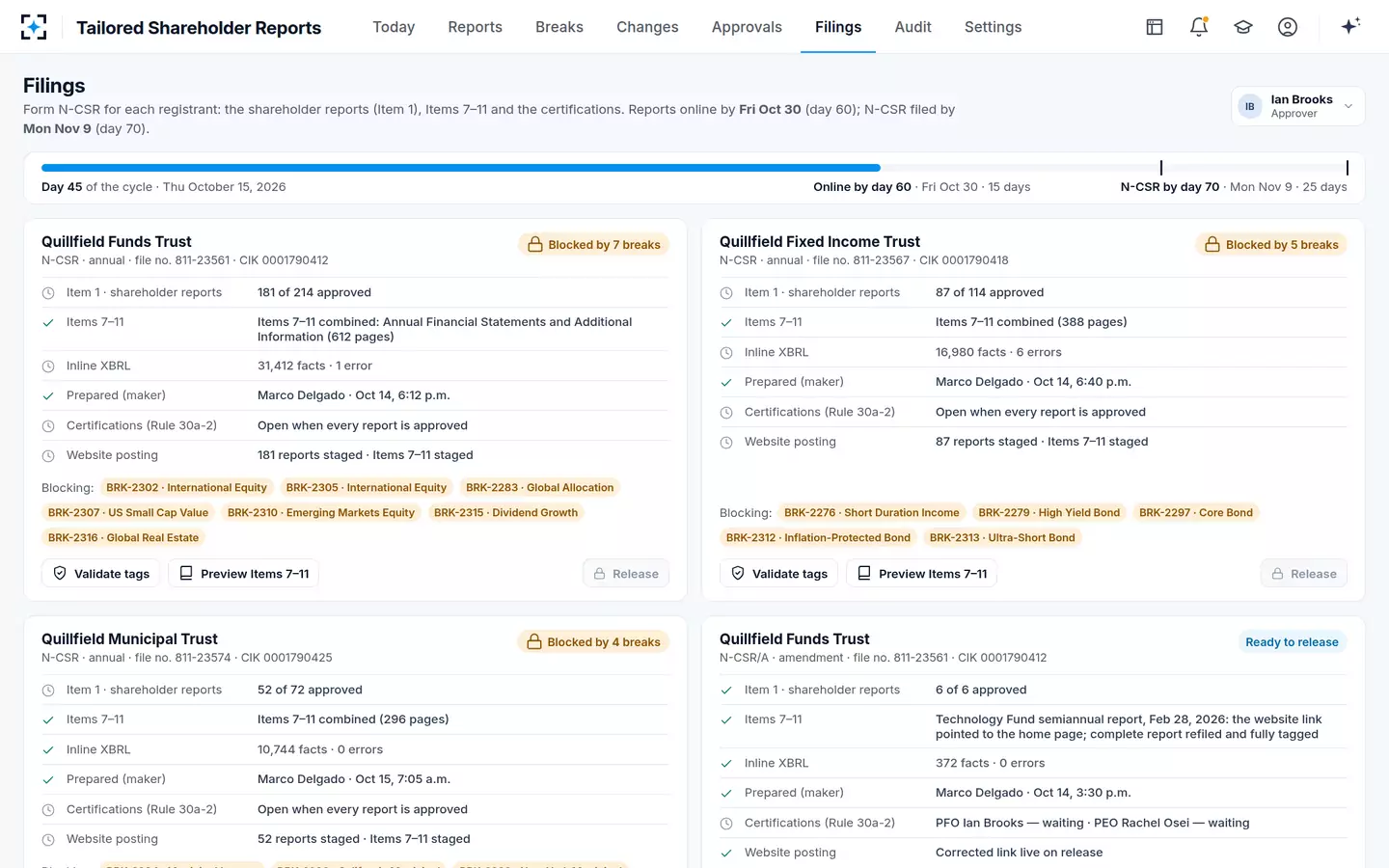
Each registrant's Form N-CSR: reports, Items 7–11, tags and certifications
Where Tailored Shareholder Reports fits the rule
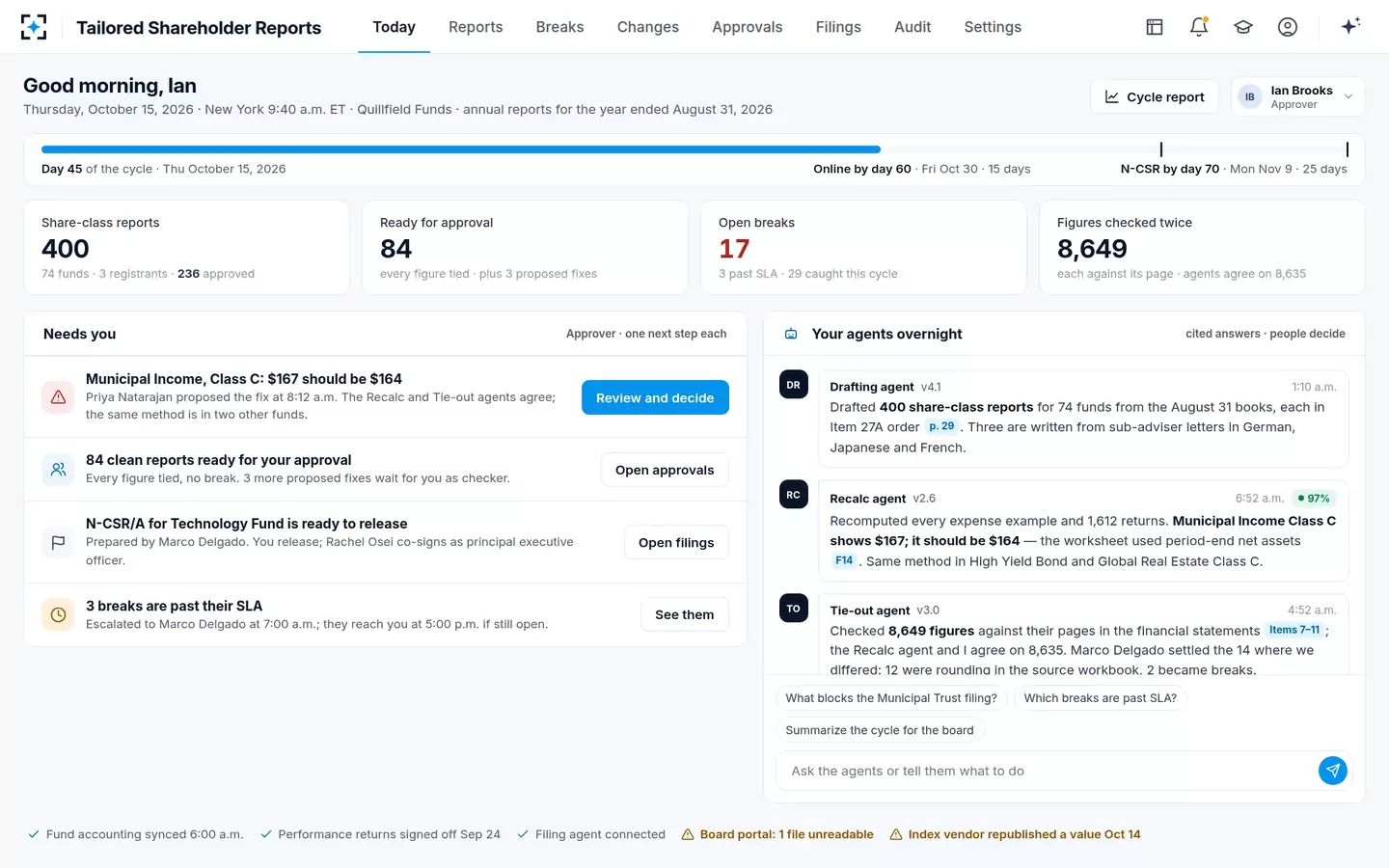
The rule split one long document into hundreds of short ones and a filing, and the risk moved with it: the hard part is no longer typesetting a book but keeping hundreds of class reports, their tags and Items 7 to 11 consistent with one set of financial statements inside a 60-day window. Tailored Shareholder Reports takes that part. Its agents draft each class report in Item 27A order, recompute every expense example and return from the raw class data, tie every figure to its page in the financial statements, search the year's documents for material fund changes, and check order, permitted content, links and Inline XBRL tags.
People keep the decisions the rule assigns to them. A fund administration analyst proposes each fix and the treasurer approves it; counsel rules on materiality; the principal financial and principal executive officers certify Form N-CSR; and the treasurer releases the filing to the filing agent. The solution does not print, mail or file on EDGAR, and it does not choose the fund's index.
The day-60 and day-70 clock, and one next step each
To see the rule's workload run on your own funds, start from Tailored Shareholder Reports.
Questions people ask
Where is the tailored shareholder report adopting release?
It is SEC Release No. 33-11125 (also 34-96158 and IC-34731), dated October 26, 2022, published at 87 FR 72758 on November 25, 2022, file number S7-09-20. The SEC's rule page lists it as a final rule effective January 24, 2023, with the compliance dates set out in section II.J of the release.
What is the tailored shareholder report compliance date?
July 24, 2024: Form N-1A funds' shareholder reports transmitted on or after that date must follow Item 27A, be tagged in Inline XBRL, and come with the new website and Form N-CSR requirements. The SEC staff's ADI 2024-14 states: "As of July 24, 2024, these new requirements apply to all fund shareholder reports."
Did the rule change the 60-day deadline?
No. Rule 30e-1 still requires each report to be transmitted within 60 days after the period end, and Form N-CSR is still due within 10 days after transmission. The rule added a parallel 60-day deadline for posting Items 7 to 11 of Form N-CSR on the fund's website.
Has the SEC changed the rule since 2022?
The SEC's page for the release lists no later amendments. The staff has issued guidance, a common-issues ADI in November 2024 and an FAQ last updated in January 2025, and the Commission proposed in July 2026 to rescind rule 30e-3 and allow default electronic delivery as part of Regulation E-Delivery, which remains a proposal.
Do ETFs follow the same rule as mutual funds?
Yes, ETFs registered on Form N-1A send the same reports, with two differences: an ETF identifies the principal US market where it trades, and it may include a premium and discount table unless it meets rule 6c-11's website conditions. Its returns in the report must be based on net asset value; the staff said market-price returns are not permitted.
Can a fund still send the old long report alongside the new one?
A fund may send other materials with the report, but the tailored report "must be given greater prominence" than most accompanying materials, and the long financial statements belong on Form N-CSR and the website. The report itself may contain only what Item 27A requires or permits.