Financial printer companies are the firms that compose, print and distribute regulated documents, and for a mutual fund or ETF that usually means typesetting each share class's tailored shareholder report, printing and mailing it to shareholders who receive paper, posting it, and often converting, tagging and filing Form N-CSR on EDGAR. They are one of three places the work can sit: the printer, the fund administrator's financial reporting team, or agents working beside the fund's own team. The SEC estimates the rule 30e-1 reporting work at 107 internal hours a year per open-end fund, plus $12,924 of outside costs, and those estimates are the only public baseline for comparing options; vendors don't publish comparable prices. Botminds' Tailored Shareholder Reports does not print or mail. It drafts and ties out each class report and Form N-CSR item before they reach the printer, which is where the cost of an error is decided.
What the SEC estimates shareholder reporting costs a fund
107hours
internal work a year per open-end fund under rule 30e-1, both reports
$580/hour
the SEC's blended attorney and programmer rate for those hours
$12,924
outside costs a year per open-end fund, on the same estimate
7.75hours
per Form N-CSR filing, twice a year, for 13,052 respondents
What does a financial printer do for a fund? The meaning in fund reporting
In fund reporting, a financial printer is a firm that turns approved content into the documents shareholders and the SEC receive. For a tailored shareholder report that typically means composing each class report to the fund's design, producing the website and e-delivery versions, printing and mailing paper copies to shareholders who have not chosen electronic delivery, and handling requests for paper copies. Many also convert filings to EDGAR format and apply Inline XBRL, either themselves or through a filing agent.
What a printer usually does not do is decide what the figures are. The class expense ratios, returns, statistics and holdings come from fund accounting and financial reporting, and the printer composes what it is given. That division matters for cost, because the printer's bill depends on page counts, versions and mail volumes, while the expensive errors are made upstream, in the figures. The SEC's own release noted that the costs of delivering shareholder reports, "including printing and mailing costs and processing fees, are generally fund expenses borne by shareholders" (Release 33-11125).
How much does a tailored shareholder report cost? The SEC's estimates
The only published estimates come from the SEC, and they come in two kinds. The current one is the Paperwork Reduction Act estimate for rule 30e-1, renewed in 2026: 107 internal hours a year per open-end fund at a blended $580 an hour, or $62,060, plus $12,924 of outside costs, across 12,709 open-end funds, for a total of 1,359,863 hours a year (91 FR 21585). The blended rate is the average of an attorney at $744 and a computer programmer at $416. The SEC notes that such estimates are "made solely for the purposes of the Paperwork Reduction Act and are not derived from a comprehensive or even representative survey or study".
The second kind is the adoption-time estimate of what the change itself would cost. The release estimated 72 hours per fund in the first year for the new annual report and 10 hours a year after, 36 and 5 hours for the semi-annual report, and 18 hours to set up Inline XBRL tagging, all at a blended $381 an hour. It added $500 a year per fund for printing and mailing documents requested on paper. Those figures are a change in effort, not the total effort, which is why the 2026 estimate is the better baseline for comparing options.
What did printing and mailing shareholder reports cost, and what did the rule change?
Before the rule, the SEC had estimated annual printing and mailing costs, including processing fees, of $20,707.33 per fund for a fund that mailed full reports rather than relying on rule 30e-3 notices. In adopting the rule it estimated that mailing a 3-to-4-page report instead of a long one would cut those transmission costs by 34% on average for such funds, about $7,040 a year, and by about 8%, or $1,243, for the 89% of funds that had been mailing notices instead. Across 11,840 funds, that came to about $22.3 million a year.
The saving was modest because most funds were already mailing short notices. What the rule added instead was work upstream: a report for every class, website posting of Form N-CSR Items 7 to 11 within 60 days, and Inline XBRL. For a printer, a class-level report means many more, shorter documents, each with its own version for paper, web and e-delivery. For the fund, it means many more figures to get right in the same 60 days. The SEC also said it could not quantify the added cost of sending separate reports to shareholders who hold several classes or series, for lack of data on how many there are.
The cost per class report, worked for a 74-fund family
Applying the SEC's per-fund estimates to a fund family gives a starting figure a treasurer can compare quotes and internal budgets against. The arithmetic below uses the solution's sample family, 74 funds producing 400 class reports a cycle. It is our arithmetic on the SEC's estimates, not a measured cost, and the per-report figure falls as classes per fund rise.
A cost per class report from the SEC's estimates, for the sample family
Funds (series) in the family
74
Sample family
Class reports a cycle; cycles a year
400; 2
Sample family: 800 class reports a year
Internal hours a year (SEC estimate per open-end fund × funds)
107 × 74 = 7,918 hours
Rule 30e-1 notice, April 2026
Internal cost at the SEC's blended $580 an hour
7,918 × $580 = $4,592,440
Attorney $744 and programmer $416, averaged
Outside costs (SEC estimate per fund × funds)
$12,924 × 74 = $956,376
Rule 30e-1 notice, April 2026
Total a year, on the SEC's estimates
$5,548,816
Not a measurement
Per class report
$5,548,816 ÷ 800 ≈ $6,936
Before any amendment or rework
Two features of the figure matter more than its size. First, roughly five-sixths of it is internal time, the hours the fund's own people or its administrator spend preparing and checking, and only a sixth is outside cost such as printing; on the SEC's split, a cheaper printer moves the smaller part. Second, the figure assumes the report goes out once. Every amendment repeats part of the work, and in a family where a wrong worksheet formula reaches every class built from it, one error can mean several amendments.
Financial printer companies, administrators or agents: the cost lines side by side
The three options carry different cost lines, and comparing quotes only on the printer's line misses most of them. No regulator or independent study publishes prices for these services, and vendors don't publish comparable ones, so the table compares what each option charges for and what it leaves with the fund.
Where the money goes under each option
| Cost line | Financial printer company | Administrator's reporting service | Agents beside the fund's team |
|---|---|---|---|
| Drafting class reports | Usually not; composes supplied content | Included in the service fee | Drafted by the agents; reviewed by the team |
| Tie-out of every figure | No | The service's proof review; the fund re-checks | Two independent checks, each figure linked to its page |
| Composition and versions | Per page or per document, by volume | Often passed through to a printer | Not included; approved files go to the printer |
| Printing, mailing, fulfilment | Per piece; depends on paper elections | Passed through | Not included |
| EDGAR filing and Inline XBRL | Often offered, or through a filing agent | Often bundled | Tags checked before filing; filing by the fund's agent |
| Internal review hours | Unchanged | Reduced, not removed: the officers still certify | Reduced to deciding breaks, ruling on changes and approving |
| Errors after filing | Reprint and refile, charged as new work | Usually rework by the service | Fewer expected, since checks run before release; each fix applied to every copy |
The cost no estimate includes: a report that has to be fixed
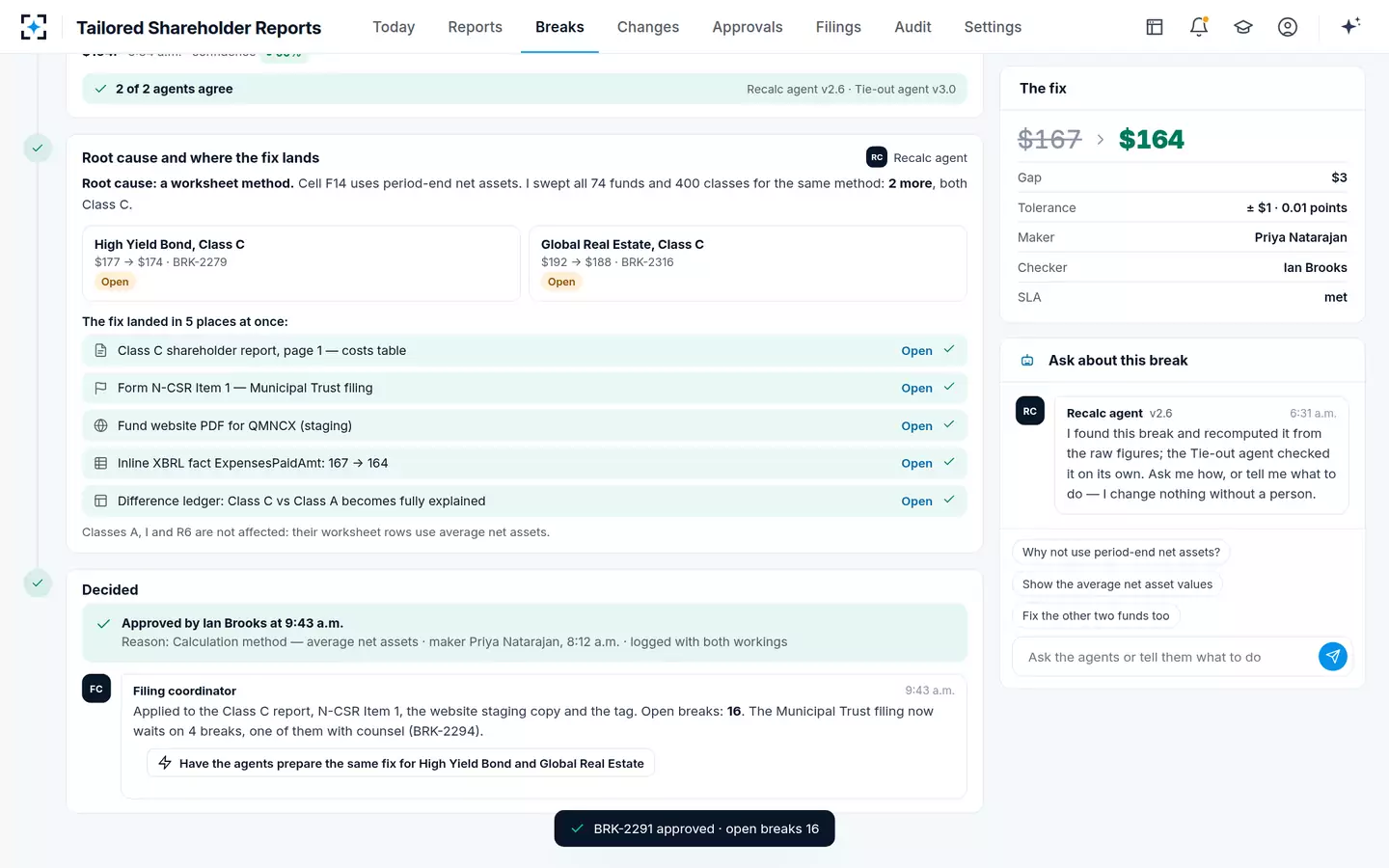
The SEC's hours assume a clean cycle; the expensive cycles are the ones that need a correction. A figure fixed after the reports are printed and filed has to change in several places: the class report, Form N-CSR Item 1, the website copy and the Inline XBRL fact, and possibly a reprint. For the filing, the SEC staff's view is that an amendment can reasonably carry the complete amended class report, re-tagged in full rather than only where it changed (staff FAQ, question 12), so a one-figure error becomes a whole-report refiling.
The sample data shows how errors cluster. In the fictional family's annual cycle, one class's expense example used period-end rather than average net assets, giving $167 instead of $164; the same worksheet method was then found in two more classes, $177 instead of $174 and $192 instead of $188. Caught before printing, each was one approved fix applied to four copies at once. Caught after filing, each would have been a reprint, a website correction and an amendment, and the previous annual cycle in the same sample ended with three amendments.
One approved fix, applied to the report, Form N-CSR, the website copy and the tag
How to measure the cost of a shareholder report yourself
Measure it per class report and per cycle, and include the rework. The SEC's figures are a public baseline, but a fund family's real cost depends on its classes per fund, its share of paper delivery, how its administrator and printer charge, and how often it amends. The method below needs only the cycle's timesheets and invoices.
Measuring your own cost per tailored shareholder report
- Count class reports, not funds
Two cycles a year; include new classes and mergers.
- Log internal hours by step for one cycle
Data, drafting, tie-out, counsel review, approvals, filing.
- Price internal hours at your own loaded rates
Or use the SEC's blended $580 as a placeholder.
- Split outside invoices by line
Drafting service, composition, print and mail, EDGAR and XBRL.
- Count corrections after filing and price them
Amendments, reprints, website fixes and the hours behind each.
- Note the day sign-off was ready
Days of margin before day 60 are what absorb a late surprise.
- Divide by class reports
Compare cycles, and compare options on the same basis.
Where Tailored Shareholder Reports sits beside a financial printer
Before the printer, not instead of it. The agents draft each class report in Item 27A order, recompute and tie out every figure, find material fund changes for counsel and check the tags; the treasurer releases approved reports to the fund's financial printer and website and the Form N-CSR to the filing agent. The question for a buyer is which of the internal hours in the SEC's estimate the agents remove, and Botminds' own estimate for a mid-size family's annual cycle is shown below. It is an estimate, not a measured result, and a fund can test it on a replay of its own last cycle.
Botminds' estimate of staff days in an annual cycle, by hand and with the agents
| Step | By hand | With the agents |
|---|---|---|
| Filling the data template for every fund and class | 20 | 2 |
| Performance commentary from portfolio managers and sub-advisers | 25 | 10 |
| Finding material fund changes in supplements and minutes | 20 | 5 |
| Re-tying every figure to the financial statements | 15 | 4 |
| Inline XBRL tagging, order and length checks | 10 | 3 |
| Approvals, certifications and the Form N-CSR | 10 | 5 |
| Total staff days | 100 | 29 |
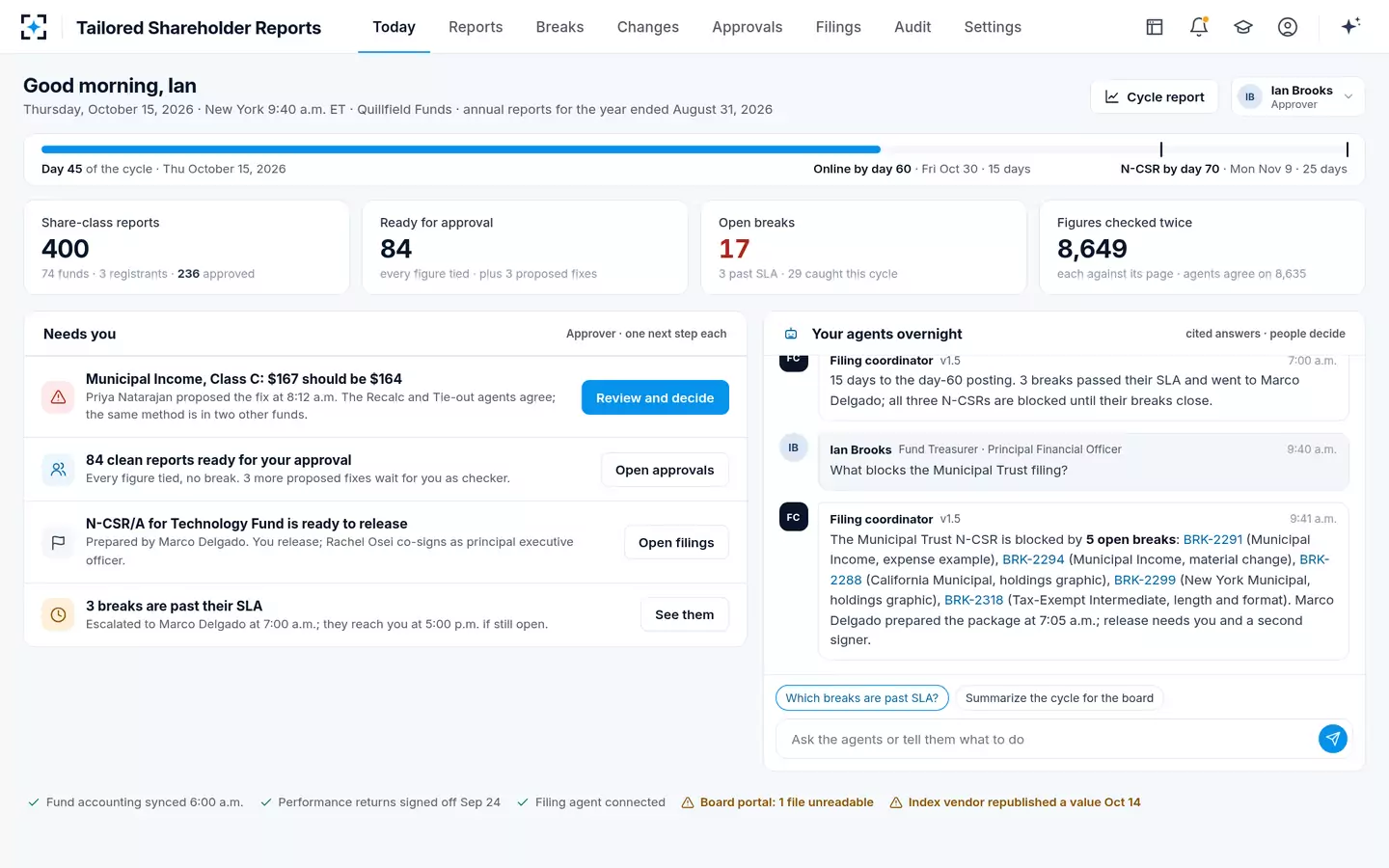
A cycle summary for the board, answered with its sources
To compare the options on your own classes and invoices, start from Tailored Shareholder Reports.
Questions people ask
What are financial printers in fund reporting?
Firms that compose, print, distribute and often file regulated documents such as prospectuses and shareholder reports. For a mutual fund or ETF, the printer typically produces each class's report in paper, web and e-delivery versions and handles mailing and requests for paper copies.
Do financial printers check the numbers in a shareholder report?
Generally they compose what the fund or its administrator supplies; the figures are the fund's responsibility and are certified by its principal executive and principal financial officers on Form N-CSR. A printer's proofs are a check on layout and transcription, not on whether the expense ratio matches the financial highlights.
What is the SEC burden estimate for rule 30e-1?
In its April 2026 notice the SEC estimated 107 internal hours a year per open-end fund at a blended $580 an hour ($62,060), plus $12,924 of outside costs, across 12,709 funds: 1,359,863 hours a year in total. The estimate is for Paperwork Reduction Act purposes and is not derived from a representative survey.
Did tailored shareholder reports lower printing costs?
The SEC estimated savings of about $22.3 million a year across all funds in printing, mailing and processing, about 34% for funds that had mailed full reports and 8% for those that had mailed notices. It also expected new costs elsewhere: class-level reports, website posting and Inline XBRL.
How many funds need tailored shareholder reports?
Every open-end fund on Form N-1A. The SEC's registered fund statistics for March 2026 counted 8,117 mutual funds and 4,829 ETFs (SEC Analytics Office), each sending a report per share class twice a year.
Can agents replace the administrator's reporting service?
They can take over the drafting and checking a service does, if the fund wants that work in-house, but not the fund accounting itself, the printing or the filing. A family can also keep its administrator and printer and use agents to check and tie out what the service drafts before it reaches the treasurer.