Fund manager commentary is the portfolio manager's own account of why a fund did what it did, and it has a known lean: good results tend to be explained by the manager's decisions and bad ones by the market. A study of mutual fund shareholder reports found managers were 40.6% more likely to attribute contributors than detractors to internal factors (Wang, SSRN working paper, 2023). The habit matters because readers act on the explanation, and because in a benchmark-relative attribution almost every effect is a decision, the losses included. Botminds' Portfolio Commentary Generation drafts commentary in which each causal claim is tied to an attribution effect and to a source for its cause, so a CIO or compliance reviewer can see whether the account is symmetric before the PM signs it.
The worked example on this page uses a fictional manager, Quillfield Capital, and its Global Core Equity strategy in a third-quarter 2026 cycle run through the solution on sample data. Where a study is a working paper rather than a published one, the text says so.
The seven largest effects of one quarter: every one a decision, the two losses too
What is fund commentary, and what makes it fund manager commentary?
Fund commentary is the written explanation of a fund's performance over a period, published in shareholder reports, on factsheets and in client letters. It becomes fund manager commentary when it speaks in the manager's voice: "we added", "our overweight", "we remain". That voice is what readers value, because it promises the reasoning of the person who made the decisions, and it is also what makes the explanation partial, because the person explaining the result is the person being judged by it.
Mutual fund commentary has a regulatory home. The US annual shareholder report must summarize the key factors that materially affected performance, and the factors it names explicitly include the adviser's own investment strategies and techniques, beside market conditions (Form N-1A, Item 27A(d)(1)). Hedge fund commentary usually arrives as a quarterly letter to investors, with its own rules and conventions, which the Quarterly Investor Letters solution covers. Institutional mandate letters sit between the two. In each, the manager explains a result in which the manager's own choices are the main subject.
What is self-attribution bias?
Self-attribution bias is the tendency to credit success to one's own ability and failure to circumstances. Organisational researchers have studied causal reasoning in corporate annual reports at least since Bettman and Weitz's 1983 study in Administrative Science Quarterly, and the question for fund commentary is narrower: does the pattern show up in what portfolio managers write to their shareholders, and does it matter?
Two working papers go straight at fund managers. One, using how far a fund's holdings depart from its index as a measure of a manager's confidence, finds that "the average mutual fund manager tends to boost his confidence to a larger extent after receiving confirming public signals than to decrease it after disconfirming public signals", and that the bias is stronger among inexperienced managers (Choi and Lou, SSRN working paper, 2010). The other reads the commentary itself.
What one study of fund shareholder reports found
40.6%
more likely to attribute contributors than detractors to internal factors
More
trading and risk-taking the next period at funds with stronger bias, which hurt their performance
Poor
performance is the only time biased attribution was found to move flows
The evidence from mutual fund shareholder reports
The 2023 study built a language-model pipeline to read the performance discussions in mutual fund shareholder reports and classify each explanation of a contributor or detractor as internal or external to the fund's management. On average, it found, managers "are 40.6% more likely to attribute performance contributors versus performance detractors to internal factors" (Wang, 2023). The bias was larger after good performance.
Two further findings make the pattern a governance question rather than a matter of tone. Funds that displayed stronger self-attribution traded more and took more risk in the following period, and that hurt their performance. And the study concludes that biased attribution "likely stems from cognitive bias rather than strategic choices". If that is right, telling managers to be more balanced will not fix it; a process that checks every causal claim against the numbers will.
The study is a working paper and has not been through peer review, and its classifications depend on how a model reads text. Treat it as a strong signal rather than a settled fact; its value is that it measures the tendency where it matters here, in the commentary a fund sends its shareholders.
Does fund commentary affect flows?
Yes, according to peer-reviewed research on shareholder letters: tone moves money, and dishonesty is punished. Hillert, Niessen-Ruenzi and Ruenzi analysed the writing style of mutual fund shareholder letters and found that a less negative tone leads to higher net flows, so letters can be used tactically, but that communication inconsistent with the fund's actual performance reduces flows. They also found that a positive writing style predicted more idiosyncratic risk and more style bets, and no consistent ability to predict future performance (Management Science, 2025).
Read with the self-attribution evidence, the implication is uncomfortable for a commentary process that leaves explanations unchecked. A manager's natural lean toward crediting skill produces a more positive tone, which may attract money in the short run, while the same research suggests investors eventually discount accounts that do not match the numbers. A commentary whose causal claims are tied to the attribution protects the firm on both counts: it can be positive when the numbers are, and it cannot be caught out when they are not.
Why "the market hurt us" is rarely an explanation of relative performance
In a benchmark-relative attribution, the market's own move is already in the benchmark return, so it cannot explain the difference between fund and benchmark. What explains the difference is how the portfolio departed from the index: which sectors it held more or less of (allocation), which stocks it chose within them (selection), and whether it hedged currency. Every one of those is a decision. A full Brinson-Fachler report, cell by cell, shows where each effect comes from.
Take the sample quarter. Energy was the index's strongest sector, up 9.57%, and the portfolio held 2.6% in it against 4.4% for the index. The 11 basis points that cost are not the oil market's doing; they are the price of an underweight the manager chose. Health Care cost 24 basis points through selection, mostly one biotechnology holding that fell 18.2% after a delayed trial readout: a stock the manager picked. A commentary that says "Energy's rally was a headwind" and "biotech sentiment weighed on Health Care" describes real events and still misattributes the result, because it presents decisions as weather.
The same logic cuts the other way. Industrials selection added 38 basis points, led by Vossberg Antriebstechnik, which rose 21.4% after raising its full-year guidance. The manager chose to own Vossberg, and that choice is fairly credited. Whether owning it was skill or luck is a question one quarter cannot answer, and the commentary should not pretend to: it can say what was owned and what happened, and leave the claim of insight out.
The same quarter, explained two ways
Self-serving: wins as skill, losses as weather: Our disciplined, research-driven stock selection in Industrials was rewarded, led by our high-conviction position in Vossberg.
Tied: each claim to its effect and its source: Stock selection in Industrials added 38 basis points, led by Vossberg Antriebstechnik, which rose 21.4% after raising its full-year guidance on August 6.
Self-serving: wins as skill, losses as weather: Health Care faced a difficult environment as biotech sentiment weakened.
Tied: each claim to its effect and its source: Stock selection in Health Care cost 24 basis points, chiefly Orrelle Biotherapeutics, which fell 18.2% after a delayed trial readout.
Self-serving: wins as skill, losses as weather: A sharp rally in energy stocks, driven by oil, was a headwind for relative returns.
Tied: each claim to its effect and its source: Our underweight in Energy cost 11 basis points as the sector rose 9.57% with oil prices.
Self-serving: wins as skill, losses as weather: Currency movements also had an impact.
Tied: each claim to its effect and its source: Currency added 9 basis points, mainly from the yen’s 4.1% rise against the dollar.
How do you check a manager's explanation?
Check each causal claim in three steps: does the effect it explains exist, with the sign and type the sentence implies; does a source support the cause it gives; and are contributors and detractors explained with the same kind of cause? A reviewer, a consultant or a CIO can run the test with nothing more than the attribution report and the commentary side by side.
Five common claims in fund manager commentary, and the test for each
| The claim | What it implies in the attribution | The check |
|---|---|---|
| “Our stock selection drove outperformance” | A positive selection effect that is most of the active return | Selection total positive and larger than allocation; name the sectors where it came from |
| “Market headwinds weighed on returns” | Usually a negative allocation or selection effect, both decisions | Find the effect; rewrite as the decision it measures (an underweight, a stock choice) |
| “Our overweight in X contributed” | A positive allocation effect in sector X | Allocation, not total effect: in the sample, 9 basis points, not the sector total of 12 |
| “Holding Y was the largest contributor” | Y’s contribution or its share of a selection effect | Y’s return and weight from portfolio accounting; the reason from Y’s own release |
| “Our process held up in a difficult quarter” | Nothing measurable | Delete, or replace with the effect that shows it |
The symmetry test is the one most often skipped. Count the causes: if contributors are explained by "our research", "our discipline" or "our conviction" and detractors by "the market", "sentiment" or "the environment", the commentary leans, whatever its numbers. A balanced version explains both in the same terms: what was owned, how much, and what happened to it.
Reading commentary across quarters: the pattern that gives the lean away
One commentary rarely proves a lean; four consecutive ones usually show it. A consultant or CIO reading a manager's commentary over a year should track two things for each quarter: the sign of the active return, and the share of explanations that credit the manager's own decisions. If the share rises in good quarters and falls in bad ones, the explanation is following the result rather than the decisions. The 2023 study found exactly that shape across funds: more self-attribution after higher performance.
A second tell is vocabulary that changes with the sign. Winning quarters bring "conviction", "discipline" and "our research"; losing quarters bring "headwinds", "rotation" and "a challenging environment". The underlying decisions, overweights and stock choices, do not change category when they stop working. A useful exercise is to rewrite a losing quarter's commentary in the winning quarter's vocabulary, and see whether it still reads as true.
A third is what disappears. A holding that was the largest contributor two quarters ago and is now the largest detractor should appear in both commentaries. If it appears only in the good one, the reader has been told half of the story of that decision. The working papers behind the attribution, which an adviser must keep for every performance figure it publishes, make this check possible for anyone with access to them.
None of this needs a model to run, but it needs the attribution and the commentary side by side for every quarter, which is exactly what a commentary process that ties each sentence to its cell produces as a by-product.
What the rules ask: key factors, fairly presented
No rule forbids a manager from claiming credit, but several make an unbalanced explanation a compliance problem. The US annual report asks for the key factors that materially affected performance, which includes the factors that hurt it; a commentary that explains every contributor and none of the detractors has left key factors out. When commentary is used as an advertisement, the SEC's marketing rule bars presenting specific investment advice or performance results in a way that is not fair and balanced, and statements of material fact the adviser cannot substantiate (17 CFR 275.206(4)-1(a)).
"Members and Candidates must not knowingly make any misrepresentations relating to investment analysis, recommendations, actions, or other professional activities."
CFA Institute Standards of Professional Conduct, I(C) Misrepresentation
For a CFA charterholder, the professional standard reaches further: presenting a decision as an external event is, at the margin, a misrepresentation of the manager's actions. If the 2023 study is right that the lean is cognitive rather than strategic, most of it is not knowing at all. That is the case for checking it systematically rather than relying on the writer's or the manager's intentions.
How Portfolio Commentary Generation keeps the explanation honest
The solution's design treats every causal claim as something to be proved. The Drafting agent plans each commentary from the signed-final attribution: performance, what drove it, what the manager did, how the portfolio is positioned. It must give a source for every reason and may not write a view the PM has not written. Detractors are drafted from the same effects table as contributors, so a sizeable loss cannot be left out without someone deciding to leave it out.
Every causal sentence drawn to its cell: winners and losers alike
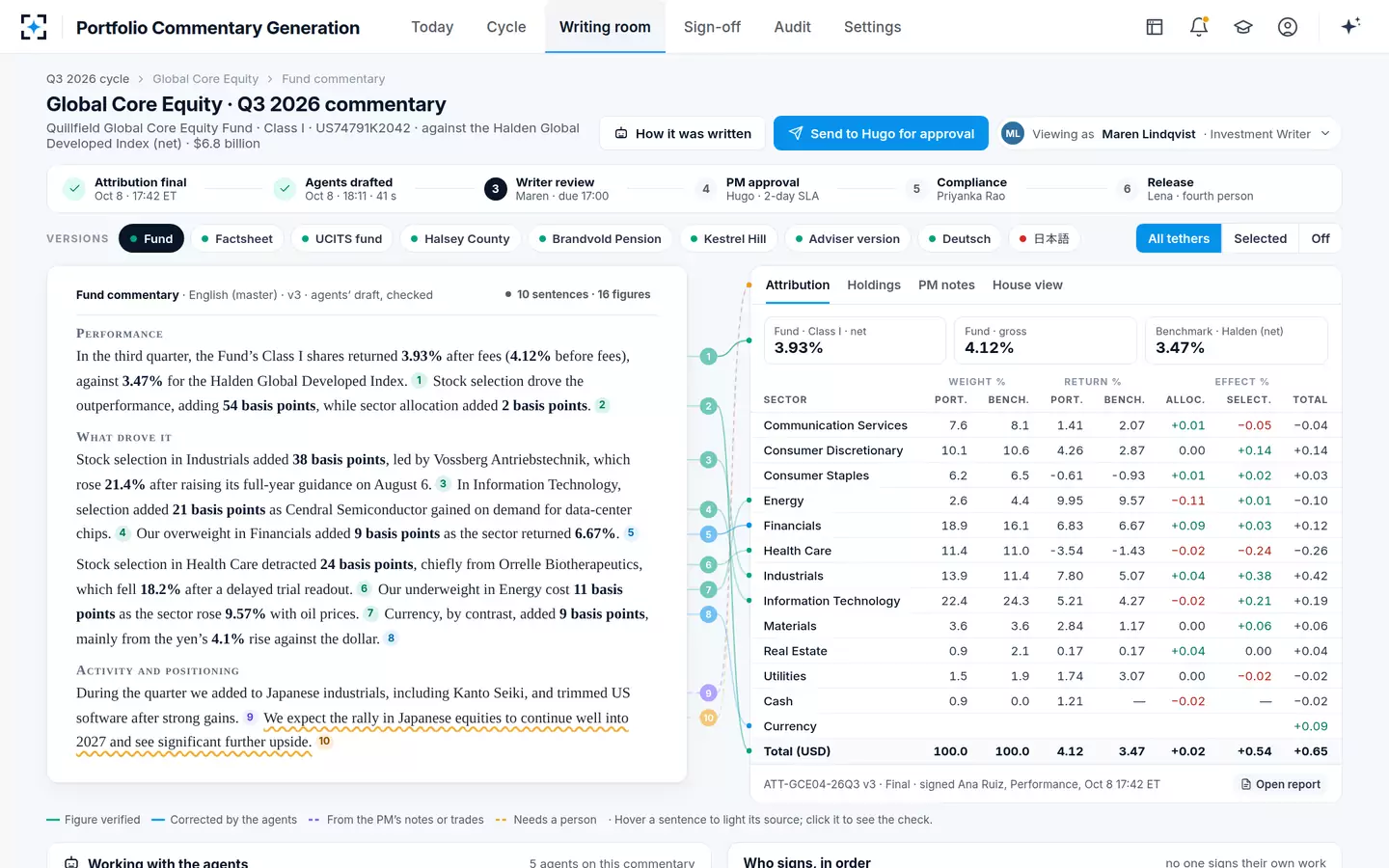
A separate Fact-check agent then tests each claim: the effect's value, unit, sign and type, and the source of the cause. In the sample draft it caught the Financials overweight credited with 12 basis points, which was the sector's total effect; allocation alone was 9. The Tone checker compares the views with the house view and flags lines that predict performance, but leaves the manager's view to the manager.
The PM's own words, re-checked before they are saved
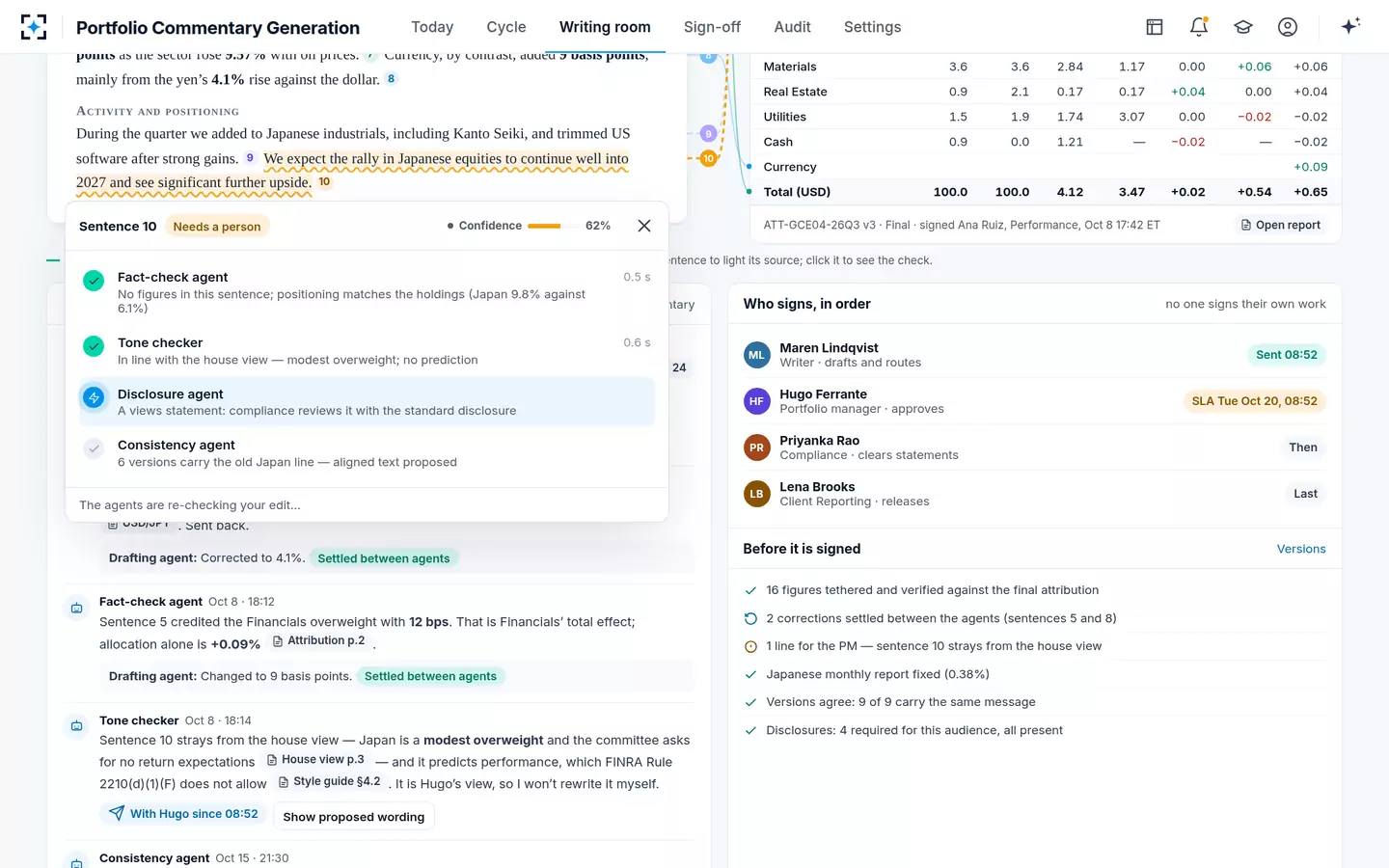
What the agents cannot do is decide whether a result was skill. That judgement belongs to the CIO, the board and the investor, over many quarters. A commentary that ties every claim to its effect gives them a clean record to judge from. To see the drafting and the checks on your own attribution, start from Portfolio Commentary Generation; how one figure is followed from the attribution into every version is shown in financial commentary examples, one figure at a time.
Questions people ask
What is hedge fund commentary?
It is a hedge fund manager's periodic account of performance and positioning, usually sent as a monthly or quarterly letter to investors. It answers to the anti-fraud rule for pooled investment vehicles, which forbids untrue or misleading statements to any investor or prospective investor, and it becomes subject to the marketing rule if it offers new services. The same symmetry test applies: explain losses as the decisions they were.
Where can I find mutual fund commentary?
In the fund's annual shareholder report, where US funds must include a management's discussion of fund performance, and usually on the fund's website as a quarterly commentary or factsheet paragraph. The annual report's version is filed with the SEC on Form N-CSR; the website versions are marketing materials with their own review.
Do upbeat commentaries predict better performance?
The evidence says no. In the peer-reviewed study of shareholder letters by Hillert, Niessen-Ruenzi and Ruenzi, a positive writing style predicted more idiosyncratic risk and more style bets but showed no consistent predictive power for future performance. Read tone as information about the manager, not about next year's returns.
Can a manager blame the market for underperformance?
Not for underperformance against a benchmark, which already contains the market's move. A relative loss comes from allocation, selection or currency choices; the commentary should name the choice. The market's move can explain absolute returns, which is why a commentary should be clear about which one it is discussing.
Who writes fund manager commentary?
Usually an investment writer or product specialist drafts it from the attribution and the manager's notes, and the portfolio manager edits and approves it. In larger firms compliance then reviews it before release. The manager's signature means the explanation is the manager's, whoever typed it.