Automated commentary generation succeeds or fails on one behaviour: whether the portfolio manager edits the draft or rewrites it. A PM who rewrites has turned the tool into an extra step; a PM who reads a change summary, rewrites only his own view and signs has turned a two-hour task into a short review. That shift comes from trust built in rungs: figures the PM never has to check, the PM's own notes visibly used, a voice that sounds like the house, and the PM's final word on every view. Research on algorithm aversion points the same way: people use imperfect algorithms far more readily when they can modify the output (Dietvorst, Simmons and Massey, Management Science, 2018). Botminds' Portfolio Commentary Generation is built so that the PM controls the one part that is his, and the agents prove everything else.
The examples come from a fictional manager, Quillfield Capital, and its portfolio manager for Global Core Equity, in a third-quarter 2026 cycle run through the solution on sample data. The rollout timings are our suggestion, not a measured result.
The trust ladder over two quarters: what the PM sees, and what the PM still decides
- Setup and shadow run on a published quarter6 wk
- Live: figures tethered, PM reads every line7 wk
- Notes visibly used; voice tuned6 wk
- Change summary, edit, sign7 wk
What is automated commentary generation?
Automated commentary generation is software that writes the narrative around data: what changed, by how much, and why. Business intelligence tools offer it for dashboards, describing a chart in sentences, which is what most searches for "power bi automated commentary" are after. Fund commentary asks more. It must explain decisions rather than describe numbers, cite a source for every cause, carry the portfolio manager's views in his own words, and pass compliance. A sentence such as "Revenue rose 4% quarter on quarter" is a description; "Our underweight in Energy cost 11 basis points as the sector rose 9.57% with oil prices" is an explanation someone signs.
That is why adoption is the real project. A dashboard narrative is read and forgotten; a fund commentary is signed by a named PM, reviewed by compliance and kept for years. Nobody signs text they do not trust, and the people asked to sign are senior, busy and sceptical, with good reason.
Will portfolio managers trust AI drafts?
Not at first, and not because they dislike technology. Research on forecasting has a name for the pattern, algorithm aversion, from a 2015 study titled "people erroneously avoid algorithms after seeing them err" (Dietvorst, Simmons and Massey, Journal of Experimental Psychology: General). As the same authors later summarised it, although evidence-based algorithms consistently outperform human forecasters, people often stop using them once they learn the algorithms are imperfect. A PM who catches one wrong figure in a draft will read every figure in the next one, and then the automation has saved nothing.
The same researchers found the remedy. In incentivised forecasting tasks, people who could adjust an imperfect algorithm's forecasts chose to use it far more often, and did better for it, even when the adjustments allowed were tightly limited (Management Science, 2018). The finding is about forecasts, not prose, but its lesson carries: control, even a small amount, is what makes people accept a machine's output.
"This research suggests that one can reduce algorithm aversion by giving people some control—even a slight amount—over an imperfect algorithm’s forecast."
Dietvorst, Simmons and Massey, 'Overcoming Algorithm Aversion', Management Science, 2018
In commentary, the control that matters is over the view. The figures are not the PM's to change; they are the attribution's. The view is. A system that lets the PM own every view sentence completely, and proves every figure sentence so he does not have to read it twice, gives him control where he wants it and relief where he does not.
Rung one: figures the PM never has to check
The first thing a PM must see is that the numbers are right without checking them himself. In the solution, every figure sentence is drawn to the cell it came from, a separate Fact-check agent has re-derived it, and a figure sentence without a source cannot be sent to the PM at all. The sign-off panel says so in one line: in the sample, "16 figures tethered and verified against the final attribution".
The PM also sees what the agents changed. Two sentences in the Global Core Equity draft were corrected before anyone read it: the yen's rise was 4.1%, not 6.1%, and the Financials overweight added 9 basis points, not 12. Showing the corrections, rather than hiding them, is what builds trust: the PM learns what the checker catches, and stops looking for it himself.
Rung two: the PM's own notes, visibly used
The second rung is recognition. A draft that reads like a stranger's account of the PM's quarter will be rewritten; one that uses his own notes, visibly, will be edited. In the solution the Drafting agent may not write a view the PM has not written, and every sentence drawn from a PM note or a trade is marked as such, in its own colour, so the PM can see which lines are his reasoning and which are the attribution's arithmetic.
In the sample, the Drafting agent read two notes from the PM, written on 2 and 24 September, alongside 19 filled orders and 92 holdings, and drew the activity and positioning sentences from them. Notes can be in any language: elsewhere in the cycle, a forecast in an analyst's note written in Portuguese was caught and flagged in the original.
Rung three: a voice the house recognises
The third rung is voice. A PM who signs commentary under his name cares how it sounds, and a house that publishes hundreds of commentaries cares that they sound like one firm. The solution writes to the firm's style guide and house view, and each agent's version is scored on a set of 400 approved sentences before a change goes live, with a second administrator and compliance approving the change.
Voice is the rung most likely to be overdone. A PM's distinctive phrasing belongs in his view sentences, which he writes; the figure and cause sentences should sound like the house, plain and consistent across strategies. Trying to imitate each PM's style in the arithmetic sentences invites the PM to treat them as his to rewrite.
Rewrite or edit: what decides which one the PM does
The PM rewrites when: He has found one wrong figure before, and cannot tell which are checked.
The PM edits when: Every figure is tied to its cell, and the corrections the agents made are listed.
The PM rewrites when: The draft explains moves with causes he did not give and cannot verify.
The PM edits when: Each cause cites a filing, a data series or his own note.
The PM rewrites when: The draft puts an outlook in his mouth.
The PM edits when: Only his own words appear as views, and a stray line comes to him as a question.
The PM rewrites when: He must read the whole document to find what changed.
The PM edits when: He reads a change summary: what was corrected, what needs him, what was fixed elsewhere.
The PM rewrites when: His edits disappear into the next version.
The PM edits when: His edit is re-checked and saved, and the first draft stays on the record.
Rung four: the PM keeps the last word on every view
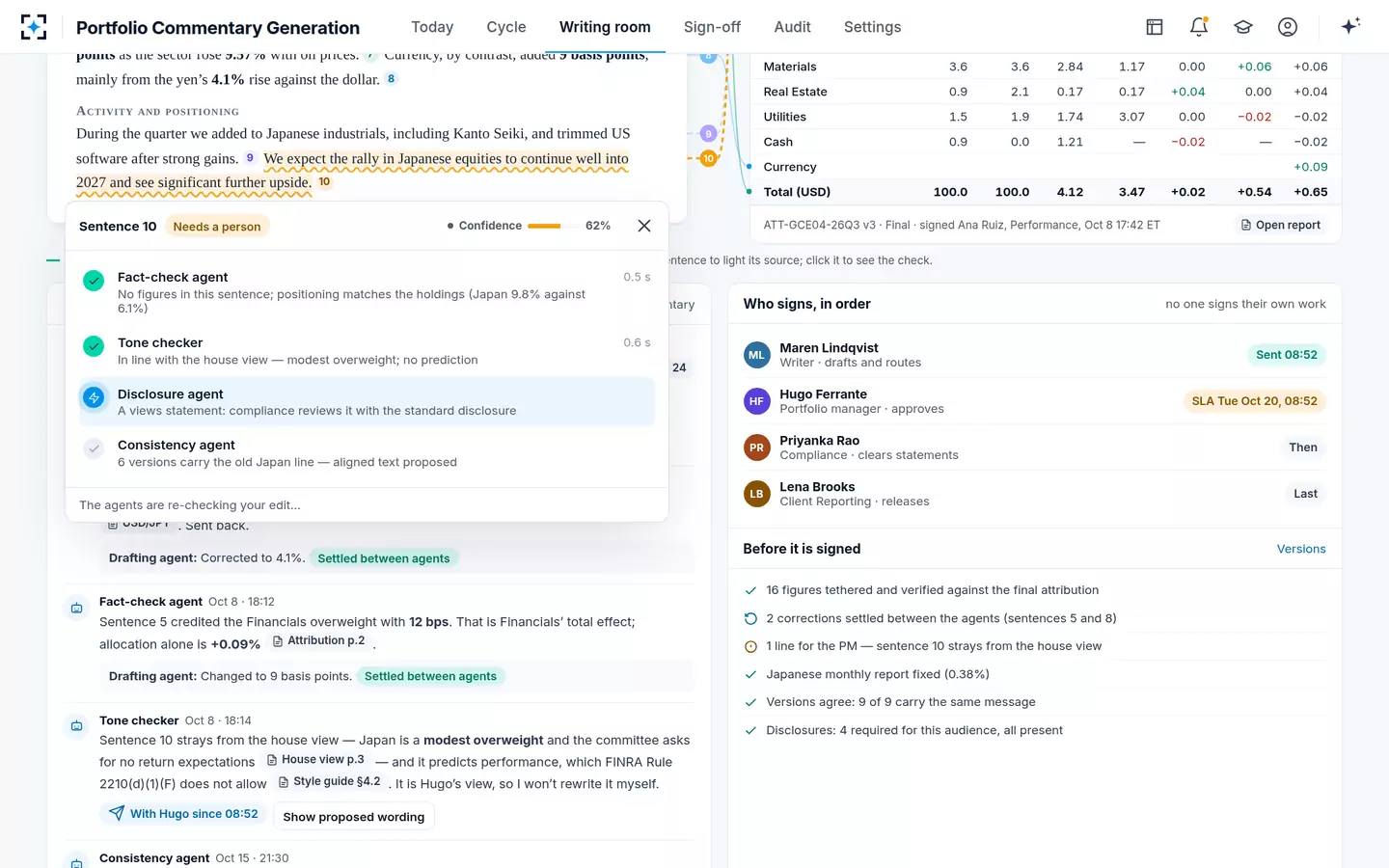
The final rung is the one that makes the others safe: the PM's view is his, and nothing rewrites it. In the sample draft the tenth sentence, from the PM's note, predicted performance: "We expect the rally in Japanese equities to continue well into 2027 and see significant further upside." The Tone checker flagged it against the house view and the style guide and proposed wording, but would not change it: "It is Hugo's view, so I won't rewrite it myself." The writer sent the line to the PM with a question. Even the writer cannot edit a view sentence; only the PM can.
The PM rewrote it himself: "We remain modestly overweight Japan, and we are watching the path of interest rates closely." Before the edit was saved, four agents re-checked it. It contained no figures, and its positioning matched the holdings, Japan at 9.8% of the portfolio against 6.1% of the index; it sat within the house view; it was a views statement, so compliance would see it with the standard disclosure; and six versions still carried the old line, so aligned text was proposed for each.
The PM's edit, re-checked by four agents before it is saved
Who signs automated commentary?
The same people who sign commentary written by hand, and the automation should make each signature more meaningful, not less. In the solution, the writer reviews and routes, the portfolio manager of record approves and signs, compliance clears each flagged statement, and a fourth person releases, each with a reason code. Nobody approves or releases their own work, and bulk actions still take one signature per commentary.
Four signatures on every commentary, and what each one means
| Who | Signs that | Cannot |
|---|---|---|
| Investment writer | The draft is ready for the PM; disagreements between agents are decided | Edit the PM’s view, approve or release |
| Portfolio manager of record | The commentary, as edited, is his account of the period | Clear a compliance flag or release |
| Compliance reviewer | Each flagged statement is cleared, reworded or returned with a reason | Release the commentary |
| Client reporting lead | All versions go out together to their channels | Release a commentary she wrote or approved |
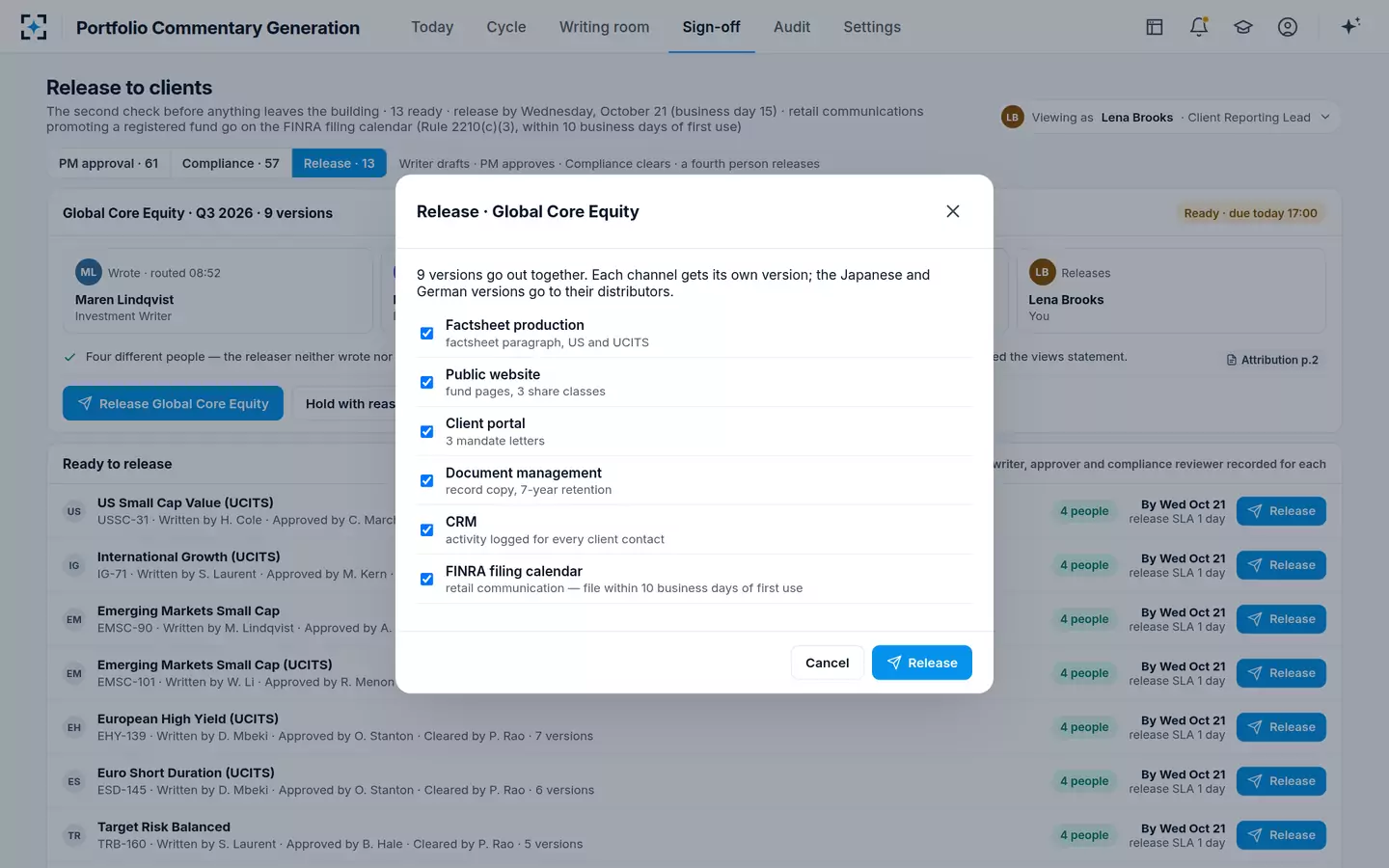
Some of those signatures are required by rule. At a FINRA member, a qualified registered principal must approve each retail communication before it is used or filed (FINRA Rule 2210(b)(1)), and a factsheet built from the commentary is usually one. An adviser must also be able to rebuild each performance figure in it from records (17 CFR 275.204-2). In the sample, release sends all nine versions at once to factsheet production, the website, the client portal, document management and the CRM, and puts retail communications on the FINRA filing calendar.
A fourth person releases: nine versions to every channel, together
How long does it take to adopt commentary automation?
Plan for two quarterly cycles before PMs work routinely from the draft: one to set up and shadow, one to run live with the PM editing only his views. No independent study measures adoption time for commentary tools, so treat that as our planning assumption, and measure your own.
The first cycle does the setup the solution needs: connecting the performance system, portfolio accounting, the order system and the document store; mapping strategies to templates; setting roles; and a trial on three strategies from a past quarter, compared with what was actually published. The comparison is the most important trust-building step in the whole rollout, because the PM sees his own quarter, his own notes and the commentary he signed, side by side with the agents' draft and the corrections they would have made.
Seven things that make PMs sign the draft sooner
- Start with the PM’s own published quarter
The shadow comparison earns more trust than any demonstration on sample data.
- Show every correction the agents made
Hidden corrections look like hidden errors.
- Make views untouchable
No agent and no writer rewrites a PM’s view; flags come as questions.
- Send a change summary, not a document
What was corrected, what needs him, what was fixed in other versions.
- Re-check his edits visibly
He sees his own line checked against holdings and the house view before it is saved.
- Keep the first draft on the record
Accountability is clear: what the agents wrote, what he changed.
- Measure approvals as edited
The share of commentaries approved with only view edits is the adoption metric.
Which desks and PMs should go first
Roll out where trust is cheapest to earn, and let the results travel. Three tests pick the first desks. Clean attribution: equity strategies with a sector Brinson-Fachler report signed final on a predictable day give the agents an unambiguous source for every figure. Fixed income strategies, where effects split into carry, duration, curve, spread and selection, are worth doing, but second, once the template for their effects is agreed; why bonds need their own attribution model explains the difference.
PMs who already write notes are the second test. The Drafting agent may only use views the PM has written, so a PM who sends two notes a quarter gets a draft that sounds like him, and one who sends none gets a draft with an empty positioning section and a question. That is the right behaviour, but it is not the way to win the first convert.
Many versions is the third. A strategy with a factsheet, an offshore class, several mandate letters and two translations shows the value of the cross-version check in its first cycle, because the writer and the product specialist see right-but-different numbers explained and a late PM edit carried into every version without retyping. In the sample cycle, Global Core Equity had nine versions; a single-version strategy shows less.
Once the first desk's PMs are approving with only view edits, their numbers are the business case for the next desk, and they are more persuasive coming from a colleague than from a vendor.
Measuring trust: the numbers that show PMs have adopted it
Trust is visible in three numbers. The share of commentaries a PM approves with only view edits should rise cycle by cycle. The time a commentary spends in PM approval should fall: in the sample cycle, PM approval was the longest step, a median of 1.3 business days of the 3.0 from final attribution to publication, against a two-day service level met 88% of the time. And the share of figure sentences that people change after the agents have checked them should stay low; in the sample it was 1.5% part-way through the cycle.
ESMA warns that over-reliance on AI is a risk in itself, and expects firms to monitor AI-driven processes after the fact, not only before (ESMA public statement, May 2024). The same numbers guard against that. A PM who approves every draft unchanged in seconds is not trusting the system; he has stopped reading it. Watch for approval times that fall too far, and keep the view sentences his. The four numbers that prove it pays sets out the wider scorecard; to run the shadow comparison on your own quarter, start from Portfolio Commentary Generation.
Questions people ask
What is algorithm aversion?
It is the tendency to stop using an algorithm after seeing it make a mistake, even though evidence-based algorithms tend to outperform human forecasters, as Dietvorst, Simmons and Massey documented in 2015. Their 2018 follow-up found people were considerably more likely to use an imperfect algorithm when they could modify its output, even slightly.
Is automated commentary in Power BI the same as automated fund commentary?
No. Business intelligence tools describe what a chart shows. Fund commentary explains a portfolio's performance against its benchmark, ties each figure to a signed attribution, carries the PM's views and must pass compliance, so it needs sources, checks and signatures that a dashboard narrative does not.
What happens if the PM disagrees with the agents' flag?
The PM decides what his view says; the agents propose and ask. If the line still reads as a prediction or strays from the house view, it goes to compliance as a flagged statement, and compliance clears it, uses proposed wording or returns it with a reason. No agent clears a statement.
Does automation change who is accountable for the commentary?
No. The PM who signs is accountable for his account of the period, compliance for what it clears, and the firm for the whole. What changes is the evidence: every agent step, edit before and after, and signature is recorded, so it is clear who wrote, changed and approved each sentence.
Can automated commentary use PM notes written in other languages?
In the solution's design, yes: notes can be in any language, and issuer filings are read in their original language beside an English reading. In the fictional sample, a forecast in an analyst's note written in Portuguese was flagged in the original before it reached the English draft.