Quarterly investment commentary is the manager's account of the quarter for each strategy, and it is produced in a season that starts at quarter end and ends when the last version reaches clients. The deadline is set by the calendar rather than by the writing: nothing can be drafted until the performance team signs the attribution final, and after that the commentary waits in a writer's queue, a portfolio manager's queue, compliance's queue and a translation vendor's queue, while the factsheets, client reports and distributor documents built from it wait in turn. In a fictional sample cycle of 214 strategies, the slowest attribution was still not final on business day 12 of a 15-day window. Botminds' Portfolio Commentary Generation drafts each commentary within the hour that its attribution is signed final, and checks it, so the days that are left go to the decisions only people can make.
The sample cycle belongs to a fictional manager, Quillfield Capital, whose third quarter of 2026 ran through the solution: quarter end on Wednesday 30 September, a publish deadline of Wednesday 21 October, business day 15.
Two strategies in one season: one waits six days for its numbers, the other twelve
- Waiting for final attribution (BD1–6)6 days
- Writer, PM, compliance, release (cycle median)3.0 days
- Room before the deadline6 days
- Still waiting for final attribution on BD1212+ days
- Everything else3 days
What is quarterly investment commentary?
Quarterly investment commentary explains one strategy's quarter: its return against the benchmark, what drove the difference, what the manager did and how the portfolio is positioned. It is published on fund websites and factsheets, sent to institutional clients and consultants, and cut into versions for advisers and other languages. Quarterly market commentary, by contrast, is the firm's view of markets in general, and a quarterly market review is usually a retrospective of index and sector returns without a portfolio in it.
The three are often produced in the same weeks by the same people, and they depend on each other. The market review needs only market data and can be written first. The investment commentary needs each strategy's signed attribution and can only start when that arrives. A firm that writes the market view first and lets it set the tone of every strategy commentary risks exactly the generic discussion Form N-1A tells US funds to keep out of the annual report's performance section (Form N-1A, Item 27A(d)(1), Instruction 1); how to write the commentary itself covers that.
When is quarterly commentary published?
No rule sets a deadline for a quarterly commentary as such. Firms set their own, driven by the documents that consume it: factsheets, institutional client reports, consultant database updates and distributor deadlines. The sample manager's deadline was business day 15, three weeks of working days after a Wednesday quarter end.
What the rules do set are clocks for the documents around the commentary, and those clocks shape the season. A US fund's shareholder reports go out within 60 days of the period end, and the fund files them with the SEC on Form N-CSR within 10 days of sending them (17 CFR 270.30e-1; 270.30b2-1). A FINRA member files a retail communication promoting a registered fund within ten business days of first use (FINRA Rule 2210(c)(3)). Fund advertisements quoting performance carry month-end figures that must be current within a short window (17 CFR 230.482). And in the UK and EU, a portfolio manager's periodic statement to a retail client comes every three months and must include a fair and balanced review of the period (COBS 16A.4; Delegated Regulation 2017/565, Article 60).
The clocks around quarterly commentary, and which document each one governs
| Clock | What it governs | How it shapes the commentary season |
|---|---|---|
| 60 days after period end | US fund annual and semi-annual shareholder reports (rule 30e-1) | The annual report’s performance discussion is written from the same attribution, weeks later; it should agree with the quarter’s commentary |
| 10 days after transmission | Form N-CSR filing of those reports (rule 30b2-1) | Whatever the report says is filed and certified; late changes to the commentary ripple into it |
| 10 business days after first use | FINRA filing of retail communications promoting a registered fund (Rule 2210(c)(3)) | A factsheet or website commentary released on day 15 is filed by about day 25 |
| Month-end performance, current | US fund advertisements quoting performance (rule 482) | Factsheets can’t wait for a slow commentary; the paragraph is cut from whatever is approved |
| Every three months | UK and EU periodic statements to retail portfolio clients | Mandate and client reports need their commentary on the client’s own schedule |
How long after quarter end is commentary due?
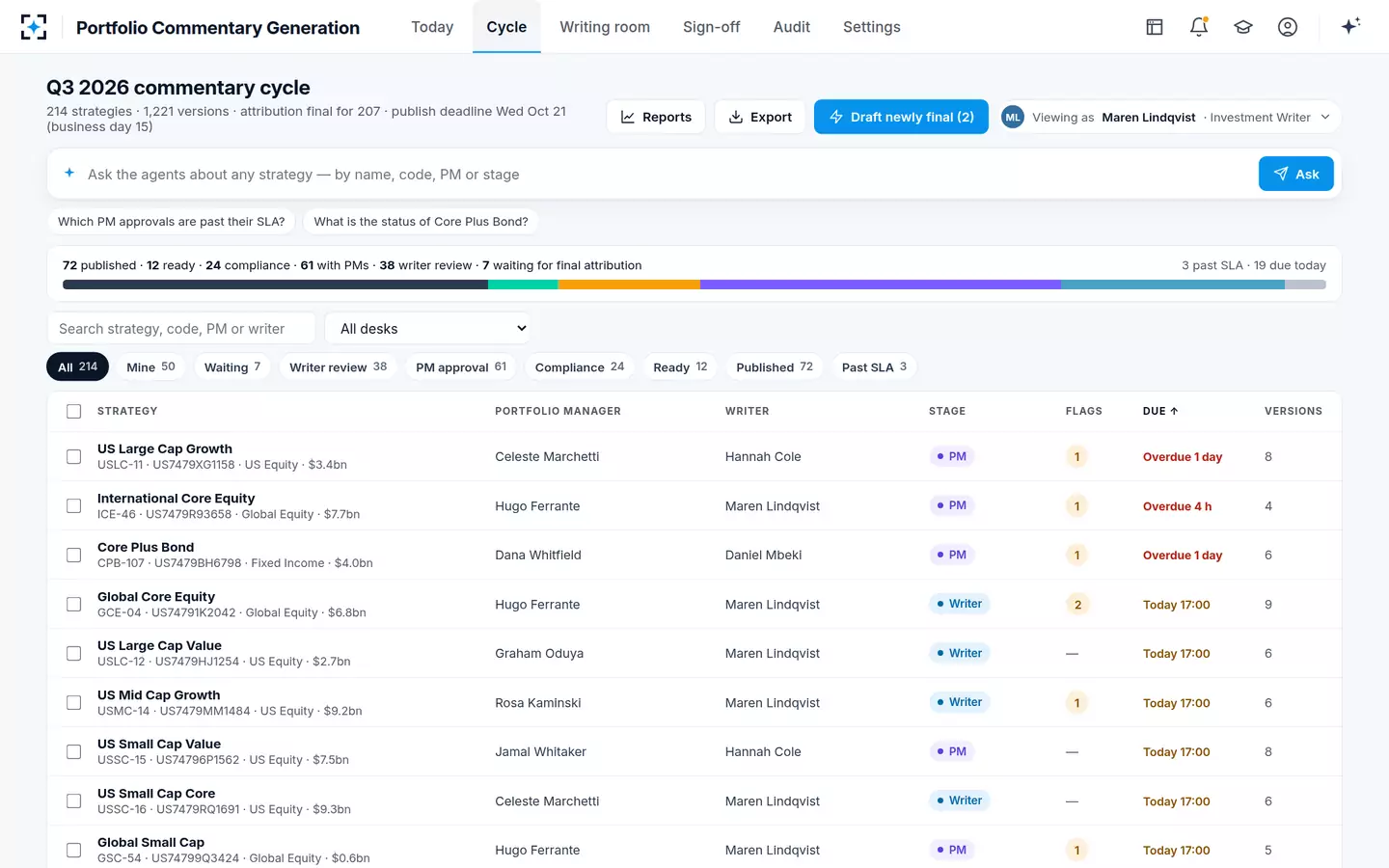
When the firm's own deadline says, and the useful number is not the deadline but the window: the business days between a strategy's attribution being signed final and the deadline. That window is what the writer, PM, compliance and translators share, and it shrinks for every day the attribution is late. In the sample, Global Core Equity's attribution was final on business day 6, leaving nine business days; for the last seven strategies, still waiting on day 12, three were left.
Attribution can be late for ordinary reasons. Prices for less liquid holdings settle late, corporate actions are reconciled, benchmark providers restate, and the performance team will not sign a preliminary run. A commentary process that drafts from preliminary numbers to save time is drafting sentences that may not survive the final run, which is why the sample process waits: the Intake agent never drafts from preliminary or restated attribution, and tells the writer when final numbers are expected.
Where the days go once the numbers are final
Once the attribution is final, the drafting is the shortest step. In the sample cycle the agents drafted 207 of 214 strategies within an hour of their attribution being signed final, and the run for Global Core Equity took eleven minutes, reading twelve sources. The median from final attribution to publication was 3.0 business days, and most of it was people's queues.
From final attribution to publication: the PM's queue is the longest step
Median 3.0 business days, sample cycle
- Writer review 0.6 · 20%
- PM approval 1.3 · 43%
- Compliance and release 1.1 · 37%
The PM's queue is the longest because PMs read commentary between markets, and because a PM who does not trust the draft reads all of it. In the sample, the PM receives a change summary instead: what the agents corrected, which line needs him, what was fixed in other versions. Three approvals were past their two-day service level on the Friday before the deadline; the Publishing agent drafted reminders and copied desk heads, and nothing was sent until the writer pressed send. Getting PMs to sign the draft deals with that queue directly.
The commentary season is not a writing problem. It is a waiting problem with a writing step in the middle, and the only way to shorten it is to make every queue after the attribution shorter.
Quarterly market commentary, monthly fund commentary and the quarter-end collision
Quarter end is also a month end, and the monthly work does not stop. Monthly fund commentary for factsheets is due on its own short clock, the quarterly market commentary is being written for the firm's website, and the quarterly investment commentary for each strategy is waiting for attribution. The same writers, PMs and compliance reviewers carry all three in the same weeks.
Two practices reduce the collision. First, write the monthly factsheet paragraph for the quarter-end month from the quarterly master rather than separately, so there is one text to approve, not two; one commentary cut five ways shows how. Second, keep the market commentary from setting the tone of every strategy: it describes the quarter everyone had, and each strategy commentary should describe the quarter that strategy had.
Restatements and late edits: the season runs backwards too
Two events send the season backwards, and both are common enough to plan for. The first is a restated attribution: a price correction, a late corporate action or a benchmark provider's restatement after the performance team has signed. Every sentence that cites a restated cell has lost its working paper, and every version that repeats it is wrong, including any already released. An adviser must keep the records that show how each performance figure it sends was calculated, so a restatement after release is also a records event, not only an editing one.
The second is the late master edit. Suppose the PM approves on day 13, but the factsheet paragraph, the mandate letters and the translations were cut on day 11 from the draft he had not yet read. In the sample, the PM rewrote one sentence of the Global Core Equity master, and six of the other eight versions still carried the old line; the Consistency agent found them and proposed aligned text for each version's owner to approve. By hand, that is a search through documents owned by five people in three languages, on the last two days of the season.
Both are reasons to release all of a strategy's versions together, after every signature, rather than as each is ready. It costs a day at the end of the season and saves the reissue that a version released early would need.
Translation is a season inside the season
Translated versions run on the translation vendor's clock, which starts only when the master is stable. A strategy sold in Germany and Japan needs its master approved early enough for the vendor to translate, for an in-country reviewer to check, and for the result to be compared with the master before release. When the PM approves on day 13 of 15, translation has two days, and the figures in it are the ones most likely to change without anyone noticing: in the sample, the Japanese monthly report gave 0.83% for an effect the master and the attribution put at 0.38%.
The planning answer is to book translation slots before quarter end, to send masters for translation the moment the PM signs, and to check every translated figure against the source cell rather than against the English text. The solution's setting to hold a translated version on any figure mismatch, while the other versions go ahead, keeps a slow or wrong translation from holding up the whole release.
The people in the season, and the queue each one owns
Every queue in the season belongs to one person or team, and each has its own service level in a well-run process. Naming them makes the calendar manageable, because a late commentary is always waiting in someone's queue.
Who holds the commentary at each step of the season
| Step | Owner | Sample service level | What they need to move it |
|---|---|---|---|
| Attribution signed final | Performance team | By business day 6 for most strategies | Final prices, reconciled holdings, the benchmark file |
| Draft and figure check | Agents | Within an hour of final attribution | The final attribution, returns, holdings, trades and PM notes |
| Writer review | Investment writer | 1 business day | A checked draft with the lines that need a person marked |
| PM approval | Portfolio manager of record | 2 business days | A change summary and one question, not a document |
| Statements cleared | Compliance | 2 business days | Each flagged sentence with its rule and proposed wording |
| Versions aligned | Product specialist, translation vendor | Before release | The approved master and every claim mapped to each version |
| Release | Client reporting lead | 1 business day | Four signatures recorded; every channel ready |
The season on one screen: 214 strategies by stage, deadline business day 15
Planning the season: a checklist for the head of investment writing
The season can be planned a quarter ahead, because its shape repeats. The list below is the one we would use, whatever tools the team has.
Before quarter end: eight things to have in place
- Expected final-attribution date for every strategy
From the performance team, with the usual late ones named.
- Service levels for each queue
Writer, PM, compliance, translation and release, agreed with each owner.
- PM notes requested before quarter end
Positioning and views in the PM’s words, ready when the numbers arrive.
- The house view current
Investment committee positions dated, so stray lines can be spotted.
- Templates and length limits per version
Factsheet characters, adviser word count, mandate letter format.
- Translation slots booked
The vendor knows when masters will arrive and how many languages.
- The disclosure library updated
Views statements, past performance and currency warnings per audience.
- A rule for late attribution
What gets published if a strategy’s numbers are not final by a cut-off day.
Where Portfolio Commentary Generation gives the days back
The solution cannot make attribution final sooner, and it does not try. What it changes is everything after: the draft exists within the hour, checked against the final numbers; the writer opens it with the lines that need a person already marked; the PM gets a change summary; compliance gets a queue of specific statements; and every version is compared with the master before release.
The writer's view of the season: what is due, what the agents did, what needs a person
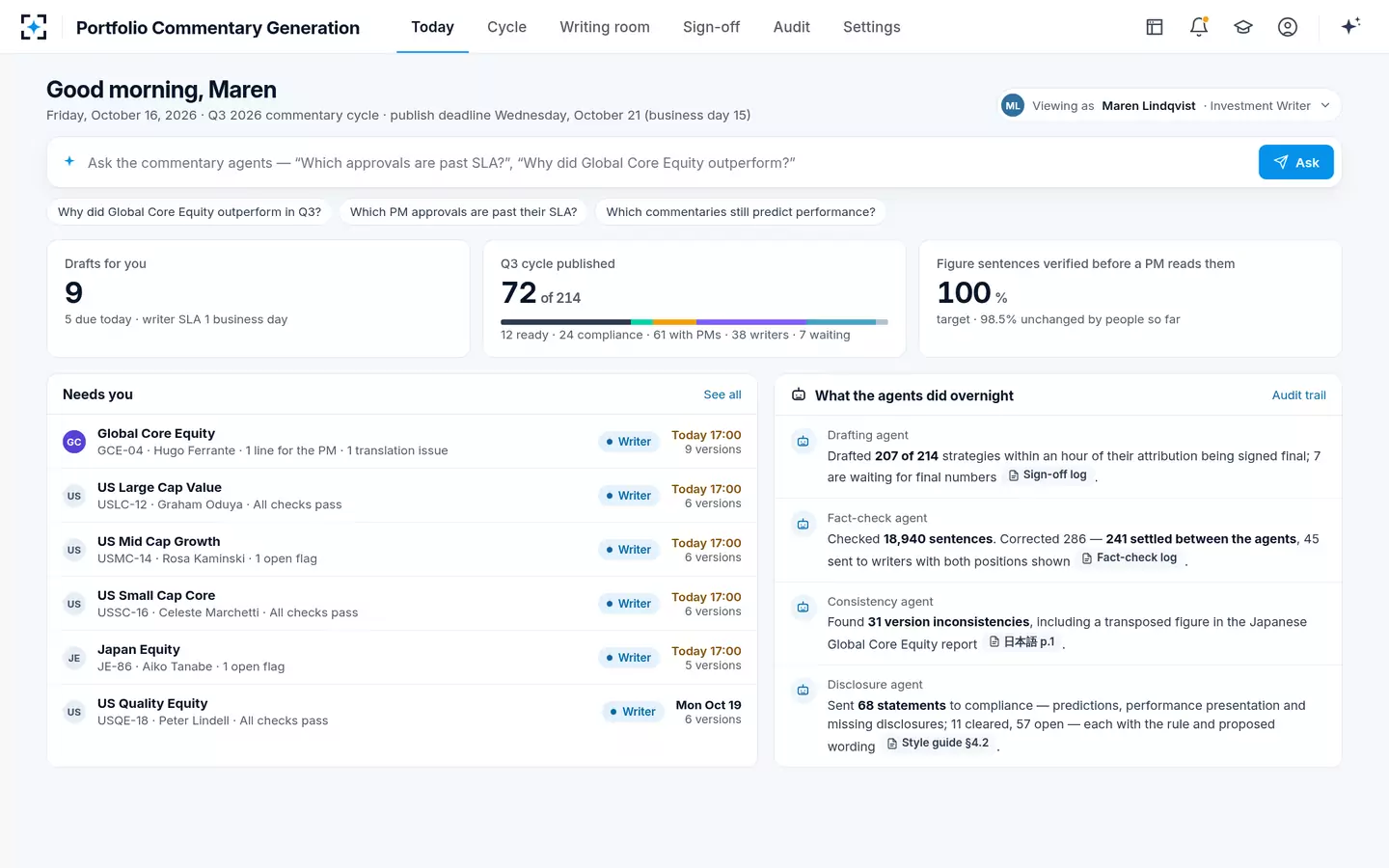
In the sample, that leaves the last seven strategies, whose numbers arrive on day 12 or later, with three days that are almost all queue. That is the case the season is planned around, and the one in which a draft that already exists, checked, the moment the numbers do is worth most. The four numbers that prove it pays shows how to measure the change in your own season; to see it on your own quarter, start from Portfolio Commentary Generation.
Questions people ask
What is the difference between a quarterly market review and a quarterly investment commentary?
A quarterly market review describes what markets did: index, sector and asset-class returns, rates and currencies. A quarterly investment commentary explains what one portfolio did against its benchmark and why, from its attribution, and carries the manager's positioning and views. The review can be written before attribution is final; the commentary cannot.
Do US funds have to publish quarterly commentary?
No rule requires a quarterly commentary. US open-end funds must send shareholder reports at least twice a year within 60 days of the period end, and the annual report must include a discussion of the key factors that affected performance. Quarterly commentary is a market practice driven by clients, consultants and distributors.
Why is performance attribution late after quarter end?
Because it depends on final prices, reconciled holdings and transactions, and the benchmark provider's final constituent data, and a performance team will not sign a run while any of those may still change. A commentary drafted from preliminary attribution may cite effects that move when the final run is signed.
Can the factsheet go out before the commentary is approved?
The figures can; the commentary paragraph should not, because it is cut from the master and must agree with it. A firm can publish the factsheet's figures and hold its paragraph back, rather than release text the PM has not approved. In the sample design, every version is released together, after the PM signs and compliance clears.
How many strategies can one writer cover in a quarter?
No public survey measures it, and it depends on versions and languages as much as strategy count. In the fictional sample cycle, one equities writer carries 50 of 214 strategies, possible only because agents draft and check, leaving the writer to review and decide.