Fair, clear and not misleading is the FCA's core standard for communications: COBS 4.2.1R says "A firm must ensure that a communication or a financial promotion is fair, clear and not misleading", and the Consumer Duty repeats the test for everything a firm tells retail customers. The rule is applied to a communication as a whole, but in fund commentary it is breached one sentence at a time: a benefit stated without its risk, a comparison with no basis, a forecast in the outlook, the word "assured". The practical test is therefore a sentence classifier: sort every sentence into the types the detailed rules govern, check the risky types against their conditions, and send each one that fails to a person. Botminds' Portfolio Commentary Generation runs that test on every draft, with a Disclosure agent that flags sentences and proposes wording, and a compliance reviewer who alone decides.
The flagged sentences on this page come from a fictional manager, Quillfield Capital, in a third-quarter 2026 cycle run through the solution on sample data. The UK rules are those in force in October 2026; where the EU's differ, they are set beside them.
Seven sentence types that break fair, clear and not misleading, and the rule each meets
Benefit
Example“The strategy offers attractive income with lower volatility.”
The conditionMust give “a fair and prominent indication of any relevant risks” when referencing potential benefits
RuleCOBS 4.5A.3R(2)(b)
Comparison
Example“Our fund beat its peers and the index.”
The conditionMeaningful, fair and balanced; sources, key facts and assumptions stated
RuleCOBS 4.5A.7R
Past performance
Example“The fund has returned 11% a year since launch.”
The conditionNot the most prominent feature (outside a periodic statement); five years of complete 12-month periods; the prominent warning
RuleCOBS 4.5A.10R, 4.6.2R
Forecast
Example“Poised to outperform over the next 12 months.”
The conditionReasonable assumptions on objective data, scenarios both ways, the forecast warning; otherwise leave it out
RuleCOBS 4.5A.14R, 4.6.7R
Absolute word
Example“Income is assured.”
The conditionNot “guaranteed”, “protected”, “secure” or similar unless the term is fair and fully explained
RuleCOBS 4.2.5G
Omission
ExampleThree contributors named, no detractor.
The conditionConsider whether leaving out a relevant fact makes the whole unfair or misleading
RuleCOBS 4.5A.6G
Jargon
Example“Positive selection effect in cyclicals.”
The conditionPlain and intelligible language; unavoidable technical terms explained, for retail readers
RulePRIN 2A.5.7G
What does fair, clear and not misleading mean under the FCA rules?
It means a communication gives its reader an accurate impression, in terms they can follow, without leaving out what would change that impression. The rule itself is one sentence long; the FCA's guidance says it "applies in a way that is appropriate and proportionate taking into account the means of communication, the information the communication is intended to convey and the nature of the client" (COBS 4.2.2G). A note to a professional client "may not need to include the same information, or be presented in the same way" as one to a retail client, but it is still covered.
That last point matters for commentary, which is often sent to professional and institutional clients and is often not a financial promotion at all. COBS 4.2.1R reaches a firm's communications to clients as well as its financial promotions, and the guidance says a communication to a professional client that is also a promotion "will still be subject to the fair, clear and not misleading rule". A writer does not need to decide whether a commentary is a promotion to know the standard applies; the classification decides which detailed conditions come with it.
The rule carries a defence worth knowing. If a firm "takes reasonable steps to ensure it complies with the fair, clear and not misleading rule", a breach does not give rise to a private action for damages under section 138D (COBS 4.2.6R). A documented, sentence-level review is what reasonable steps look like on paper.
MiFID II fair, clear and not misleading: where the UK and EU rules come from
The UK rule implements the same standard as the EU's: the Handbook notes COBS 4.2.1R against article 24(3) and article 30(1) of MiFID, among others. Since 23 October 2025, when the FCA restated the onshored MiFID Organisational Regulation in its Handbook, the detailed conditions for MiFID business, once Article 44 of that regulation, sit in COBS 4.5A (FCA PS25/13), while COBS 4.6 keeps parallel conditions for business outside MiFID. For EU funds marketed across borders, Regulation (EU) 2019/1156 requires marketing communications to be identifiable as such, to describe risks and rewards with equal prominence, and to be fair, clear and not misleading (Regulation (EU) 2019/1156, Article 4(1)).
Which fair, clear and not misleading conditions apply to a commentary sentence
| Framework | Applies to | What it adds at sentence level |
|---|---|---|
| COBS 4.2 (UK) | Communications to clients and financial promotions | The core standard; no “guaranteed”, “protected” or “secure” without full explanation; the reasonable-steps defence |
| COBS 4.5A (UK, MiFID business) | Information to retail and professional clients, including marketing | Risks prominent beside benefits; comparisons; past, simulated and future performance; consistency with service information |
| COBS 4.6 (UK, other business) | Financial promotions likely to reach retail clients | Past and future performance conditions for non-MiFID business |
| PRIN 2A.5 (UK Consumer Duty) | All communications to retail customers | Understanding: plain language, key information prominent, test before sending, monitor after |
| Reg. 2019/1156 and ESMA guidelines (EU) | Marketing communications for UCITS and AIFs | Identifiable as marketing; risks and rewards equally prominent; consistency with the fund’s legal documents |
ESMA's guidelines turn the EU standard into drafting rules a writer can apply. "All marketing communications, regardless of the target investors, should contain fair, clear and not misleading information", and on risks and rewards, "Both the risks and rewards should be mentioned either at the same level or one immediately after the other" (ESMA34-45-1272, ¶16 and ¶15). A commentary paragraph that lists what helped and saves the risks for a disclaimer page fails the second sentence even if every figure in it is right.
What makes commentary misleading?
Commentary misleads when the impression a reader takes away is not what the facts support, and that usually happens through what a sentence implies or leaves out rather than through a false number. The FCA's guidance for MiFID business puts it as a question every reviewer can ask: a firm "should consider whether omission of any relevant fact will result in the information being insufficient, unclear, unfair or misleading" (COBS 4.5A.6G).
Four patterns account for most of it in fund commentary. A benefit stated without its risk: "attractive income" with nothing about what can reduce it, where the rule requires "a fair and prominent indication of any relevant risks when referencing any potential benefits" (COBS 4.5A.3R(2)(b)). A selective story: contributors explained and detractors omitted, which leaves a reader with a better impression of the manager's decisions than the attribution supports. A comparison with no stated basis: "beat its peers" without saying which peers, over what period, from whose data. And an absolute word: the FCA's guidance says a feature should not be called "guaranteed", "protected" or "secure", "or use a similar term", unless the term is capable of being fair and the firm explains it fully (COBS 4.2.5G). "Income is assured", from a fictional multi-asset income fund in the sample cycle, is a similar term.
Information to clients must "not disguise, diminish or obscure important items, statements or warnings".
FCA Handbook, COBS 4.5A.3R(2)(e)
Can commentary include a forecast?
Rarely, and almost never in the form PMs write one. A forecast is an indication of future performance, and the FCA's conditions for it are demanding: it must not rest on simulated past performance, it must be based on reasonable assumptions supported by objective data, it must reflect scenarios in both negative and positive market conditions, it must disclose the effect of charges if based on gross figures, and it must carry a prominent warning that forecasts are not a reliable indicator of future performance (COBS 4.5A.14R; for other business, COBS 4.6.7R). The guidance adds that a firm "should not provide information on future performance if it is not able to obtain the objective data needed".
"Poised to outperform over the next 12 months" meets none of those conditions; it is a forecast with no scenarios, no data shown and no warning. The fix is almost always to replace the forecast with positioning and reasoning, which tells the reader what the manager has done and why without promising what will happen. For US readers the parallel rule is FINRA's bar on predicting performance in member communications, with its narrow exceptions; how to write market commentary covers the US side.
Flagged sentences and fair, clear and not misleading rewrites
As drafted: With valuations at a 20-year discount, international small caps are poised to outperform over the next 12 months.
Rewritten: International small caps trade at a wide valuation discount to their 20-year average, which is why we continue to add to them.
As drafted: Brazilian equities could rise a further 20% as rate cuts begin.
Rewritten: We added to Brazilian equities, where we expect interest-rate cuts to support domestic companies.
As drafted: Income is assured.
Rewritten: The fund aims to pay a regular income; payments are not guaranteed and may fall.
As drafted: Security selection added 41 basis points before fees.
Rewritten: The fund returned [net]% after fees and [gross]% before fees; security selection added 41 basis points before fees.
Consumer Duty: clear, fair and not misleading for retail readers
For retail customers, the Consumer Duty adds understanding to accuracy. PRIN 2A.5.3R requires communications that meet retail customers' information needs, are likely to be understood by them and equip them to make effective decisions, and states that "A firm must communicate information to retail customers in a way which is clear, fair and not misleading" (PRIN 2A.5.3R(2)). The guidance asks firms to "use plain and intelligible language" and to explain jargon "as simply as possible", to make key information prominent, and to "avoid unnecessary disclaimers".
The Duty also asks firms, where appropriate, to test communications before sending them to retail customers and to monitor their effect afterwards (PRIN 2A.5.10R). For a wealth-adviser version of a commentary, that is a reason to keep a separate plain-language version rather than send the institutional text with a glossary. In the sample cycle the adviser version runs to 140 words against the master's 236, drops two of the master's effects, keeps the Health Care detractor, and is checked by the Tone checker at a stricter setting than the institutional versions.
Up to date, consistent, in one language: the test across versions
A commentary that is fair, clear and not misleading in its master can fail in its versions. The FCA's general requirements for MiFID business include two that are easy to miss: information must be "up-to-date and relevant to the means of communication used", and it must be "consistently presented in the same language throughout all forms of information and marketing materials that are provided to each client", unless the client has agreed to receive information in more than one language (COBS 4.5A.3R(2)(f) and (g)).
Both bite when commentary is cut into versions on a deadline. A factsheet paragraph cut from day seven's master, sent after the PM edited the master on day nine, is no longer up to date with what the firm is telling its other clients. A mandate letter in English with a German appendix, sent to a client who agreed to German only, fails the language condition even if the translation is perfect. And a translated figure that disagrees with the master, such as the sample's Japanese report giving 0.83% for an effect the master and the attribution put at 0.38%, makes two statements to clients that cannot both be fair.
The sentence test therefore runs on every version, not only on the master. In the sample cycle the Consistency agent compares each version's claims with the master's, reads translations in their own language, and proposes aligned text when the master changes; the owner of each version approves it. One figure followed through nine versions shows the comparison in detail.
The sentence test: how to review a commentary against the standard
Read the commentary once as a whole, for the impression it leaves, then once sentence by sentence, sorting each into the types in the grid at the top of this page. Most sentences will be figures and causes, which are tested against the attribution rather than the conduct rules. The ones to stop on are benefits, comparisons, performance claims, forecasts, absolute words and anything a retail reader would not understand.
Fair, clear and not misleading: a sentence-level review in eight questions
- Does every benefit have its risk beside it?
Same prominence, same place, not a disclaimer page away.
- Is every comparison specified?
Which index or peer group, which period, whose data, on what basis.
- Does any sentence forecast performance?
Replace with positioning, or meet the conditions in full.
- Are past returns presented on the rules’ terms?
Complete 12-month periods, the period and source stated, the warning, currency risk where relevant.
- Is any feature called guaranteed, protected, secure, assured?
Remove it or explain it completely.
- Are detractors explained?
A story of only what went well misleads by omission.
- Would a retail reader understand every term?
For retail versions: plain words, jargon explained, key facts prominent.
- Does the version agree with the master and the fund’s documents?
Same figures, same benchmark, consistent message in every language.
How Portfolio Commentary Generation runs the test, and who decides
In the solution, the Disclosure agent screens every sentence of every version for predictions, performance presentation and the disclosures each audience and jurisdiction requires, and sends each flag to compliance with the rule, the reason and proposed wording. The Tone checker compares views with the house view at a sensitivity set by audience, strict for retail and adviser versions. Neither clears anything. In the sample cycle the Disclosure agent had sent 68 statements to compliance by the Friday before the deadline: 11 cleared, 57 open.
Statements to clear: the rule, the reason and proposed wording, for compliance to decide
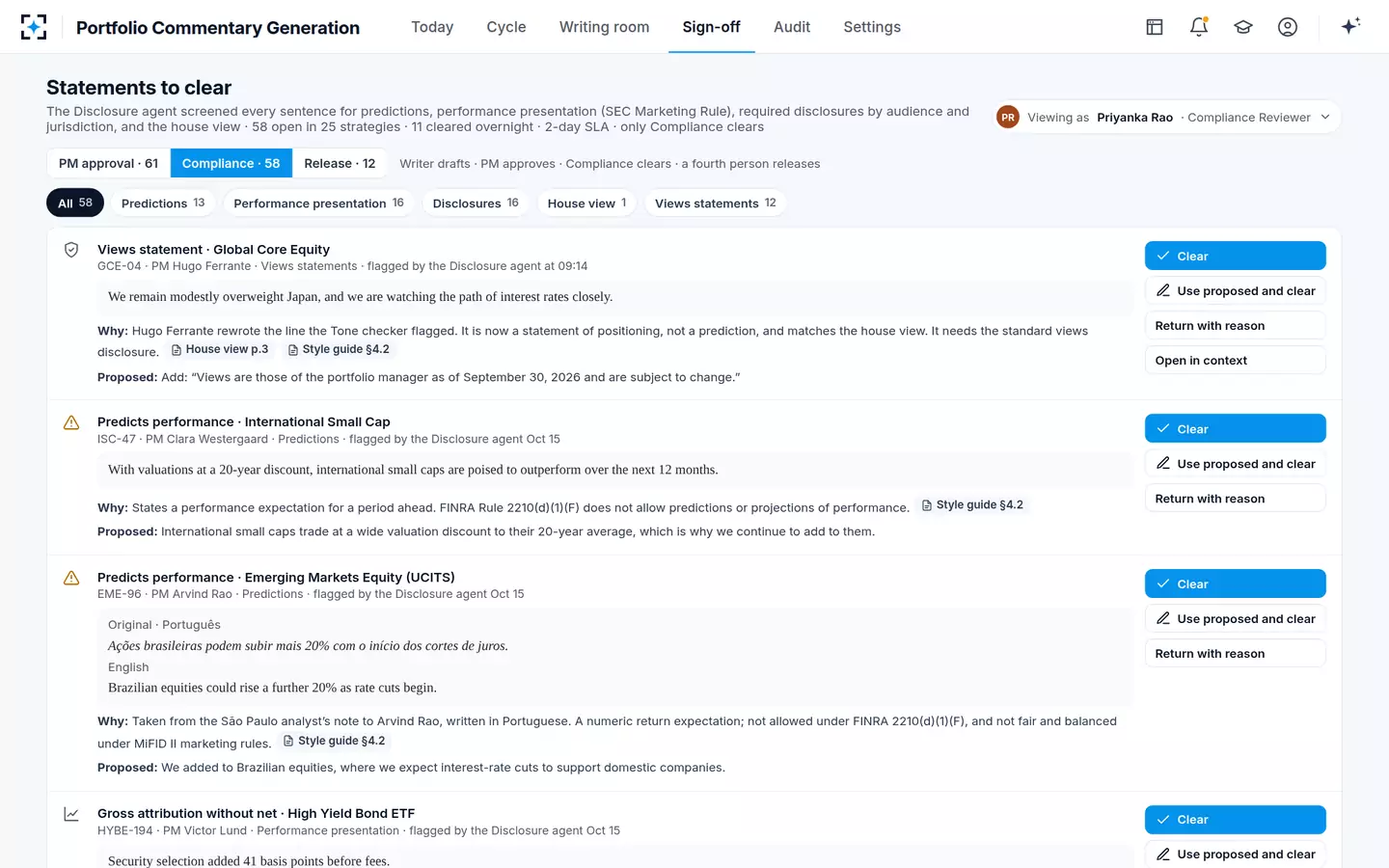
The reviewer's choices are deliberately few: clear, use the proposed wording and clear, or return with a reason code. Each choice is recorded with the rule and the reviewer's name, which is the reasonable-steps evidence COBS 4.2.6R rewards. The writer can ask the agents across the whole cycle, in plain words, which commentaries still predict performance.
Asking the agents which commentaries still predict performance
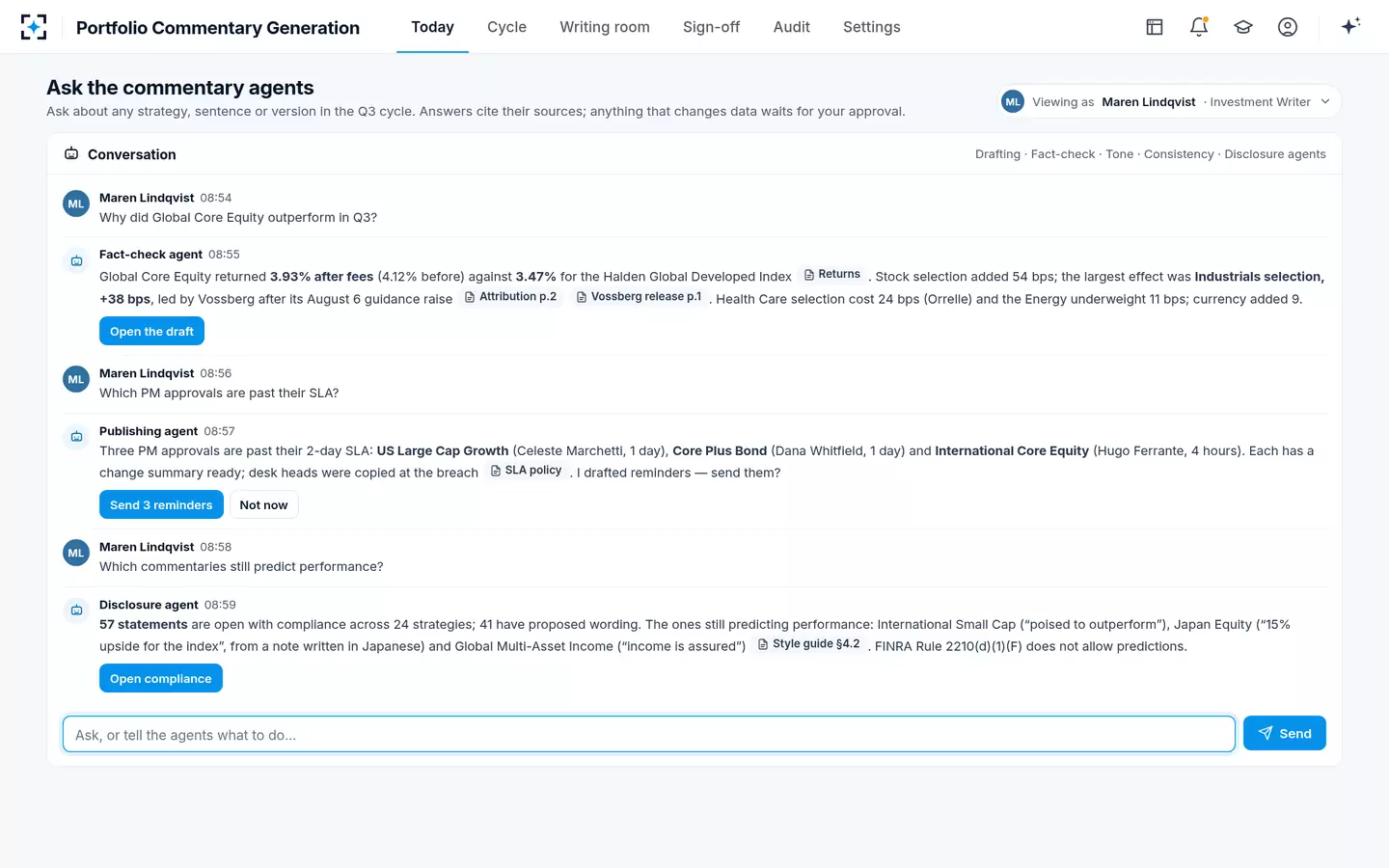
Some limits are worth stating. The agents classify and flag; they do not judge whether a firm's reasonable steps were enough, and they do not decide whether a document is a financial promotion. They make the reviewer's sentence-level test complete and recorded, so the judgement is spent on the sentences that need it. To run the test on your own commentary, start from Portfolio Commentary Generation; one commentary cut for five audiences shows how the rules shift between versions.
Questions people ask
Do financial promotions have to be fair, clear and not misleading?
Yes. COBS 4.2.1R applies the rule to financial promotions a firm communicates or approves, as well as to its communications with clients, with exceptions such as excluded communications and, for promotions, non-retail communications. Approving another firm's promotion makes the approver answerable for it too.
Does fair, clear and not misleading apply to professional clients?
Yes, proportionately. The FCA's guidance says a communication to a professional client may not need the same information or presentation as one to a retail client, but the rule still applies, and for MiFID business COBS 4.5A sets conditions for information addressed to professional as well as retail clients.
Is a periodic statement allowed to lead with past performance?
Yes. The FCA's guidance says a periodic statement sent under its client-reporting rules may include past performance as its most prominent feature, an exception to the usual condition that past performance must not be the most prominent feature of a communication. A factsheet built from the same commentary does not get the exception.
What is the FCA's reasonable steps defence?
Under COBS 4.2.6R, if a firm takes reasonable steps to ensure a communication complies with the fair, clear and not misleading rule, a breach does not give rise to a right of action for damages under section 138D of FSMA. It does not stop the FCA acting; it limits private claims. A recorded, sentence-level review is the kind of evidence it rests on.
Does a disclaimer make a misleading sentence fair?
Usually not. ESMA's guidelines say risks and rewards should appear at the same level or one immediately after the other, the FCA's rules forbid disguising or obscuring important warnings, and the Consumer Duty asks firms to avoid unnecessary disclaimers. Fix the sentence rather than qualifying it at the bottom of the page.