Good financial commentary examples are sentences in which every number can be traced to one cell in a signed file, and the instructive ones are the near misses: a figure that is right in the attribution report and wrong by the time it reaches a client. This guide follows a single number, a 0.38% stock selection effect in Industrials, from a performance attribution report into a fund commentary, a factsheet paragraph, three institutional mandate letters, an offshore fund version and two translations. At each hop the figure can change unit, change label or change digits, and the reason commentary errors persist is that each hop is usually checked by a different person, against the previous version rather than the source. Botminds' Portfolio Commentary Generation exists to tie every version of every figure back to its cell, so the check at each hop is against the file the number came from.
The number belongs to a fictional manager, Quillfield Capital, and its Global Core Equity strategy in a third-quarter 2026 commentary cycle, run through the solution on sample data.
One effect's journey: seven hops from the attribution cell to every version
Agent
Attribution cellIndustrials, stock selection, +0.38%, Q3 2026, in report ATT-GCE04-26Q3 v3, signed final by the performance team.
Never: drafts from a preliminary or restated run
Agent
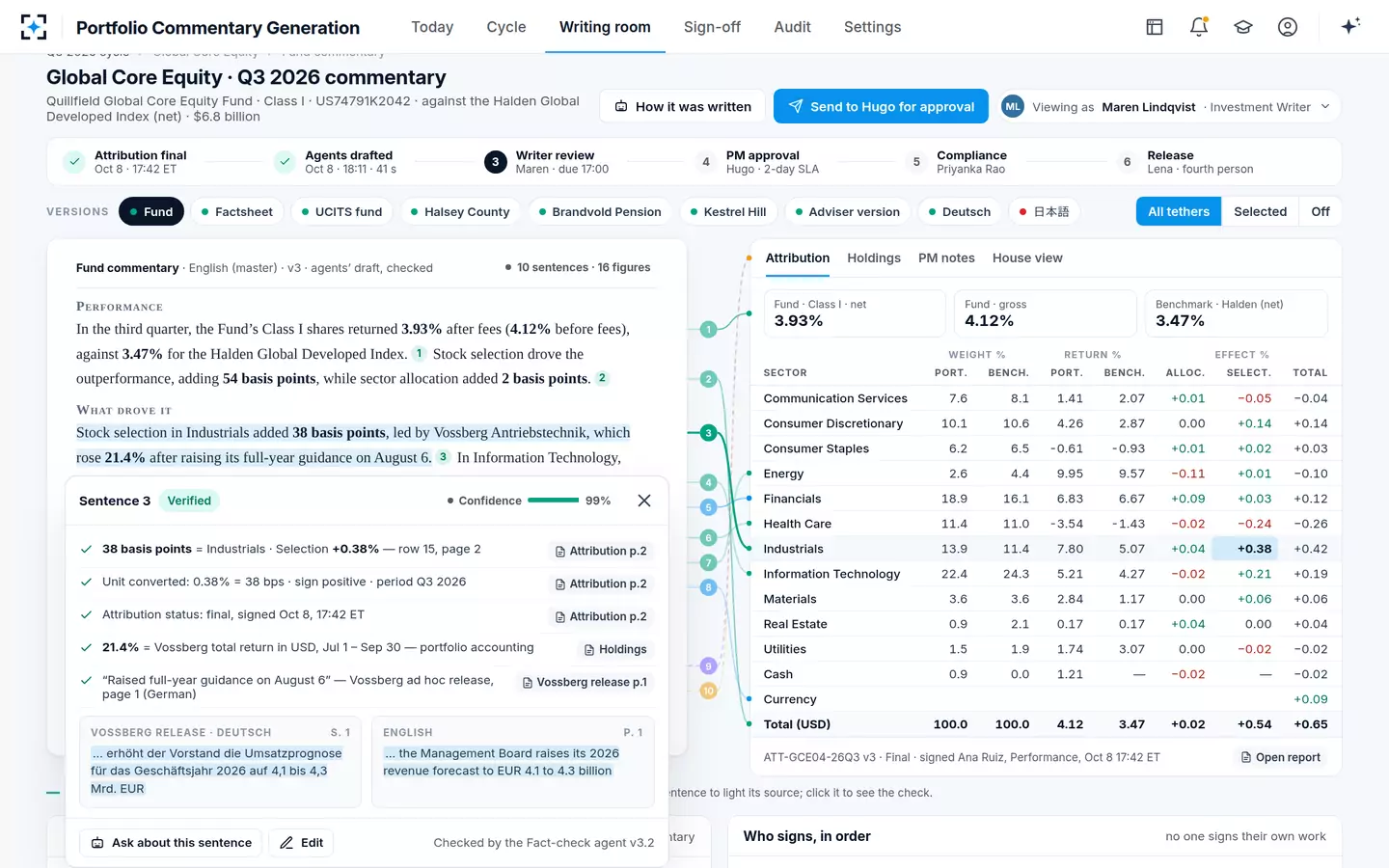
Master sentence“Stock selection in Industrials added 38 basis points, led by Vossberg Antriebstechnik…” Unit converted, effect named, cause sourced.
Never: gives a reason no source gives
Agent
Independent checkValue, unit, sign, period, effect type and final status re-derived from the cell, with different instructions from the drafter.
Never: accepts a figure without an official source
Agent
VersionsThe same claim written into the factsheet paragraph, the offshore fund version, three mandate letters, German and Japanese.
Agent
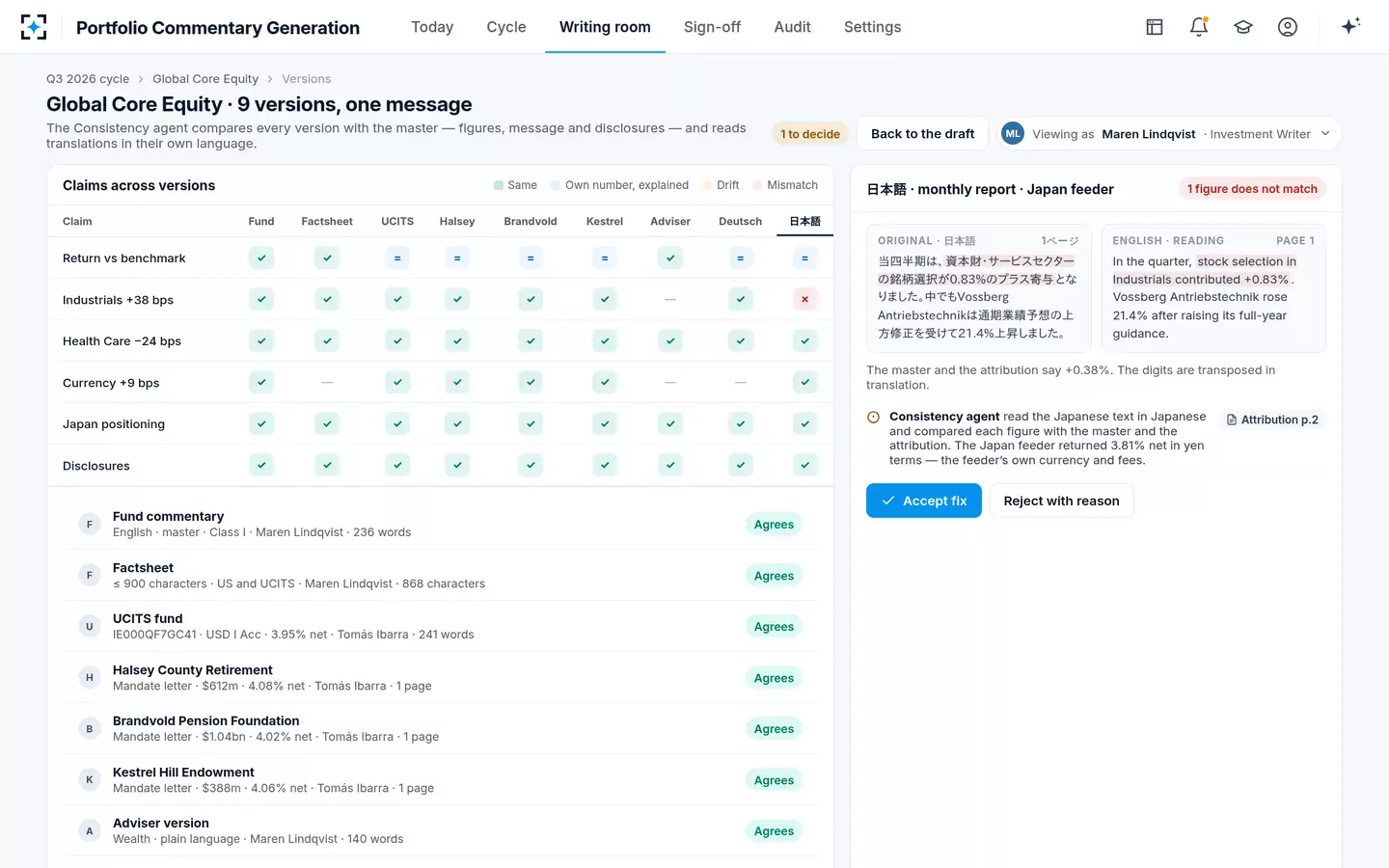
Cross-version comparisonEach version compared with the master, translations read in their own language: the Japanese report says 0.83%.
A person decides
Writer accepts the fixThe transposed digits are corrected to 0.38% and the translation vendor is told.
A person decides
PM signs, compliance clears, a fourth person releasesNine versions go out together, each still tied to the same cell.
What is performance attribution, and where does a commentary figure start?
Performance attribution decomposes the difference between a portfolio's return and its benchmark's into the decisions that caused it. In a Brinson-Fachler model by sector, each sector gets an allocation effect (from holding more or less of it than the index) and a selection effect (from holding better or worse stocks within it), and the effects add up to the active return; a full attribution report, worked cell by cell, shows the arithmetic. Every effect figure in a commentary should start life as one cell of that report.
In the sample, Industrials had a portfolio weight of 13.9% against 11.4% for the index, a portfolio return of 7.80% against 5.07%, an allocation effect of +0.04% and a selection effect of +0.38%, for a total of +0.42%. Three numbers in that row could become "Industrials added X" in a careless sentence, and only one of them is what the commentary means when it says stock selection. The report was signed final by the performance team on 8 October; anything drafted from an earlier run is drafted from a number that may not survive.
Advisers must keep the working papers that show how any performance figure in a client communication was calculated (17 CFR 275.204-2(a)(16)). The attribution report, version and final status are those working papers for every effect figure. A sentence that cannot name its cell has nothing behind it.
Basis points vs percentage: the first hop and the first error
Write effects in basis points and returns in percent, and convert once, at the first hop. One basis point is one hundredth of one percent, so the cell's +0.38% becomes 38 basis points. The conversion is trivial; the error is in skipping it, or doing it twice, so that the sentence says "0.38 basis points" or "38%".
The convention exists because effects are small and returns are large, and mixing units makes them hard to compare. "The fund returned 3.93% and selection added 0.54%" invites a reader to subtract; "selection added 54 basis points" signals a different kind of number. The sample house style makes it a writing rule, and the Fact-check agent checks the unit of every figure sentence as one of its five properties.
How to explain an allocation effect without calling it something else
An allocation effect measures the decision to hold more or less of a sector than the index, so explain it as that decision: "Our overweight in Financials added 9 basis points as the sector returned 6.67%." The common error is to use the sector's total effect, allocation plus selection, and call it allocation. In the sample's first draft, the Financials sentence credited the overweight with 12 basis points; the cell for allocation said +0.09, and +0.12 was the sector's total.
Nothing in the 12-basis-point sentence looked wrong. It was a real number from the right row of the right report, and it read naturally. It was caught only because the checker re-derived the figure from the cell the sentence named, rather than checking that the number appeared somewhere in the file. Sectors with offsetting effects make this worse: a sector with large positive selection and negative allocation can show a small total that hides both decisions. Where the model reports an interaction term, it belongs to neither decision, and the interaction effect and what not to say about it covers that case.
Financial commentary examples: one sentence pattern for each effect
| Effect | Pattern that names it correctly | Pattern that mislabels it |
|---|---|---|
| Allocation (overweight) | Our overweight in [sector] added [n] basis points as the sector returned [r]%. | [Sector] added [n] basis points (when n is the total effect) |
| Allocation (underweight) | Our underweight in [sector] cost [n] basis points as the sector rose [r]%. | [Sector]’s rally was a headwind |
| Selection | Stock selection in [sector] added [n] basis points, led by [holding], which rose [r]% after [sourced event]. | Our research-driven approach in [sector] was rewarded |
| Currency | Currency added [n] basis points, mainly from the [currency]’s [r]% rise against the dollar. | Currency movements had an impact |
| Total active | Class [x] returned [a]% after fees against [b]% for the [index named in full]. | The fund outperformed (no class, period or basis) |
Portfolio commentary example: the same figure in nine versions
A single portfolio commentary rarely travels alone. In the sample cycle, Global Core Equity's master was cut into eight more versions, and the Industrials claim appears in seven of them. Each version is owned by a different person and read by a different audience, and some legitimately carry different numbers: the offshore fund class returned 3.95% net and a pension client's account 4.08%, against the master's 3.93%. A checker has to know which differences are right.
One claim, “Industrials selection +38 basis points”, across every version
| Version | Audience | What it says | Status |
|---|---|---|---|
| Fund commentary (master) | Fund shareholders | Stock selection in Industrials added 38 basis points | Tied to the cell |
| Factsheet paragraph (868 characters) | Investors and advisers | The same claim, shorter | Same |
| Offshore UCITS fund | European investors | The same effect; the class return is its own, 3.95% net | Same; own return explained |
| Three mandate letters | Pension, county and endowment clients | The same effect; each account’s own return (4.02% to 4.08% net) | Same; own returns explained |
| Adviser version (140 words) | Wealth advisers | Leaves the Industrials effect out; keeps the Health Care detractor | Not mentioned |
| German version | German distributors | The same claim, read in German | Same |
| Japanese monthly report | Japanese feeder fund investors | “+0.83%” for Industrials selection | Mismatch: digits transposed |
Nine versions, one message: the claims grid and the Japanese mismatch
Where translation changes the digits
Numbers are where machine and human translation both fail most quietly, because a wrong figure reads as fluently as a right one. A peer-reviewed study of neural machine translation found numerical mistranslation to be a general issue across commercial and research systems, and that the systems tested "are more likely to malfunction when translating larger integers and decimals with longer fractional parts" (Wang and colleagues, Findings of ACL 2021). The authors single out financial documents, where one extra or missing digit or decimal point can cost money; how good AI translation is on fund documents takes their tests further.
Translation also changes the format of correct numbers. German writes 0,38 % with a decimal comma, and other languages have their own conventions for units and separators. A check that compares strings will flag those as errors and miss a transposition that keeps the format. The test that works is semantic: read the translated sentence in its own language, extract the figure, and compare its value with the cell. In the sample, the Consistency agent did exactly that with the Japanese report and found 0.83% where the master and the attribution say 0.38%.
Regulators expect the versions to agree. ESMA's guidelines on fund marketing communications expect a performance figure in marketing to use the method and the number of the fund's legal documents, whatever the layout (ESMA34-45-1272, ¶21). In the UK, information in a marketing communication must be consistent with the information the firm gives clients in providing its services (COBS 4.5A.9R). A factsheet or translation that disagrees with the master is not a typo; it is two statements to clients that cannot both be true.
When the master changes after the versions are cut
The most expensive hop is the one that runs backwards. Versions are cut from the master while it is still being reviewed, because the calendar does not allow waiting, and then the portfolio manager edits the master. Every version cut earlier now carries the old text, and nothing in the versions themselves says so.
The sample shows it on a sentence with no figure at all. The PM rewrote the tenth sentence of the Global Core Equity master, turning a forecast about Japanese equities into a statement of positioning. Six of the other eight versions carried the old Japan line. The Consistency agent found all six, proposed aligned text for each, and waited for each version's owner to approve it; it never changes a version on its own. A figure works the same way: if a restated attribution moved the Industrials selection effect, every one of the seven versions that cite it would need the same correction, and the claims grid shows which.
By hand, the defence is a version log: for each claim in the master, the list of versions that repeat it. Without one, a late edit is a search through documents owned by five people, some of them in other languages. With one, it is a list of approvals. Either way, the lesson for financial commentary examples is the same: a number is not written once and copied; it is written once and tied, so that when the source moves, every copy knows.
Who checks the numbers in commentary?
In a commentary process run by hand, the checking is split: everyone checks a little and no one checks all of it. The writer checks the master against the attribution, the PM reads for tone, compliance reads for predictions and disclosures, the product specialist checks the mandate letters, and the translation vendor's reviewer checks the language. Each compares the version in front of them with the version before it. A figure that went wrong at the second hop is faithfully copied into the next six.
The fix is to check every figure in every version against the source cell, not against its neighbour, and to make that check independent of whoever wrote the sentence. Machine text generation from numbers is not new: a 2017 peer-reviewed model learned to write market comments from stock prices and could "generate a numerical value by selecting an appropriate arithmetic operation such as subtraction or rounding" (Murakami and colleagues, ACL 2017). What has changed is the checking. Evaluation research on long-form generated text breaks it into atomic facts and measures the share supported by a reliable source, and found one widely used chat model supported on only 58% of the facts in the biographies it wrote (Min and colleagues, arXiv preprint, EMNLP 2023 paper). A commentary sentence with a figure is an atomic fact with a known source, which makes it checkable one fact at a time.
The check behind one figure: cell, unit, period, status and cause
Checking a financial commentary figure: the tie at each hop
The checklist below is the one the sample process runs, and it works by hand as well, if slowly. Each item is a property of a figure that can change between files without the sentence looking wrong.
Seven ties for every figure, at every hop
- Source cell
The figure names one cell in one report, by version.
- Final status
The report was signed final before drafting; a restatement re-opens every sentence that cites it.
- Unit
Basis points for effects, percent for returns, converted once.
- Sign
“Added” for positive, “cost” for negative; a negative effect never described as a contribution.
- Effect type
Allocation, selection, currency or total, as the model names it.
- Period and basis
The quarter, and gross or net, matching the return it is set against.
- Every version
Each version’s figure compared with the cell, translations read in their own language; right-but-different numbers explained.
In the sample cycle, the agents checked 18,940 sentences and made 286 corrections; 241 were settled between the drafting and checking agents, and 45 went to writers with both positions shown. Those are sample figures, not a measured error rate for any firm, but they show the scale of the problem: at that density, a team checking by eye is choosing which figures not to check. Why the checker must not be the writer explains how the two agents are kept independent; to see the ties on your own attribution, start from Portfolio Commentary Generation.
Questions people ask
What is an example of attribution commentary?
"Stock selection in Industrials added 38 basis points, led by Vossberg Antriebstechnik, which rose 21.4% after raising its full-year guidance on August 6" is one, from the fictional sample. It names the effect type, the sector, the size in basis points, the main holding behind it and a sourced cause, so each part can be checked against the attribution, portfolio accounting and the issuer's release.
How many basis points is 0.38%?
Thirty-eight. A basis point is one hundredth of a percentage point, so multiply a percentage by 100 to get basis points. The usual convention in commentary is basis points for attribution effects and percent for returns, so readers do not confuse a small effect with a return.
Should the factsheet commentary use the same numbers as the fund report?
The same effect figures, yes, and the same return for the same class and period. ESMA's guidelines expect performance figures in marketing communications to use the same methodology and values as the legal documents, although the presentation may differ. Different classes, accounts or currencies may rightly show different returns, and each should say which it is.
What happens if the attribution is restated after the commentary is published?
Every sentence that cites the restated cells has lost its working paper and should be re-checked; any that changed need correcting in every version. That is why the sample process never drafts from preliminary attribution and records the report version behind each figure.
Can a figure be right in English and wrong in translation?
Yes, and it is the error most likely to reach a client unseen, because the people who check the English master often cannot read the translation. In the sample, the Japanese report said 0.83% where the master said 0.38%; the fix is to read each translation in its own language and compare its figures with the source cell.