Investment writing, stripped to its core, is this: turn the performance attribution, the portfolio manager's notes and the firm's house view into fund commentary, client letters and fund documents, in house style, on deadline, and get each one through PM approval, compliance review and translation. The seat sits in investment writing, product or client reporting teams at asset managers, and it is hard because the writer owns none of the inputs and signs none of the outputs, yet answers for every sentence in between. Botminds' Portfolio Commentary Generation was built around that seat: agents draft each commentary from final attribution and check every figure, so the writer's day moves from typing and proving to deciding the lines that need a person.
The examples below come from a fictional manager, Quillfield Capital, and one of its investment writers in a third-quarter 2026 commentary cycle of 214 strategies, run through the solution on sample data.
The investment writer and the three people every commentary passes through
Today
Reads the attribution, chases the PM for notes, drafts, checks sixteen figures by eye, then rewrites the same paragraph for the factsheet, mandate letters and the adviser version.
With agents
Opens a checked draft with every figure tied to its cell, decides the one or two lines that need a person, and routes it to the PM with a question.
Still theirs: Judgement on what matters this quarter, house style, and the conversation with the PM.
Today
Gives the writer ten minutes between markets; rewrites tone; sometimes rewrites everything.
With agents
Reads a change summary, rewrites only his own view, sees it re-checked and signs.
Still theirs: Every view and every outlook sentence, and the signature.
Today
Reads every commentary for predictions, gross-only figures and missing disclosures, across hundreds of strategies in a week.
With agents
Works one queue of flagged statements, each with the rule, the reason and proposed wording.
Still theirs: Every clearance. No agent clears a statement.
Today
Keeps mandate letters, the offshore version and translations in line with the master by hand.
With agents
Sees each claim across every version, with right-but-different numbers explained.
Still theirs: Approval of each version and the client relationship.
What does an investment writer do?
An investment writer explains, in plain and accurate prose, what a portfolio did and why, for readers who were not in the investment meeting. Most of the work is periodic: monthly and quarterly fund commentary, the management's discussion of fund performance in US annual reports, factsheet paragraphs, institutional mandate letters, and the narrative parts of fund documents. Around that sit request-for-proposal answers, strategy papers and market outlooks, depending on the firm.
The defining feature is that the writer is a translator between specialists. The performance team owns the numbers, the portfolio manager owns the views, compliance owns what may be said, the product specialist owns the client, and the translation vendor owns the other languages. The writer owns the sentences that connect them, and for a US fund report the standard those sentences must meet is set out in Form N-1A, which asks for a brief summary of the key factors that materially affected the fund's performance, market conditions and the adviser's own strategies among them (Form N-1A, Item 27A(d)(1)).
In the sample cycle one writer, responsible for equities, carried 50 of the 214 strategies. A load of that size is possible only because drafting and figure-checking are no longer done by hand; how the structure of each commentary is built is set out in how to write market commentary a reviewer signs first time.
Investment writing duties: inputs, handoffs and who signs
The clearest way to describe the work is by duty, with the input each duty depends on and the person who signs what the writer produces. Every line in the table below is a handoff, and every handoff is a place where a deadline can slip or a number can change.
The investment writer's duties, as handoffs
| Duty | Depends on | Handed to | Who signs |
|---|---|---|---|
| Draft the quarterly fund commentary | Signed-final attribution and official returns from the performance team | Portfolio manager | The PM of record |
| Explain each driver | The PM’s notes, filled orders, issuer releases, market data | Portfolio manager | The PM of record |
| Keep views in line with the house view | The investment committee’s current house view | Portfolio manager, then compliance | The PM; compliance clears any flagged statement |
| Cut the factsheet paragraph | The approved master; the factsheet template’s length limit | Factsheet production | Compliance, where the factsheet is a retail communication |
| Write mandate letters and the adviser version | Each account’s own returns; the audience’s reading level | Product specialist | The product specialist and compliance |
| Brief and check translations | The approved master; the translation vendor’s versions | Translation vendor, then in-country distributors | The version’s owner |
| File the record copy | Everything above | Document management | Nobody signs; the rules require it kept |
Two of those signatures are set by rule rather than by habit. At a broker-dealer that distributes the fund, a qualified registered principal has to approve each retail communication before it is used or filed (FINRA Rule 2210(b)(1)(A); the factsheet rules guide sets out who files what), so a factsheet or adviser piece built from the writer's text has a named approver who is never the writer. And for a registered adviser, the working papers behind every performance figure in an investment letter must be kept, which is why filing the record copy is a duty even though nobody signs it.
Where a commentary's writing hours go
Most of a writer's hours on a commentary are not spent writing. Gathering the inputs, checking every figure against the attribution and rewriting the text for each version take more time, together, than the first draft. No regulator or independent study publishes how long a fund commentary takes; the split below is Botminds' own design estimate for one strategy, and the way to replace it is to log a quarter of your own.
One strategy's commentary hours, by hand and with agents: drafting is the smaller part
By hand · 2.5 writer hours
- Gather inputs · 20%
- Draft · 30%
- Check figures · 20%
- Rewrite versions · 20%
- Check translations · 10%
With agents · 15 writer minutes
- Gather · 8%
- Draft · 12%
- Check figures · 40%
- Versions · 20%
- Translations · 20%
The second bar is the more interesting one. When the agents do the gathering and drafting, checking becomes the largest share of what is left. That is the right shape for the job: the writer's time goes to the decisions that need a person, such as whether a disputed figure is right, whether a cause is supported, or whether the PM's view has drifted from the house view.
Investment writing tips from the review queue
The best investment writing tips are the reasons drafts come back. Each one below is a pattern that a reviewer catches and a writer can prevent at the keyboard.
Lead with the number the reader holds. A shareholder in Class I wants Class I's return after fees, not the composite gross. Name the class, the period and the benchmark in the first sentence.
Write effects in basis points and say which effect. "Selection in Industrials added 38 basis points" is precise; "Industrials contributed strongly" is not, and "allocation" used for a sector's total effect is wrong. Both corrections in the sample draft were of this kind: a figure that read well and was wrong.
Explain detractors as carefully as contributors. A commentary that gives three reasons for each win and none for each loss reads as advocacy, and research on shareholder reports suggests it is a common habit; why wins sound like skill and losses like luck sets out the evidence.
Keep the PM's views in the PM's words. The writer's job is to place the view, check it against holdings and the house view, and flag a prediction, not to sharpen it. A rewritten view is a view the PM did not sign.
Write the master once and derive the rest. Every version retyped from scratch is a version that can drift when the PM edits the master late. Track which claim appears in which version, so a change in one is a change in all.
The rules an investment writer works inside
An investment writer is not a compliance officer, but four rules shape almost every sentence, and a writer who knows them sends fewer drafts back and forth. None of them is long; each changes what a good sentence looks like.
The US annual report asks for specifics. Form N-1A's instruction for the management's discussion of fund performance tells funds to leave out long, generic discussions of what moved markets in general and to summarize the key factors behind this fund's result (Item 27A(d)(1) and its Instruction 1). A writer trained on market newsletters has to unlearn the scene-setting paragraph.
Performance figures need their working papers. A registered adviser must keep the records that show how every performance figure in an investment letter or other communication was calculated, for five years, counted from the end of the fiscal year the communication last went out (17 CFR 275.204-2). A figure copied from last quarter's draft, or from a preliminary attribution run, has the wrong working paper behind it.
Retail communications must not predict. FINRA Rule 2210 bars communications that predict or project performance, outside narrow exceptions (FINRA Rule 2210(d)(1)(F)); the exception the SEC approved in October 2026 for projections and targeted returns is aimed at institutional and other sophisticated investors, not at a factsheet. The writer is usually the first person to see a PM's forecast, and the cheapest place to catch it.
In the UK and EU, the test is fair, clear and not misleading. The FCA applies it to every communication and financial promotion, and its detailed rules on past and future performance turn it into sentence-level conditions; the sentence-by-sentence test works through them.
Will AI replace investment writers?
The evidence so far says AI takes the drafting and leaves the judgement, which changes the job more than it removes it. In a randomised experiment with 453 college-educated professionals doing occupation-specific writing tasks, access to ChatGPT cut the average time taken by 40% and raised output quality by 18% (Noy and Zhang, Science, 2023). Those were mid-level professional tasks, not fund commentary, and nobody checked figures against an attribution file; the result is about speed of drafting, which is the part of the commentary job that was already smallest.
Regulators have said the obligations stay with the firm whoever writes the text. FINRA told members in 2024 that its rules apply in the same way whether a person or a tool drafts a communication, and that a firm using such tools in supervision should cover them in its technology governance, model risk included (FINRA Regulatory Notice 24-09). The SEC's Division of Examinations, in its fiscal 2027 priorities, says registrants are building "super intelligence (SI)" into their businesses and that examiners will test whether they still meet the obligations that apply whatever the technology (SEC Division of Examinations, FY2027 priorities; the full passage is in the guide to how asset managers are using AI). ESMA warned in May 2024 that text generators can "hallucinate", writing statements that sound accurate and are false, and that firms and clients may lean on AI at the expense of human judgment (ESMA public statement, May 2024).
For a writing team those three statements land in the same place. A drafted sentence is still the firm's communication, the review that catches a wrong cause is still a person's job, and the record of who checked what is what an examiner will ask for. None of that shrinks when drafting gets faster.
Put together, the evidence points to a smaller, more senior writing team, not none. Someone must decide what mattered this quarter, judge whether a cause is supported, hold the conversation with the PM and own the house style. Those are the duties in the right-hand column of the role cards above, and none of them is drafting.
What changes on the desk when Portfolio Commentary Generation drafts
With the solution, the writer's day starts from a queue rather than a blank page. Overnight the Drafting agent wrote first drafts for 207 of the 214 sample strategies within an hour of each one's attribution being signed final; the other seven wait for final numbers, and the agents never draft from a preliminary run. The Fact-check agent checked 18,940 sentences and made 286 corrections: 241 settled between the agents, and 45 sent to writers with both positions shown.
The writer's morning: drafts due, what the agents did overnight, and what needs a person
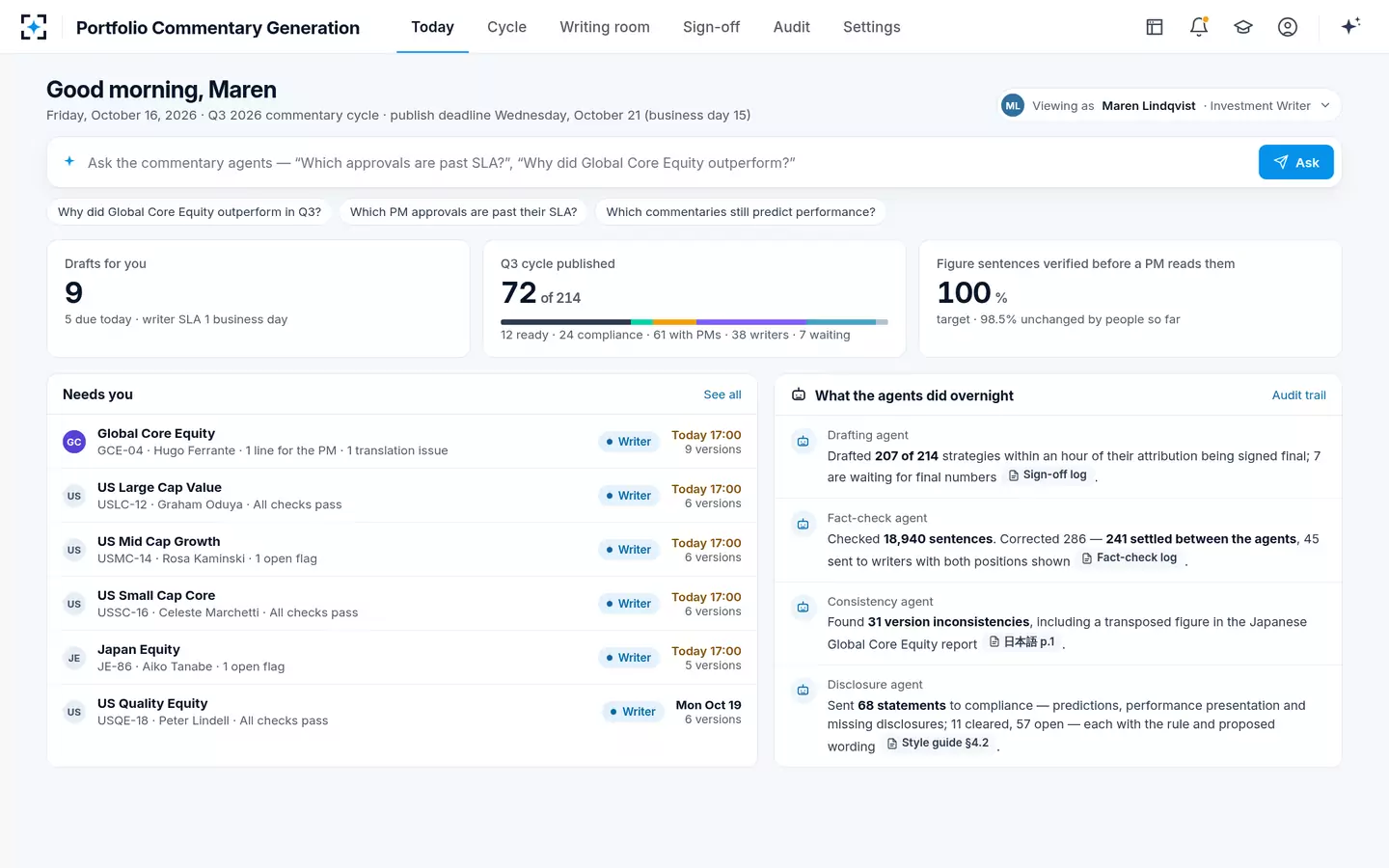
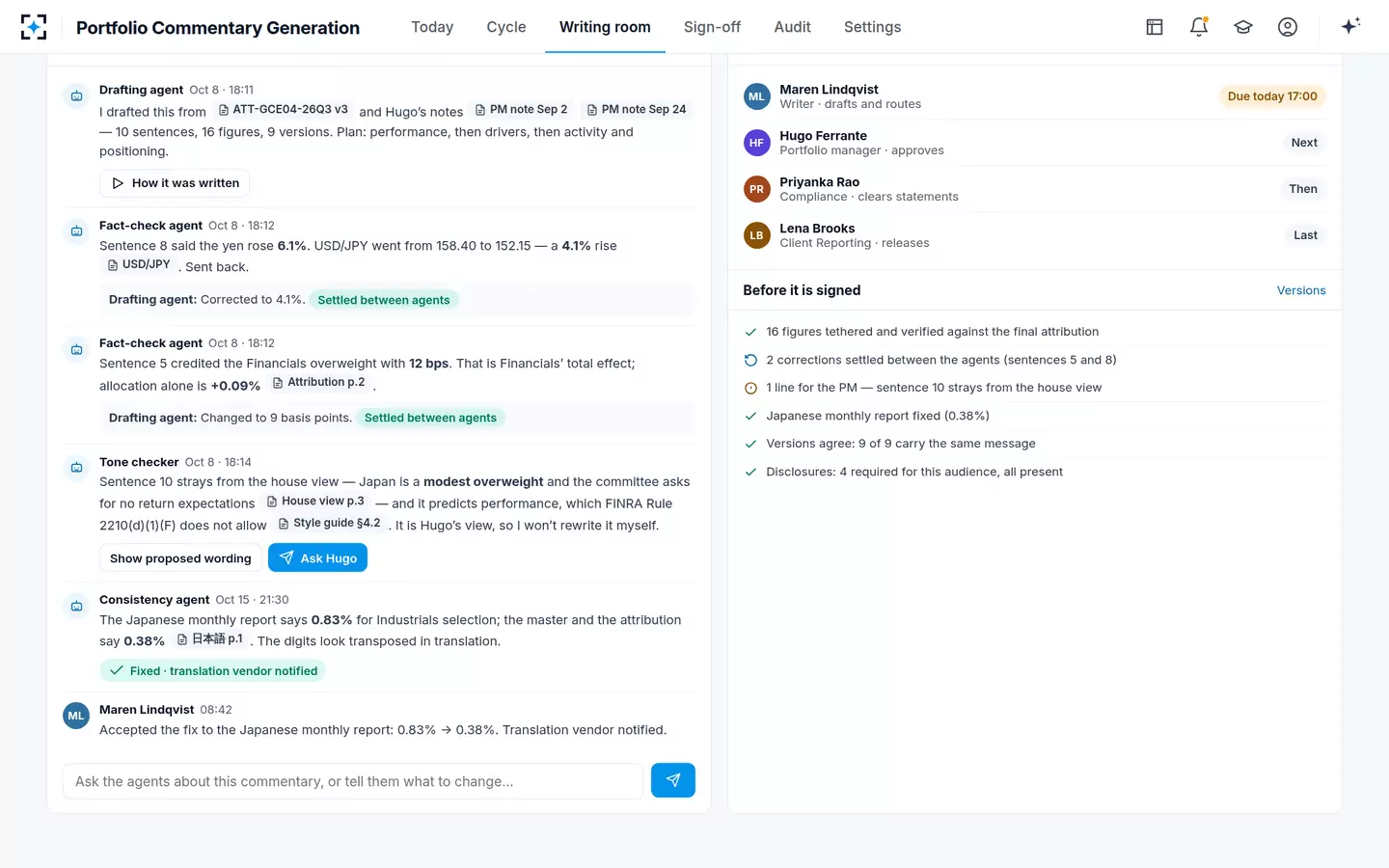
What remains is the part of the work that was always the hardest to staff: reading a disagreement between two agents and deciding which is right, sending the PM the one line that strays from the house view with a question rather than a rewrite, and approving aligned text when the PM edits the master late. The writer still routes every commentary; the agents never send it to the PM or release it.
Working with the agents on one commentary
Calibrating the commentary desk: six tests of judgment
Because the work is a set of handoffs, a head of investment writing who wants to know whether the desk is ready for agents should test the handoffs, not prose style alone. A writing sample shows fluency; the exercises below show whether the desk can do the parts of the work that agents cannot.
Six exercises that show what a commentary desk adds to the agents
- Explain one attribution report in four sentences
Give a Brinson table and a return pair; look for the right effect names, basis points and a detractor explained.
- Find the planted errors in a draft
A total effect called allocation, a gross return beside a net index, a currency move mistyped.
- Turn a prediction into positioning
Hand over “we see significant further upside” and ask for a sentence the holdings can prove.
- Cut the master to 900 characters
Without changing a figure or dropping a detractor.
- Write the email to the PM
One line strays from the house view: ask, do not rewrite.
- Spot the version that drifted
A mandate letter and a translation that no longer match the master after a late edit.
A desk that does all six well is doing the work the agents leave behind. To see how that work looks on your own strategies, start from Portfolio Commentary Generation; how the PM's side of it changes is covered in getting PMs to sign an automated draft.
Questions people ask
Is an investment writer the same as a financial writer?
An investment writer is a financial writer who specialises in what portfolios do: fund commentary, client letters and fund documents for an asset manager. A financial writer may also cover personal finance, corporate reporting or financial journalism.
Who must approve an investment writer's commentary?
No regulator requires a qualification to write commentary; approval is where qualifications bite. At a FINRA member, an appropriately qualified registered principal must approve each retail communication before use, so the writer is never the final approver. Firms still look for writers who can read an attribution report, because that is the core skill of the work.
How many commentaries does an investment writer handle?
It depends on the firm's strategy count and how much is automated; no public survey measures it. In the fictional sample cycle one equities writer carries 50 commentaries a quarter, each with up to nine versions, which is feasible only because agents do the first draft and the figure checks.
What is the difference between an investment writer and a product specialist?
The writer owns the text; the product specialist owns the strategy's story with clients. In practice the product specialist briefs the writer, approves mandate letters and offshore versions, and handles client questions about the commentary, while the writer drafts, checks and keeps every version in line with the master.
Which team owns investment writing at an asset manager?
At asset managers and wealth managers with many strategies or funds it usually sits in product, marketing, client reporting or investment communications, and smaller managers often use an agency. Titles vary: investment writer, investment content writer, product writer and investment communications manager all describe overlapping roles.