Fund factsheets are not a regulatory requirement in the US, the EU or the UK: no rule in any of the three tells a fund to publish one each month. But once a manager publishes a factsheet it is an advertisement in the US and a marketing communication in the EU and UK, so its performance figures, costs, risk statements and legends are regulated line by line, and supervisors examine them. That is the paradox behind fund factsheet production: the document is optional, its contents are not, and the volume runs to one factsheet per share class, market and language every month. Botminds' Factsheet Automation exists for that combination. Its agents build each factsheet from signed data, check every field against the fund's legal documents and the rules of each market, and hold anything they cannot prove for a compliance reviewer, who signs the release.
The answer matters in practice. It tells a product team where the legal risk sits (in what a factsheet says, not whether it exists), it tells compliance which rulebook applies to which line, and it explains why a factsheet published a day late is a commercial problem while a factsheet published with the wrong benchmark is a regulatory one.
Not required in any of the three markets; regulated in all of them
US: No rule requires it. Funds must send shareholder reports at least twice a year and keep a prospectus current.
EU: No. ESMA lists the fund’s legal and regulatory documents; a factsheet is measured against them, not among them.
UK: No. The FCA’s rules govern a factsheet’s content once it is communicated, not whether it exists.
US: An advertisement or sales literature (Rule 482, Rule 34b-1); for a FINRA member, a retail communication.
EU: A marketing communication under Article 4 of Regulation (EU) 2019/1156.
UK: A financial promotion when it invites investment and reaches retail clients.
US: A registered principal of the distributor approves it; filed with FINRA within 10 business days of first use.
EU: The manager. A national authority may ask for prior notification; most do not.
UK: The firm that communicates or approves the promotion.
US: 1, 5 and 10-year returns to the latest calendar quarter; month-end figures by phone or website; a prescribed legend.
EU: 10 years (KIID funds) or 5 in complete years; the same benchmark as the KID; “Past performance does not predict future returns”.
UK: Five years in complete 12-month periods; a prominent warning that past performance is not a reliable indicator.
US: Mislead (anti-fraud rules still apply even when Rule 482 is met).
EU: Contradict or diminish the prospectus or KID; show rewards without risks.
UK: Be unfair, unclear or misleading; fail the Consumer Duty’s understanding test.
Is a fund factsheet required by law? The documents that are
The documents a fund must produce are named in its rulebook, and a factsheet is not among them. In the US, a registered fund must send shareholders a report "at least semi-annually" and file it with the SEC (17 CFR 270.30e-1), alongside its prospectus. In the EU, ESMA's guidelines list the "legal and regulatory documents" a marketing communication must be consistent with: the prospectus, the fund's constitutional documents, "The KID or KIID", the sustainability disclosures on the manager's website, and "The annual and half-yearly reports" (ESMA34-45-1272, paragraph 18). The factsheet is what gets measured against that list.
In practice factsheets are close to universal, and the pressure to publish them is commercial. Fund platforms, fund selectors, consultants and advisers expect a current factsheet for every class they list, and data vendors take the figures from it. A US complex choosing among 8,117 mutual funds and 4,829 exchange-traded funds registered at the end of March 2026 (SEC Registered Fund Statistics) does not publish a factsheet because a rule says so; it publishes one because a fund without one is hard to sell.
Is a factsheet a marketing communication?
Yes, when it promotes the fund, and in the EU a factsheet should say so on its face. Regulation (EU) 2019/1156 requires managers to ensure "that all marketing communications addressed to investors are identifiable as such and describe the risks and rewards of purchasing units or shares of an AIF or units of a UCITS in an equally prominent manner, and that all information included in marketing communications is fair, clear and not misleading" (Article 4(1)). ESMA treats the label as the test: a communication is identified as marketing "when it includes a prominent disclosure of the terms “marketing communication”" (paragraph 6).
Supervisors read factsheets under that heading. In ESMA's January 2026 report to the EU institutions, the breaches national authorities cite include a sub-fund "fact sheet" whose benchmark did not match its KIID and another whose "investment results referred to the performance of the WIG20 index, even though it was unrelated to the adopted investment policy" (ESMA report, 6 January 2026). Both appear in the list of marketing communication breaches. In the US, Rule 482 applies to "an advertisement or other sales material" for a registered fund (17 CFR 230.482(a)), and the definition of sales literature in Rule 34b-1 covers any "advertisement, pamphlet, circular, form letter, or other sales literature addressed to or intended for distribution to prospective investors" (17 CFR 270.34b-1).
What the law demands, and what the factsheet borrows from it
Required documents: Prospectus, KID or summary prospectus, annual and half-yearly or semi-annual shareholder reports.
The factsheet: A one- or two-page monthly summary per share class, market and language.
Required documents: A rule names it, its contents and its deadline.
The factsheet: Platforms, selectors and advisers expect it; no rule names it.
Required documents: Prepared under the rule that requires it, and signed or certified.
The factsheet: Copied from the required documents and signed month-end data.
Required documents: Its own rule: form, content, timing.
The factsheet: Advertising and marketing rules: consistency, balance, performance periods, warnings, legends.
Required documents: A filing or disclosure deficiency.
The factsheet: A misleading marketing communication, and a reissue to every platform that took it.
United States: Rule 482, Rule 34b-1 and FINRA Rule 2210
A US fund factsheet that shows performance falls under three overlapping rules. Rule 482 sets what the advertisement must say. It must tell investors to "consider the investment objectives, risks, and charges and expenses of the investment company carefully before investing" and say where to get a prospectus (Rule 482(b)(1)). If it shows performance, it must carry a legend that the data "represents past performance; that past performance does not guarantee future results", that principal value will fluctuate, and that "current performance may be lower or higher" (482(b)(3)(i)), presented "in close proximity to the performance data" and, in print, "in the body of the advertisement and not in a footnote" (482(b)(5)). Average annual total returns for one, five and ten years must be "current to the most recent calendar quarter ended prior to the submission of the advertisement for publication" (482(d)(3)).
Rule 34b-1 pulls the same disclosures into sales literature generally and applies Rule 482's timeliness test to it. And FINRA Rule 2210 governs the broker-dealer that distributes the fund: a factsheet distributed to more than 25 retail investors within 30 calendar days is a retail communication; "An appropriately qualified registered principal of the member must approve each retail communication" before use; and "Within 10 business days of first use or publication" the member must file "Retail communications that promote or recommend a specific registered investment company" (FINRA Rule 2210(a), (b)(1)(A), (c)(3)). The detailed filing and content questions under Rule 482 and Rule 2210 belong to marketing compliance; what matters for production is that each rule turns into a box, a legend or a date on the page.
European Union: Article 4 of Regulation 2019/1156 and ESMA's guidelines
In the EU the factsheet rules have applied in their current form since 2 August 2021, when Article 4 of Regulation (EU) 2019/1156 took effect (Article 19). Article 4 adds to the UCITS Directive's older requirement that marketing communications be "clearly identifiable as such" and "fair, clear and not misleading" (Directive 2009/65/EC, Article 77). A UCITS marketing communication must say that a prospectus and key investor information exist, and where, how and in which language an investor can get them, with links (Article 4(2)), and point to a summary of investor rights and say the manager may terminate its marketing arrangements (Article 4(3)).
ESMA's guidelines turn those principles into checks a factsheet must pass: the label; risks "at least equal to the predominant font size"; the same risk classification as the KID; costs explained so investors understand "the overall impact of costs on the amount of their investment"; past performance consistent with the KID, over set periods, with each year shown beside any cumulative figure; and a fixed statement before it. They are guidelines, not a regulation, but national authorities "must make every effort to comply" and must tell ESMA whether they do (paragraphs 3 and 4), and four countries have written them into binding law (ESMA report, 2026, paragraph 13). How these play out market by market is the subject of UCITS factsheet rules.
United Kingdom: COBS 4 and the Consumer Duty
In the UK, the FCA's conduct rules apply to a factsheet as a financial promotion to retail clients. The base rule is that every communication and financial promotion must be fair, clear and not misleading (COBS 4.2.1R(1); fair, clear and not misleading, sentence by sentence applies it to fund commentary). For performance, COBS 4.6.2R requires that past performance is "not the most prominent feature of the communication", covers "the preceding five years" in "complete 12-month periods", states "the reference period and the source of information", and carries a prominent warning that the figures are past results and no reliable guide to the future (COBS 4.6.2R). The FCA past performance disclaimer guide takes that warning apart.
Since 31 July 2023 the Consumer Duty adds a test of outcome, not just form: firms must make sure communications "are likely to be understood by retail customers" (PRIN 2A.5.3R) and, where appropriate, test them on retail customers before sending them (PRIN 2A.5.10R). A factsheet that ticks every COBS box can still fail if the people it is written for misread it.
What must a fund factsheet include once you publish one?
It must include whatever its content triggers. A factsheet with no performance figures needs fewer legends than one with a ten-year table; one sold in three countries needs three sets of local wording. The table below lists the triggers that matter most for a production team. The box-by-box version, with a source and an owner for each line, is the fund factsheet template.
If the factsheet shows this, it must also show that
| If the factsheet shows | United States | European Union | United Kingdom |
|---|---|---|---|
| Any performance figure | Rule 482 legend beside it; 1, 5 and 10-year standardised returns to the latest quarter; a phone number or website for month-end data | “Past performance does not predict future returns” before it; reference period and data source | Prominent warning that past performance is not a reliable indicator; reference period and source |
| A cumulative return | Standardised returns with equal or greater prominence | Each year of the period as well | Complete 12-month periods |
| A cost figure | Total annual expenses before waivers, as prominent as any other cost figure; waiver end date | Costs consistent with the KID, explained for their effect on returns | Effect of charges if performance is gross |
| Figures in another currency | No specific legend | The currency and a currency warning | The currency and a currency warning |
| A fund for sale | Read the prospectus first; where to get it | “Marketing communication”; where, how and in which language to get the prospectus and KID | Fair, clear and not misleading; understood by its audience |
Do ETFs need a fact sheet?
No rule requires an exchange-traded fund to publish a factsheet either, but ETFs publish them for the same commercial reasons, and the same rules apply with one addition. In the EU, ESMA's guidelines ask an ETF's marketing communications to name the regulated markets where the fund trades, and to base any expected-performance figures on the fund's NAV (paragraph 58), and recommend the words "passive" or "passively managed" alongside "index-tracking" (paragraph 28). In the US, most ETFs are open-end funds, so Rule 482 governs the performance they advertise.
The volume is rising. The SEC counted 4,829 ETFs at the end of March 2026, against 3,992 in April 2025 (SEC Registered Fund Statistics, Table 1.1): more than 800 new funds in eleven months, each with at least one factsheet to produce.
Who checks factsheets, and how often do supervisors find problems?
The manager checks them first; supervisors check some of them afterwards. In the EU, Article 5 of Regulation 2019/1156 lets a national authority demand prior notification and answer "within 10 working days", but the majority of authorities "do not carry out systematic ex-ante verification of marketing material"; more of them now check after publication, case by case and on a risk basis (ESMA report, 2026, paragraphs 37 to 39 and 61). Where authorities do look, they find work to send back: between February 2023 and January 2025 Belgium's supervisor sent back 1,822 requests to amend marketing material it reviewed in advance, Denmark's 878 and France's 25 (paragraph 64).
…four years after the publication of the ESMA Guidelines and three years after the entry into force of the Regulation, many marketing communications still do not meet the standards introduced by the Regulation and the ESMA Guidelines.
ESMA, report to the European Parliament, Council and Commission, 6 January 2026, paragraph 62
The most frequent breaches the report lists are the ones a factsheet template can prevent: communications not identifiable as marketing, risks and rewards presented unequally, the presentation of past performance, and information inconsistent with the fund's own documentation (paragraph 71).
Why the optional document carries the strictest rules
A factsheet is read more often than any required document and acted on faster, which is why the rules bear down on it. The KID is the document an investor must be given; the factsheet is the one a platform shows on the fund's page, a selector screens on and an adviser prints. That is why the rules insist it borrow its numbers from the legal documents rather than invent its own: ESMA's guidelines want any indicator calculated the same way, and to the same value, as in the legal documents, even if it is laid out differently (paragraph 21; the factsheet template quotes it box by box).
For a manager, the consequence is that factsheet risk is volume risk. Each extra share class, market and language multiplies the number of documents that must agree with a KID, a prospectus and a registration list that change during the year. Most errors supervisors cite are not drafting errors but consistency errors: a stale figure, the wrong benchmark, a cost shown on the wrong basis, a legend missing for a new market. Those are the errors a manual four-eyes review on a sample is least likely to catch, because each factsheet looks right on its own.
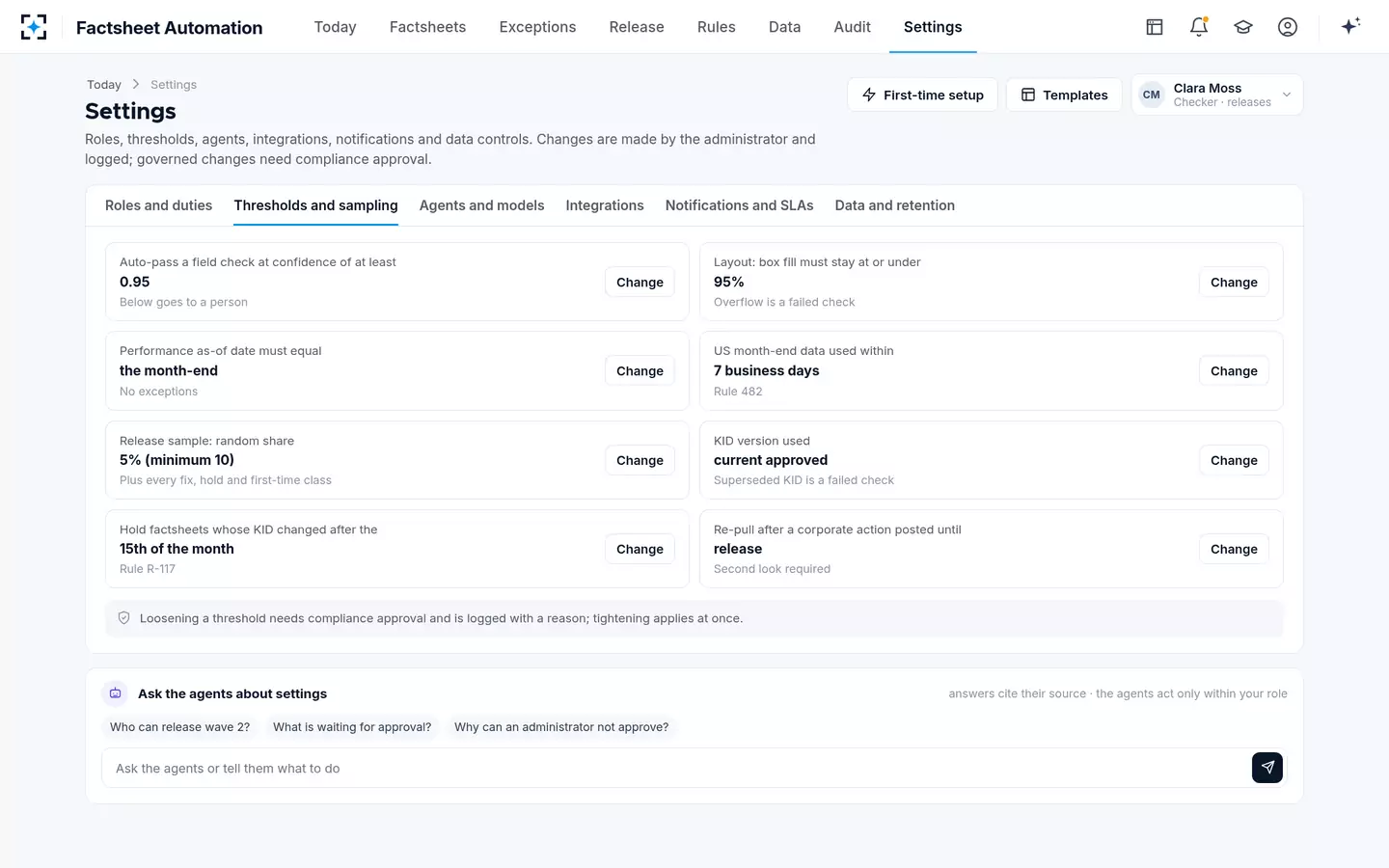
Factsheet Automation's thresholds: the rules as settings
Where Factsheet Automation fits
Factsheet Automation does not decide whether to publish factsheets or what the rules mean; your product and compliance teams do. It applies the rules you set to every factsheet in every cycle. Seven agents collect signed month-end data, build each factsheet from an approved template for every registered share class, market and language, check dates and figures against the KID and prospectus, derive each market's legends from the live registration list, compare every language with the English master, and hold what they cannot prove. People decide the holds, work a risk-based sample and sign one release per wave.
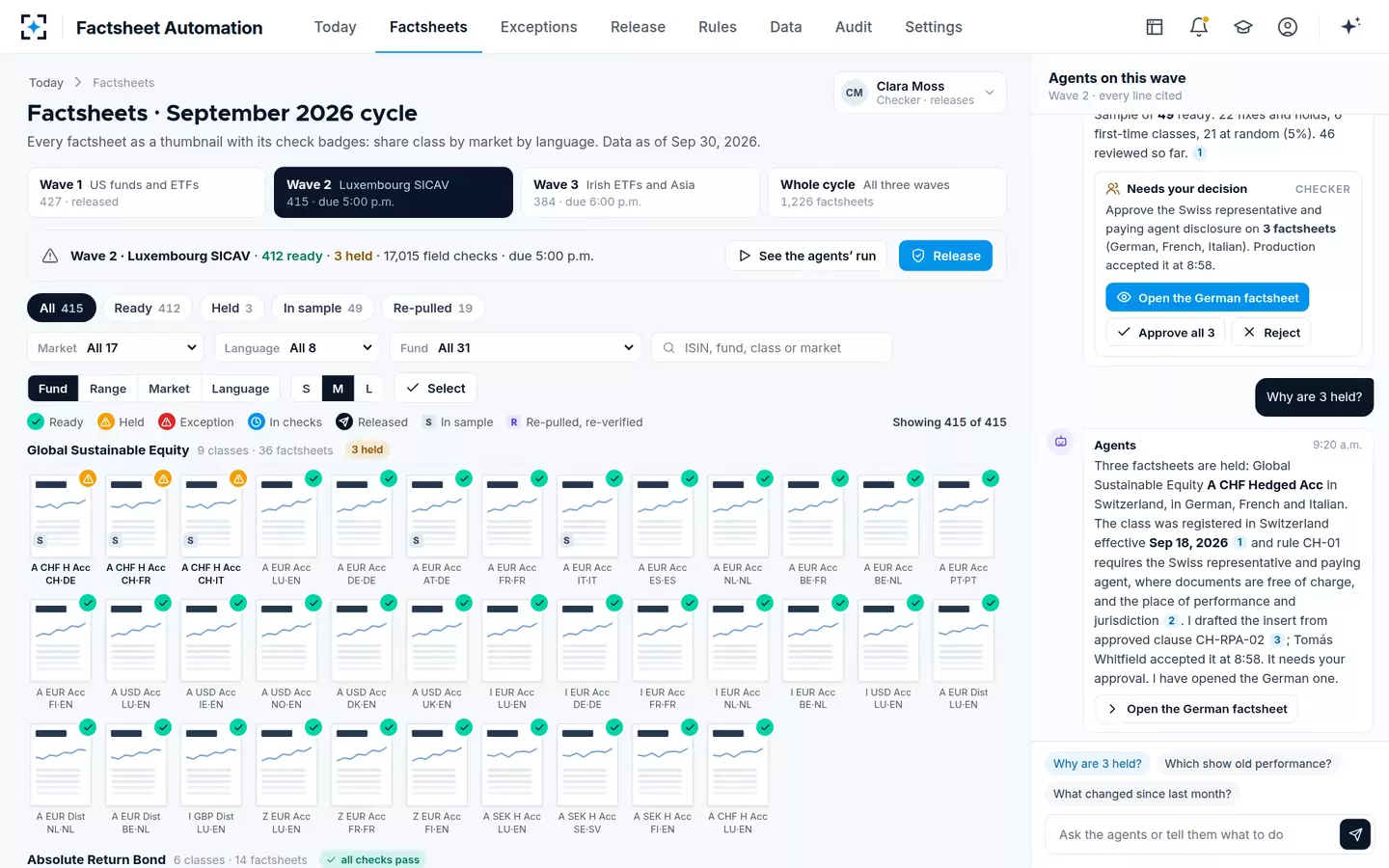
In the solution's fictional sample cycle, the Disclaimer agent held three Swiss factsheets for a class registered in Switzerland on 18 September because the Swiss representative and paying agent legend was missing, drafted the insert from an approved clause, and waited for the production lead and the compliance reviewer to approve it. Nothing in that sequence changes what the law requires. It changes how many of 415 factsheets a reviewer has to open to be sure that each one meets it.
Asking Factsheet Automation why three factsheets are held
Questions people ask
Who regulates fund factsheets?
In the US, the SEC through Rule 482 and Rule 34b-1, and FINRA through Rule 2210 for the broker-dealers that distribute funds. In the EU, the fund's home and host national authorities apply Regulation 2019/1156 and ESMA's guidelines. In the UK, the FCA applies COBS 4 and the Consumer Duty.
Does a fund factsheet need compliance approval?
A US factsheet that is a retail communication of a FINRA member must be approved by a registered principal before use. EU and UK rules put the responsibility on the manager or the firm communicating the promotion rather than naming an approver, so most managers route factsheets through marketing compliance before release.
Are fund factsheets filed with FINRA?
Retail communications that promote or recommend a specific registered investment company must be filed by the member firm within 10 business days of first use or publication under Rule 2210(c)(3). Whether a given monthly update needs a fresh filing is a question for the firm's marketing compliance team.
How often must a factsheet be updated?
No rule sets a frequency, but the figures must be current when used. In the US, returns must be current to the latest calendar quarter, with month-end returns available unless the ad shows returns to the month ended seven business days before use. ESMA expects features to "be kept up to date" and allows a current-year figure updated to the most recent quarter-end.
Is a factsheet a KID?
No. The KID is a required pre-contractual document with a fixed format and a limit of three sides of A4; the factsheet is a marketing communication that must be consistent with it. A factsheet should tell the reader where to find the KID, in which language, with a link.
Does a factsheet for professional investors follow the same rules?
Mostly. ESMA's guidelines apply to all marketing communications "regardless of the target investors", but allow the level of detail and the way information is presented to be adapted to whether the fund is open to retail investors. In the US, a factsheet sent only to institutional investors is an institutional communication under Rule 2210 rather than a retail one.