A fund factsheet template should hold fourteen boxes: the marketing label, the fund and class identity with its date, objective and policy, benchmark, the performance table, calendar-year returns, the past performance and currency statements, fund facts, costs, the risk indicator with its risk text, holdings and sectors, commentary, sustainability, and the legends each market requires. What makes it a good template is not the design but what sits behind each box: the system the number comes from, the person who owns it and the rule it must satisfy. Get those three right and the same template can produce one factsheet or a thousand. Botminds' Factsheet Automation treats the template that way, as a set of fields its agents fill from signed sources and check before a compliance reviewer releases the result.
The difficulty is multiplication. A template is approved once; it is then filled for every share class in every market where that class is registered, in each language of that market, every month. A box that is safe in the English master for one class can be wrong in the German version for another. ESMA's 2026 report to the EU institutions shows where the errors cluster: past performance tables, benchmarks, risk indicators, cost figures and the information on where to obtain the prospectus and KID.
The 14 boxes of a fund factsheet template
- Marketing label and disclaimer
“Marketing communication”, and where to read the prospectus and KID before deciding. ESMA paragraphs 6–7.
- Identity and date
Fund, share class, ISIN, currency, as-at date. Every other box depends on these being right.
- Objective and policy
From the prospectus; active or passive in so many words. ESMA paragraphs 26 and 28.
- Benchmark
The index the KID and prospectus use, by name. ESMA paragraph 43.
- Performance table
Signed returns, fund beside benchmark; US standardised 1, 5 and 10 years to quarter-end. Rule 482(d)(3).
- Calendar years
Ten complete years for KIID funds, five otherwise, or since launch. ESMA paragraphs 44 and 46.
- Performance and currency statements
The fixed statement before the figures; the currency warning. ESMA 47–48; Rule 482(b)(3).
- Fund facts
Fund size, NAV per share, launch date, number of holdings, as at the same date.
- Costs
Ongoing charges or total annual expenses on the legal documents’ basis. ESMA 21 and 41; Rule 482(i).
- Risk indicator and risk text
The KID’s class, and risks as prominent as rewards. ESMA 13 and 36.
- Holdings, sectors, regions
Top ten and weights from portfolio accounting; weights that sum.
- Commentary
Approved text from the portfolio manager; claims justified by verifiable sources. ESMA 32.
- Sustainability
Classification and claims consistent with the prospectus, with the disclosure link. ESMA 59–62.
- Legends by market
Investor rights summary, termination of marketing, local warnings, representatives. Regulation 2019/1156 Art. 4(2)–(3).
What should a fund factsheet template include?
It should include every box a reader needs to understand the fund and every box a rule requires once the factsheet shows performance, costs or risks, and for each box three fields that no designer's mock-up carries: the source, the owner and the rule. The source is the system of record the value is taken from: the performance system for returns, the administrator for NAV, the KID for costs and risk, the prospectus for objective and benchmark, portfolio accounting for holdings, the distribution database for registrations. The owner is the person who signs that value off. The rule is the sentence in ESMA's guidelines, Rule 482 or COBS 4 that the box must satisfy.
ESMA states the governing principle in one line: the wording or the presentation "should not be inconsistent with, add to, diminish or contradict any information mentioned in the legal or regulatory documents of the promoted fund" (ESMA34-45-1272, paragraph 20). A template built on that line borrows every regulated number from a regulated document. The table below shows the result for each box.
Each box with its source, its owner and what supervisors have found wrong
| Box | Source | Owner | Seen by supervisors |
|---|---|---|---|
| Label and disclaimer | Approved clause library | Marketing compliance | Not identifiable as a marketing communication (BG, HR, PT) |
| Benchmark | KID and prospectus | Performance | Factsheet benchmark EONIA+2.5% where the KIID said €STR (PL) |
| Performance and calendar years | Signed returns file | Performance analyst | Cumulative performance without each year (IT); current year to month-end, not quarter-end (LU) |
| Costs | Current KID | Product | Management fee shown where the KID showed ongoing charges (LU) |
| Risk indicator | Current KID | Risk or product | Inaccurate risk indicators, benchmark and past performance tables (IE) |
| Objective and holdings | Prospectus; portfolio accounting | Product; data | A fund of funds factsheet describing the underlying foreign fund without saying so (PL) |
| Legends by market | Registration list and clause library | Compliance and registration | No statement of where and in which language to get the prospectus and KID (AT, BG, LU) |
The header block: label, identity and the date
The header carries the three facts every other box depends on: what kind of document this is, which share class it describes, and the date its figures are as at. In the EU the label is not decoration. A communication counts as identified when it "includes a prominent disclosure of the terms “marketing communication”", and ESMA's model disclaimer adds "Please refer to the [prospectus …] and to the [KIID/KID] before making any final investment decisions" (paragraphs 6 and 7). It belongs in the reader's language: on the solution's fictional German sample factsheet, the label reads "Marketing-Anzeige".
Identity is the ISIN, the class name and its currency, and the one place a template should never let a person type. Classes of one fund often differ only by a letter and a currency (A EUR Acc, A CHF Hedged Acc, I USD Dist), and a factsheet built for the wrong class carries the wrong costs and the wrong returns while looking perfectly normal. Draw the identity block from the distribution database and the as-at date from the signed data, not from the calendar.
Objective, policy and benchmark: copied, never paraphrased
The objective and policy box summarises the prospectus, and the safe way to fill it is with approved wording taken from the prospectus. ESMA expects "at least a short description of the investment policy of the fund and an explanation on the types of assets into which the fund may invest" (paragraph 26(b)), and recommends naming the style: "passive" or "passively managed" for index trackers, "active" or "actively managed" otherwise, with "the degree of freedom from the benchmark" for active funds managed in reference to an index (paragraph 28).
The benchmark gets its own box because it is the number every return is judged against. When the KID or prospectus measures the fund against an index, "the same benchmark index should serve as a reference in the marketing communication" (paragraph 43). A benchmark changes rarely, which is exactly why templates get it wrong: a change in the prospectus that the template never picked up leaves every factsheet in the range comparing the fund with last year's index.
What goes in the performance section of a factsheet?
The performance section holds signed returns for the share class beside its benchmark, over periods fixed by rule, with the statement that governs how they are read. It is the box with the most rules, and it differs by market. Under ESMA's guidelines, past performance should cover "the preceding 10 years for funds establishing a KIID, or for the preceding 5 years for other funds", "based on complete 12-months periods", optionally "supplemented with performance for the current year updated at the end of the most recent quarter" (paragraph 44); cumulative figures need each year beside them (paragraph 46); and the figures are "preceded by the following statement: “Past performance does not predict future returns”" (paragraph 47). It "should not be the main information of the marketing communication" and should name "the reference period chosen for measuring the performance and the source of the data" (paragraph 44).
A US template needs a different table. Rule 482 requires average annual total return "for one, five, and ten year periods" "current to the most recent calendar quarter", set out "with equal prominence" (Rule 482(d)(3)), and any other performance measure no more prominent than those. The legend that goes with it must sit "in close proximity to the performance data" and, in print, "not in a footnote" (482(b)(5)). A UK template follows COBS 4.6.2R: five years, complete 12-month periods, the source stated, and a prominent warning that the figures are historical and do not reliably predict future results (COBS 4.6.2R; the exact words and what testing shows about them are in the past performance disclaimer guide). One template serving all three markets therefore needs a performance section that changes shape by market, not one table with three legends pasted under it.
Presenting risks and rewards in the form of a two-column table or summarised in a list clearly differentiating the risks and the rewards on a single page is a good example of how risks and rewards can be presented in an equally prominent manner.
ESMA guidelines on marketing communications, paragraph 13
Cost and risk boxes: the KID's numbers, the KID's method
The cost and risk boxes should show the same figures, calculated the same way, as the current KID. ESMA puts it precisely: where figures relating to "risks and rewards, costs, or past and expected future performance" appear, "the methodology and the value for the computation of the indicators should be the same as in the legal and regulatory documents although the presentation may be different" (paragraph 21). The cost box also needs "an explanation to allow investors to understand the overall impact of costs on the amount of their investment and on the expected returns" (paragraph 41), and a currency warning where costs are paid in a currency other than the investor's (paragraph 42). In the US, a factsheet that shows any fee or expense figure must include total annual expenses before any waiver, "at least as prominently as any other fee or expense figure" (Rule 482(i)(1)).
The risk box takes the KID's risk class and must "refer to the same risk classification as that included in the KID or the KIID" (paragraph 36). The risk text beside it is a design constraint: the font for risks "should be at least equal to the predominant font size", and risks should not be "in a footnote or in small characters within the main body" (paragraph 13). The quote above is ESMA's own suggestion for the layout. The timing trap is the KID itself: KIDs are revised during the year, and a template that copied costs and risk class at its last approval will show superseded numbers until someone notices.
Holdings and sector boxes: the data that moves after a corporate action
Holdings, sector and region weights come from portfolio accounting, as at the factsheet date, and they are the boxes most likely to change after the data has been pulled. A stock split, merger or spin-off posted late in the cycle can change a top-ten table, its names or its weights. The checks a template should carry are simple to state: the weights sum to 100% within rounding, the names match the security master, the date matches the as-at date, and the number of holdings matches the fund facts box.
Fund-of-funds structures need one more rule. Poland's regulator reported a sub-fund factsheet that described "the investment policy and portfolio structure of a foreign fund in which more than 90% of the sub-fund's assets were invested, without informing investors that the data presented referred to the foreign fund" (ESMA report, 2026). If the template shows look-through data, it must say so.
Commentary and sustainability text: approved words, placed not written
The commentary is the one box written each month, and the template's job is to place approved text, not to produce it. ESMA asks that statements be "adequately justified based on objective and verifiable sources, which should be quoted", and that communications avoid "overoptimistic wording, such as “the best fund” or “the best manager”" and wording "that would diminish the risks, such as “safe investment”" (paragraph 32). A template should fix the commentary's length so it fits the box in every language, because translated text runs longer and the easy fix, shrinking the font, works against the readability ESMA asks for in paragraph 24.
Sustainability claims are the fastest-growing source of breaches. The national authorities' list in ESMA's report includes communications that "failed to comply with ESG provisions" in four countries, and examples where "The strategy concerning ESG investment was overemphasised compared to the strategy set out in the regulatory documentation" (ESMA report, 2026). The template box should carry the fund's SFDR classification from the prospectus and a link to the website disclosure, which ESMA expects "where relevant" (paragraph 60).
Legends by market: the block a template cannot hard-code
The legend block is different for every market a class is registered in, so it has to be assembled from the registration list each month, not typed into the template. EU law requires every UCITS marketing communication to tell investors where, how and in which language they can get the prospectus and the key investor information, with links, to point to "a summary of investor rights", and to state that the manager "may decide to terminate the arrangements made for the marketing" (Regulation (EU) 2019/1156, Article 4(2) and (3)). National rules then add their own wording, which UCITS factsheet rules by market maps country by country.
The failure mode is the newly registered class. The template was approved when the class was sold in five countries; in September it is registered in a sixth, and nothing in the template knows. A legend block built from a live registration list catches it; a legend block in a Word file does not.
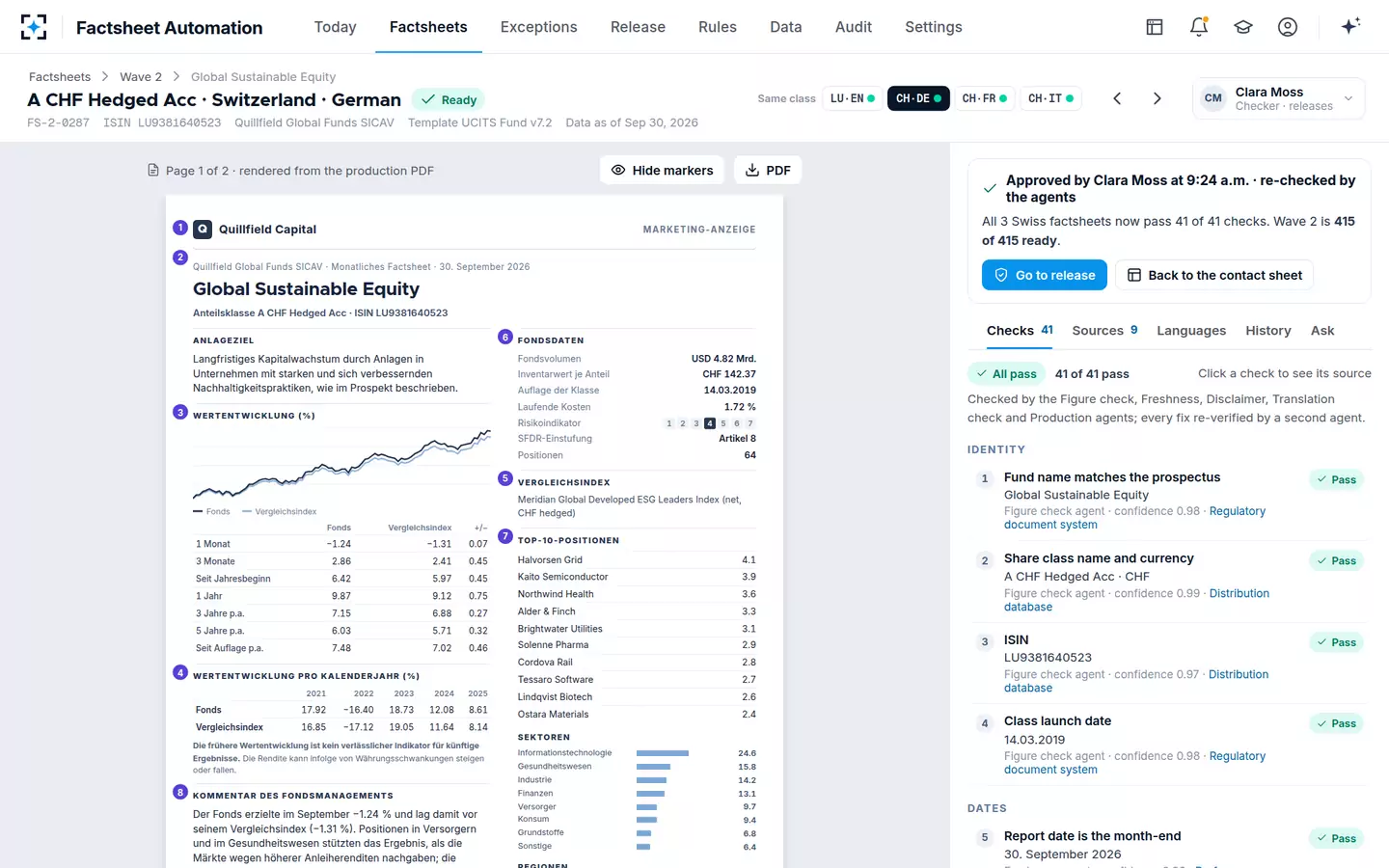
A Factsheet Automation template filled: every box numbered to its check
Fund fact sheet template in Word, or a template as data?
A Word or design-tool template is fine for one fund in one market and breaks down at volume, because the rules live in people's heads rather than in the template. A template as data stores each box as a field with its source, owner, rule and allowed length; the layout is generated from it. The choice is less about software than about where the checks sit.
Two ways to hold a factsheet template, and where the rules live
Document template (Word or design tool): Copy last month’s file, edit the class name, ISIN and costs by hand.
Template as data: Add the class to the distribution database; every box fills from its source.
Document template (Word or design tool): Someone remembers to add the local legend.
Template as data: The registration list adds the market; the legend block follows its rule.
Document template (Word or design tool): Found when someone compares the two documents.
Template as data: A superseded KID fails the cost and risk checks.
Document template (Word or design tool): Font shrunk to fit.
Template as data: Overflow is a failed check; the text goes back for shortening.
Document template (Word or design tool): The final PDF.
Template as data: Each value with its source, date, owner and the check it passed.
Hedge fund and mutual fund fact sheet templates: what changes
A US mutual fund fact sheet template follows Rule 482: standardised one-, five- and ten-year returns to the latest quarter with the legend beside them, the instruction to read the prospectus, and gross expenses before waivers. A hedge fund factsheet is different in law. A private fund's factsheet is an adviser's communication rather than a registered fund advertisement, so the SEC's adviser marketing rule applies, with its prohibitions on presenting performance or time periods in a way that is not fair and balanced (17 CFR 275.206(4)-1(a)); its gross and net performance questions belong to marketing compliance. In the EU, a hedge fund is an AIF, and the ESMA guidelines apply to its marketing communications too, adapted where the fund is sold only to professional investors (paragraph 16).
The structure of the template barely changes between them: identity, strategy, performance, risk, exposures, terms, legends. What changes is the rule behind each box, which is the argument for writing the rule into the template rather than into the reviewer's memory.
How Factsheet Automation locks the template
Factsheet Automation keeps the template as approved boxes and lets agents fill them, not edit them. The Production agent builds each factsheet from the approved range template for every registered share class, market and language, places the approved commentary and clauses, and checks that every box fits; overflow is a failed check, and it never shrinks fonts. It never writes or rewords commentary or legal text and never produces a factsheet for a market where the class is not registered. The Disclaimer agent derives each factsheet's legends from the live registration list and drafts missing legends only from approved clauses.
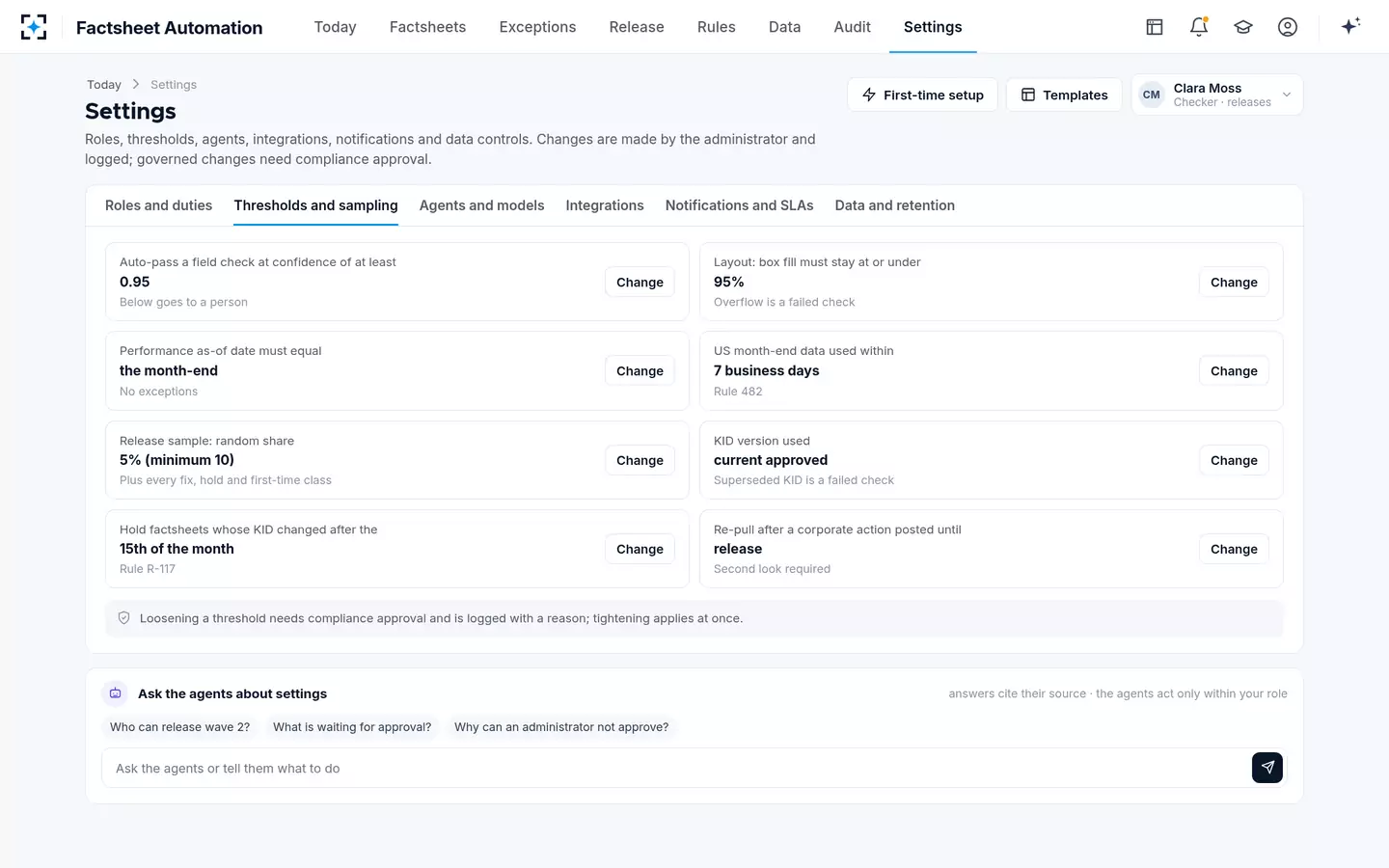
The thresholds sit beside the template as settings: box fill at or under 95%, performance as-of date equal to the month-end, the current approved KID only, and a hold on factsheets whose KID changed after the 15th of the month. Loosening any of them needs compliance approval. In the solution's fictional sample cycle, the September factsheets for one Luxembourg range were built on template "UCITS Fund v7.2" and each checked 41 times before release. When a production lead asks who waits on whom each month, most of the answer is which box's owner has not yet signed.
Template rules as Factsheet Automation settings
Questions people ask
Is there a free fund fact sheet template?
Design templates are easy to find; the regulated content is the part you must build yourself. Start from the 14 boxes on this page, then add the source, owner and rule for each box from your own systems and markets. A template copied from another manager also copies its legends, which may be wrong for your registrations.
How long should a fund factsheet be?
Most are one or two pages, and no rule sets a length. ESMA asks that the amount of information be "proportionate to the size and format of the communication" and that the font be "easily readable", so a template should fix box sizes and text limits rather than let content push type smaller.
Should the factsheet template include the risk indicator?
If the factsheet describes risks and rewards, yes: ESMA expects the same risk classification as the KID. Showing it also gives the reader one comparable number across funds. Place it next to the risk text, at the same type size as the main body.
Who should own the factsheet template?
One person should own the template as a whole, usually the factsheet production lead, with marketing compliance approving every change. Each box's content belongs to its source owner: performance for returns, product for the objective and costs, compliance for legends.
How often should a factsheet template be reviewed?
At least whenever a rule or a legal document changes: a new KID, a prospectus update, a new market registration or revised guidance. The ESMA guidelines themselves "will be updated periodically", so a yearly review against the current text is a sensible floor.