The FCA's past performance disclaimer rule, COBS 4.6.2R, requires any communication to retail clients that shows past performance to carry "a prominent warning that the figures refer to the past and that past performance is not a reliable indicator of future results", alongside five years of figures in complete 12-month periods, the reference period and source, and a currency warning where needed. Unlike ESMA, which fixes the sentence "Past performance does not predict future returns", the FCA rule fixes what the warning must say, not its exact words. Compliance means meeting that content in every factsheet; good practice, under the Consumer Duty, means checking that readers understand it, and the research suggests the standard form does little. Botminds' Factsheet Automation derives each factsheet's warnings from the rules of the market it is sold in and drafts them only from approved clauses, so the wording is right everywhere; this page is about what the wording achieves.
The comparison below puts the rule beside the evidence, element by element. The rule is the FCA's COBS 4.6, as in force in October 2026; the evidence is a controlled experiment on the US equivalent of the warning and a study of how investors read selected performance.
The past performance warning: rule text beside the evidence
What the rule requires: A prominent warning that figures refer to the past and are not a reliable indicator of future results (COBS 4.6.2R(4)).
What the tests found: The SEC-mandated equivalent “neither reduces investors’ propensity to invest in advertised funds nor diminishes their expectations” (Mercer, Palmiter and Taha).
What the rule requires: Not required in the UK, EU or US.
What the tests found: A disclaimer “that informs investors that high fund returns generally don’t persist” “would be much more effective” (same experiment).
What the rule requires: The rules govern how performance is shown, not which funds are chosen for marketing.
What the tests found: Advertised funds’ median performance rank sits between the 79th and 100th percentile; readers treat them as representative (Koehler and Mercer).
What the rule requires: Performance must not be the most prominent feature (COBS 4.6.2R(1)).
What the tests found: Investors buy disproportionately into funds that did very well the prior period (Sirri and Tufano).
What the rule requires: Communications must be likely to be understood; where appropriate, tested (PRIN 2A.5).
What the tests found: Selection neglect “can be debiased with a simple extrinsic sample space cue” (Koehler and Mercer).
What does the FCA require in a past performance disclaimer?
The FCA requires the warning as one of six conditions on any information "that contains an indication of past performance of relevant business, a relevant investment or a financial index", when it is a financial promotion to retail clients. The warning itself is condition (4): "the information contains a prominent warning that the figures refer to the past and that past performance is not a reliable indicator of future results" (COBS 4.6.2R). The same words appear in the MiFID version of the rule for investment firms (COBS 4.5A), so a UK fund manager's factsheet and a UK wealth manager's model-portfolio sheet carry the same warning.
Three features matter for a factsheet. The warning must be prominent, not merely present. It must say both things, that the figures are historical and that they are not a reliable indicator, so a shortened "past performance is no guarantee" may not meet it. And it is content, not a script: a firm may word it in its own house style, provided the content is complete and the result is fair, clear and not misleading.
COBS 4.6.2R line by line
The warning is the fourth of six conditions, and a factsheet that meets it can still fail the other five. Read in full, COBS 4.6.2R requires that:
- the indication of past performance "is not the most prominent feature of the communication";
- it covers "the preceding five years", or the whole period the investment has been offered if shorter, "or such longer period as the firm may decide", and "in every case that performance information must be based on complete 12-month periods";
- "the reference period and the source of information are clearly stated";
- the prominent warning appears;
- if the figures are in a currency other than sterling, "the currency is clearly stated, together with a warning that the return may increase or decrease as a result of currency fluctuations";
- if the indication is based on gross performance, "the effect of commissions, fees or other charges is disclosed".
The guidance that follows adds one exception that matters to client reporting rather than factsheets: a periodic statement sent under the client reporting rules may put past performance first (COBS 4.6.3G). A monthly factsheet is not a periodic statement. The section was last updated on 6 April 2026, when the UK's consumer composite investments regime began; performance shown in a CCI product summary is outside these paragraphs (COBS 4.6.1R(4)), and the Handbook already shows a future version dated 25 October 2027, so the rule is worth re-reading before each template review.
FCA, ESMA, SEC and Central Bank of Ireland: four wordings of one warning
A range sold in London, Dublin, Frankfurt and New York needs four versions of the same idea, and only some of them are fixed word for word. ESMA's guidelines set an exact sentence that "should be preceded" before the figures (paragraph 47). Ireland's Central Bank requires its own sentence "no less prominently than the information on past performance", and accepts ESMA's sentence as meeting it (ESMA report, 6 January 2026, Annex II). The SEC's legend is longer and must sit "in close proximity to the performance data" (Rule 482(b)(3)(i) and (b)(5)).
One warning, four wordings, and where each must sit
| Regime | The words | Fixed or content-based | Where it goes |
|---|---|---|---|
| FCA, COBS 4.6.2R(4) | “the figures refer to the past and that past performance is not a reliable indicator of future results” | Content: the firm words it | Prominent; performance not the most prominent feature |
| ESMA guidelines, para. 47 | “Past performance does not predict future returns” | Fixed sentence | Before the past performance information |
| Central Bank of Ireland | “Past performance may not be a reliable guide to future performance” | Fixed; ESMA’s sentence accepted instead | No less prominent than the performance figures |
| SEC Rule 482(b)(3)(i) | Data “represents past performance; that past performance does not guarantee future results”, plus fluctuation and current-performance statements | Content, with a set list | Close to the data; in print, in the body and not in a footnote |
Does the past performance warning work?
The best controlled evidence says the standard warning does not change behaviour, and a more specific statement does. Molly Mercer, Alan Palmiter and Ahmed Taha showed investors mutual fund advertisements with and without the SEC-mandated disclaimer, and report that "this SEC-mandated disclaimer is completely ineffective. The disclaimer neither reduces investors' propensity to invest in advertised funds nor diminishes their expectations regarding the funds' future returns" ("Worthless Warnings?", SSRN working paper, 2009). The same experiment found that "a stronger disclaimer – one that informs investors that high fund returns generally don't persist – would be much more effective."
The experiment also finds, however, that a stronger disclaimer – one that informs investors that high fund returns generally don’t persist – would be much more effective.
Mercer, Palmiter and Taha, “Worthless Warnings? Testing the Effectiveness of Disclaimers in Mutual Fund Advertisements”
Two limits apply. The study tested the US legend, not the FCA's or ESMA's wording; we think the result travels, because all three tell the reader the same thing in a generic way, but that is an inference. And it is an experiment with advertisements, not a field study of factsheets. Its value to a compliance reviewer is the direction: the warning everyone uses tells readers something they already believe in principle and ignore in practice; the statement that works tells them what usually happens next.
Why the warning loses to the chart
The warning loses because readers do not treat the performance on a marketing document as selected, and it usually is. Koehler and Mercer found that funds chosen for advertising had a median performance rank "between the 79th and 100th percentile", and that "both novice investors and financial professionals fall victim to selection neglect in a financial advertising task unless the advertisement makes the selective nature of available performance data transparent" (Management Science, 2009). Fund flows follow the same pattern: investors put a disproportionate share of new money into the funds that did best in the previous period (Sirri and Tufano, Journal of Finance, 1998).
A generic warning does not address selection. Koehler and Mercer's third study is the encouraging part: selection neglect "can be debiased with a simple extrinsic sample space cue", in other words by telling readers what the advertised fund was chosen from. For a factsheet that suggests two practical additions that sit comfortably inside the rules: show every calendar year, including the bad ones, as ESMA requires anyway (the factsheet review checklist explains why), and state plainly that high returns over one period are not usually repeated.
Past performance disclaimer example: wording that passes, and wording that informs
A compliant example is short; an informative one adds a sentence. For a UK retail factsheet, wording that meets COBS 4.6.2R(4) is: "Past performance refers to the past and is not a reliable indicator of future results." For an EU factsheet, the fixed sentence goes first: "Past performance does not predict future returns." A sterling investor reading a euro class also needs: "Returns may increase or decrease as a result of currency fluctuations."
Wording that informs, built on the experimental finding, could follow it: "Funds with high returns over one period have generally not repeated them in the next." That sentence must be supported by evidence the firm holds, sit beside the required warning rather than replace it, and pass the firm's own compliance review; it is our illustration, not a regulator's wording. In the EU it must come after ESMA's sentence, which has to precede the figures, and in every market it must not read as a forecast.
Six checks on the past performance warning of a UK factsheet
- Both halves are there
The figures refer to the past, and past performance is not a reliable indicator of future results.
- It is prominent
Not in a footnote or grey type; the chart is not the most prominent feature of the page.
- Five years, complete periods
Or since launch if shorter; 12-month periods, the reference period and the data source stated.
- Currency
A non-sterling class names its currency and warns that returns may rise or fall with exchange rates.
- Gross or net
If figures are gross, the effect of charges is disclosed.
- Understood
Tested where appropriate with retail readers, and adapted if they misread it (PRIN 2A.5.10R and 2A.5.13G).
Testing the warning under the Consumer Duty
Since 31 July 2023 the FCA has asked firms to test whether communications work, not just whether they contain the right words. PRIN 2A.5.10R requires a firm, where appropriate, to test communications on retail customers before sending them and to keep checking their effect afterwards (PRIN 2A.5.10R; Consumer Duty outcomes testing covers the method). The guidance lists factors for deciding when testing is appropriate, including whether a communication is "designed to prompt or inform a decision" and whether it "could impact many retail customers" (PRIN 2A.5.12G).
A monthly factsheet meets both: it informs a decision and it reaches many readers. A proportionate test needs no new research budget. Show a small group of retail readers the factsheet, ask what return they expect next year and whether the fund is likely to repeat its best year, then show a version with the added sentence and ask again. If readers' answers do not move with the warning, the Duty's guidance points to adapting the communication where "there are areas of common misunderstanding among retail customers" (PRIN 2A.5.13G). The result is evidence a firm can show a supervisor, which a template change alone is not.
Simulated and future performance: two more warnings
Factsheets that show a new share class's simulated history, or a target return, need different warnings. For simulated past performance, COBS 4.6.6R requires a prominent warning "that the figures refer to simulated past performance and that past performance is not a reliable indicator of future performance", and the simulation must rest on the actual past performance of the same or substantially the same investment. For future performance, COBS 4.6.7R requires reasonable assumptions "supported by objective data", positive and negative scenarios, and a prominent warning that forecasts do not reliably predict performance (COBS 4.6; fair, clear and not misleading for commentary applies it to outlook sentences).
ESMA allows simulated past performance only for "A new share class of an existing fund" with "the same (or substantially the same) features" or a new feeder fund, and expected performance only with a prescribed scenario statement (paragraphs 49 to 57). A template that lets a new class borrow its sister class's record has to switch the warning at the same time, which is exactly the kind of change a factsheet template held as a Word file misses. The full set of rules by market is in UCITS factsheet rules.
How Factsheet Automation places the right warning in each market
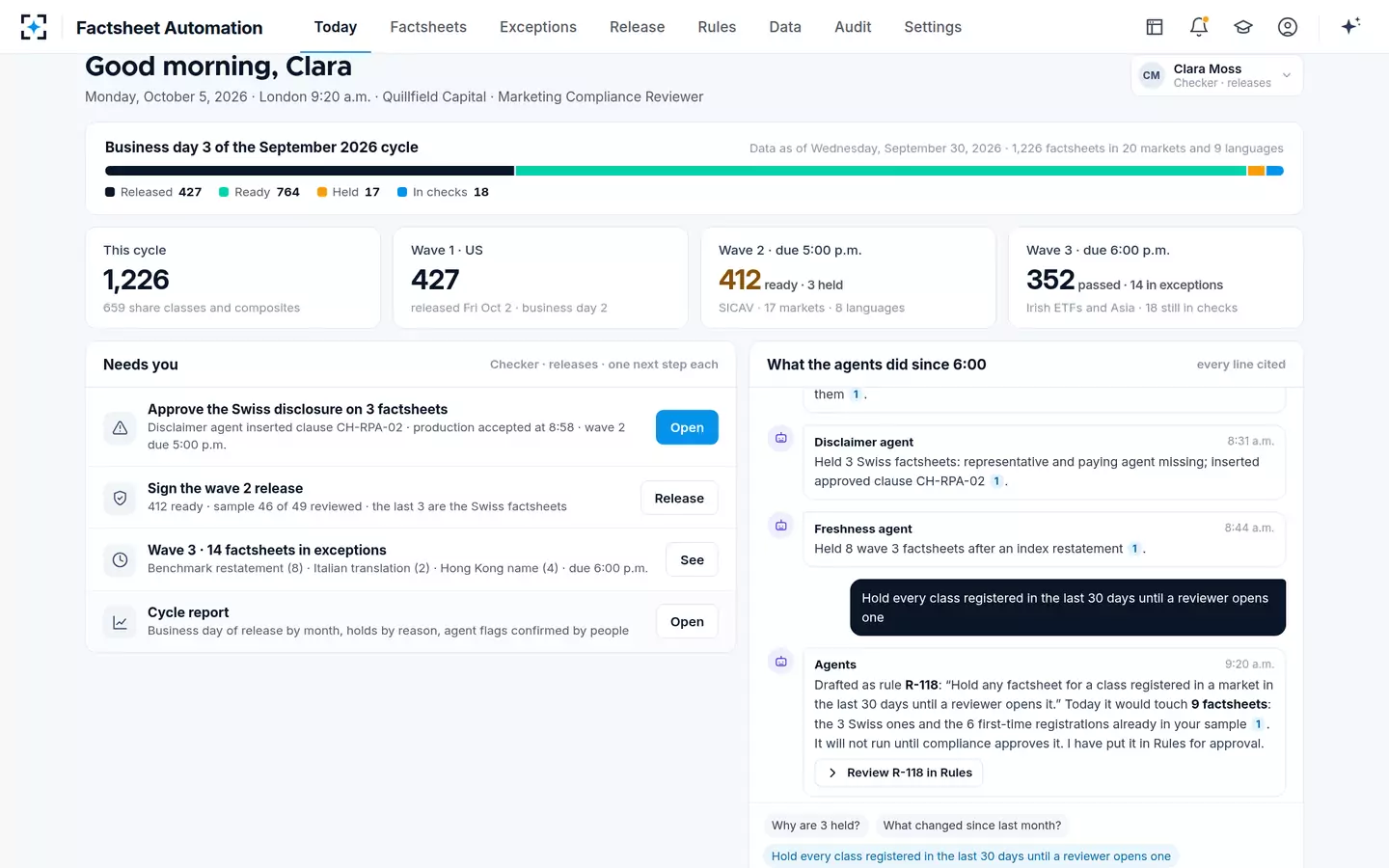
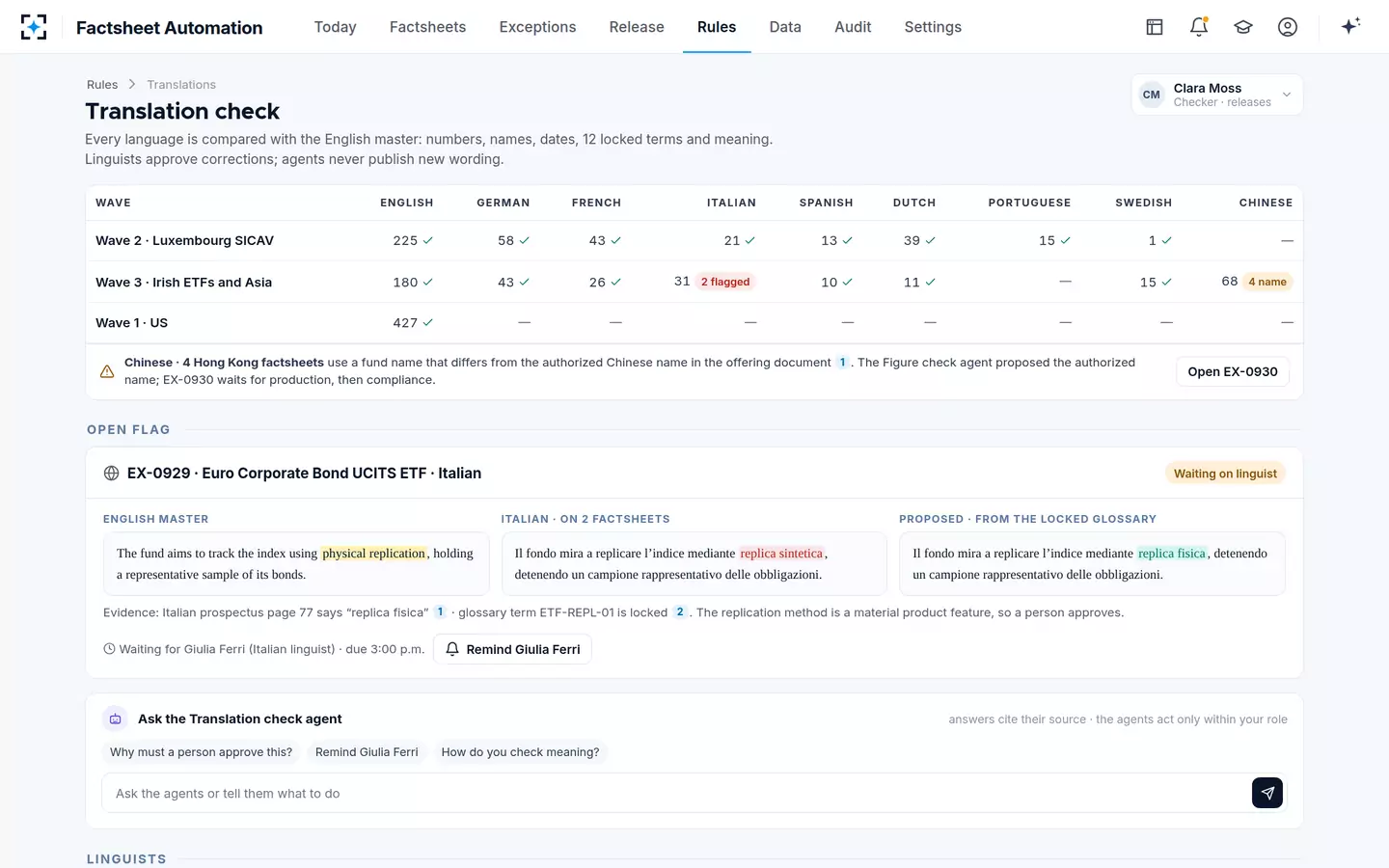
Factsheet Automation treats each warning as an approved clause tied to a country rule, not as text in a template. The Disclaimer agent derives each factsheet's required legends from the live registration list and the country rules: the marketing-communication label, past performance and currency warnings under ESMA's guidelines, local legends, and Rule 482 legends for US funds. It drafts only from approved clauses and never invents legal wording, and every insert needs a maker and a checker. The Translation check agent compares every language with the English master, including the locked glossary terms, so a warning cannot drift in translation.
The rules themselves stay with compliance. A reviewer can tell the agents a new rule in plain words, and it waits for approval before it runs. What the software does not do is decide whether your warning is understood: that test sits with your compliance and consumer-outcome teams under PRIN 2A.5, and the agents' job is to make sure the wording you chose appears, correctly, on every one of the factsheets you release. Whether the factsheet needed a warning at all is covered in are fund factsheets a regulatory requirement.
Telling Factsheet Automation's agents a rule in plain words
Locked terms checked in every language
Questions people ask
Is "past performance is not a guarantee of future results" enough for the FCA?
It may not be. COBS 4.6.2R(4) asks for a warning that the figures refer to the past and that past performance is not a reliable indicator of future results. "No guarantee" says something different from "not a reliable indicator", so the safest course is wording close to the rule's own.
What is the FCA past performance rule for less than five years of data?
Show the whole period the investment has been offered, or the index has existed, in complete 12-month periods. The rule allows "such longer period as the firm may decide" but not a shorter one where five years exist.
Does the past performance warning apply to professional clients?
COBS 4.6 applies to financial promotions addressed to, or likely to be received by, retail clients. Communications only to professional clients fall under the general fair, clear and not misleading rule. A professional factsheet is easily forwarded to retail readers, which is a practical reason to keep the warning on it.
Where should the past performance risk warning go on a factsheet?
In the UK it must be prominent; ESMA's guidelines put the fixed statement before the figures; the SEC wants its legend in close proximity to the data and not in a footnote. The safest layout places the warning directly above the performance table, in body-size type, in every market.
What is ESMA's past performance statement?
"Past performance does not predict future returns." ESMA's guidelines on marketing communications (ESMA34-45-1272, paragraph 47) say past performance information should be preceded by that statement; like the rest of the factsheet, it is written in the official language of the market where the fund is distributed (paragraph 17).
Who checks that the warning is right on every factsheet?
Marketing compliance approves the wording; production places it. In Factsheet Automation, the Disclaimer agent adds the approved clause for each market, another agent re-checks every fix, and the compliance reviewer signs the release after working a risk-based sample.