An AI factsheet generator, done properly, does not write factsheets: it assembles them from signed data and approved text, checks every field against the fund's legal documents, and holds anything it cannot prove for a person to decide. The useful question for a buyer is not whether the output looks right but whether each value can be traced to its source and each decision to a named person. Botminds' Factsheet Automation is built that way. Seven agents collect month-end data, build each factsheet for every registered share class, market and language, check figures, dates, legends and translations, and prepare a risk-based sample; production accepts fixes as maker and marketing compliance signs the release as checker. This page follows one share class through that process on the solution's fictional sample data, so you can see what "AI" does at each step and what it is never allowed to do.
The class is Global Sustainable Equity, A CHF Hedged Acc, in Switzerland, in German: factsheet FS-2-0287 in wave 2 of the September 2026 cycle at the fictional manager Quillfield Capital. It is one of 415 factsheets due by 5:00 p.m. on business day 3, and it is one of the three that the agents could not release on their own.
One factsheet through Factsheet Automation, 6:00 to 9:29 a.m. on business day 3
- Plan the wave; collect signed data from 12 systems6:00
- Build 415 factsheets from template UCITS Fund v7.26:25
- Check figures, dates, languages; hold for a missing legend7:48
- Production lead accepts the insert (maker)8:31
- Sample built; reviewer asks, approves at 9:24; agents re-check; signed at 9:298:58
What does an AI factsheet generator do?
It does the mechanical work between month-end data and a releasable factsheet: fetching the inputs, placing them in the template, checking them against their sources, and preparing the release. In Factsheet Automation that work is split among seven agents, each with a narrow job and written limits. The Intake agent collects month-end data from every system of record and checks each file's as-of date, sign-off and row count. The Production agent builds each factsheet from the approved template. The Freshness agent checks every date and watches for restatements. The Figure check agent ties every figure to its source and to the KID and prospectus. The Disclaimer agent derives each factsheet's legends from the registration list. The Translation check agent compares every language with the English master. The Release agent builds the sample and distributes after the signature.
The split matters because it makes each step testable. A single model asked to "produce the factsheet" gives you a document; seven agents with separate jobs give you a trail of what each one read, checked and decided, and they can check each other: every fix one agent makes gets a second look from the Figure check agent before it can be released.
Can AI write a fund factsheet?
It can build one; it should not write the regulated parts. A factsheet's numbers must be the signed ones, its objective must match the prospectus, its costs and risk class must match the KID, and its legal legends must be approved wording. ESMA's guidelines say a factsheet may not contradict, add to or water down anything in the fund's legal documents (ESMA34-45-1272, paragraph 20; the factsheet template guide quotes it box by box). Generated text is the wrong tool for any of that, and ESMA's statement on AI says why.
ESMA's statement on AI in retail investment services (30 May 2024) names the failure in one word: text generators can "hallucinate", producing figures and claims that read as accurate and are wrong (paragraph 5). On a factsheet that means a return, a charge or a risk class that looks right and matches nothing in the fund's records.
So Factsheet Automation's agents are bound by limits rather than trusted to be careful. The Production agent never writes or rewords commentary or legal text; the Disclaimer agent drafts only from approved clauses and never invents legal wording; the Translation check agent proposes corrections only from the translation memory and never publishes new wording without a linguist; the Freshness agent holds a figure it cannot confirm and never substitutes a number. The commentary is written by the portfolio manager and approved by compliance, as before. Writing commentary with AI is a different job, with its own maker and checker.
6:00 to 7:48: plan, collect signed data, build from a locked template
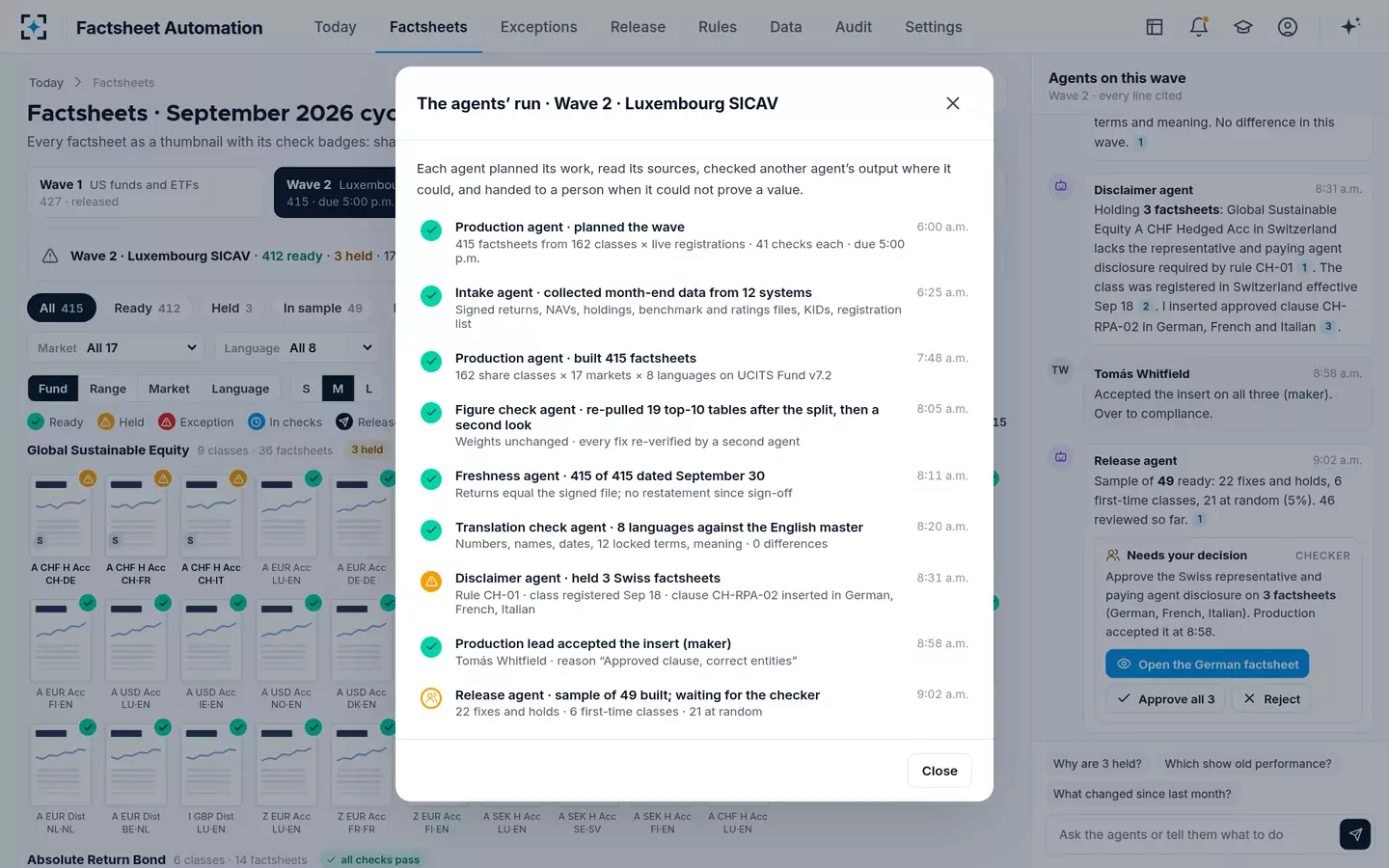
At 6:00 the Production agent planned the wave: 415 factsheets from 162 share classes, crossed with their live registrations, 41 checks each, due at 5:00 p.m. At 6:25 the Intake agent had collected the month-end data from 12 systems: signed returns, NAVs, holdings, benchmark and ratings files, KIDs and the registration list. It never uses unsigned performance and never edits source data; a feed that fails is retried once and then handed to a person. That morning the ratings feed came in on its retry.
At 7:48 the Production agent had built 415 factsheets, 162 classes across 17 markets and 8 languages, on template "UCITS Fund v7.2". For FS-2-0287 that meant the German template for a Swiss-registered class, the class's own NAV of CHF 142.37, ongoing charges of 1.72% and risk indicator 4 of 7 from the current KID, and the approved German commentary. It never produces a factsheet for a market where the class is not registered, and a box that overflows fails a check instead of having its font shrunk.
Factsheet Automation's agents' run for the wave, step by step
7:48 to 8:31: the checks, and the hold
Four agents then checked the wave, each against a different source. At 8:05 the Figure check agent re-pulled 19 top-ten tables after a stock split was posted, confirmed the weights, and had each fix re-verified by a second agent. At 8:11 the Freshness agent confirmed all 415 factsheets were dated 30 September and that the returns equalled the signed file with no restatement since sign-off. At 8:20 the Translation check agent compared eight languages with the English master for numbers, names, dates, 12 locked terms and meaning, and found no differences.
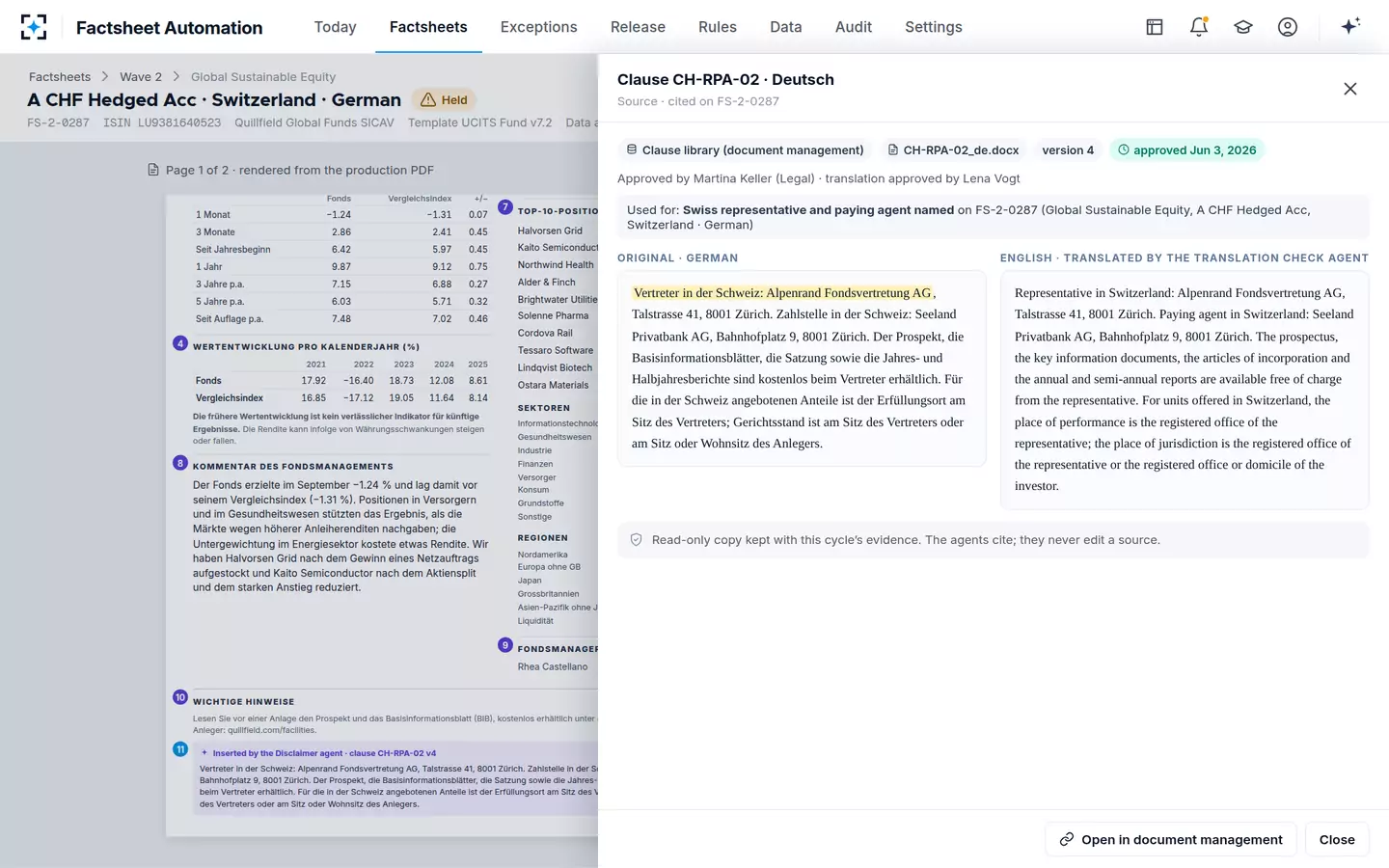
At 8:31 the Disclaimer agent held three factsheets, FS-2-0287 among them. The class had been registered in Switzerland effective 18 September 2026; the country rule required the Swiss representative and paying agent to be named, where documents are free of charge, and the place of performance and jurisdiction; and this sub-fund's template had no Swiss block because it had never been sold there. The agent inserted the approved clause, version 4 of a clause Legal approved on 3 June 2026, in German, French and Italian, and stopped. An insert into a legal legend needs a maker and a checker; the agent is neither.
The held factsheet, field check 32, and the clause behind it
8:31 to 9:29: the people, the maker, the checker and the signature
The rest of the trace is people deciding, with the agents preparing. At 8:58 the factsheet production lead accepted the insert as maker, with the reason "Approved clause, correct entities". At 9:02 the Release agent built the release sample: all 22 fixes and holds, the 6 first-time classes and 21 more at random, 5% of the wave, 49 in all. At 9:20 the marketing compliance reviewer asked the agents in plain words why three factsheets were held, and the answer came back with numbered citations to the registration list, the country rule and the clause.
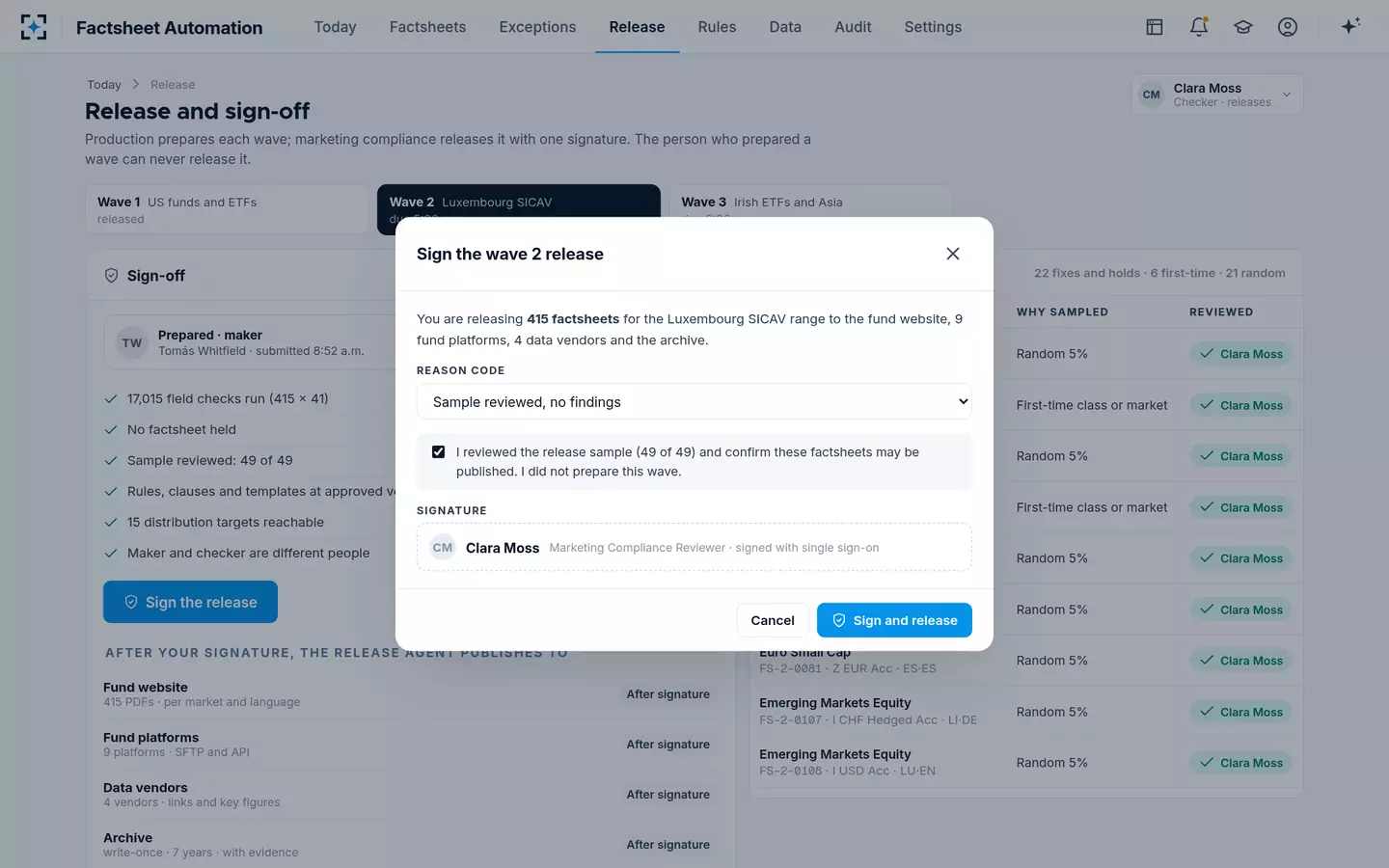
At 9:24 she approved the three as checker with the reason code "Clause matches the approved source". The agents re-checked at once: the legend present in German, French and Italian, the wording equal to the clause in each, no overflow, 41 of 41 checks passed. At 9:29, with the sample reviewed, she signed the release with the reason code "Sample reviewed, no findings" and attested that she had not prepared the wave. Only then did the Release agent publish 415 PDFs to the fund website, 9 fund platforms, 4 data vendors and the write-once archive.
Who does what in Factsheet Automation, and what each may never do
Agent
Intake agentCollects month-end data; checks as-of date, sign-off and row count; reconciles NAV with the administrator.
Never: Never uses unsigned performance; never edits source data.
Agent
Production agentBuilds each factsheet from the approved template for every registered class, market and language.
Never: Never writes or rewords commentary or legal text.
Agent
Freshness, Figure check, Translation checkCheck dates, figures against the KID and prospectus, and meaning in every language.
Never: Hold rather than substitute; disagreements go to a person.
Agent
Disclaimer agentDerives legends from the registration list and country rules; drafts missing ones from approved clauses.
Never: Never invents legal wording.
A person decides
Production lead (maker)Accepts or rejects proposed fixes; submits the wave.
A person decides
Compliance reviewer (checker)Decides holds, works the sample, signs the release.
Never: The maker of a wave can never release it.
Agent
Release agentBuilds the risk-based sample; publishes after the signature; keeps the evidence.
Never: Never releases without the checker’s signature.
Is an AI factsheet compliant? What regulators have said
An AI-built factsheet is held to the same rules as a hand-built one, no more and no less. FINRA has said so directly: "the content standards of Rule 2210 (Communications with the Public) apply whether" communications "are generated by a human or technology tool", and "FINRA intends for its rules and guidance to be technologically neutral" (FINRA Regulatory Notice 24-09, 27 June 2024). The same notice reminds firms that under Rule 3110 they need "a reasonably designed supervisory system tailored to its business". So a US factsheet built by agents still needs a registered principal's approval before use (Rule 2210(b)(1)(A)).
The SEC's Division of Examinations uses its own term. Its fiscal 2027 priorities, published on 23 October 2026, describe registrants building "super intelligence (SI)" into their businesses and say examiners will study what the tools do to outcomes and test whether duties that predate them are still being met (SEC, Fiscal Year 2027 Examination Priorities; the passage is quoted in full in our guide to how asset managers are using AI). In the EU, ESMA's statement on AI in investment services, addressed to firms under MiFID II, leaves every decision with the firm's management body whether a person or an AI tool took it, and asks firms to keep a record of how decisions were reached: the data used, the algorithms and each change to them over time (paragraphs 2 and 24).
Read together, the message is consistent: the rules do not change, the evidence expected does. A factsheet built by agents should leave a better trail than one built by hand, showing for each value its source and as-of date, and for each decision who took it and why.
Who approves an AI factsheet?
The same people who approve any factsheet, and the generator should make it impossible to skip them. In Factsheet Automation, the performance team signs the data before it is used, linguists approve any correction that changes meaning in their language, the production lead accepts fixes as maker, and the marketing compliance reviewer approves and signs the release as checker, with single sign-on, a reason code and an attestation. The person who prepared a wave can never release it, administrators can never approve, and agent versions change only with compliance approval.
In the US, approval for a retail communication rests with the distributor's registered principal under Rule 2210(b)(1)(A); in the EU and UK the manager carries responsibility for its marketing communications under Article 4 of Regulation (EU) 2019/1156 and COBS 4. An AI factsheet generator should map its release step onto whichever of those your firm uses, not replace it.
The signature that releases the wave
What to ask an AI factsheet generator before you buy
Ask to see a trace like the one above on a factsheet of yours, not the vendor's. The ten questions below separate a generator that leaves evidence from one that leaves only a document.
Ten questions for any AI factsheet generator
- Does it use only signed data?
Show what happens when the performance file is unsigned, or restated after sign-off.
- Can it change source data?
It should read sources, never edit them.
- Which parts does it write?
Commentary and legal text should be placed from approved sources, not generated.
- What does each field check compare with?
The KID for costs and risk, the prospectus for objective and benchmark, the registration list for legends.
- What happens when it cannot prove a value?
A hold with an owner and a clock, not a best guess.
- How are legends chosen per market?
From the live registration list and approved clauses, including a class registered this month.
- How are translations checked?
Numbers, names, locked terms and meaning against the master, with linguists approving changes.
- Who signs, and can the maker release?
Maker and checker separated by the system, with reason codes.
- What evidence does each factsheet leave?
Source, as-of date, check result and approver for each value; agent and rule versions.
- How was its accuracy tested?
Seeded errors and a re-run of factsheets you already released, scored by error type.
Question 10 is the one most often skipped. A seeded test plants known errors in a factsheet and counts what is caught (the fund factsheet example test); a pilot re-makes last month's released factsheets and compares them field by field (the agentic AI proof of concept). Both use your data and your rules, which is the only evidence that matters.
Where an AI factsheet generator does not fit
It does not fit where the inputs are not settled. If returns are not signed in a system, if the registration list lives in several spreadsheets that disagree, or if approved clauses are not kept anywhere a machine can read, a generator will either hold most factsheets or, if built carelessly, fill gaps it should not. The first project in those firms is the data, not the generator.
It also adds little for a manager with a handful of funds sold in one market and one language, where a designer and a careful reviewer can check every factsheet each month. The case for agents grows with the product of share classes, markets and languages, and with how often KIDs, registrations and benchmarks change. Pricing that case on your own numbers is the subject of fund data management solutions vs agents.
Questions people ask
Is there a free AI fact sheet generator for fund factsheets?
General-purpose generators produce a layout from text you give them; they do not know your signed returns, KID figures, registrations or approved legends, and they cannot show a source for each value. For a regulated fund factsheet the cost is in checking and evidence, which free tools do not provide.
What are AI factsheets?
The phrase is used for two different things: fund factsheets produced with AI help, as on this page, and "AI factsheets" that document an AI model's purpose, data and testing. The second kind is model documentation, not investor material.
Can an AI factsheet generator handle restated benchmarks?
It should hold the affected factsheets rather than publish either number. In the solution's fictional sample, an index vendor restated a 30 September level after sign-off, moving a benchmark's one-month return from −3.42% to −3.24%; the Freshness agent held eight factsheets and asked the performance analyst to re-sign with the exact difference.
Does an AI-built factsheet need to say AI was used?
The rules cited here do not require a factsheet to say how it was produced. What they require is that the content meets the same standards and that the firm can show how it was supervised; ESMA expects records of AI use, and FINRA expects a supervisory system that covers the tools a firm uses.
How long does it take an AI factsheet generator to build a wave?
The build is the short part. In the fictional sample, 415 factsheets were built between 6:25 and 7:48 a.m.; what decides the release time is how quickly people resolve the holds and review the sample, which the design target puts on business day 3.