ESMA's guidelines on marketing communications (ESMA34-45-1272) apply to every fund factsheet a manager uses in the EU, and they read as a checklist: label the document a "marketing communication", describe risks as prominently as rewards, use the same benchmark as the KID or prospectus, show past performance over complete 12-month periods with every calendar year beside any cumulative figure, state costs on the same basis as the legal documents, copy the risk class from the KID, and carry the fixed warnings. A compliance reviewer's job is to test each box against its source before release, every month, for every share class, market and language. Supervisors' own reports show where the tests fail. Botminds' Factsheet Automation builds the factsheets and runs those checks itself, 41 per factsheet in the sample, tying each figure to the KID, prospectus or signed returns, so the reviewer signs a sample and the exceptions rather than re-reading every page.
This guide is for the marketing compliance reviewer who releases each month's factsheets and the client reporting lead who produces them. Paragraph numbers refer to ESMA's guidelines; the examples use the solution's fictional sample fund range.
Why one month of factsheets is a large review
41
checks run on each factsheet in the sample range, from fund name to legends
10 yrs
of complete 12-month periods of past performance for a fund that had a KIID; 5 for others
1 to 7
the risk class scale a factsheet must copy exactly from the current KID
What do the ESMA marketing communications guidelines require of a factsheet?
They require a factsheet to identify itself as marketing, to be fair and not misleading in how it presents risks, returns and costs, and to be consistent with the fund's legal documents. A marketing communication should carry "a prominent disclosure of the terms 'marketing communication'", and ESMA's model disclaimer sends the reader to the prospectus and the KID before any final investment decision (ESMA guidelines, paragraphs 6 and 7). Most of the rest is consistency: the factsheet's numbers must match documents other teams own.
That is what makes factsheet review hard to staff. The page is assembled from figures signed elsewhere, returns from the performance team, the net asset value from the administrator, holdings from portfolio accounting, costs and the risk class from the KID, commentary from the portfolio manager, and one fund with ten share classes sold in eight countries can need dozens of versions in local languages. Whether the factsheet is required at all is a separate question, answered in are fund factsheets a regulatory requirement.
A factsheet review, box by box: the check, the source and the paragraph
| Box | What the reviewer checks | Tested against | ESMA paragraph |
|---|---|---|---|
| Header | "Marketing communication" label; fund, class, ISIN, as-at date | Distribution database, prospectus | 6–7 |
| Objective and benchmark | The index named is the one the fund is measured against | KID and prospectus | 43 |
| Performance table | Complete 12-month periods; cumulative figures with every year beside them | Signed fund and benchmark returns | 44, 46 |
| Calendar years | Every complete year shown, fund beside benchmark; current year to the last quarter-end | Signed returns | 44 |
| Costs | Ongoing charges, not the management fee alone | Current KID | 21 |
| Risk indicator | Risk class equal to the KID's | Current KID | 36 |
| Risks and rewards text | Risks as prominent as rewards, same font size, not in a footnote | The layout itself | 11–13 |
| Commentary | Claims justified by objective, verifiable sources; no "the best fund" | Data behind each claim | 32 |
| Legends | Past performance sentence; currency warning where relevant | Fixed wording and class currency | 47, 48 |
Benchmark and past performance: where supervisors find the most errors
The benchmark must be the one the prospectus or KID measures the fund against (paragraph 43), and past performance must run over complete 12-month periods, ten years for a fund that had a KIID and five for others (paragraph 44). Where cumulative performance appears, ESMA says that "the communication should also display the performance of the fund for each year of the considered period" (paragraph 46). A factsheet with only cumulative and annualized figures is missing the box that shows the bad years.
National supervisors report the failures. Poland's regulator found a factsheet comparing a sub-fund with EONIA plus 2.5% while its KIID named €STR; Luxembourg's flagged a communication that updated the current-year figure to the last month-end, where paragraph 44 allows the last quarter-end; and Ireland's reported marketing materials with "inaccurate information relating to synthetic risk and reward indicators, benchmark used and past performance tables" (ESMA report to the EU institutions, 6 January 2026). Each is a mismatch between the factsheet and a document the reviewer could have opened.
The research explains why supervisors care about selection. Advertised funds attract "significantly more money in comparison with a group of control funds", yet "there is no superior performance in the postadvertisement period" (Jain and Wu, Journal of Finance, 2000), and "both novice investors and financial professionals fall victim to selection neglect" unless the selective nature of the data is made plain (Koehler and Mercer, Management Science, 2009). The calendar-year rule is the control against that, which is why a reviewer should treat a missing year as a hold, not a style point.
Costs and the risk class: two numbers copied from the KID
The cost figure on a factsheet should be the KID's, on the KID's method; ESMA expects the same methodology and value as the legal documents (paragraph 21). The ongoing charges figure was created as "a single figure" "representing all annual charges and other payments taken from the assets of the UCITS over the defined period" (Regulation (EU) No 583/2010, Article 10(2)(b)), and since UCITS moved to the PRIIPs key information document at the start of 2023 (Regulation (EU) 2021/2259) the KID shows costs in its own format. Luxembourg's regulator reported a marketing communication that "only displayed management fees while the PRIIPs KID displayed ongoing charges" (ESMA report, 2026).
The two cost numbers a reviewer sees, and which one the factsheet must carry
Management fee: The manager's annual fee only.
Ongoing charges, as in the KID: All annual charges and other payments taken from the fund's assets over the year.
Management fee: The prospectus fee schedule.
Ongoing charges, as in the KID: The current KID, based on the previous year's costs.
Management fee: Not shown alone where the KID shows ongoing charges.
Ongoing charges, as in the KID: The same methodology and value as the legal documents (paragraph 21).
Management fee: An advisory fee shown alone invites the same finding.
Ongoing charges, as in the KID: Rule 482(i): total annual expenses without waivers, at least as prominent as any other fee figure.
The risk class is a copy, not a judgment. The PRIIPs rules aggregate "market risk, credit risk and liquidity risk" into a single indicator on a scale of 1 to 7 (Delegated Regulation (EU) 2017/653, recital 5), and ESMA expects the factsheet to show the KID's own class (paragraph 36). The common failure is timing: the KID is updated mid-cycle, the factsheet template still holds last quarter's class, and nobody re-checks after the KID changes. A review that tests against "the KID" must test against the version in force on the factsheet date.
Is the risk text as prominent as the return?
It must be. ESMA's guidelines say risks and rewards should be described in "an equally prominent manner", in a font "at least equal to the predominant font size", and not "in a footnote" (paragraphs 11 to 13). That is a layout test, and it fails more often in translation than in the master: a German or French sentence runs longer than the English, the template shrinks the font to fit the box, and the risk text ends up smaller than the performance commentary.
The commentary has its own test. Statements should be "adequately justified based on objective and verifiable sources" and avoid "overoptimistic wording, such as 'the best fund'" (paragraph 32). A reviewer's practical check is to read the commentary against the performance table beside it: a month in which the fund lagged its benchmark should not be described only by the stocks that helped.
Legends, languages and the US overlay
The legends are fixed text, and fixed text is where a reviewer can be exact. ESMA's past performance sentence is "Past performance does not predict future returns" (paragraph 47), and a factsheet whose figures are in a currency other than the investor's home currency should say so, "together with a warning indicating that returns may increase or decrease as a result of currency fluctuations" (paragraph 48). Country legends add more: a class sold in Switzerland, Ireland or the Netherlands carries local wording, which the UCITS factsheet rules by market set out.
A range sold in the US adds Rule 482. An advertisement must tell readers where to find month-end performance unless it carries returns to a month-end no more than seven business days before use (17 CFR 230.482(b)(3)(i)); standardized one-, five- and ten-year returns must run to the last calendar quarter-end before submission for publication (482(d)(3)); and where a sales load is not reflected, the advertisement must say so (482(b)(3)(ii)). A reviewer covering both regimes should keep two timing rules in view: the EU current-year line to the last quarter-end, and the US month-end legend.
The release test for one factsheet, in the order a reviewer can fail it fastest
- Identity
Class name, ISIN and currency match the distribution database; the as-at date is the cycle's month-end.
- Label and disclaimer
"Marketing communication" prominent; KID and prospectus named in a language the market reads.
- Benchmark
The KID's index, hedged the same way as the class.
- Past performance
Complete 12-month periods; every calendar year beside any cumulative figure; current year to quarter-end.
- Costs
The KID's ongoing charges figure, not the management fee.
- Risk class
Equal to the KID in force on the factsheet date.
- Prominence
Risk text at least the predominant font size, not in a footnote, in every language version.
- Legends
Past performance sentence, currency warning, country legends for each market; Rule 482 legends for US use.
Can a reviewer check every factsheet every month?
Not by reading each one, once a range runs to hundreds of factsheets a month; the realistic control is automated checks on every factsheet plus a risk-based sample that a person reads, with the sampling rule written down. Reading alone catches the errors that look wrong and misses the ones that look right but disagree with a document that is not on the screen, such as a KID updated mid-cycle. How to measure what a review actually catches, by seeding known errors, is set out in fund factsheet example: plant 12 errors, count what review catches.
The checks that suit automation are the consistency checks: every number and fixed phrase that has a source document. The ones that stay with a person are judgments: whether commentary is balanced, whether a new claim is justified, whether a hold should be released. Maker and checker should be different people, and the release should carry a reason and a signature.
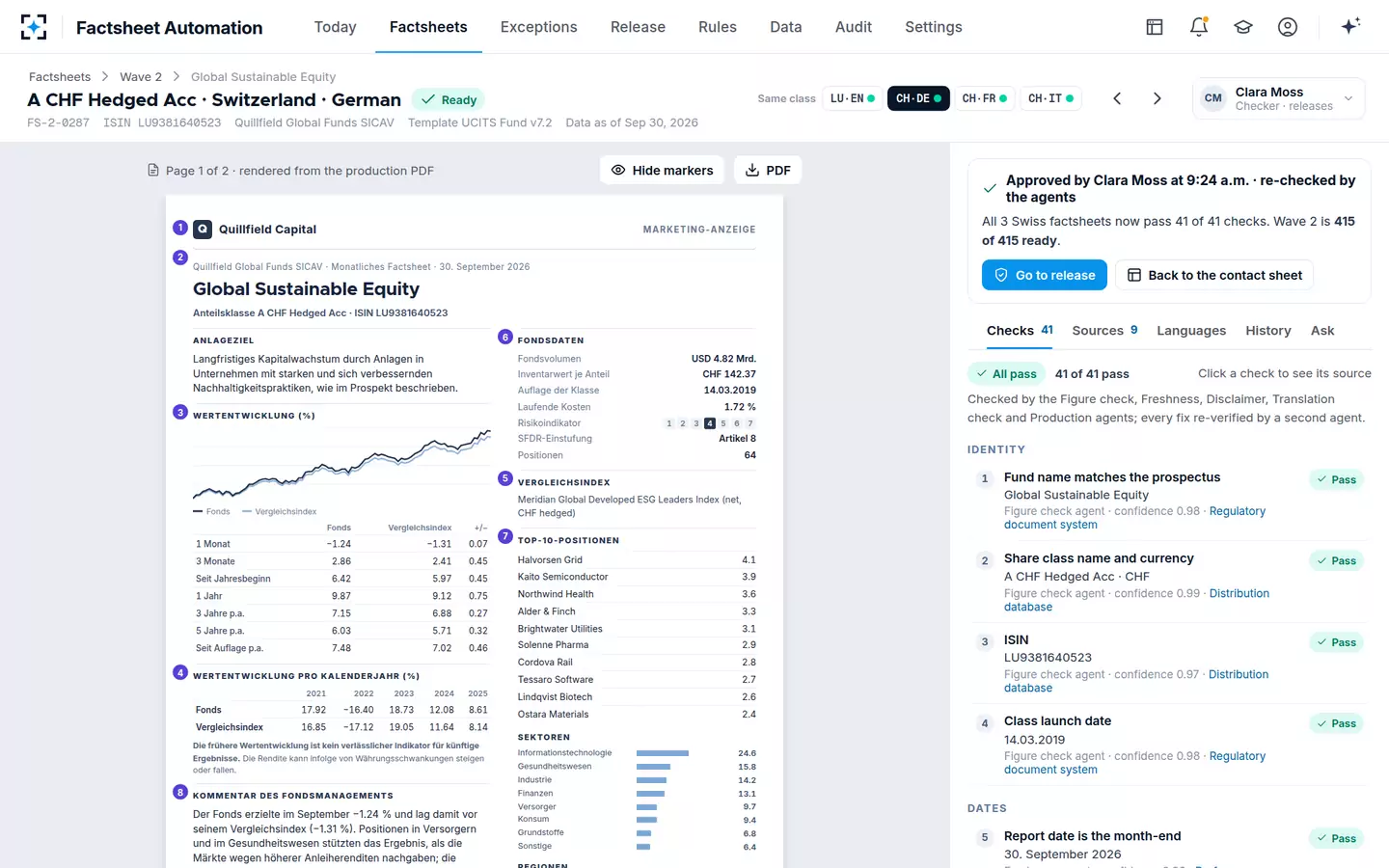
One fictional factsheet, every box numbered to its source, 41 of 41 checks passed
What should the release record show an examiner?
For each factsheet released, the record should show the exact file published, the KID and prospectus versions it was tested against, every check run with its result, any hold and how it was resolved, the sampling rule that chose what a person read, and who prepared and who signed the release with a reason. ESMA's guidelines are about the content of the communication; the firm's ability to show how each one was checked is what it needs when a supervisor asks, and the supervisors' findings cited above were each a mismatch with a document a reviewer could have opened.
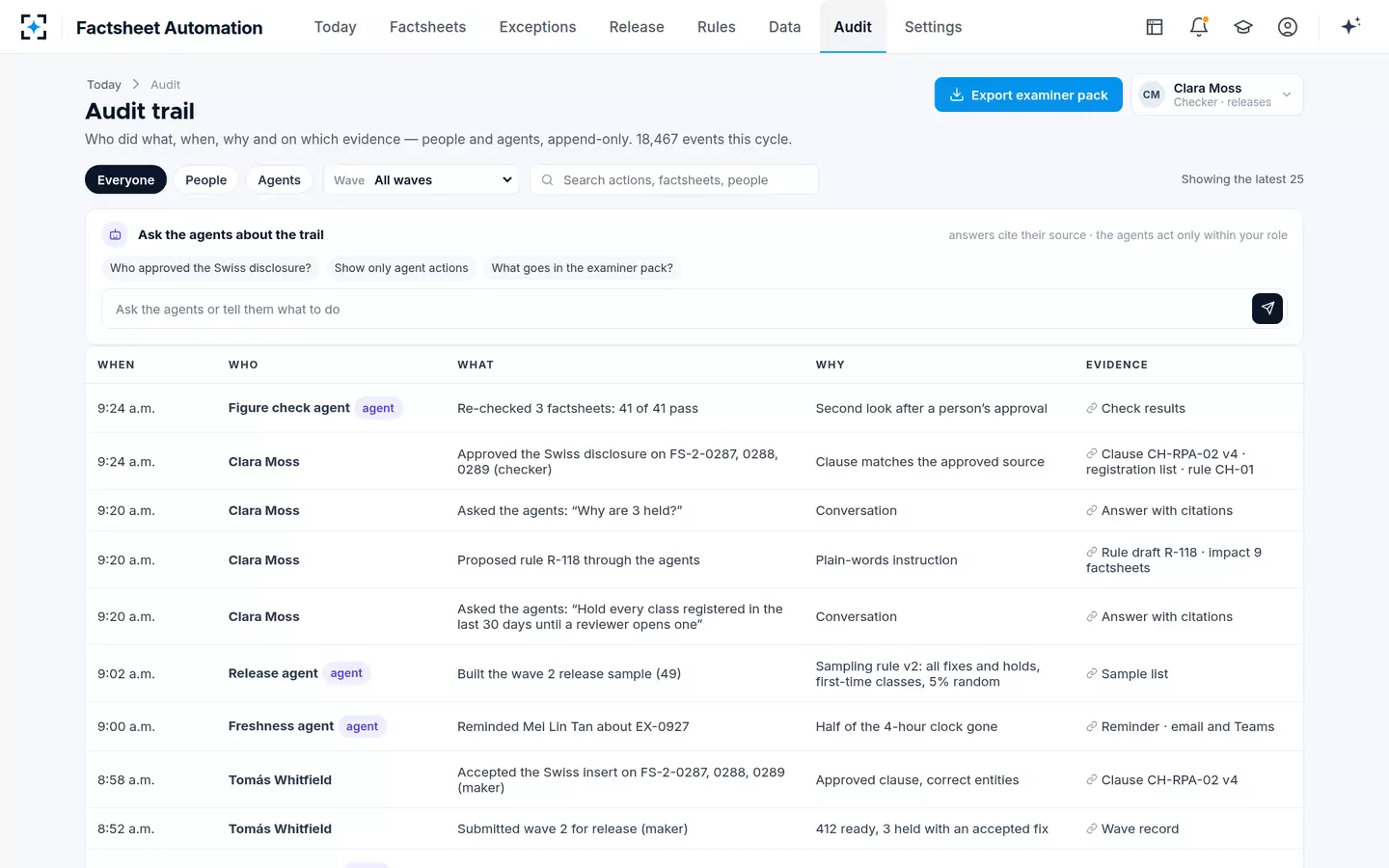
Two details make the record usable. It should be append-only, so a correction appears as a new version rather than an overwrite, and it should be exportable by fund, market and month, because a supervisor's request usually names a fund and a period. Factsheet Automation keeps each action by people and agents with who, what, when, why and the evidence, and exports an examiner pack from the same trail.
The audit trail behind each release, with the examiner pack export
How Factsheet Automation runs the review before the reviewer signs
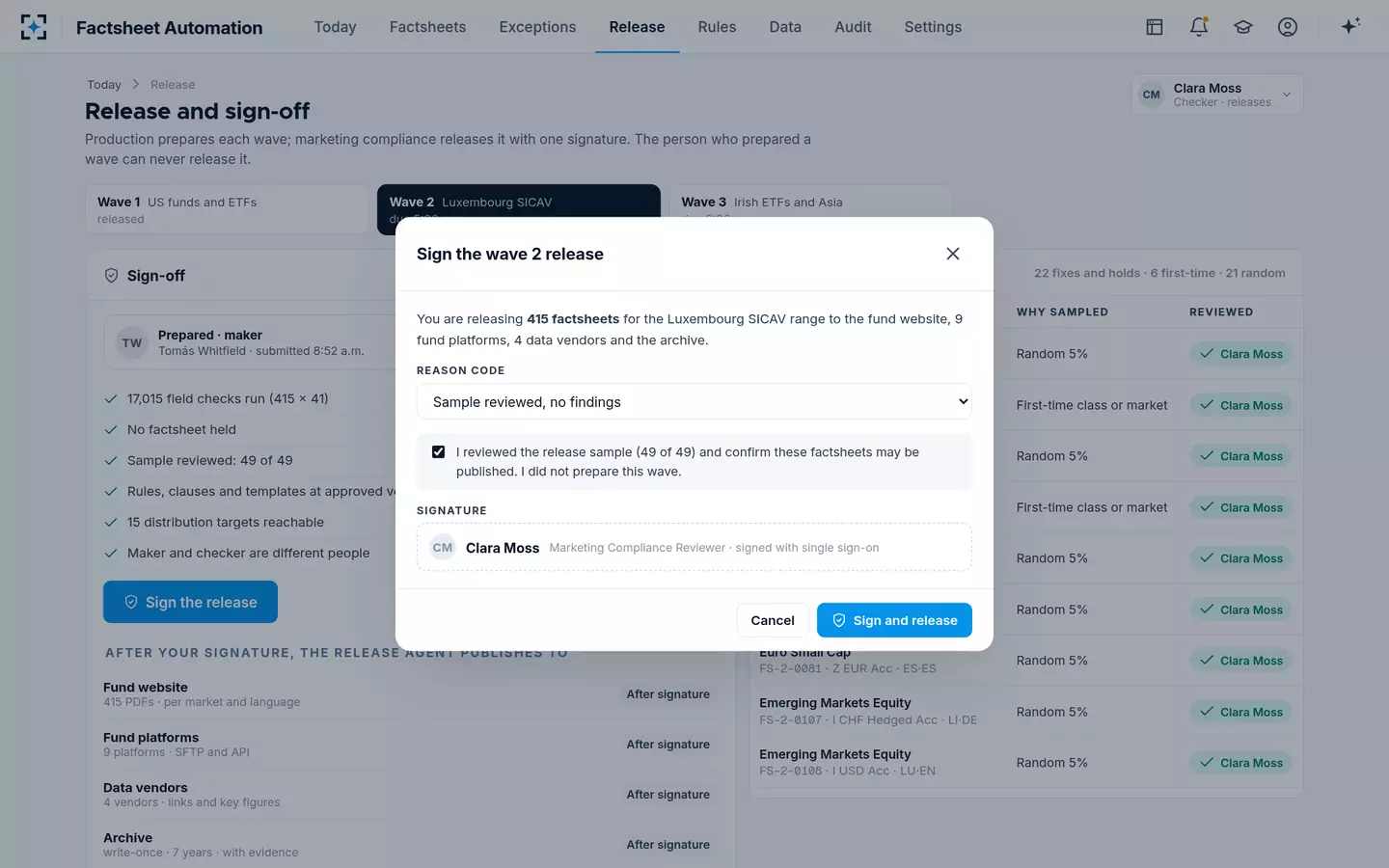
Factsheet Automation builds each factsheet for every class, market and language and runs the checks above on every one before the reviewer sees the wave. Anything the agents cannot prove, a benchmark restated after performance sign-off, a missing country clause, a translation that drifts from the master, is held with its owner and clock. The reviewer works from the holds and a risk-based release sample, and signs with a reason code and an attestation; the person who prepared the wave cannot sign it. In the sample's second wave, 415 factsheets for a Luxembourg range, that meant 17,015 field checks run by the agents and a release sample of 49 read by the reviewer: 22 factsheets that had been fixed or held, 6 for a class or market published for the first time and 21 drawn at random.
The release: a checklist, a risk-based sample and a signature the maker cannot give
In the sample cycle report, people confirmed 96.4% of the agents' flags, and release came on business day 3 of the month, against business days 8 to 10 before go-live; those are figures from fictional sample data, not a customer's results. The checks themselves, their thresholds and the KID versions in force are settings with a change log. The full product is on the Factsheet Automation page.
Questions people ask
Do the ESMA marketing communications guidelines apply to factsheets?
Yes. A fund factsheet used to market a UCITS or AIF in the EU is a marketing communication, and the guidelines expect it to be labelled as one, to point to the prospectus and KID, and to present risks, returns and costs consistently with them.
How many years of past performance must a UCITS factsheet show?
Complete 12-month periods over the last ten years for a fund that had a KIID, and five for others, under paragraph 44. Where a cumulative figure is shown, every year of the period must be shown beside it (paragraph 46).
Can a factsheet show the management fee instead of ongoing charges?
Not on its own where the KID shows ongoing charges. ESMA expects cost information consistent with the legal documents, and Luxembourg's regulator reported a communication that displayed only management fees while the KID displayed ongoing charges.
Must the factsheet risk indicator match the KID?
Yes, exactly, and it must be the KID in force on the factsheet date. ESMA expects the factsheet to use the KID's own risk class (paragraph 36), and Ireland's regulator has reported inaccurate risk indicators in marketing materials.
What wording does ESMA require for past performance?
The figures are introduced by "Past performance does not predict future returns" (paragraph 47). Where figures are in a currency other than the investor's, the factsheet must say so and warn that returns may rise or fall with currency movements (paragraph 48).
Who should sign off a fund factsheet?
A marketing compliance reviewer who did not prepare it, with a reason and a record of what was checked. The guidelines do not name the role; maker and checker separation is the firm's control, and it is what an examiner will look for in the release trail.