Fund data management solutions centralise a manager's fund data (share classes, identifiers, registrations, prices, performance and documents) and distribute it to platforms and data vendors, and most add templates that render factsheets from that data. They are one of three ways to produce factsheets at scale; the others are an outsourced production bureau, and agents that build and check factsheets on the systems you already have. No regulator or independent study publishes the cost of a factsheet, and vendors don't publish prices, so the comparison has to be built from your own volumes and hours. This guide gives the model: count the factsheets as classes × markets × languages, price the hours and the exceptions, add the cost of errors, and put each option through the same sum. Botminds' Factsheet Automation is the third option, and the guide is explicit about where it fits and where a data platform or a bureau is the better buy.
The comparison is between operating models more than products. A data platform is software your team runs. A bureau is people outside your team. Agents are software that does the mechanical work and hands decisions to your team. Each moves cost between licence, people and risk in a different way.
Three ways to produce factsheets, priced on the questions a COO asks
Data platform: Software: a central store of fund data with templates that render documents and feeds to platforms.
Bureau: People and process: a team outside the firm builds and checks factsheets from your data.
Agents: Agents on your existing systems: they collect signed data, build from your templates, check every field and hold what they cannot prove.
Data platform: Rules you configure; review by your team on a sample.
Bureau: The bureau’s reviewers, usually four-eyes on a sample, then your compliance.
Agents: Every field against its source on every factsheet; people decide holds and a risk-based sample.
Data platform: Licence, implementation, data clean-up, template build, your production staff.
Bureau: Price per factsheet or per fund, set-up, change requests, your oversight time.
Agents: Subscription, connection to your systems, rules and templates set-up, your people for decisions.
Data platform: Configure the template and legend rules; someone must remember.
Bureau: A change request and a lead time.
Agents: The registration list adds it; legends come from approved clauses; first-time classes are always sampled.
Data platform: Found if someone re-runs the data.
Bureau: Found if the bureau is told.
Agents: Held automatically with the exact difference, an owner and a clock.
Data platform: The data history and the rendered PDF.
Bureau: The bureau’s sign-offs and your oversight file.
Agents: Each value with its source, as-of date, check and approver; agent and rule versions.
Data platform: Your fund data is scattered and you need one golden source and distribution.
Bureau: You lack staff and your range changes little.
Agents: Your data is signed in systems of record and the volume or change rate defeats sample review.
What does a fund data management platform do for factsheets?
It holds the data a factsheet is made from, in one place, and pushes it out. The core is a fund and share-class master (names, ISINs, currencies, launch dates, fees), joined to dynamic data (NAVs, returns, holdings, risk and cost figures), to documents (prospectuses, KIDs, reports) and to the registration list of which class is sold in which country. On top of that most platforms render documents from templates and send data and documents to fund platforms, websites and data vendors.
What a platform does not do on its own is decide whether a value is right. It stores what it is given and renders what its rules say. If the performance file was restated after sign-off, if a KID was revised mid-month or a class was registered in a new market, the platform's output is only as current as the person who updates it. That is why buying one rarely removes the review step, and why its cost has to be counted with the people who run it.
How much does factsheet production cost?
No regulator or independent study publishes the figure, so measure it yourself: the cost of a month's factsheets is the number of factsheets, times the minutes each takes to build and check, times a loaded hourly rate, plus the time spent on exceptions, plus the cost of each reissue, plus whatever you pay for software or a bureau. The formula below names each term and who can price it. Every input comes from your own files: timesheets or a two-week time study, the registration list, last year's reissues, and your contracts.
The monthly cost of factsheets, term by term
Build and check
factsheets × minutes each × hourly rate
Production and review time, measured over one cycle.
Production lead
Exceptions
exceptions × minutes each × hourly rate
Restatements, KID changes, new registrations, translation queries.
Production and performance
Reissues
reissues × (rebuild + redistribution + review)
Each goes to every platform and vendor that took the first version.
Marketing compliance
Tools or bureau
licence or fees ÷ 12 + your oversight time
Include implementation spread over the contract.
COO and procurement
For the hourly rate, use your own loaded cost. As a reference point, the US median pay for financial analysts, the occupation that includes performance and reporting analysts, was "$103,570 per year" in 2025 (Bureau of Labor Statistics), about $50 an hour across 2,080 working hours, before benefits and overheads, on our arithmetic. Production specialists, designers, linguists and compliance reviewers have their own rates; a time study tells you how much of each a factsheet uses.
Count the unit: classes × markets × languages
The number of factsheets is the term that varies most between managers and the one most often underestimated. It is not the number of funds. It is the number of share classes, multiplied by the markets each class is registered in, multiplied by the languages each market needs, and sometimes multiplied again by audience (retail and professional versions). A US fund family usually multiplies little; a European cross-border range multiplies a lot, because ESMA expects each market's factsheet in an official language of the place where the fund is sold (ESMA guidelines, paragraph 17; the language rules by country show how far that reaches).
Take a fictional manager, Oxbury Capital, with 40 funds and 120 share classes, each class registered in 3.2 markets on average and each market needing 1.5 languages on average: 120 × 3.2 × 1.5 is 576 factsheets a month, before retail and professional versions. In Factsheet Automation's fictional sample, a larger manager produces 1,226 a month from 659 share classes and composites in 20 markets and 9 languages. Neither figure is a benchmark; the point is that the count is a product of three numbers you already hold.
The US fund universe, where factsheet counts start
8,117
mutual funds (excluding money market funds), March 2026
4,829
ETFs, March 2026
+837
ETFs in eleven months, from 3,992 in April 2025
How to measure your own hours in two weeks
A time study over one cycle gives you the inputs the formula needs, and it is cheaper than any consultant's benchmark. Ask everyone who touches factsheets (production, performance, data, product, linguists, compliance) to log their time against five stages for one month-end: collecting and reconciling data, building, legends and translations, checking and review, and release. Log exceptions separately, each with its cause: a restatement, a KID change, a new registration, a translation query, a corporate action.
Then divide by the number of factsheets released to get minutes per factsheet for each stage, and count the exceptions per hundred factsheets. Add last year's reissues from your distribution records. Three numbers fall out that every option can be judged on: minutes per factsheet, exceptions per hundred, and reissues per year. Ask each vendor or bureau which of the three it changes, by how much, and how it would prove it on your files.
Where the time goes in a manual cycle
Most of a manual cycle is not building factsheets. On Botminds' design estimate for a global range produced by hand, collecting and reconciling data takes about two business days, building per class, market and language about three, legends and translation checks about one, four-eyes checks and compliance review about two and a half, and release about one. The share each stage takes is what a cost model should price separately, because each option removes a different stage.
Where a manual factsheet cycle's elapsed days go
By hand, about 9.5 business days
- Collect and reconcile · 21%
- Build · 32%
- Legends and translations · 11%
- Four-eyes and compliance · 26%
- Release · 10%
A data platform mainly shortens the build and, if its feeds are clean, the data gathering. A bureau moves the build and first check outside the firm but leaves data gathering and compliance with you. Agents shorten data gathering, build and the mechanical checks, and change compliance review from reading a random sample to deciding holds and a risk-based sample; the decisions themselves stay with people.
The cost lines buyers forget
The visible cost is the licence or the bureau's invoice; the larger costs are often the ones nobody budgets. Four deserve a line each in the model.
Reissues. A wrong factsheet is corrected on the website, on every fund platform that took it and at every data vendor that read figures from it, and compliance reviews the correction. Count last year's reissues and price one. Restatements and late changes. Index vendors restate benchmark levels, administrators correct NAVs, corporate actions post late, KIDs are revised mid-month; each sends part of the cycle round again.New registrations. Each new class or market adds factsheets and legends; at a growing manager this is a recurring cost, not a one-off. Evidence. When an examiner or auditor asks who checked a factsheet and against what, the time to reconstruct the answer is a cost; US rules already require advertisements to carry legends and returns in specific forms and timeliness (Rule 482), and showing that they did is part of the work.
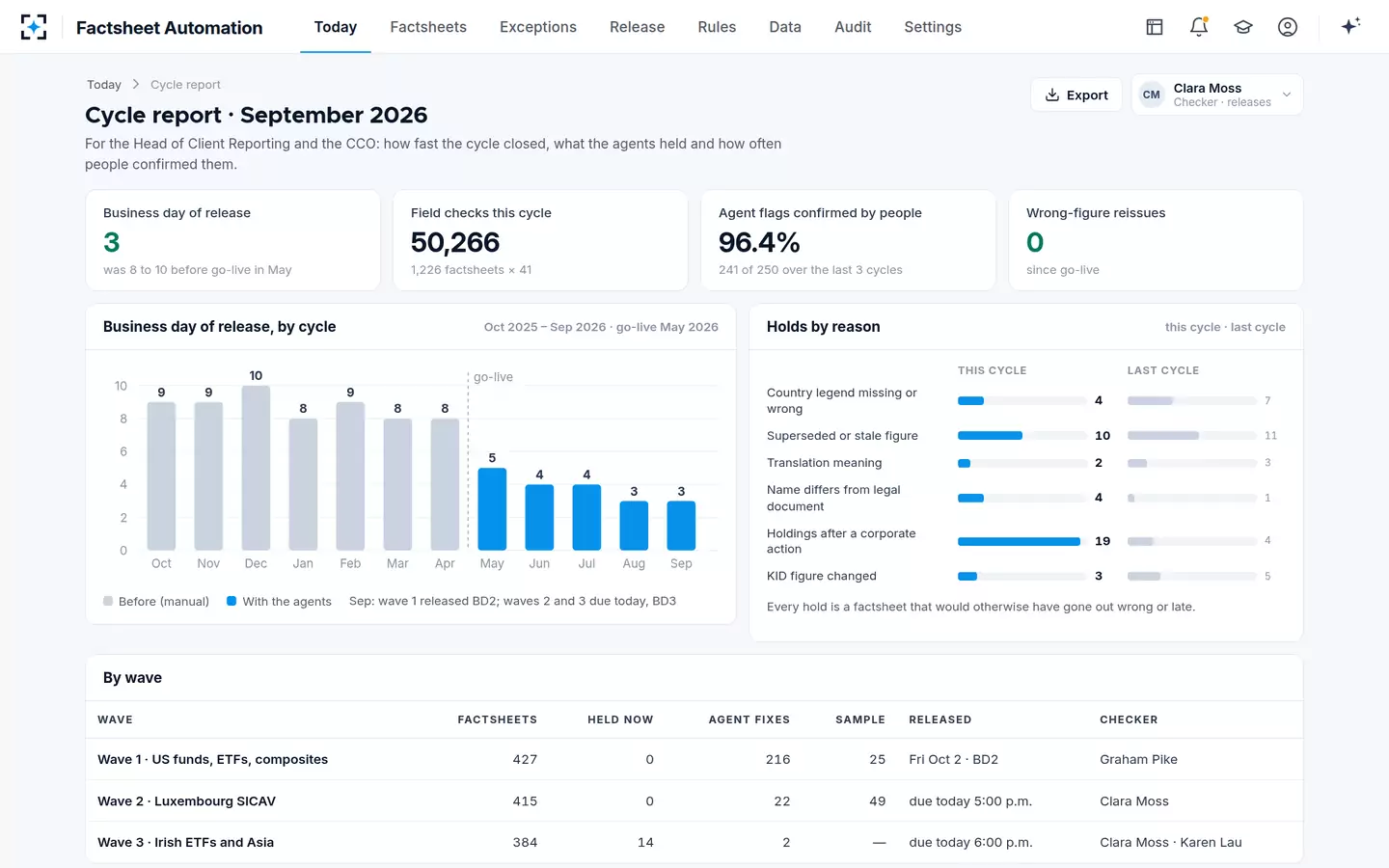
Factsheet Automation's cycle report: the measures a COO should ask any option for
Should you outsource factsheet production?
You can outsource the work but not the responsibility. In the EU the manager answers for every marketing communication being recognisable as marketing and its contents being fair, clear and not misleading, whoever produced them (Regulation (EU) 2019/1156, Article 4(1)). A bureau makes sense when the constraint is staff and the range is stable: it brings capacity and experienced people, and its price per factsheet makes cost predictable. It makes less sense when the range changes often, because each new class, market or template change becomes a change request with a lead time, and when the bureau's own check is a sample, because your compliance review then rests on two samples rather than one complete check.
The same reasoning applies to software. ESMA's statement on AI in investment services keeps responsibility for decisions with the firm's management body however they were taken (ESMA, 30 May 2024), and FINRA has said its communications rules apply in the same way to text written by a person or a tool (Regulatory Notice 24-09). Whichever option you choose, keep the release decision, and the evidence for it, in-house.
What to look for in fund data management software
Look for the features that reduce the expensive terms of the model, not just the build. The checklist applies to a platform, a bureau's tooling and agents alike; ask each to show it on your own data.
Nine things to test before buying fund data management software for factsheets
- Registration-driven output
Factsheets generated from the live registration list, so a new market or class produces its factsheets and legends without a template copy.
- Signed data only
Unsigned or restated figures are blocked, not used.
- Consistency with the KID
Costs, risk class, benchmark and objective compared with the current KID and prospectus on every factsheet.
- Legends from approved clauses
Each market’s legends drawn from a clause library with versions and approvals.
- Language checks
Numbers, names and locked terms compared across languages, with linguists approving changes of meaning.
- Exceptions with owners
Every problem routed to a named owner with a deadline, not to a shared inbox.
- Maker and checker in the system
The person who prepared a release cannot approve it.
- Evidence per value
Source, as-of date, check and approver for each figure, exportable for an examiner.
- Measured on your files
A seeded-error test and a re-run of last month’s released factsheets, scored by error type.
That last item is what makes a demonstration evidence. The agentic AI proof of concept re-makes last month's released factsheets and compares them field by field; the seeded-error test plants known errors and counts what is caught. Run both on any option before you sign.
Where Factsheet Automation fits, and where it does not
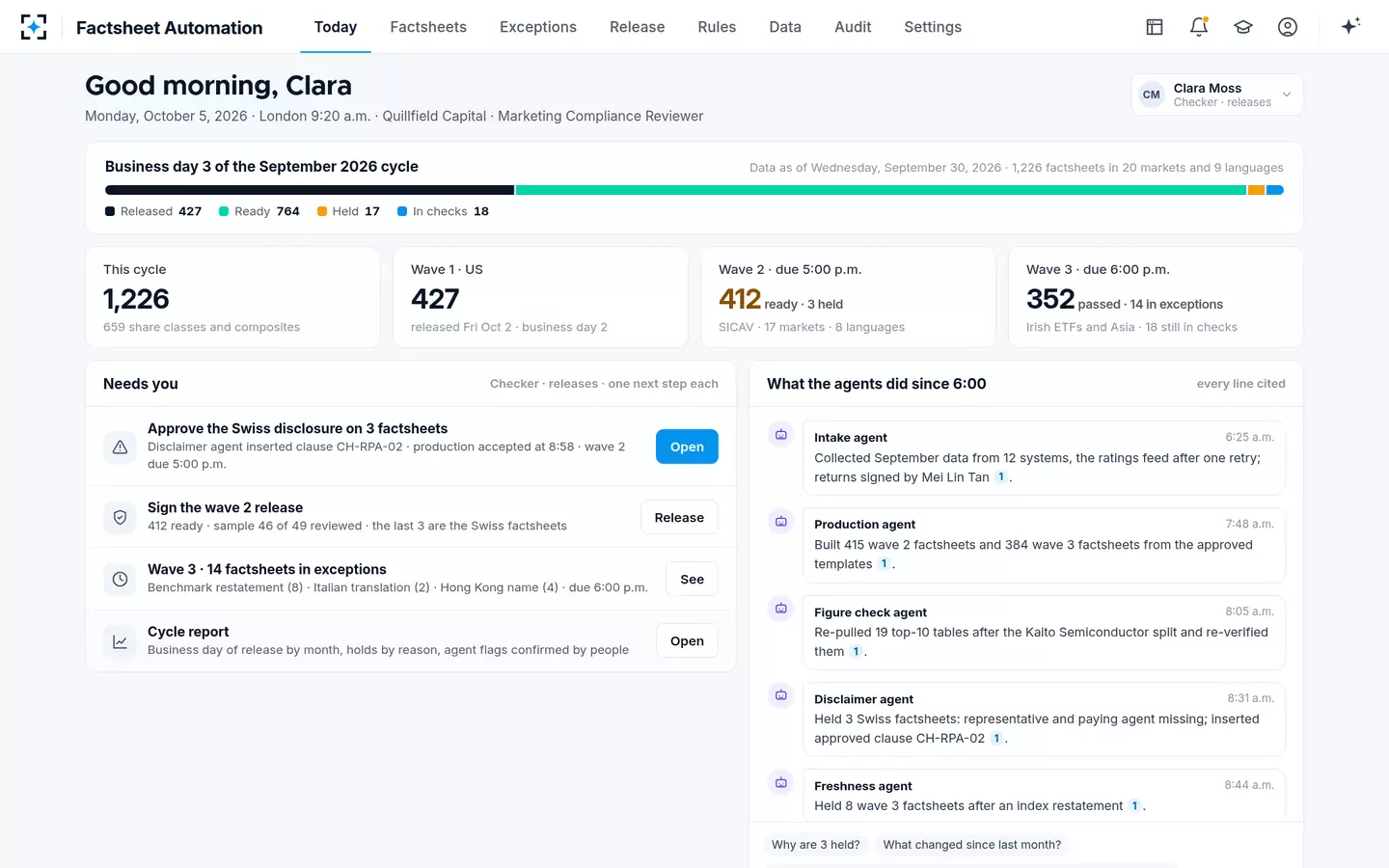
Factsheet Automation fits a manager whose data already lives in systems of record (signed returns in a performance system, NAVs from an administrator, holdings in portfolio accounting, KIDs and prospectuses in a document system, a registration list, a clause library) and whose volume or rate of change has outgrown sample review. It works with those systems rather than replacing them: seven agents collect the signed data, build every factsheet from your approved templates for each registered class, market and language, run 41 field checks on each, hold what they cannot prove with an owner and a clock, and hand compliance a risk-based sample and one signature per wave. Its design targets are factsheets out on business day 3 rather than 8 to 10, no factsheet released with a stale figure or a missing country legend, and about 400 factsheets per production analyst per cycle, worked by exception.
It does not replace a fund data management platform where you need one: if your share-class master, registrations and documents are scattered across spreadsheets and inboxes, the first purchase is a golden source, and agents come after. And for a small range in one market and one language, a careful person with a good template may be the cheapest option on the model above. The sum, done honestly on your numbers, should tell you which case you are in; the AI factsheet generator trace shows what the agents do at each step if it points to the third option.
One cycle in Factsheet Automation: released, ready, held, in checks
Questions people ask
What are fund data management services?
Services that maintain a manager's fund data for it: setting up share classes, keeping identifiers and registrations current, collecting prices and documents, and distributing them to platforms and data vendors. Some also produce factsheets and other documents. They are an outsourcing option; the responsibility for the content of marketing communications stays with the manager.
How do you calculate the cost per factsheet?
Divide the month's total cost (build and check time, exception time, reissues, and tools or bureau fees) by the number of factsheets released. Measure the time over at least one full cycle, and price reissues separately, because one error that reaches many platforms can cost more than a month of building.
Is fund data management software the same as factsheet software?
Not quite. Fund data management software is the store and distribution layer; factsheet software produces the documents. Many platforms do both. Agents that check factsheets sit on top of either and compare what was produced with its sources.
How long does it take to implement a fund data platform for factsheets?
It depends mostly on the state of your data, which no vendor can know before looking. Budget for data clean-up, registration-list reconciliation and template rebuilds as well as the software, and ask for a re-run of a released cycle before go-live.
Do agents replace the factsheet production team?
They change its work. The team stops collecting, re-keying and cross-checking, and spends its time on exceptions, templates and new registrations; compliance decides holds and samples instead of reading a random share of every wave. Signing the data, approving translations and releasing stay with people.