Fund factsheet production is the monthly work of turning month-end data from five or six teams into one factsheet per share class, market and language, and it is slow because each team waits on another, not because any one step is long. Returns cannot be placed until the performance team signs them; the NAV and fund size wait on the administrator; costs and the risk indicator wait on the current KID; commentary waits on the portfolio manager and compliance; translations wait on the master; and the release waits on all of it. Botminds' Factsheet Automation was built around that chain: its agents collect signed data from each system the moment it lands, build and check every factsheet, and hand people only the factsheets they cannot prove, so the production lead manages exceptions instead of a spreadsheet of waits.
The seats differ from firm to firm, but the dependencies do not. Below are the seats a production lead deals with each month, what each waits for and who waits for them.
Five seats and a production lead: what each waits for, and who waits for it
Today
Waits for the administrator’s final NAVs and index vendors’ month-end levels, then calculates and signs class and benchmark returns. Everyone downstream waits for that signature.
With agents
Signs as before; a restatement after sign-off comes back with the exact difference and a clock, and the affected factsheets wait.
Still theirs: Signs every return that reaches a factsheet
Today
Deliver NAVs, fund size, holdings and weights. A corporate action posted late means the top-ten tables are pulled again.
With agents
Files are collected as they land, checked for as-of date, sign-off and row count, and reconciled with the administrator.
Still theirs: Own the source data; nothing is edited downstream
Today
Owns costs, risk class and the objective. A KID revised mid-month can leave last month’s cost figure on hundreds of factsheets.
With agents
A superseded KID fails the cost and risk checks on every factsheet that uses it.
Still theirs: Approves the legal documents the factsheet copies
Today
The manager’s commentary is drafted, approved, then translated; linguists read every language line by line against the English.
With agents
Linguists get only the sentences whose meaning moved, with the master, glossary term and prospectus page.
Still theirs: Writes and approves the words
Today
Receives hundreds of factsheets at once, samples them, and must release before the deadline without knowing which hide the problem.
With agents
Decides the few holds, works a risk-based sample with every field cited, signs one release per wave.
Still theirs: Releases; the maker never can
Today
Runs the calendar, the data pull and the exceptions in spreadsheets, chasing each seat by email.
With agents
Sees every exception with its owner and its clock; accepts the agents’ proposed fixes as maker.
Still theirs: Owns the wave and the template
Who produces fund factsheets?
The factsheet production lead produces them, usually in marketing operations or client reporting, but no one in that team owns a single number on the page. The lead owns the template, the calendar and the release file. The values belong to others: the performance analyst who signs returns, the fund administrator who strikes the NAV, the data team that owns holdings and the security master, the product team that owns the KID and prospectus, the portfolio manager who writes the commentary, the linguists, and the marketing compliance reviewer who releases. In the US, the broker-dealer that distributes the funds adds one more seat: a registered principal who must approve each retail communication before use (FINRA Rule 2210(b)(1)(A)).
The performance seat is the bottleneck and the most skilled. Performance and client reporting analysts sit in the occupation the Bureau of Labor Statistics calls financial analysts, with a median wage of "$103,570 per year" and "443,100" jobs in 2025 (BLS Occupational Outlook Handbook). A team of that cost should spend its month-end calculating and signing, not answering "is it ready yet?" from the factsheet desk.
How long does factsheet production take?
No regulator or independent study publishes a benchmark for it, so the useful measure is your own: the business day on which the last factsheet of the month is released. For a range sold across many markets and produced by hand, our design estimate puts that around business day 9 or 10, and most of the time is waiting rather than working. The estimate below, from the Factsheet Automation design, splits a manual cycle of about nine and a half business days for a global range into its stages, and shows the target with agents doing the collection, building and checking.
Where a month of factsheet production goes, in business days after month-end
- Collect and reconcile data2 d
- Build per class, market, language3 d
- Legends, translations1 d
- Four-eyes and compliance2.5 d
- Release1 d
- Agents collect, build, add legends1.5 d
- People decide, sign; release1.5 d
Measured on your own range, the shape is usually the same: the build is not the longest stage, and the waiting at both ends is. That is the argument of this page. Speeding up the template does little if the template is waiting for a signature, and speeding up the review does little if the reviewer receives every factsheet at once on the last afternoon.
Why are factsheets late? Waits, not work
Factsheets are late because the chain is serial and each link has a reason to wait. The performance analyst waits for final prices and NAVs. The production team waits for signed returns. Compliance waits for a complete wave. The linguists wait for approved English. Each wait is reasonable on its own, and together they push the release into the second week.
The month-end chain: each step waits for the one before
A person decides
Administrator and data teamStrike NAVs; deliver fund size, holdings and weights as at month-end.
A person decides
Performance analystCalculate class and benchmark returns; sign them.
Never: A factsheet never shows a return that was not signed.
Agent
Intake and productionCollect each signed file as it lands; build every factsheet from the approved template.
Never: Never uses unsigned performance or edits source data.
Agent
ChecksDates, figures against the KID and prospectus, legends from the registration list, meaning in every language.
Never: Holds what it cannot prove; never substitutes a number.
A person decides
Production lead (maker)Accepts or rejects proposed fixes; submits the wave.
A person decides
Compliance reviewer (checker)Decides holds, works the sample, signs the release.
Never: The person who prepared a wave cannot release it.
The performance seat: nothing moves until returns are signed
Every factsheet waits on one signature: the performance analyst's sign-off on class and benchmark returns. It cannot be skipped, because the factsheet's returns must be the official ones, and in the EU they must match the KID and prospectus (ESMA guidelines, paragraph 43). What can be removed is the work around it: assembling the inputs, re-keying the signed figures into templates, and checking afterwards that the template shows what was signed.
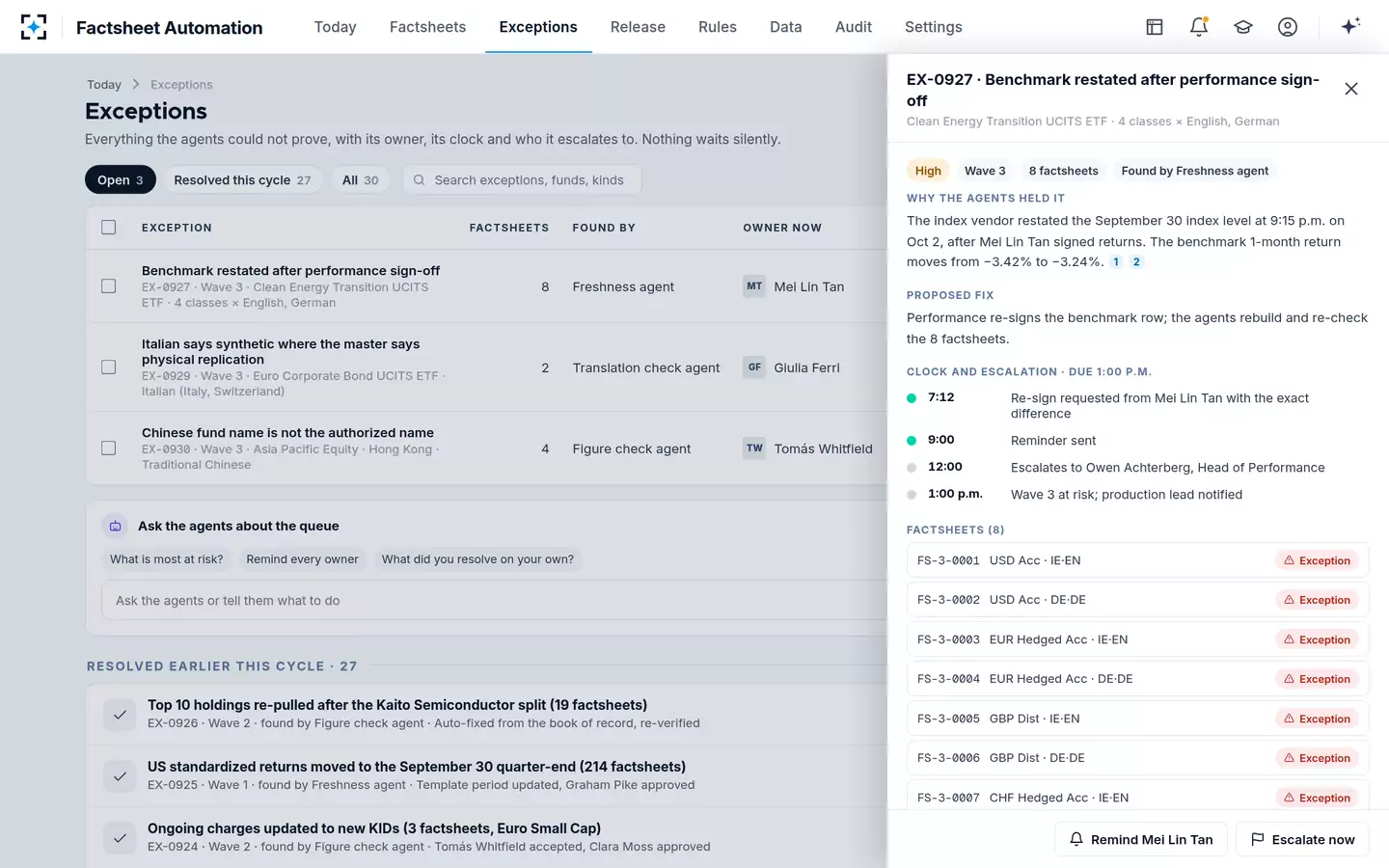
The harder dependency is what happens after the signature. Index vendors restate levels; administrators correct NAVs. A restatement after sign-off is the classic way a wrong benchmark return reaches a client: the factsheet is built from the signed file, the signed file is now out of date, and nobody downstream knows. In Factsheet Automation's fictional sample cycle, the performance analyst signed September returns on a Friday evening; later that evening the index vendor restated a benchmark's 30 September level, moving its one-month return from −3.42% to −3.24%. The Freshness agent held the eight affected factsheets, asked her to re-sign with the exact difference, sent a reminder and set an escalation to the head of performance at noon.
A restatement after sign-off, held with its owner and clock
Administrator, data and product: inputs that change after they arrive
The other inputs arrive on time more often than they arrive final. The administrator's NAV and fund size are usually ready early, but holdings and weights depend on corporate actions posted late; a stock split near month-end changes a top-ten table after it has been built. In the fictional sample cycle, the Figure check agent re-pulled 19 top-ten tables after a split and had each fix re-verified before release.
The product team's input changes least often and is missed most easily: the KID. When a KID is revised, its cost figure and risk class change on the day it is published, and every factsheet for that class must follow. ESMA's guidelines want those indicators calculated as, and equal to, the figures in the legal documents (paragraph 21), and national authorities still report factsheets that show the management fee where the KID shows ongoing charges (ESMA report, 6 January 2026). The dependency is not on a person but on knowing which version of the KID is current.
Linguists and compliance: the end of the chain
The last two seats receive everything at once, which is why the end of the cycle is where time is lost. Linguists can start only when the English master is approved, then review every language of every factsheet against it. Compliance can release only a complete wave, so it receives hundreds of factsheets on the same afternoon and has to decide how many to open. A four-eyes review on a sample, done in series at the end, both delays the release and misses errors outside the sample.
The change that helps is in what reaches them, not how fast they read. A linguist who sees only the sentences whose meaning differs from the master, with the glossary term and the prospectus page beside them, can approve a correction in minutes. In the sample cycle, the Translation check agent compared eight languages with the English master for one range and found no differences; in another range it found two Italian factsheets that described an ETF's replication as "replica sintetica" where the master said physical, and sent the correction to the Italian linguist before compliance. How the reviewer's sample is drawn is covered in the seeded-error test of a fund factsheet example.
Two regulatory clocks: the US date of use and the EU quarter-end
Regulation sets the freshness a factsheet must have when it is used, not a production deadline, and the US and EU clocks differ. In the US, Rule 482 treats an advertisement's returns as timely if they are current to the most recent calendar quarter and month-end returns are available by phone or website, or if the advertisement itself carries returns "current to the most recent month ended seven business days prior to the date of use" (17 CFR 230.482(g)). The note to that paragraph is the one production teams forget: "The date of use refers to the entire period of use by investors and not simply the first date on which an advertisement is used." A factsheet that sits on a platform all month must be current all month.
In the EU, ESMA's guidelines let the complete-year figures carry a current-year figure, but only one updated to the last quarter-end (paragraph 44); one supervisor, Luxembourg's, regulator has flagged a communication that used the month-end figure instead (ESMA report, 2026). A range that serves both markets therefore needs two sets of dates in one production cycle: quarter-end standardised returns and month-end figures for the US, quarter-end current-year figures for the EU, each correct for its market.
Which waits can agents remove, and which they cannot?
Agents can remove the waits between people; they cannot remove the decisions people make. The collection of signed files, the build, the re-keying, the comparison of each figure with its source, the derivation of legends from the registration list and the comparison of every language with the master are mechanical and can run as soon as each input lands. The signature on returns, the approval of a new legend, the approval of a translation that changes meaning, and the release itself are decisions, and in Factsheet Automation they stay with named people.
Regulators expect that split. ESMA's statement on AI in investment services holds the management body to account for every decision, human or machine-made (ESMA, 30 May 2024). The useful design question is not how much an agent can do but which decisions it is never allowed to take; for the step-by-step version, an AI factsheet generator traced on one share class follows a single class through the cycle.
What should a production lead measure each month?
Four numbers describe a factsheet cycle better than any staffing plan, and each one points at a dependency. The first is the business day of the last release, by wave: it shows whether the chain is getting shorter. The second is holds by reason (stale figure, benchmark restated, KID changed, legend missing, translation meaning, name mismatch, corporate action): it shows which seat the waits come from. The third is reissues after release, the costliest failure, because each one goes back to every platform and data vendor that took the first version. The fourth is the share of factsheets a person had to open, which shows whether reviewers are reading the right ones.
Track them by seat, not in total. A rise in benchmark holds is a conversation with the performance team about index vendor cut-offs; a rise in KID holds is a conversation with product about when revised KIDs are published; a rise in legend holds means registrations are moving faster than the template. In Factsheet Automation's fictional sample cycle report, the largest single reason for a hold was holdings after a corporate action (19), followed by stale or superseded figures (10); people confirmed 241 of the last 250 flags the agents raised, a rate the head of client reporting can watch for drift.
A month with Factsheet Automation, from the production lead's seat
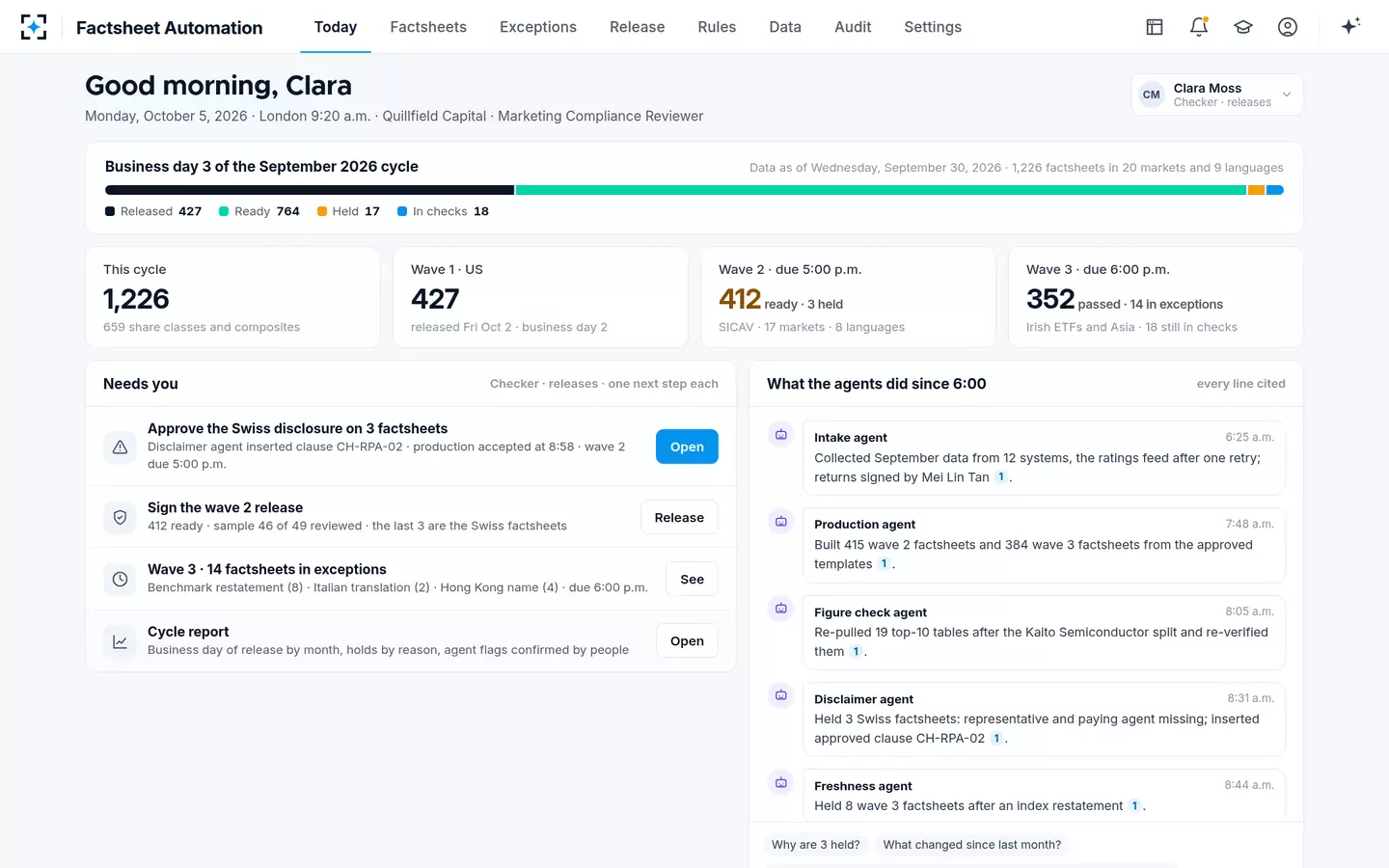
In the solution's fictional sample, Quillfield Capital closes its September 2026 cycle with 1,226 factsheets from 659 share classes and composites, in 20 markets and 9 languages, in three waves: US funds and ETFs, a Luxembourg SICAV, and Irish ETFs and Asia. The production lead's view on business day 3 is a contact sheet of the wave, held factsheets first, and a list of exceptions each with an owner and a clock: a benchmark restatement with the performance analyst, an Italian translation with the linguist, a Hong Kong fund name with production. The US wave was released on business day 2; the other two are due that afternoon.
The sample firm's own history shows the effect the design aims for. Before go-live in May, its cycle closed between business days 8 and 10; in the months since, between days 5 and 3. These are fictional figures from the sample cycle report, shown to illustrate the measure we recommend, not a customer result.
Business day of the last factsheet release, by month, at a fictional sample firm
The production cycle on one bar in Factsheet Automation
Questions people ask
What does a factsheet production lead do?
The production lead owns the monthly cycle: the calendar, the template, the data pull, the exceptions and the release file. In a maker-checker model the lead prepares and submits each wave as maker, and a marketing compliance reviewer releases it as checker. The lead rarely owns a number on the page; the job is to know who does and when it will be final.
What is the monthly factsheet process?
Month-end data is collected and reconciled, returns are signed, factsheets are built per class, market and language, legends and translations are added, compliance reviews and releases, and the factsheets go to the website, fund platforms and data vendors. Restatements and late corporate actions send parts of the cycle round again.
Can factsheets be produced before returns are signed?
A draft can be built, but a factsheet should not be released with unsigned figures. In Factsheet Automation, unsigned performance never reaches a factsheet; the build waits for the signed file and runs as soon as it lands.
Why do factsheets need re-producing after release?
Usually because an input changed: a benchmark or NAV restated after sign-off, a KID revised, a corporate action posted late, or a legend missing for a market. A reissue goes to every platform and data vendor that took the first version, which is why holding a factsheet is cheaper than correcting it.
How many people does factsheet production need?
No regulator or study publishes a staffing ratio. Count it on your own range: the number of factsheets a month (classes × markets × languages), the hours each takes to build and check, and the number of exceptions. The design target for Factsheet Automation is about 400 factsheets per production analyst per cycle, worked by exception.