UCITS factsheet rules come in three layers. EU law requires every UCITS marketing communication to be identifiable as marketing, fair, clear and not misleading, consistent with the prospectus and KID, and to say where, how and in which language investors can get those documents and a summary of their rights. ESMA's guidelines turn that into detailed tests on risks, costs and past performance. Each host member state then sets the language and may add its own warnings. The practical result is that a UCITS factsheet is not one document but one per share class per registered market, each in that market's language with that market's legends, and the list of registrations, not the template, decides how many there are. Botminds' Factsheet Automation builds factsheets from that list: its Disclaimer agent reads the live registration list every cycle and derives each factsheet's legends from the country rules, drafting only from approved clauses.
The matrix below shows the effect on a small fictional range: four share classes of one Luxembourg UCITS, registered in eight markets between them. Four classes become fifteen factsheets before a single word of commentary is written.
Four share classes, eight markets, fifteen factsheets
What are the UCITS factsheet rules? Three layers
The first layer is EU law. The UCITS Directive has long required that "marketing communications to investors shall be clearly identifiable as such" and "fair, clear and not misleading", and that a communication containing specific information about a UCITS "shall make no statement that contradicts or diminishes the significance of the information contained in the prospectus and the key investor information" (Directive 2009/65/EC, Article 77). Since 2 August 2021, Article 4 of the cross-border distribution regulation has applied the same principles to the marketing communications of UCITS and AIFs alike, with more detail on what each communication must contain (Regulation (EU) 2019/1156).
The second layer is ESMA's guidelines on marketing communications (ESMA34-45-1272, 2 August 2021), which say how to meet the principles: the label, equal prominence of risks and rewards, consistency with the KID, costs, past performance periods and statements. The third layer is national. Host states set the language, decide whether to check communications before or after publication, and in some cases prescribe warnings. ESMA's report of 6 January 2026 found that national authorities "broadly apply the rules stemming from the UCITS Directive" in ten countries, that four had written the guidelines into binding legislation, and that two apply "additional requirements on the content, format and manner of presentation of marketing communications, including compulsory warnings and restrictions on the use of certain words or phrases" (ESMA report, paragraphs 12 to 14).
What must a UCITS marketing communication include?
Every UCITS marketing communication, a factsheet included, must carry a short set of statements whatever the market. Under Article 4(2) of Regulation 2019/1156 it must "indicate that a prospectus exists and that the key investor information is available" and "specify where, how and in which language investors or potential investors can obtain the prospectus and the key investor information", with "hyperlinks to or website addresses for those documents". Under Article 4(3) it must also say where, how and in which language investors can obtain "a summary of investor rights", with a hyperlink, and "contain clear information" that the manager "may decide to terminate the arrangements made for the marketing" of its funds (Article 4).
On top of that come ESMA's content tests, which apply only if the factsheet contains what they govern: the marketing-communication label and disclaimer (paragraphs 6 and 7), risks as prominent as rewards (13), the KID's risk classification (36), costs consistent with the KID and explained (21 and 41), past performance over 10 years for funds with a KIID or 5 for others in complete 12-month periods (44), each year beside any cumulative figure (46), the fixed statement "Past performance does not predict future returns" before the figures (47), and a currency warning where the figures are in another currency (48). The box-by-box version is the fund factsheet template.
The Article 4 statements are where the cross-border errors show up. ESMA's report lists, among the most frequent breaches of Article 4, UCITS communications that "failed to indicate that the prospectus and the key investor information were available and how to obtain these documents (AT, LU)", that did not say in which language the prospectus and key investor information could be had (AT, BG, LU), that failed to point to the summary of investor rights (BG, IT), and that omitted "the warning that the fund manager may decide to terminate the arrangements made for the marketing" (IT, LU) (paragraph 74).
Which markets need a local factsheet?
Every market where the class is registered for marketing and where you show it to investors, and no market where it is not. ESMA's guidelines open with the second half: a reference to a UCITS in an advertisement "may only be published after" the home authority's approval where required and, "if applicable", once the management company "has received notification that it may market the promoted fund in the targeted host Member State" (paragraph 5). A factsheet for a market where the class is not yet notified is marketing that should not exist; a factsheet missing for a market where it is registered leaves platforms and distributors there with nothing current.
That is why the unit of work is the cell of the registration matrix, not the fund. The fictional range above has four classes and fifteen factsheets; a real range with dozens of classes across a dozen markets runs to hundreds, which is the scale Factsheet Automation's sample cycle uses: 415 factsheets in one wave from 162 share classes registered across 17 markets in 8 languages.
What language must a UCITS factsheet be in?
In the language of the market where it is sold. ESMA's guideline asks for an official language of the part of the country where the fund is distributed, or another language the local authority accepts (paragraph 17; the language rules by country quote it and map each market). "The part of the Member State" matters in countries with language areas: a factsheet for Belgian investors generally needs French and Dutch versions. "Another language accepted" matters for markets that accept English for some audiences, which is a question to settle with each host authority's published rules rather than assume.
Language also drives the Article 4 statement: the factsheet must say in which language the prospectus and KID can be obtained. The rules on translating the KID itself, and how to check translations, are a separate subject from the factsheet's own language. For the factsheet, the check that matters most is that the translated version still says what the master says about the product: replication method, hedging, distribution policy, active or passive.
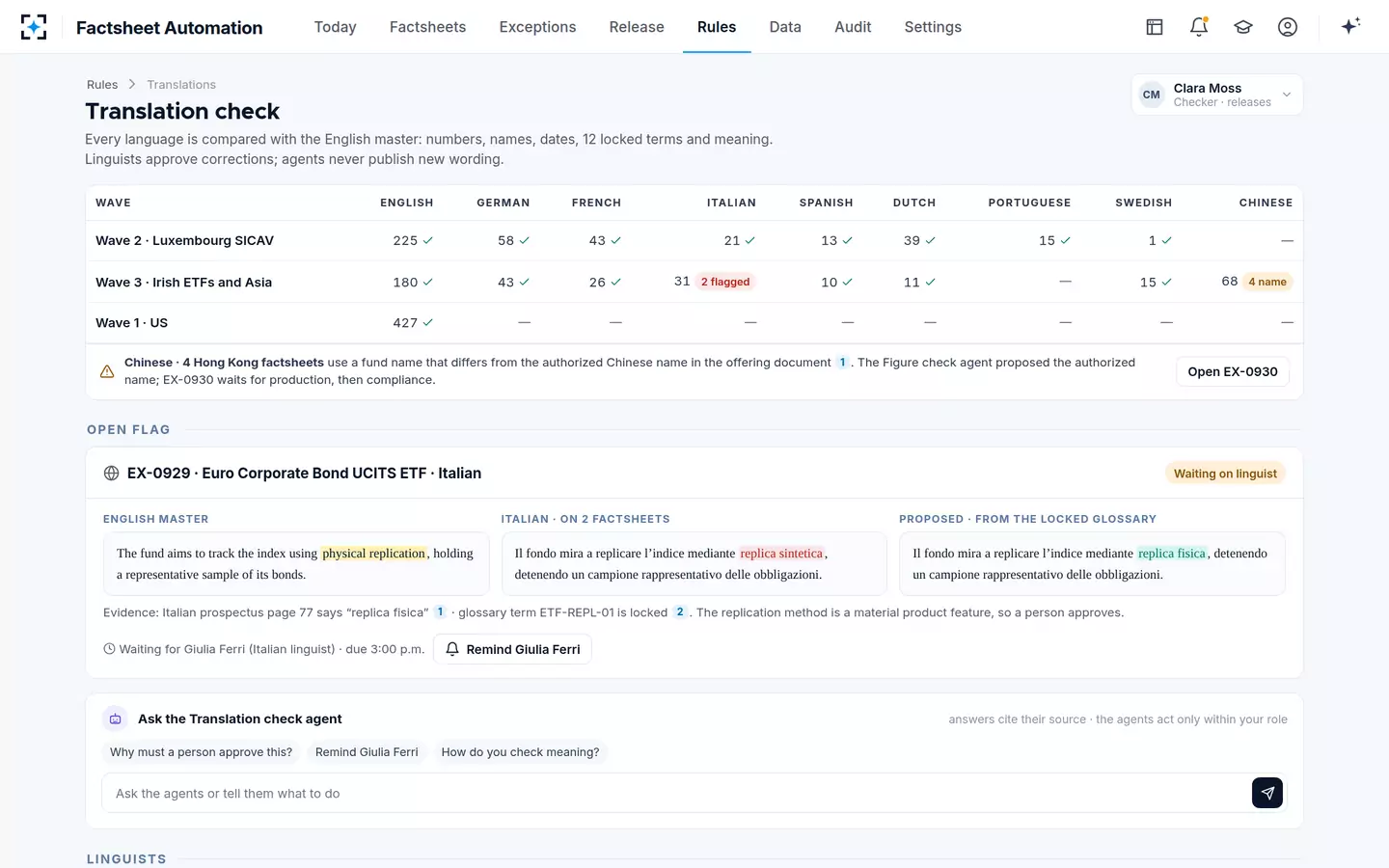
Factsheet Automation's translation check: meaning, not just strings
National top-ups: Ireland, Belgium, the Netherlands, Germany, France
The host-state layer is where a single EU template breaks. ESMA's report reproduces each national authority's own summary of its rules (ESMA report, Annex II), and five of the largest markets for UCITS factsheets show the range.
Ireland. The Central Bank requires that the name and regulatory status of a UCITS be "clearly displayed in any advertisement relating to that UCITS" (paragraph 14), and prescribes warnings in its own words. An advertisement with past performance must carry "Past performance may not be a reliable guide to future performance", "no less prominently than the information on past performance", though the Central Bank accepts ESMA's sentence in its place. A fund that may yield a fluctuating income must say "Income may fluctuate in accordance with market conditions and taxation arrangements", and a fund in a currency other than that of the country where the advertisement is issued must say "Changes in exchange rates may have an adverse effect on the value price or income of the product".
Belgium. For public offers of UCITS units in Belgium, the UCITS Royal Decree "sets out requirements for the form and contents of those marketing communications", and the FSMA's Communication FSMA_2022_29 gives questions and answers on them. Belgium is also where prior review bites hardest: its authority made 1,822 requests for amendments to management companies' marketing communications on prior review between February 2023 and January 2025 (paragraph 64).
The Netherlands. There is no prior notification, but Dutch conduct rules apply and "marketing materials must include Dutch compliant disclaimers". Germany. Sections 297 to 308 of the Capital Investment Code set the framework; communications must be identifiable and fair, clear and not misleading, and "No approval has to be obtained before publication." France. The AMF's marketing provisions require documents to be "clearly identifiable, fair, clear and not misleading and mention the existence of the prospectus and the availability of the KIID", and it combines "non-systematic ex-ante review and sample-based ex-post review".
Prior review is concentrated: requests to amend management companies' marketing communications before publication
Outside the EU: the UK and Switzerland
A UCITS sold to UK retail investors leaves ESMA's guidelines behind and meets the FCA's rules on financial promotions: the fair, clear and not misleading rule (COBS 4.2.1R), the past performance conditions of COBS 4.6.2R and the Consumer Duty. The wording differs from ESMA's, as the FCA past performance disclaimer guide shows, so a UK version of an EU factsheet is a separate cell in the matrix even when the language is the same.
Switzerland sets its own requirements for foreign funds offered there, which are outside the EU texts this page relies on; check them with Swiss counsel and your Swiss representative. Factsheet Automation models them the same way as an EU host state, as a country rule tied to approved clauses. In the solution's fictional sample, a Swiss country rule requires the factsheet to name the Swiss representative and paying agent, say where documents are free of charge, and state the place of performance and jurisdiction.
Why a few funds carry most of the work
Cross-border registration is concentrated in a small number of funds, so a small number of funds generate most of a manager's factsheets. ESMA's analysis of the cross-border register measured that concentration at a Gini coefficient of 0.50 for UCITS and 0.52 for AIFs: most funds account for a handful of notifications each, and a few funds for most of the activity (ESMA report, paragraphs 79 and 80). Luxembourg and Ireland send most of those funds, and theirs reach nearly every member state; cross-border distribution in seven numbers sets out the register's figures.
For a production team the implication is practical: the flagship funds sold everywhere deserve a fully automated matrix, because each change to them (a new class, a new market, a revised KID) fans out across dozens of factsheets at once, while a fund sold in its home market alone may never need more than one or two.
UCITS ETF factsheets: the trading line
A UCITS ETF factsheet follows the same rules with additions. ESMA's guidelines say that "If the information concerns an ETF, marketing communications should indicate the regulated markets where the fund is traded", and that any figures on expected future performance "should be based on the fund's NAV" (paragraph 58). Index-tracking funds should use the words "passive" or "passively managed" alongside "index-tracking" (paragraph 28). The listing line differs by market as well as by class, because a class may be listed on different exchanges in different currencies, so it belongs in the matrix, not the template.
ETFs also carry the product features most likely to be mistranslated: replication method, securities lending and currency hedging. In the solution's fictional sample, two Italian factsheets for a corporate bond ETF described synthetic replication where the English master and the Italian prospectus said physical; the Translation check agent proposed the locked glossary term and the Italian linguist approved the correction before compliance did.
The class registered this month: where the matrix fails first
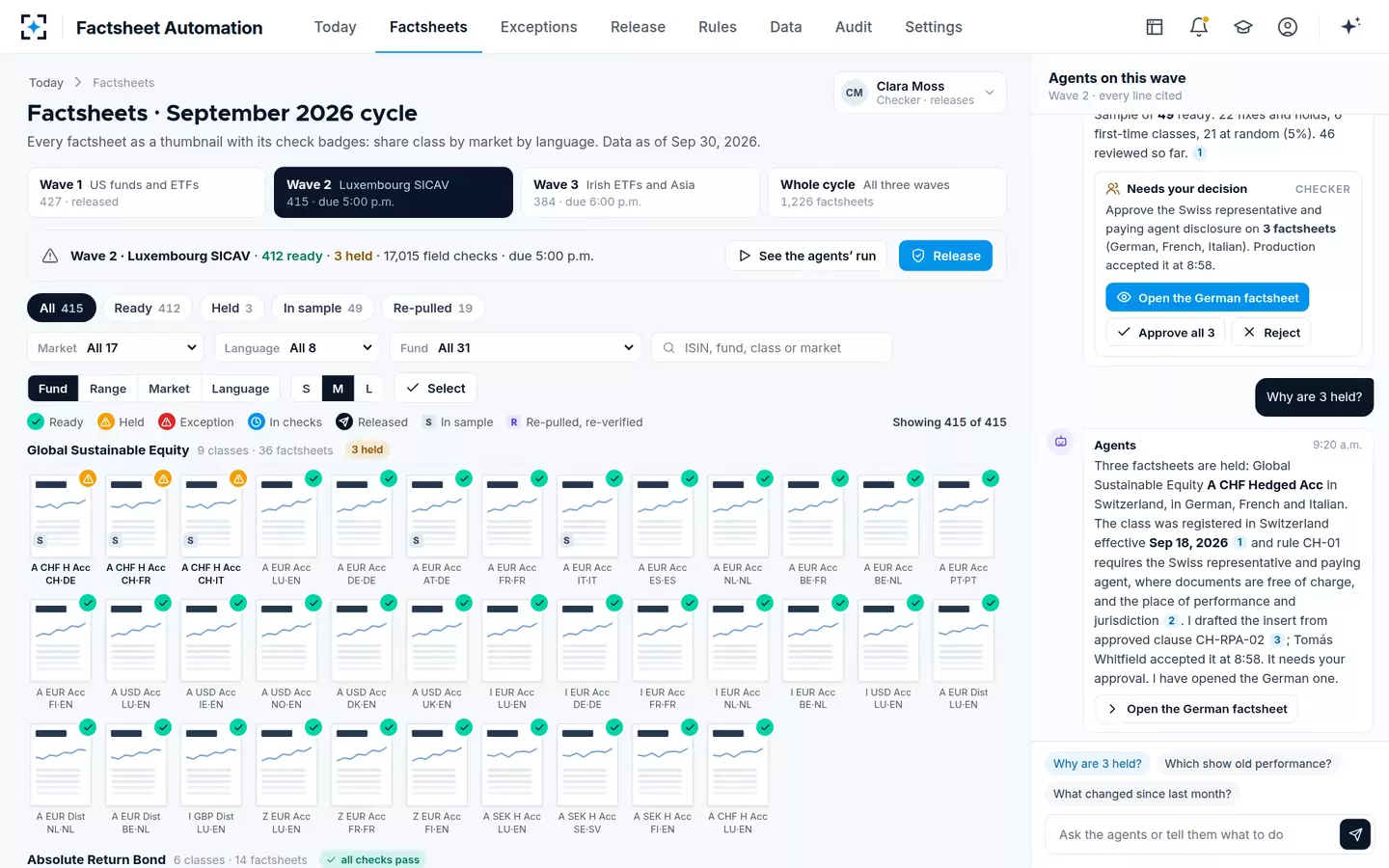
The cell that goes wrong is the new one. A class newly registered in a market inherits whatever its template holds, and a template approved before the registration has no legend block for that market. In Factsheet Automation's fictional sample cycle, a class of a global equity fund was registered in Switzerland effective 18 September 2026; the September factsheets in German, French and Italian were built from a template with no Swiss block, and the Disclaimer agent held all three, inserted the approved Swiss clause, and waited for the production lead and the compliance reviewer to approve it. The compliance reviewer then told the agents to hold every class registered in the previous 30 days until a reviewer opens one, as a standing rule awaiting compliance approval.
Before a class's first factsheet in a new market
- Notified and effective
The host-state notification is complete and the marketing start date has passed (ESMA paragraph 5).
- Language versions
Every official language of the part of the market where it will be sold, or one the authority accepts (paragraph 17).
- Article 4 statements
Where, how and in which language to get the prospectus, KID and summary of investor rights, with links; the termination statement.
- National legends
The host state’s own warnings and disclaimers, from approved clauses in that language.
- Currency warning
If the class or its figures are in a currency other than the investors’ (paragraph 48).
- Consistency
Costs, risk class, benchmark and objective identical to the KID and prospectus in that language.
- ETF line
For an ETF, the regulated markets where it trades (paragraph 58).
- First review in full
A person reads the whole factsheet once before it joins the automated cycle.
How Factsheet Automation builds the matrix from the registration list
Factsheet Automation treats the registration list as the source of truth for what to produce. Each cycle the Production agent builds a factsheet for every registered share class, market and language, and never for a market where the class is not registered. The Disclaimer agent reads the live registration list and the country rules and derives each factsheet's legends: the marketing-communication label, the past performance and currency warnings under ESMA's guidelines, the Article 4 statements, and national legends such as the Swiss representative and paying agent. It drafts only from approved clauses, never invents legal wording, and every insert needs a maker and a checker.
The rest of the chain checks the matrix's output. The Translation check agent compares each language with the English master, including locked glossary terms; the Figure check agent ties costs, risk class and benchmark to the KID and prospectus in each language; and the release sample always includes every first-time class and market. The reviewer can ask the agents why any cell is held and get an answer with its sources.
Asking Factsheet Automation why a new market's factsheets are held
Questions people ask
Do ESMA's marketing guidelines apply to factsheets for professional investors?
Yes. They apply to all marketing communications "regardless of the target investors", although the level of information and its presentation may be adapted where the fund is open only to professional investors. Article 4 of Regulation 2019/1156 applies to UCITS marketing communications generally.
Can a UCITS factsheet be in English only?
Only where the host authority accepts English. ESMA's guideline is the official language, or one of them, of the part of the member state where the fund is distributed, or another language the national authority accepts; check each host state's published rules.
When did the UCITS marketing rules change?
Article 4 of Regulation 2019/1156 applied from 2 August 2021, and ESMA's guidelines, dated 2 August 2021, applied six months after their publication in all EU languages, in early 2022. ESMA's January 2026 report found many marketing communications still falling short of both.
Does every UCITS factsheet need a hyperlink to the KID?
Article 4(2) requires UCITS marketing communications to give hyperlinks to, or website addresses for, the prospectus and the key investor information, and to say in which language they can be obtained. A printed factsheet meets it with a web address.
How many factsheets does a cross-border UCITS range produce?
Count the cells: for each share class, each market where it is registered, times the languages of each market. No regulator publishes an industry figure, so the count is yours. In Factsheet Automation's fictional sample, one Luxembourg range produced 415 factsheets a month from 162 classes.