The cross border distribution of funds regulation is Regulation (EU) 2019/1156, adopted with Directive (EU) 2019/1160 as one package to make it easier and cheaper to market UCITS and AIFs in other EU countries. Its rules on marketing communications have applied since 2 August 2021, and ESMA's central database under it now holds 149,363 notifications of funds marketed outside their home country, 83,773 of them UCITS. Each notification is a fund registered in a host country, and each host country brings its own language: the regulation and the directive say, in several places, which documents and services must be offered in the host's official language. That is the multiplication behind Botminds' Fund Document Translation, whose agents work out which languages every factsheet, KID and notice owes from the fund registrations and translate only what changed. The seven numbers below are the regulation's and the supervisors' own.
149,363 cross-border marketing notifications in ESMA's register, by legal framework
What is the cross border distribution of funds regulation? A regulation and a directive
The cross-border distribution package has two legal acts with different reach. Regulation (EU) 2019/1156 applies directly in every member state: it sets the requirements for marketing communications, makes national regulators publish their marketing rules, governs ex-ante review of marketing material and created ESMA's central database (Regulation (EU) 2019/1156). Directive (EU) 2019/1160 amends the UCITS and AIFM directives, changing the rules on local facilities for investors, pre-marketing and withdrawing from a market, and had to be applied by member states "from 2 August 2021" (Directive (EU) 2019/1160, Art. 3).
So "cross border distribution of funds directive" and "cross border distribution of funds regulation" name two halves of one reform, and people searching for either usually need both. The regulation itself "shall apply from 1 August 2019", but the parts that matter most for fund documents, Article 4 on marketing communications and Article 5 on the publication of national rules, "shall apply from 2 August 2021". The package did not create the passport; it changed what a fund must do in each host country once it has one.
Number one: 149,363 notifications, and every one is a language decision
ESMA's register held 149,363 notifications of cross-border marketing at its cut-off of 6 October 2025: "The majority (56%) of notifications is related to UCITS, while AIFs represent 44% of the total." Each notification is a fund marketed in a country other than its home country (ESMA, 6 January 2026). It is the closest thing to a public count of the language obligations the EU's fund market carries, because each notification brings the host country's rules on which documents must be in which language.
For UCITS the most important of those rules is old but absolute: a host country gets the key investor information in its own official language unless its regulator approves another (UCITS Directive, Art. 94(1)(b)). Each of the 83,773 UCITS notifications is a host market whose accepted languages decide whether the KID must be translated, and for most host markets it must; share classes multiply the count again.
The cross border distribution of funds regulation in seven numbers
149,363
notifications of cross-border marketing in ESMA's register, October 2025
89%
of outbound notifications come from two countries: Luxembourg 59%, Ireland 30%
4
host countries with more than 10,000 inbound notifications each: Germany, Italy, France, Spain
0.50
Gini coefficient of UCITS notifications across funds: a few funds account for most of them
10days
working days a regulator has to ask for changes to a marketing communication it reviews ex ante
1,822
requests to amend UCITS marketing material made by Belgium's FSMA in two years of ex-ante review
24
official languages in the EU; the EEA adds Icelandic and Norwegian
Number two: 89% of outbound notifications come from two domiciles
Two countries send most of Europe's cross-border funds: "Luxembourg accounts for the largest share of outbound notifications (59%), with a nearly even distribution between AIFs and UCITS. Ireland follows (30%), where UCITS constitute the majority of notifications of cross-border marketing." ESMA's heatmaps show both "with their funds distributed widely across almost all Member States". By contrast, the regulators of most other countries "report only limited outbound activity, highlighting the structural dominance of a small number of fund domiciles".
The language consequence is that a cross-border fund's master documents are written once, in one place, and then have to reach every host language. Every host country whose accepted languages do not include the master's needs a translation of at least the KID, and every change to the master text has to travel to every one of those languages. Concentration in two domiciles means the same few teams carry the translation work for most of Europe's cross-border funds.
Number three: four host countries above 10,000 inbound notifications
"Germany, Italy, France and Spain account for the highest number of inbound notifications, having more than 10,000 each, with UCITS representing the majority in each of these jurisdictions," ESMA reports. Those four are also among the strictest language markets. In the European Supervisory Authorities' table of KID languages, Germany, Italy and France accept a retail KID only in their official language, and the French regulator accepts only French for a KID addressed to retail investors. Spain accepts another language only where the distributor has ensured, and can evidence, that the investor knows it.
The biggest host markets therefore offer the least room for an English-only approach. A fund registered in all four owes at least German, Italian, French and Spanish KIDs, kept current, and in practice factsheets and notices in the same languages, since marketing communications there must also be in a language the regulator accepts. The full country-by-country list of KID languages shows how few markets accept anything else.
Number four: a Gini coefficient of 0.50, so a few funds carry most of the work
The notifications are not spread evenly across funds. ESMA measured the distribution with Lorenz curves and found "the Gini coefficients, 0.50 for UCITS and 0.52 for AIFMD", concluding that "while a large majority of funds account for only a few notifications, a small number of funds dominate cross-border activity". A Gini of 0 would mean every fund was registered in the same number of countries; 1 would mean one fund held all the registrations.
For a manager this is useful in two directions. The flagship funds sold in fifteen or twenty markets generate most of the translation volume, as they do most of the factsheets (UCITS factsheet rules by market shows the same multiplication), so they are where turnaround matters most and where a one-sentence English edit costs most. The long tail of funds sold in two or three markets generates little volume each but many separate jobs, each with its own reviewer, which is where routing and tracking, rather than translation speed, decide whether the cycle finishes on time.
Number five: ten working days, twice
Ten working days appears twice in the passport process, once on each side. A home regulator that receives a UCITS notification must transmit the complete documentation to the host "no later than 10 working days of the date of receipt of the notification letter accompanied by the complete documentation", and "the UCITS may access the market of the UCITS host Member State as from the date of that notification" (UCITS Directive, Art. 93(3)). That documentation must already include the translated key investor information (Art. 93(2)), so the translation comes before the clock starts.
Opening a host market: the translation comes before the regulator's clock starts
- Translate and approve the KIDmanager's time
- Home regulator checks and transmits≤ 10 working days
- Marketing may startfrom notification
- Translate the factsheet or admanager's time
- Regulator may ask for changes≤ 10 working days
- Useonce settled
The other ten days come from the regulation. A regulator may require "prior notification of marketing communications", and where it does it must, "within 10 working days of receipt of marketing communications, inform the UCITS management company of any request to amend its marketing communications" (Regulation (EU) 2019/1156, Art. 7(1)). The prior notification "shall not constitute a prior condition for the marketing of units", but a manager that waits for the reply before using a factsheet adds up to two working weeks to every new or changed communication in that market. Six EEA states separately require the KID itself to be notified before use.
Number six: 1,822 requests to amend marketing material, from one regulator
Ex-ante review is rare but intense where it exists. ESMA's report found that "NCAs from 25 jurisdictions indicated they did not make any requests for amendments on the basis of ex-ante verifications", and that "NCAs from only three jurisdictions made requests for amendments (BE: 1,822 requests; DK: 878 requests; FR: 25 requests)", between 1 February 2023 and 31 January 2025, for UCITS management companies. For AIFs marketed to retail investors, the same three countries and Poland made requests: Denmark 741, France 224, Belgium 36 and Poland 2.
Requests to amend fund marketing material after ex-ante review, February 2023 to January 2025
Belgium's number connects to language directly. In the ESAs' table of KID languages, Belgium's entry says that when advertising goes to the FSMA for approval, the KID sent with it must be in the advertising's language. A Belgian request for amendment of a Dutch factsheet is a change to a Dutch text, which may cascade to the French version and to the KID that accompanies both. Every amendment request in a host market is a translation event as well as a compliance one.
Number seven: 24 official languages
"The EU has 24 official languages," the European Union's own page states, and "English is also one of Ireland's and Malta's official languages" (European Union). The EEA's other three states add Icelandic and Norwegian, with German already counted for Liechtenstein. Regional languages come on top: Spain accepts Catalan, Basque and Galician where they are official, and Luxembourgish is an official language of Luxembourg. A fund sold in the four big host markets, the Nordics, Benelux and central Europe can owe more than a dozen languages, and multilingual countries add versions without adding languages: Belgium takes Dutch and French.
What did the cross border distribution regulation change about language?
The package wrote language requirements into four new places. Facilities for investors, which a fund must make available in each host country, must be provided "in the official language or one of the official languages of the Member State where the UCITS is marketed or in a language approved by the competent authorities" (Directive (EU) 2019/1160, new UCITS Art. 92(3)(a)). When a fund withdraws from a market, the redemption offer and the public notice of its intention must be provided in the same way, and the offer must stay publicly available "for at least 30 working days". Marketing communications must say "in which language" investors can obtain the prospectus and key investor information. And regulators must publish their own marketing rules "in, as a minimum, a language customary in the sphere of international finance", so that managers can read them.
Where the cross-border distribution package puts a language requirement
| Requirement | Where it is | Language |
|---|---|---|
| Facilities for investors in each host country | Dir. 2019/1160, UCITS Art. 92(3)(a); AIFMD Art. 43a for retail AIFs | Official language of the host country, or one its regulator approves |
| Notice and redemption offer when withdrawing from a market | Dir. 2019/1160, UCITS Art. 93a(1) | Official language of the host country, or one its regulator approves |
| Marketing communications that mention a UCITS | Reg. 2019/1156, Art. 4(2) | Must say in which language the prospectus and KID can be obtained |
| Summary of investor rights | Reg. 2019/1156, Art. 4(3) | Communications must say where, how and in which language it can be obtained |
| National marketing rules published by each regulator | Reg. 2019/1156, Art. 5(1) | At least a language customary in international finance |
| ESMA's central database of cross-border funds | Reg. 2019/1156, Art. 12(1) | Publicly accessible in a language customary in international finance |
Supervisors check the marketing half. Among the breaches ESMA's report lists are marketing communications of UCITS that "failed to indicate in which language(s) the prospectus and key investor information could be obtained (AT, BG LU)". The language of the communication itself follows ESMA's guidelines, which point to the local official language, or another language the host supervisor accepts (ESMA34-45-1272, ¶17); the language rules by country list what each market accepts.
What does ESMA's cross border distribution of funds database show?
ESMA's central database lists every UCITS and AIF marketed outside its home country, its manager and the countries where it is marketed; Article 12 of the regulation required ESMA to publish it "by 2 February 2022" and keep it up to date, fed quarterly by national regulators. ESMA also publishes, under Article 6, the summaries of each country's marketing rules and links to the regulators' own pages: its March 2026 publication gathers them for 27 EU and three EFTA states (ESMA, Cross-border distribution of investment funds).
For a localization manager the two publications answer different questions. The database says where a competitor's fund is registered, and so which languages it must be producing. The summaries say what each host country requires, including its language rules, and they differ more than the EU texts suggest: Croatia's rules, as summarised in ESMA's 2026 report, say "all marketing communication materials must be written in Croatian language", while Lithuania's summary allows information for investors who stay in a fund after it stops marketing there to be provided "in Lithuanian or in English" and adds: "Key information for investors document shall be provided in Lithuanian."
From registrations to language versions: the arithmetic at one manager
64
cross-border funds
→
135
English sources this month: factsheets, KIDs, commentary, notices
×
9.5
market versions each, on average, out of 21
=
1,284
language versions owed in one monthly cycle
How many funds are sold cross border, and what does it mean for a translation budget?
No regulator publishes the number of language versions the industry produces, and vendors don't publish comparable prices, so a manager has to build its own count. ESMA's register gives the market-wide denominator, 149,363 notifications; the manager's own registration system gives the numerator. The method is simple: for each fund, multiply the documents produced in a cycle by the host-market language versions it owes, then add the event-driven documents, such as shareholder notices and KID revisions, which arrive whenever something changes.
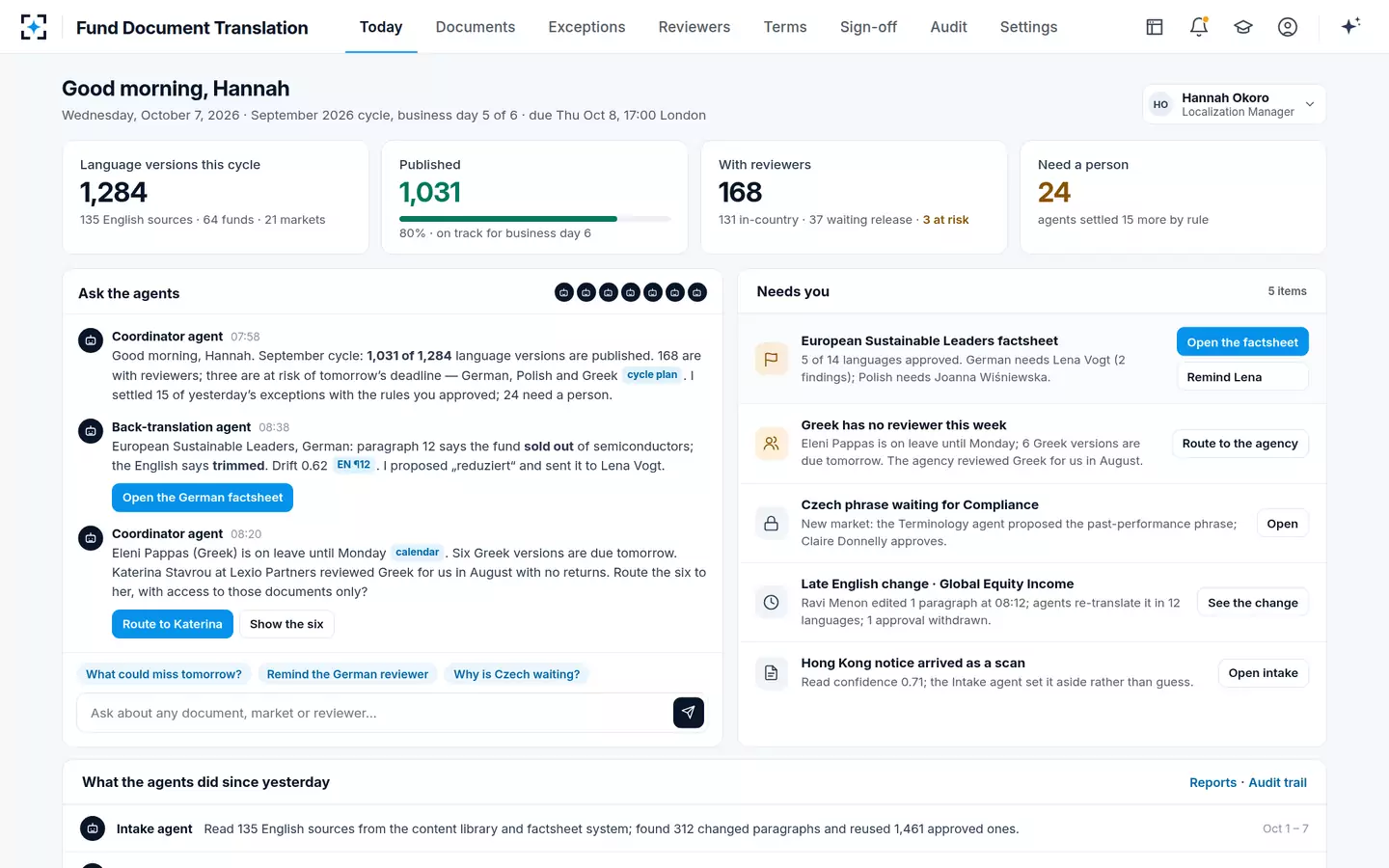
At the solution's fictional sample manager the arithmetic gives 1,284 language versions in one monthly cycle, from 135 English sources for 64 funds across 21 market versions, which is how a manager with sixty-odd funds comes to owe well over a thousand language versions a month. The count matters more than any per-word rate, because most of the cost of a version is not the translation of new text but the handling: batching, waiting, reviewing and releasing, repeated for every language every time the English moves. What a week of that handling costs is the better basis for comparing suppliers.
One monthly cycle: 1,284 language versions owed, and where they stand
Where Fund Document Translation fits in a cross-border distribution operation
The solution sits after registration and before publication. It does not file notifications, decide where a fund is registered or replace the regulatory team that tracks host-country rules. It reads the fund registration system to know which fund is sold where, and from that which languages each document owes; it reads the English sources and the fund's data; and it produces approved, released language versions with the evidence behind each one. The agents translate only the paragraphs that changed since the last approved version, hold each market's regulated phrases to Compliance's approved wording, translate every paragraph back to check meaning and prove every figure in the market's number format.
People keep every decision the regulation puts on the firm. An in-country reviewer for each market approves the language with a reason, and Marketing Compliance releases it as a second person. Where a host regulator asks for an amendment, the change is made once in the source, and the agents reopen only the affected paragraphs in every language. To see that on your own registrations, start from Fund Document Translation.
Questions people ask
Is the cross border distribution of funds framework a directive or a regulation?
Both. Regulation (EU) 2019/1156 applies directly and covers marketing communications, publication of national rules, ex-ante review and ESMA's database. Directive (EU) 2019/1160 amends the UCITS and AIFM directives on facilities, pre-marketing and de-notification, and member states had to apply it from 2 August 2021.
What is CBDF?
CBDF is the common abbreviation for cross-border distribution of funds, and ESMA uses it for the 2019 package. Its stated aim is to remove barriers to marketing funds in other EU countries; its effect on documents is a set of language and disclosure requirements in each host country.
Does the regulation require fund marketing in the local language?
Not directly. The regulation sets content requirements for marketing communications; ESMA's guidelines say a communication should be in an official language of the part of the country where the fund is distributed, or another language the regulator accepts, and national rules decide which. Croatia, for example, requires all UCITS marketing communications in Croatian.
How long does a UCITS passport notification take?
The home regulator must transmit a complete notification to the host within 10 working days, and the fund may market from the date it is told of the transmission. The translated key investor information must already be in the file, so the translation time comes first.
What languages must a fund provide when it leaves a market?
The redemption offer and the public notice of its intention to stop marketing must be in an official language of the host country or one its regulator approves, and the offer must be publicly available for at least 30 working days, under the de-notification rules added by Directive (EU) 2019/1160.