An AI document translation tool for regulated fund documents should be bought on its limits before its features: it must never change a figure silently, never reword a regulated phrase or translate a registered fund name, never approve or release a translation, never guess at text it cannot read, and never let one model check its own work. Each limit answers a rule. Under the PRIIPs Regulation a KID translation must reflect the original faithfully and accurately (Article 7), the manufacturer's civil liability reaches its translations as well as the original (Article 11), and a breach of Article 7 is one Article 24 sanctions. A general-purpose AI translator is built to produce fluent text quickly; a fund document needs a tool built to stop. Botminds' Fund Document Translation is built around these limits: seven agents draft, check, flag and propose, and people in each market approve while Compliance releases.
The examples come from the solution running on fictional sample data, a manager called Quillfield Capital with 64 cross-border funds and fifteen in-country reviewers.
Fund Document Translation's limits matrix: each agent, what it may never do, and who checks
Coordinator agent
DoesPlans the cycle from the fund registrations, routes each version to its reviewer, watches the deadline.
NeverNever approves or releases; reassigns only within the reviewer roster.
Who checksLocalization manager confirms any re-routing.
Intake agent
DoesPicks up English sources, identifies fund and share class, finds the paragraphs that changed.
NeverSets aside a scan below 0.85 read confidence rather than guess; flags duplicates instead of merging them.
Who checksLocalization manager decides what to do with the file.
Translation agent
DoesDrafts each market version from approved translations and the market's style guide.
NeverNever rewords a locked phrase or translates a registered fund name; never publishes.
Who checksTerminology and Numbers agents check; the reviewer decides.
Terminology agent
DoesHolds each market's regulated phrases to approved wording, applies the glossary.
NeverCannot approve a new or changed locked phrase.
Who checksCompliance approves, and never the person who proposed it.
Back-translation agent
DoesTranslates every paragraph back on a different model family and scores meaning drift.
NeverNever edits the translation; drift above 0.25 goes to the reviewer.
Who checksIn-country reviewer.
Numbers agent
DoesProves every figure, date, currency, ISIN and percentage against the source and the fund's data, in the market's format.
NeverNever changes a figure silently; a mismatch always blocks release.
Who checksReviewer corrects, or sends it back to Product Governance.
Layout agent
DoesRenders each version and checks the KID stays within three pages, the factsheet within two.
NeverNever cuts regulated text or changes figures to make it fit.
Who checksReviewer chooses from approved shorter wording.
What should an AI document translation tool never do with a fund document?
Five things, each tied to a way a fund document can go wrong in a regulator's eyes. It should never change a figure without a person seeing it, because a KID's performance scenarios and costs must match the original. It should never reword a regulated phrase or translate a fund's registered name or ISIN, because those are fixed by law, guidelines or registration. It should never approve or release, because responsibility for the translation stays with the firm. It should never guess at an unreadable scan, because a confident misreading is worse than a gap. And it should never be its own checker, because a model reviewing its own output tends to agree with itself.
Those limits are what separate a tool for fund documents from a general AI document translation tool. A general tool is judged on fluency and speed and is designed to return a finished file. A tool for regulated documents is judged on what it refuses to finish without a person, and on whether it can show afterwards what it checked. The difference is design, not model quality: the same underlying model can sit inside either.
Why limits come before features: the translation carries the original's liability
Because EU law treats the translation as the document. Article 7(1) of the PRIIPs Regulation requires a translated KID to reflect the original faithfully and accurately (PRIIPs Regulation; the language rules by country quote the article). Article 11 makes the manufacturer liable, under national law, when a KID, translated or not, misleads, is inaccurate or contradicts the fund's binding documents. And Article 24 applies to "infringements of ... Articles 6 and 7", with powers to prohibit marketing, prohibit the provision of a non-compliant KID and fine a legal entity "up to 3 % of the total annual turnover".
The UCITS Directive says the same for every translated document a UCITS provides: the UCITS is responsible for its translations, and they must faithfully reflect the original (Art. 94(1)(d)). Nothing in either text forbids using AI to produce the translation. Both make the firm answer for the result, which is why the buying question is not whether a tool translates well on average, but what it does when it is wrong.
Limit one: never change a figure silently
A figure that differs from the source or the fund's data must stop the document, not be quietly fixed or quietly kept. Machine translation's weakness with numbers is documented: Wang and colleagues found commercial and research systems alike failing their number tests across many languages (Findings of ACL 2021; how good AI translation is on fund documents sets out the study). A tool that silently corrects figures is as dangerous as one that silently breaks them, because nobody can tell which happened.
A figure that cannot be kept: both readings, both sources, and a person decides
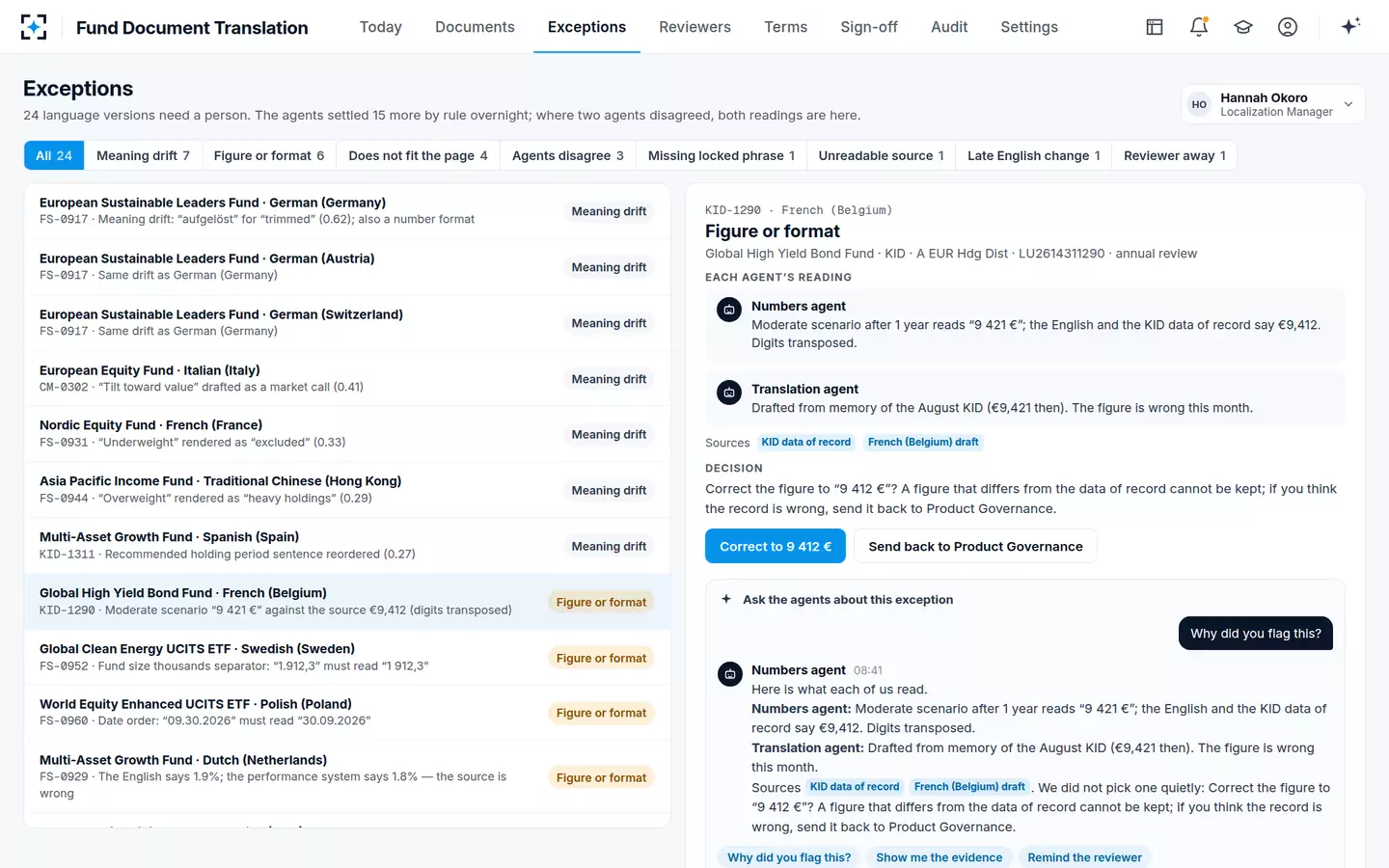
In the sample, the French KID for Belgium read "9 421 €" in its moderate scenario where the English and the fund's KID data said €9,412. The format was right for the market; the digits were transposed, because the Translation agent had drafted from the August KID. The Numbers agent did not fix it. It showed both readings with their sources, and the reviewer could correct the figure or send it back to Product Governance if the data itself was wrong. In the same cycle, one problem the Numbers agent found was in the English: a Dutch factsheet carried 1.9% because the English did, while the performance system said 1.8%. A tool that checks only against the English would have translated the error faithfully into every language.
Limit two: never reword a regulated phrase, never translate a name
Wording that the law or Compliance fixes must be held exactly, and registered names and identifiers must not be translated at all. The PRIIPs Regulation prescribes the KID's title and an explanatory statement that "shall read" a set text (Art. 8). Each market's version of such phrases, and of warnings such as past performance and currency, is approved once by Compliance and then used word for word. A fluent model will happily improve them, which is the problem.
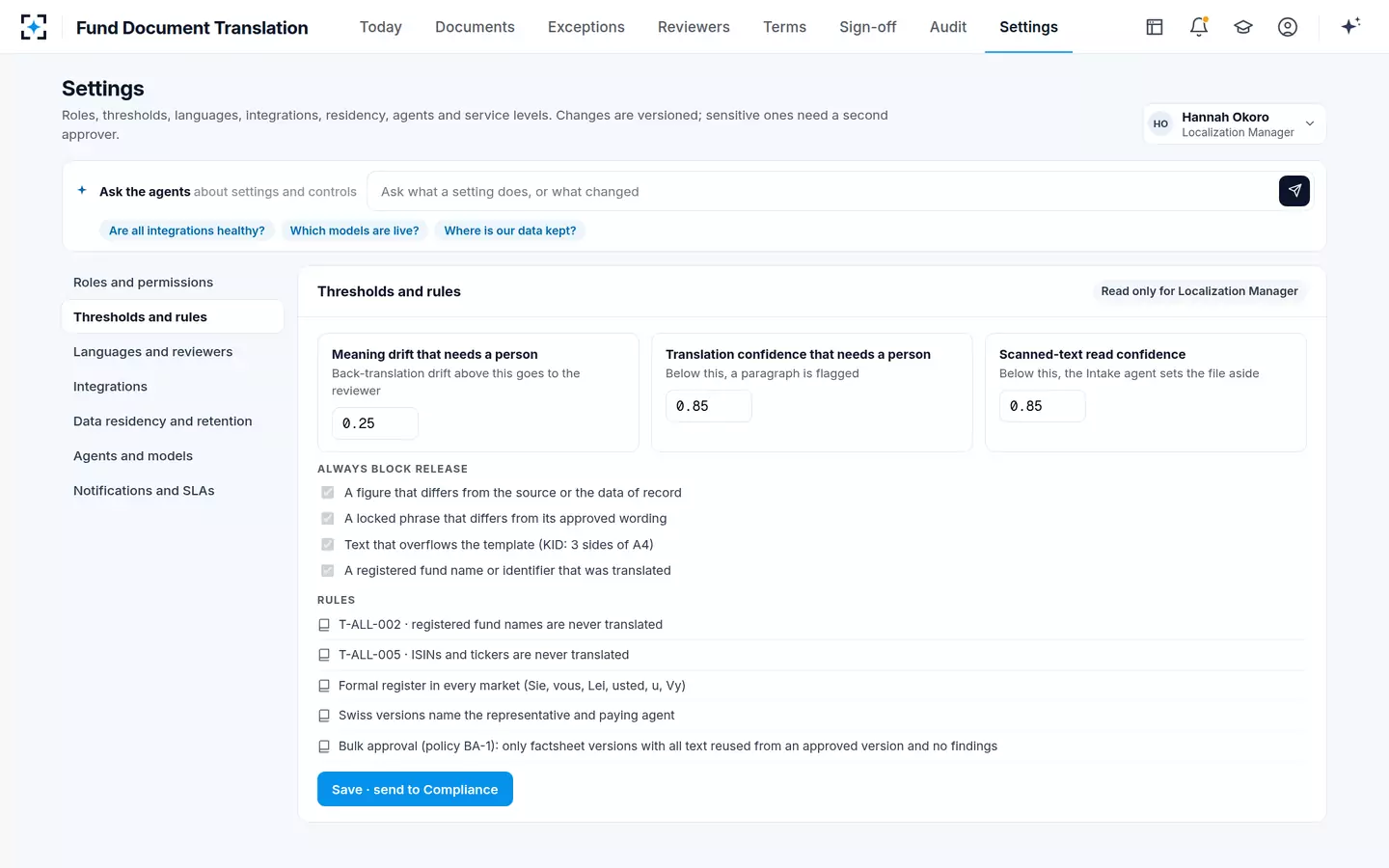
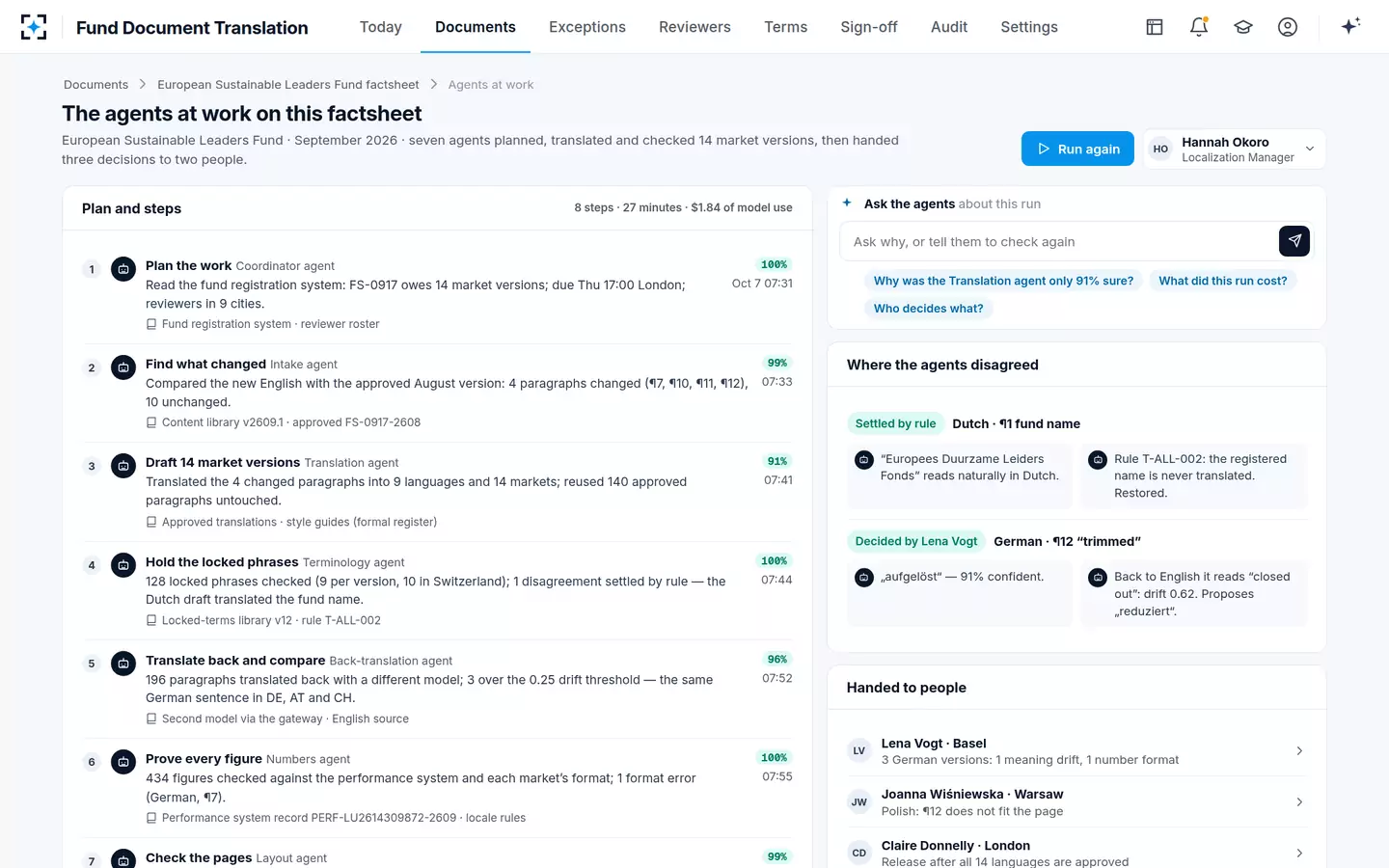
Names are the quieter risk. In the sample cycle the Dutch draft of one factsheet rendered the fund's registered name as “Europees Duurzame Leiders Fonds”, which reads naturally in Dutch and is not the name on the register. A rule that registered fund names are never translated restored it automatically, and the change was recorded. In Fund Document Translation an altered regulated phrase and a translated fund name or identifier are among the four conditions that always block release, alongside a figure mismatch and a page overflow.
What always blocks release, as settings rather than habits
Limit three: never approve or release
An AI tool should prepare a translation for a decision, not make it. ESMA's statement on AI in investment services names the risk as over-reliance: firms and clients leaning on AI for decisions at the expense of human judgement (ESMA, 30 May 2024). For a fund document the decision is two decisions: whether the language is right, which needs someone who reads it, and whether the document may go out, which needs someone accountable for marketing compliance.
Seven agents prepare; two people decide
Agent
Plan and find what changedCoordinator and Intake agents work out which languages each document owes and which paragraphs changed since the last approved version.
Agent
DraftThe Translation agent drafts only the changed paragraphs; approved paragraphs are reused untouched.
Never: Never publishes
Agent
Check four waysTerminology, Back-translation, Numbers and Layout agents check phrases, meaning, figures and pages, each citing what it checked against.
A person decides
In-country reviewer approves the languageDecides every finding with a reason; approval stays disabled until every finding is settled.
A person decides
Marketing Compliance releasesReleases as a second, different person, with the texts, findings, figures checked and phrases held attached.
In the solution both decisions belong to people and are recorded with reasons. The in-country reviewer for each market approves its version once every finding is settled. Marketing Compliance releases approved versions as a second person to the content library, the fund website for each country and the distributor data feed. The agents' part is to make both decisions fast: in the sample, the German reviewer had two findings to decide on a fourteen-paragraph factsheet, not fourteen paragraphs to read.
Limit four: never guess what it cannot read
A tool should set aside a source it cannot read reliably rather than translate its best guess. Shareholder notices, prospectus supplements and older documents still arrive as scans, and a misread digit in a scan becomes a confident error in fifteen languages. In the sample, a Hong Kong notice arrived as a scan with a read confidence of 0.71; the Intake agent's threshold is 0.85, so it set the file aside for a person instead of translating it. Ask any vendor what its tool does below its own confidence, and ask to see the number.
Limit five: never let one model check its own work
An independent check needs an independent checker. Research on round-trip translation, where one system translates forward and back, found it "a poor predictor of quality" because a system can reverse its own errors on the way back (Somers, 2005). In Fund Document Translation the Back-translation agent always runs on a different model family from the Translation agent, and any change to either agent's model or instructions needs the administrator and Compliance and is evaluated on golden paragraphs in every language before it goes live.
Eight steps on one factsheet, each with what it read and how sure it was
Can AI translate a KID?
Yes, as a drafter, provided the draft is checked and approved by people before use. No EU text forbids machine or AI translation of a key information document; the PRIIPs Regulation sets the standard for the result and leaves the method to the manufacturer. What a KID adds compared with ordinary text is a fixed structure, prescribed phrases, four performance scenarios and cost figures, and a limit of "three sides of A4-sized paper when printed" (Art. 6(4)). A tool for KIDs should treat each of those as a check, not a formatting step.
In practice the KID is also where reuse pays most. Much of it changes rarely, so a tool that translates only the paragraphs that changed since the approved version, and reuses the rest untouched, cuts both the work and the risk: an approved paragraph that is not retranslated cannot acquire a new error.
Is machine translation allowed for regulated documents?
Yes: the rules regulate the translation, not the translator. The PRIIPs Regulation, the UCITS Directive and ESMA's marketing guidelines say what a translated document must be, in which language and who is responsible, and none of them requires a human translator. What regulators expect is control. ESMA expects firms using AI to have "robust controls" ensuring accuracy "ex-ante" and "sufficiently frequent ex-post controls" (ESMA, 30 May 2024). In the UK, the Consumer Duty requires firms, where it makes sense, to try communications out on retail customers first (FCA PRIN 2A.5.10R).
A general AI document translation tool and one built for regulated fund documents
General AI document translation tool: A file in, a translated file out.
Built for regulated fund documents: A paragraph, aligned to its English source, translated only if it changed.
General AI document translation tool: Translated with the text.
Built for regulated fund documents: Each proven against the source and the fund's data, in the market's format; a mismatch blocks release.
General AI document translation tool: Improved like any other text, or held by a term list.
Built for regulated fund documents: Held word for word per market; changes need Compliance, never the proposer.
General AI document translation tool: None, or the same model reviewing itself.
Built for regulated fund documents: Every paragraph translated back on a different model family, drift scored.
General AI document translation tool: Whoever downloads the file.
Built for regulated fund documents: Reviewer per market approves; Compliance releases as a second person.
General AI document translation tool: The output file.
Built for regulated fund documents: Who approved what, when, why, and the exact text, kept seven years.
What to ask a vendor of an AI document translation tool
Make the vendor prove each limit on your documents; a demonstration on its own files proves little. The checklist below turns the five limits into questions a vendor can answer with a screen or a log, and a manager can verify on a closed cycle. The four measures of AI translation accuracy give the numbers to ask for.
Ten questions for any AI document translation tool you are evaluating for fund documents
- What happens when a figure differs from the source?
The right answer: it blocks, shows both values and waits for a person. Ask to see it on one of your KIDs.
- Does it check figures against the fund's data, or only against the English?
Only the first catches an error in the English itself.
- How are regulated phrases held, and who can change them?
Exact match per market; changes approved by Compliance, never by the proposer.
- Can it translate a registered fund name or an ISIN?
It should be unable to, and a translated identifier should block release.
- Who checks the translation, and on what model?
An independent model or person, never the translator reviewing itself.
- What does it do with a scan it cannot read?
Set it aside below a stated confidence, not guess.
- Can it approve or publish?
It should not be able to; approval and release should be two different people.
- Does it translate only what changed?
Reusing approved paragraphs untouched is faster and removes a source of new errors.
- Can it import and export your translation memory and glossary?
TMX or XLIFF, so you can leave without losing your approved translations.
- Where is the data processed, and is it used to train models?
Fund documents may need to stay in the EU or UK; the answer should be a setting, not a promise.
Where Fund Document Translation fits, and where it does not
It suits a manager that sells funds across several markets and produces KIDs, factsheets, commentary, reports and notices every month in many languages. It works beside the systems those documents already live in: the content library and document management, the factsheet and KID production systems through XLIFF, the performance system and fund master for the fund's data, the fund registration system for which fund is sold where, translation memory and glossary in TMX or XLIFF, and the fund website and distributor data feed for release. EU documents are processed and stored in the EU region, UK documents in the UK and Hong Kong documents in Asia, and nothing is used to train models.
It does not decide where a fund is registered, file passport notifications or tell a manager which host-country rules apply; those stay with the regulatory and distribution teams. It is not a sworn-translation service, and it does not replace legal review of a prospectus. It does not remove the agency either: in the sample cycle, Greek versions went to an overflow agency reviewer while the Greek in-country reviewer was on leave. What it removes is the batching, waiting and re-sending, and the unchecked figures and phrases. To see the limits work on your own documents, start from Fund Document Translation; for how this compares with machine translation and post-editing, see the comparison of the three approaches.
Questions people ask
What is an AI document translation tool?
Software that translates whole documents with a machine translation or large language model, usually keeping the layout. For fund documents the useful definition is narrower: a tool that translates, checks figures and fixed wording, and hands decisions to people, because the translation carries the same legal weight as the original.
Can I use a free AI document translator for a KID?
Not safely as the final step. Free tools return a translated file with no figure checks, no hold on regulated phrases and no record of who approved what, and the PRIIPs Regulation makes the manufacturer answer for the translation. Data in a KID before publication may also be confidential.
Are AI document translation services different from tools?
A service is usually a supplier who uses machine translation and post-editors and returns files; a tool is software your team runs. The questions are the same for both: who checks figures and fixed wording, on what, and who approves and releases.
Does AI translation need a human review for fund documents?
Yes. Responsibility for a UCITS translation stays with the UCITS, and ESMA expects controls on AI output before it reaches clients. In Fund Document Translation an in-country reviewer approves each language and Marketing Compliance releases it as a second person.
What should happen when two AI checks disagree?
Both readings should go to a person, with their sources, rather than being averaged. In the sample, the Translation and Terminology agents disagreed on whether a German KID should say „Swing Pricing" or „Swing-Pricing-Verfahren"; the German reviewer chose, and the choice can become a glossary rule once Compliance approves it.