A translation workflow for fund documents runs from the fund registrations to a released file in every market: derive the languages each document owes, find what changed in the English since the last approved version, translate only that, check every figure and regulated phrase against the source, have an in-country reviewer approve the language, have a second person in compliance release it, and keep the evidence of who approved which wording on which date. The workflow exists because the documents are regulated in every language: the UCITS Directive makes translations "produced under the responsibility of the UCITS" and requires them kept "up to date", and a PRIIPs manufacturer can be liable for a translated KID that is misleading or inconsistent. The usual failure is ownership, not language: files waiting with agencies, reviewers reading whole PDFs to find what changed, and no record of what went out. Botminds' Fund Document Translation drafts and checks with agents, routes each version to its reviewer and releaser, and keeps the trail, while people approve and release every version.
This guide is for the chief operating officer, the head of marketing operations and the localization lead of a cross-border fund manager. The desk described is the solution's fictional sample manager, with 64 cross-border funds and fifteen in-country reviewers; the rules come from EU law and the regulators' own publications.
One monthly cycle at the sample fund house
1,284
language versions in one monthly cycle
135
English source documents that month
21
market versions across the registrations
15
in-country reviewers, plus one overflow agency
What are the steps in a fund document translation workflow?
Seven steps, each with an owner: plan the languages from the registrations, isolate what changed, translate, check, review by market, release, and keep the evidence. The volume comes from multiplication rather than from any one document: the sample's 135 English sources and 21 market versions make 1,284 language versions in a month, and each must be redone when the English changes, because the UCITS Directive applies its translation rules "to any changes to the information and documents" (UCITS Directive, Art. 94(2)). A fund translation workflow is therefore mostly change management.
The translation workflow for one fund document, step by step
| Step | What happens | Owner | Rule or reason |
|---|---|---|---|
| 1. Plan languages | Derive the languages each document owes from the fund registrations | Localization lead | UCITS Art. 94(1)(b); the ESAs' KID language table |
| 2. Isolate the change | Compare the English with the last approved version; reuse approved paragraphs | Localization lead | Art. 94(2): changes trigger re-translation |
| 3. Translate | Draft the changed paragraphs in each language | Translator or agency | Glossary and approved wording per market |
| 4. Check | Figures digit for digit; regulated phrases word for word; names and ISINs untranslated; layout fits | Second checker | PRIIPs Art. 11(1): inconsistency creates liability |
| 5. Review by market | A reader of the language decides each finding and approves | In-country reviewer | Language judgment for that market |
| 6. Release | A second person releases the approved version | Marketing compliance | Maker and checker |
| 7. Keep the evidence | Who approved which wording, when, why, and the exact text released | Localization lead | Art. 94(1)(d): the UCITS's responsibility |
Two steps are the ones firms under-resource. Step 2, isolating the change, is what stops a reviewer re-reading a 40-page document for one new paragraph; without it every English edit becomes a full agency round in every language. Step 7, the evidence, is the one an auditor or regulator asks for: which wording went out in which market on which date. The sample manager's localization lead put the problem in one line: "I spend month-end chasing reviewers in fifteen cities, and I still can't prove which wording went out."
Which languages does each fund document owe?
The registrations decide, market by market. A UCITS sold in a host country must give investors there every document it gives at home, and its key investor information must be in an official language of the host country or one that country's regulator approves (UCITS Directive, Art. 94(1)(b)). Multilingual countries add versions: in the sample, one factsheet registered in twelve countries owes fourteen market versions because Belgium takes French and Dutch and Switzerland German and French.
The calendar comes with the languages. Six EEA states want the PRIIPs KID notified before use, Portugal at least two working days ahead (ESAs, table JC 2024 44), so step 1 must produce dates as well as a language list. The full map of KID languages by country is in PRIIPs KID language requirements by country.
Who should own fund translations: in-house, agency or a mix?
Most fund houses run a mix, and the decision that matters is not who translates but who approves. Agencies supply translation capacity in languages the firm cannot staff; in-country reviewers, usually sales or client service staff in each market, supply the judgment on how the language reads to that market; compliance owns the regulated wording and release. Whatever the mix, responsibility stays with the firm: translations "shall be produced under the responsibility of the UCITS" (UCITS Directive, Art. 94(1)(d)).
Two ways to run the workflow, and what each costs in time and control
Agency rounds: Whole documents in batches, including paragraphs unchanged since last month.
Changed paragraphs, checked by agents, approved by people: Only the paragraphs that changed; approved paragraphs reused untouched.
Agency rounds: Spot-checks in languages nobody on the team reads.
Changed paragraphs, checked by agents, approved by people: Every figure compared with the source in the market's number format.
Agency rounds: Every PDF in full, to find what changed.
Changed paragraphs, checked by agents, approved by people: The changed paragraphs and the findings, each with its source.
Agency rounds: Another agency round in every language.
Changed paragraphs, checked by agents, approved by people: The paragraphs and languages it reopens, and when each will be out.
Agency rounds: Email threads and file names.
Changed paragraphs, checked by agents, approved by people: Each approval and release with its reason and the exact text.
The translation workflow's five seats, and what each keeps
Today
Exports files, batches them to agencies by language, chases reviewers in fifteen cities, re-sends late English edits.
With agents
Starts the day with the agents' summary and the few items that need a decision, each with one action.
Still theirs: The plan, the exceptions, the routing around absences, and the proof of what went out.
Today
Translates whole documents in batches, including paragraphs that did not change since last month.
With agents
Covers overflow and absences: a reviewer on leave, a language with no in-house reviewer.
Still theirs: Professional judgment on the languages the firm cannot staff.
Today
Reads every PDF in full between client calls to find what changed.
With agents
Sees the changed paragraphs and the agents' findings, each with its source, and decides them.
Still theirs: Approval of the language for their market, with a reason.
Today
Spot-checks regulated phrases in languages nobody on the team reads.
With agents
Owns the approved wording for each market and releases each version as the second person.
Still theirs: Release, and every change to a regulated phrase.
Today
A one-line edit to the English costs another agency round in every language.
With agents
Sees which paragraphs and languages a late edit reopens, and when each will be out.
Still theirs: The English, which every language follows.
Who approves a fund translation, and who releases it?
A reviewer who reads the language approves it, a second person in compliance releases it, and the person who edits a translation does not approve it. No EU text names the roles, but the liability makes the control necessary: a PRIIPs manufacturer can be liable for a KID, or a translation of it, that is misleading, inaccurate or inconsistent with the binding documents (PRIIPs Regulation, Art. 11(1)), and an investor in Greece who relied on the Greek KID can claim just as one in Ireland who relied on the English.
Who does what on one language version, and what each may not do
| Seat | Does | May not |
|---|---|---|
| Agents | Draft, check figures, hold regulated phrases, translate back, check layout, route and remind. | Approve or release anything; change a figure silently; reword a regulated phrase. |
| In-country reviewer | Decides each finding with a reason and approves the language for their market. | Release the version they approved. |
| Marketing compliance reviewer | Releases approved versions as the second person; approves changes to regulated wording. | Release a version they approved as its reviewer; approve a wording change they proposed. |
| Localization lead | Plans, routes, resolves exceptions, covers absences, keeps the evidence. | Approve a translation they edited. |
| Internal audit | Reads every action by people and agents, with its reason and evidence. | Change anything. |
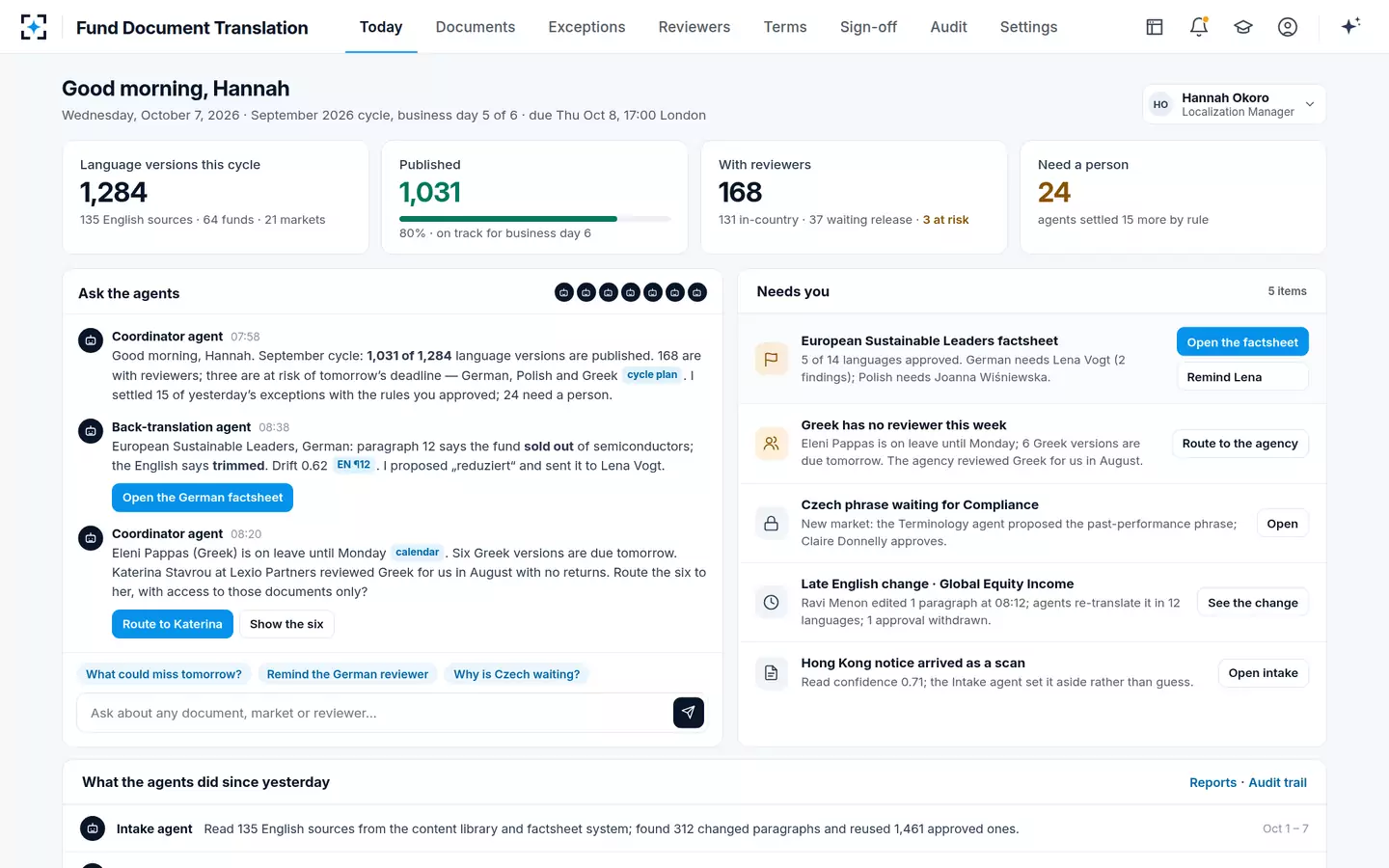
The design is tested when someone is missing. In the sample cycle the Greek reviewer was on leave with six versions due the next day. The agents proposed an agency reviewer with 31 Greek versions approved in August and none sent back, with access to those six documents only, until Monday, and compliance still releasing them; the localization lead confirmed it in one step. Covering an absence without widening who may approve is most of what a workflow's controls are for. What the in-country reviewer should see, and should not have to read, is set out in the in-country reviewer for fund documents.
What controls should every fund translation pass?
Four checks catch most of what a regulator or investor would find: figures equal to the source, regulated phrases word for word, names and identifiers untranslated, and layout intact. Each is mechanical enough to run on every version, which is why a workflow should not leave them to a reviewer's reading.
The checks every language version passes before a person approves it
- Figures digit for digit
Every number equals the source, rendered in the market's number format: 12,4 % in German is right, 12.4% is not.
- Regulated phrases word for word
The approved wording for that market, owned by compliance; nobody edits it in place.
- Names and identifiers untranslated
Fund names, share class names and ISINs exactly as registered.
- Glossary terms
One approved rendering per term per market, consistent across documents and months.
- Meaning
A back-translation or second reading flags sentences that drift, such as "sold out of" where the English says "trimmed".
- Layout
Text fits its box in the longer language, and no warning shrinks below the document's main font.
The glossary is the control that decays fastest. The KID's wording must stay the same in month eleven as in month one unless someone with authority changes it, and a desk that adds translators adds variants. Locked phrases and their owners are covered in terminology management software and locked phrases.
What happens when the English changes late?
A late English edit should reopen only the paragraphs it touches, in only the languages that carry them, with a new release date for each, and the product owner who made the edit should see that cost before making it. In an agency-round workflow a one-line edit costs another round in every language, which is why late edits are the largest avoidable delay in the sample's eleven-day cycle. The legal duty is unchanged by timing: the translation rules apply "to any changes to the information and documents" (UCITS Directive, Art. 94(2)), so a late edit that is not carried through every language leaves a market on an outdated version.
Change control also has to respect document clocks. In the sample cycle the agents proposed moving 12 German KIDs to Friday's batch, as the KIDs were due Friday, so the Basel reviewer could finish the factsheets due Thursday, for the localization lead to confirm or change. Planning by due date per document type, rather than one deadline per cycle, is what lets a late edit land without breaking another market's deadline.
How long should a monthly translation cycle take?
The useful measure is business days from English sign-off to the last language released, and in an agency-round workflow most of those days are waiting. Botminds' own estimate for a manager with about 60 cross-border funds, not a measured result, puts the agency-round process at eleven business days.
Where an agency-round cycle's eleven business days go
A firm can test the estimate on its own calendar: count the days from English sign-off to the last language released for the last three cycles, and how many of those days had a file waiting with someone. The sample manager's June cycle released its last language on business day 14; the design target for the solution is business day 6. What the lost days cost a fund is a better basis for comparing suppliers than a rate per word, as prospectus translation services: the cost of delay sets out.
Where agents fit in the translation workflow
Agents fit in the steps that are mechanical or waiting: planning, isolating the change, drafting, checking and routing. In Fund Document Translation a Coordinator agent plans the cycle from the fund registration system and routes each version to its reviewer by market and time zone; an Intake agent finds the paragraphs that changed so only those are translated; and the Translation, Terminology, Back-translation, Numbers and Layout agents draft and check. On the sample factsheet that meant four changed paragraphs translated into fourteen market versions, with 140 approved paragraphs reused untouched.
Reviewers by market and time zone, and the agents' plan to stay on time
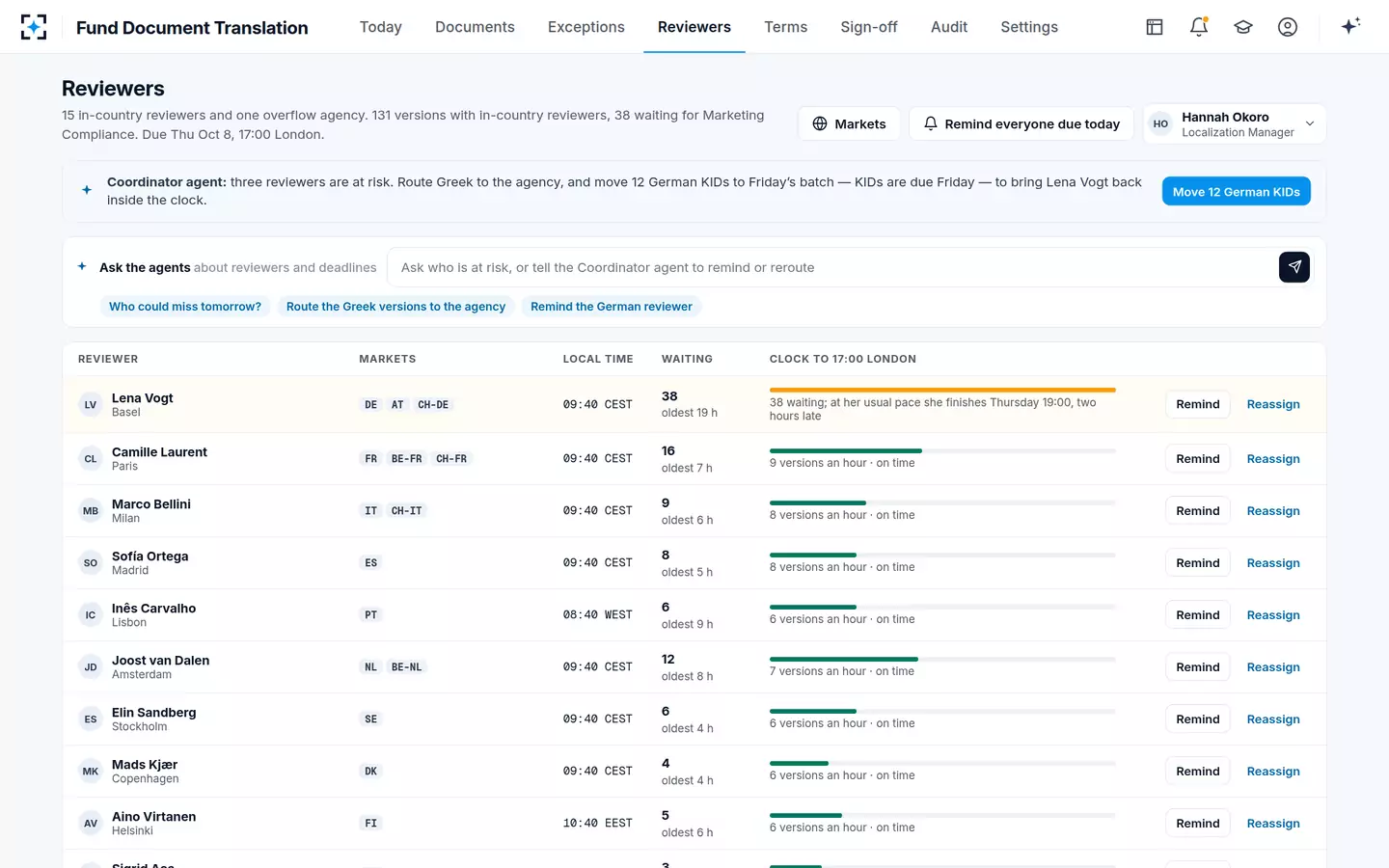
Agents never approve or release, and the Coordinator reassigns only within the reviewer roster the localization lead maintains. ESMA's statement on AI in investment services puts the principle in general terms: responsibility for a decision stays with the management body even when an AI tool took it (ESMA, 30 May 2024). In the UK the Consumer Duty adds a testing habit: firms must, where appropriate, test communications on retail customers before they go out (FCA PRIN 2A.5.10R), and a workflow that records how each translated version was checked has its answer ready.
The localization lead's morning: four numbers and the decisions only a person makes
The full product, with the agents and the approval rules, is on the Fund Document Translation page.
Questions people ask
Who is responsible if a fund translation is wrong?
The firm. The UCITS Directive makes translations of UCITS documents the responsibility of the UCITS, and a PRIIPs manufacturer's civil liability covers translated KIDs as well as the original. Contracts with agencies or tools can allocate cost, not the regulatory responsibility.
How many languages does a fund house translate into?
As many as its registrations require. Key investor information must be in an official or approved language of each host country, and multilingual countries add versions: in the sample, one factsheet registered in twelve countries owes fourteen market versions.
Must a fund document be re-translated when the English changes?
Yes. Article 94(2) of the UCITS Directive applies the translation rules to any changes to the information and documents, and Article 93(7) requires the documents and translations to be kept up to date. Translating only the changed paragraphs keeps the cost of a change proportionate.
Should in-country reviewers be sales staff or translators?
Usually staff in the market, who judge how the language reads to local investors, backed by an agency for languages the firm cannot staff. What they need is to see only what changed and the checks already run, not the whole document.
What KPIs should a fund translation workflow be measured on?
Business day on which the last language is released, versions released with an open finding (target zero), figures or regulated phrases found wrong after release, and the share of reviewer time spent on flagged items rather than whole documents. Each can be counted from approvals and releases.
Can AI approve fund translations?
It should not, and in Fund Document Translation it cannot: agents draft, check and route, while an in-country reviewer approves and a compliance reviewer releases. ESMA's 2024 statement keeps responsibility for decisions with the firm's management body whether people or AI tools take them.