An in country reviewer is a person in, or from, the market where a translated document will be used, who checks that the translation reads correctly and says what the original says before it is approved. At a fund manager the in-country reviewer for the German, Polish or Greek market is often a client service director, salesperson or local specialist with a day job of their own, asked to approve dozens of factsheets, KIDs and notices against a monthly deadline. They are the only person in the chain who reads that language, which makes their attention the scarcest resource in the translation cycle and the easiest to waste: a reviewer asked to read every page of every version spends most of that attention on text that has not changed. Botminds' Fund Document Translation is designed around that constraint. Its agents check figures, regulated phrases, meaning and layout first, and show the reviewer only the paragraphs that changed and the findings that need a person, each with its source.
The examples come from the solution running on fictional sample data: a manager with fifteen in-country reviewers, one overflow agency, and 1,284 language versions due in one monthly cycle.
What the German reviewer had to read in one factsheet: everything, or what needed her
Reviewing the whole document
- All 14 paragraphs read · 100%
Reviewing what changed and what was flagged
- 2 paragraphs with a finding · 14%
- 2 other changed paragraphs · 14%
- 10 approved paragraphs reused unchanged · 72%
What does an in country reviewer do?
An in country reviewer confirms that a translation is right for its market: that it says what the source says, uses the market's established terms and register, reads naturally to a local investor and contains nothing a local reader would misunderstand. For fund documents the reviewer also decides the findings that checks raise, and approves the language version so that compliance can release it. The reviewer is a checker, not the translator; their value lies in being a native reader who knows the market, not a second translator.
The role matters because of where responsibility sits. The UCITS answers for its translations, which must faithfully reflect the original (UCITS Directive, Art. 94(1)(d)), and a KID translation must do so faithfully and accurately (PRIIPs Regulation, Art. 7(1)). A manager needs someone who reads the language to say that it does. Some countries make that explicit: Latvia's rules, as summarised in ESMA's publication, require "a person who is entitled to take the decision on behalf of the fund" to "certify the compliance of the translation with the information contained in the documents prepared in the original language" (ESMA, March 2026).
Who are the in-country reviewers at a fund manager?
Often people whose job is something else. A fund manager selling in fifteen markets may not employ a linguist for each language, so it asks the people it has in or near each market, in sales, client service or local compliance, to review its translations. That brings real advantages: they know the market's terms, the distributors and what investors ask. It also brings the constraint this guide is about: the review is done between client calls, against targets that have nothing to do with translation.
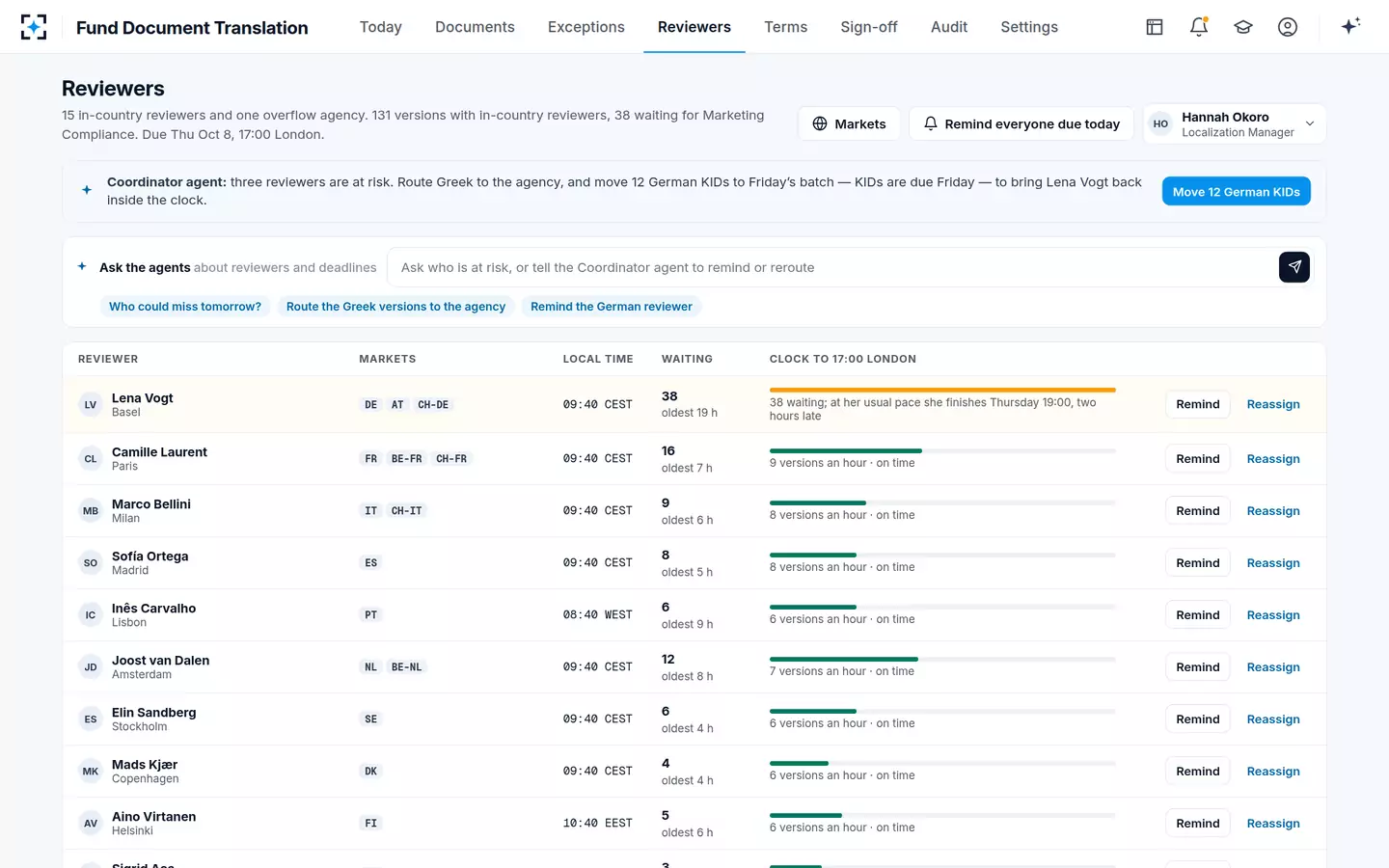
At the sample manager the German markets, Germany, Austria and German-speaking Switzerland, are reviewed by one person in Basel. Her week, as the solution describes it, began with 38 German versions to review "between client calls, reading the whole PDF to find what changed". Where a market has no reviewer available, an agency reviewer can stand in under the same rules: in the sample, the Greek reviewer was on leave and an agency reviewer took the six Greek versions, able to open those six and nothing else, until the following Monday.
"Show me only what the machine was unsure of, and show me why."
Lena Vogt, in-country reviewer for the German markets at the fictional sample manager in Fund Document Translation
The bottleneck is attention, not language
A translation cycle rarely misses its deadline because nobody can translate German; it misses because the German reviewer has 38 versions and a day of meetings. On the sample cycle's reviewer screen, most reviewers had between four and sixteen versions waiting and were on time at six to nine versions an hour. One had 38, the oldest waiting 19 hours, and at her usual pace would finish two hours after the deadline. The agents' proposal was to move twelve German KIDs, which were due a day later, to the next day's batch.
Versions waiting for each in-country reviewer on deadline day
The distribution is the lesson. Review load follows registrations, and registrations concentrate: the markets with the most funds produce the most versions for the fewest reviewers. A process that asks every reviewer to read every page scales the worst queue linearly with the fund range. One that sends them only changed and flagged items shrinks every queue, and the longest queues gain most because they hold the most versions.
Fifteen reviewers by market and time zone, and the one who will miss the deadline
How long should in country review take?
No regulator or independent study publishes a standard for review time, so the answer is to measure it and set a target per document type. Count, for the last three cycles, the hours between a version reaching its reviewer and its approval, and how much of that was the reviewer reading versus the version waiting. Most of the elapsed time is usually waiting, which a deadline and a reminder can fix; the reading time is what the review design decides.
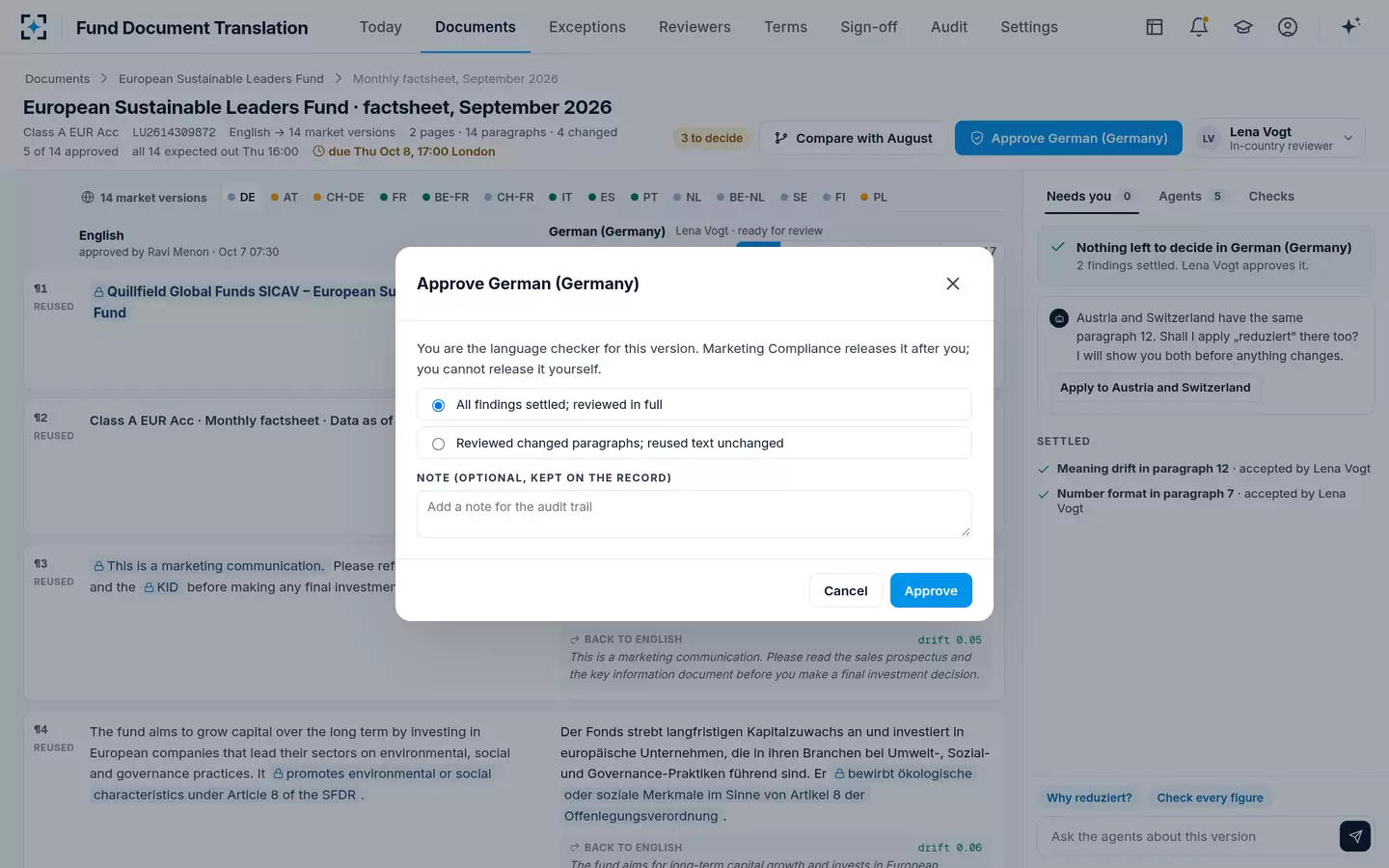
The solution makes both visible. Turnaround per language is a setting by document type, in the sample one business day for a factsheet, two for a KID, three for a notice and five for an annual report, with reminders at 50% and 80% of the clock and escalation at 100%. The reviewer screen shows each reviewer's queue, oldest item and pace against the deadline. In the sample, approvals recorded either "All findings settled; reviewed in full" with fourteen paragraphs and 31 figures, or "Reviewed changed paragraphs; reused text unchanged" with four changed paragraphs, so the time each kind of review takes can be compared.
What an in-country reviewer should see: changed, flagged and drifted
An in-country reviewer should see, first, the paragraphs that changed since the last approved version, second, every finding the checks raised with the reason and the source, and third, the back-translation of each paragraph so that a change of meaning is visible even in a long text. Everything else, the approved paragraphs reused unchanged, the figures already proven against the fund's data, the regulated phrases already held to approved wording, should be available but not in the way.
That is what the sample German reviewer saw on the factsheet: two findings. The first was a meaning drift in paragraph 12, where the draft said the fund had closed out a position the English said it had trimmed, with a proposed fix drawn from the approved August factsheet. The second was a number format in paragraph 7, where 12.4% had to read 12,4 % in Germany. She accepted both, with reasons, and approved. Approval stayed disabled until every finding was settled.
The reviewer approves only when every finding is settled, and cannot release
Reviewing a PDF and reviewing findings ask different things of the reviewer
Reviewing the whole PDF: Everywhere; the reviewer must find what changed.
Reviewing changed and flagged items: Changed paragraphs and findings, listed with their location.
Reviewing the whole PDF: Read in passing, compared by eye if at all.
Reviewing changed and flagged items: Already proven against the fund's data; only mismatches shown.
Reviewing the whole PDF: Checked from memory of the approved wording.
Reviewing changed and flagged items: Already compared exactly; only differences shown.
Reviewing the whole PDF: Judged by reading the target text alone.
Reviewing changed and flagged items: Judged with the English and a back-translation beside it.
Reviewing the whole PDF: Re-done by each reviewer, or missed.
Reviewing changed and flagged items: Offered for sister markets, applied only when confirmed.
Reviewing the whole PDF: That the reviewer looked.
Reviewing changed and flagged items: What was decided, why, and how the review was done.
Plain language starts in the English
An in-country reviewer cannot make a translation clearer than its source, and fund disclosure sources are hard to read. In a review published in July 2026 the FCA looked at 132 pre-sale investment disclosure documents and found "only 6% were written in plain English, with the rest scored difficult to read (31%) or fairly difficult to read (63%)". Testing a wider set of 172 for intelligibility, it found that "all 172 pre-sale investment disclosure documents tested fell below this benchmark", and observed that "existing PRIIPs and UCITS documents are highly templated and prescriptive and written in jargon or legal language that many consumers struggle to understand" (FCA multi-firm review, 2 July 2026).
For the reviewer that cuts two ways. A faithful translation of difficult English is difficult German, and a reviewer who "improves" it risks changing what it says, which Article 7 does not allow for a KID. But the reviewer is often the first native reader to notice that a sentence does not work, and that observation belongs upstream, with the English author. In the UK the Consumer Duty expects firms, where appropriate, to test communications before they reach retail customers (FCA PRIN 2A.5.10R), and the in-country reviewer's comments are a cheap first test for every market a fund is sold in.
Who should review fund translations?
A native reader of the target language who knows the market should approve the language, and a different person, in compliance, should release the document. The first decides whether the language is right; the second decides whether the document may go out. Keeping them apart is a control: in Fund Document Translation the approver of a language can never release it, and a localization manager who edits a translation cannot approve it.
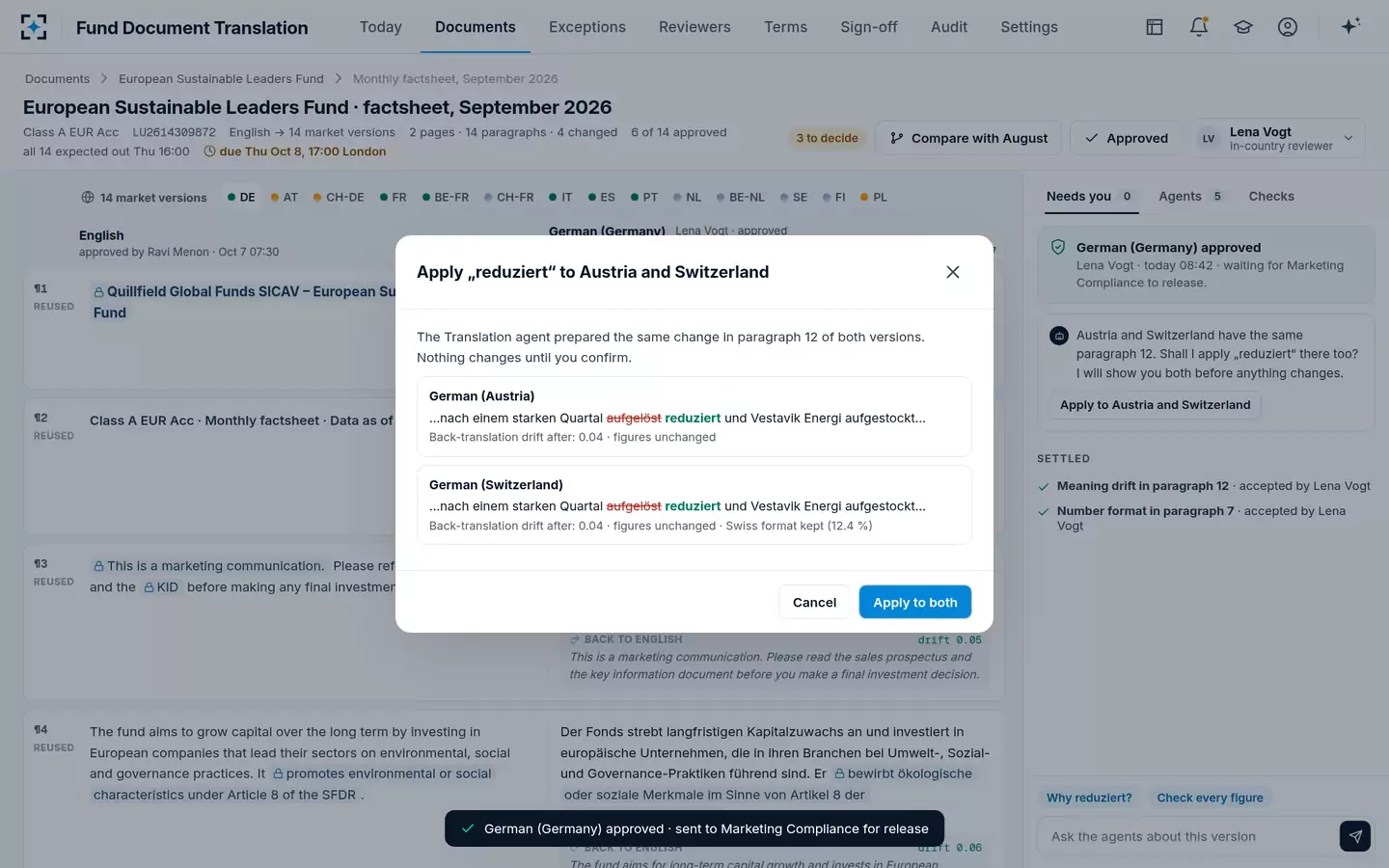
The reviewer should also have a defined scope. They approve language and meaning for their market; they do not change figures, which go back to the people who own the fund's data, or regulated phrases, which only Compliance can change. When the sample reviewer accepted the fix to paragraph 12, the solution offered the same change for Austria and German-speaking Switzerland, showed the drift after the change and kept the Swiss number format, and applied it only when she confirmed. How the translation workflow around the reviewer is organised covers the other seats.
One reviewer's fix, offered to two sister markets before anything changes
When the reviewer is away: covering a market without widening who may approve
Absences are routine, and the review design should cover them without loosening control. In the sample, the Greek reviewer was on leave on the day six Greek versions were due. The agents proposed routing the six to an agency reviewer who had reviewed 31 Greek versions for the manager in August with none returned, with access to those six documents only, until Monday, and with Compliance still releasing them. The localization manager confirmed it in one step.
The pattern generalises: name a backup for every market before it is needed, give the backup access to the specific documents rather than the whole library, keep the same approval rules, and record why the routing changed. How back translation shows meaning to reviewers who do not read every language explains the check that makes a backup reviewer's job tractable.
How to review a translation: a checklist for in-country reviewers
A good review answers a short list of questions in a fixed order, so that the reviewer's limited time goes on the questions only they can answer. The checklist below is written for a reviewer of fund documents working with checks already run; without them, the reviewer has to do the figure and phrase checks by hand first.
Reviewing a fund translation for your market: the order that saves time
- Start with the findings
Decide each one, with a reason. They are where something is most likely wrong.
- Read every changed paragraph against the English
Does it say the same thing: the same trade, the same view, the same caveat?
- Use the back-translation where the meaning is subtle
Overweight, underweight, trimmed and sold are where drafts go wrong.
- Do not edit regulated phrases
If one reads badly, propose a change to Compliance; never rewrite it in place.
- Send figure problems back, not fixed
If a figure looks wrong, it goes to the owner of the fund's data.
- Check the register and terms of your market
Formal address, the market's usual fund vocabulary, the approved glossary.
- Note what reads badly in the English
Send it upstream; the fix belongs in the source.
- Say how you reviewed
In full, or changed paragraphs only; the reason is kept with the approval.
To see the reviewer's view on your own documents and markets, start from Fund Document Translation.
Questions people ask
What is in country review?
In country review is the check of a translation by a reader in, or from, the target market before it is approved: does it say what the source says, in the terms and register local readers expect? For regulated fund documents it ends with the reviewer's approval of that language version, which a second person then releases.
Should an in-country reviewer edit the translation or comment on it?
Decide and comment, and edit only within their scope. Accepting or rejecting a proposed fix, with a reason, keeps the decision traceable; rewriting freely makes it hard to know what changed and why. Regulated phrases and figures are outside the reviewer's scope and go to Compliance or the data owner.
Can an agency do in-country review?
Yes, as cover or for markets without an in-house reviewer, under the same rules: access to the documents concerned, approval with reasons, and release by the manager's compliance team. In the sample an agency reviewer covered six Greek versions while the Greek reviewer was on leave.
How do you evaluate translation quality as a reviewer?
By marking specific errors, with their type and location, rather than giving an overall score: meaning, terminology, register, figures, fixed wording. That makes the review repeatable and shows the localization manager whether problems cluster in a language, a document type or a term.
How many in-country reviewers does a fund manager need?
At least one per language market, plus a named backup. The fictional sample manager uses fifteen reviewers and one overflow agency for its markets; the German reviewer covers Germany, Austria and German-speaking Switzerland.