The PRIIPs KID language requirements come from one sentence of Article 7 of Regulation (EU) No 1286/2014: a key information document must be written in an official language of the part of the country where the product is distributed, or in another language that country's regulator accepts, and any translation "shall faithfully and accurately reflect the content of the original key information document" (PRIIPs Regulation, Art. 7(1)). The national half of that sentence is where the work lies. In the European Supervisory Authorities' own table, updated in December 2025, eighteen of the thirty EEA states accept a retail KID only in their official language, three accept English outright, and nine accept English or another language only on conditions. For a fund sold in fifteen countries that means a translation per market, kept current every time the English changes. Botminds' Fund Document Translation exists for that obligation: agents read the fund registrations, work out which languages each KID, factsheet and notice owes, translate only what changed and check every figure and regulated phrase, while people in each market approve.
The examples come from the solution running on fictional sample data, a manager called Quillfield Capital with 64 cross-border funds.
Which language a retail KID may be in: thirty EEA states in four groups
18
Official language only
No other language is accepted for a retail KID.
- Austria
- Belgium
- Bulgaria
- Croatia
- Denmark
- France
- Germany
- Greece
- Hungary
- Italy
- Lithuania
- Netherlands
- Romania
- Slovakia
- Slovenia
- Sweden
- Liechtenstein
- Norway
2
English is an official language
Ireland (Irish or English) and Malta (English or Maltese for funds).
- Ireland
- Malta
1
English accepted outright
Greek is the official language; the table says English "is also accepted".
- Cyprus
9
Another language, on conditions
Usually a declaration or proof that the investor understands the language.
- Czech Republic
- Estonia
- Finland
- Latvia
- Luxembourg
- Poland
- Portugal
- Spain
- Iceland
What are the PRIIPs KID language requirements? Article 7 in two sentences
Article 7 sets two rules and leaves a third to each country. The first is the language: "the official languages, or one of the official languages, used in the part of the Member State where the PRIIP is distributed, or in another language accepted by the competent authorities of that Member State, or where it has been written in a different language, it shall be translated into one of these languages." The second is fidelity: a translation must faithfully and accurately reflect the original. The third, which language a regulator "accepts", is national, and it is why a KID's language list cannot be written once for Europe.
Two words in the first rule matter more than they look. "The part of the Member State" means a multilingual country is not one market: a KID distributed in Flanders and in Wallonia owes Dutch and French, and the ESAs' table records that Spain accepts Catalan, Basque and Galician "in the part of Spain where the product is going to be distributed". And "distributed" ties the language to where the product is sold, not where the fund is domiciled, which is why the language of a Luxembourg fund's home KID decides nothing about the languages it owes in Italy or Poland.
Since 1 January 2023 this is the rule for UCITS too. The PRIIPs Regulation had exempted UCITS management companies from producing a KID, and Regulation (EU) 2021/2259 replaced the end date of that exemption, "31 December 2021", with "31 December 2022" (Regulation (EU) 2021/2259, Art. 1). From the first day of 2023 a UCITS sold to retail investors in the EU has carried a PRIIPs KID, and its language follows Article 7.
Which countries accept a KID in English? Three, and nine more on conditions
Three EEA states accept a retail KID in English without conditions: Ireland and Malta, where English is an official language, and Cyprus, whose entry in the ESAs' table says "English is also accepted". Nine more accept English, or another language, only on conditions, and the conditions usually fall on the investor or the distributor rather than on the manufacturer. Everywhere else, which is eighteen states including Germany, France, Italy, Denmark, Sweden and Norway, the KID must be in the official language.
Where a KID may be in a language other than the official one, and on what condition
| Country | Official language | What else is accepted, and when |
|---|---|---|
| Czech Republic | Czech | Other languages, on conditions that include proof of the retail investor's sufficient language competence. |
| Estonia | Estonian | English, on conditions that include the seller ensuring the investor has a sufficient understanding of English. |
| Finland | Finnish or Swedish | English, on conditions that include the investor being able to understand the key features and risks. |
| Iceland | Icelandic | English for investment products not marketed in Iceland or in Icelandic, on similar conditions. |
| Latvia | Latvian | English only where a distributor solely offers access to an investment platform, with the client's written consent and signed confirmation of proficiency. |
| Luxembourg | Luxembourgish, French or German | English may be accepted by the CSSF for products other than insurance-based ones "where it is appropriate". |
| Poland | Polish | English for exchange-traded funds, with the client's declaration of English competence. |
| Portugal | Portuguese | For UCITS and AIFs, a language in current use in international financial markets, if the investor declares in a durable medium that they are fluent in it and accept the KID in it. |
| Spain | Spanish, or the co-official language of the region | For MiFID instruments, another language if the distributor has ensured the investor knows it and can evidence that. |
The pattern in the conditions is the useful finding. Where a country accepts English for a fund KID, it almost always makes someone prove the investor can read it: a declaration in a durable medium in Portugal, a signed confirmation in Latvia, evidence held by the distributor in Spain. A manager cannot satisfy that condition from head office. It depends on every distributor collecting the declaration from every investor, so a manager that relies on the English exception in Portugal or Poland has moved its language risk into its distribution agreements.
Can a KID be in English? Only where the investor, not the manager, makes it possible
A KID can be in English for retail investors in three countries as of right and in nine more if the investor or distributor meets a condition, so in practice an English-only KID works for direct, platform or adviser-led business and fails for the open retail market. The ESAs' table is precise about who bears the condition. In Estonia it is "the person advising on, or selling, the PRIIP" who must ensure the investor "has a sufficient understanding of English". In Finland it is whether "the retail investor can understand the key features and risks of the product".
France is the instructive opposite. The table records that "the AMF has specified in its rules that French is the only official language accepted for KIDs for PRIPs addressed to retail investors". Croatia allows its supervisor to approve another language "either on a case-by-case basis or generally", and adds: "Currently, HANFA has not approved the use of another language." A localization manager reading a country page should therefore look for two things: what the law permits, and what the supervisor has actually approved.
The PRIIPs KID language map in four numbers
30
EEA states in the ESAs' table, each with its own language entry
JC 2024 44, December 2025
18
accept a retail KID only in their official language or languages
6
want the KID notified to the regulator before it is used: Belgium, Finland, France, Italy, Portugal, Slovenia
24
official languages in the EU, before the EEA states add Icelandic and Norwegian
European Union
When the marketing language sets the KID language: Article 7(2) and Belgium
A fund that markets in a language must provide its KID in that language too. Article 7(2) says: "If a PRIIP is promoted in a Member State through marketing documents written in one or more official languages of that Member State, the key information document shall at least be written in the corresponding official languages." A manager whose German-language factsheet circulates in Luxembourg, where German is official, owes a German KID there, even though French alone would satisfy Article 7(1).
Belgium turns the same idea into procedure. Its entry in the ESAs' table says that where advertising is submitted to the FSMA for approval, "the language of the KID that is provided to the FSMA must correspond to the language of the advertising submitted to the FSMA for approval". In a country with three official languages, the marketing plan decides the translation plan, and the two have to be agreed before either is sent.
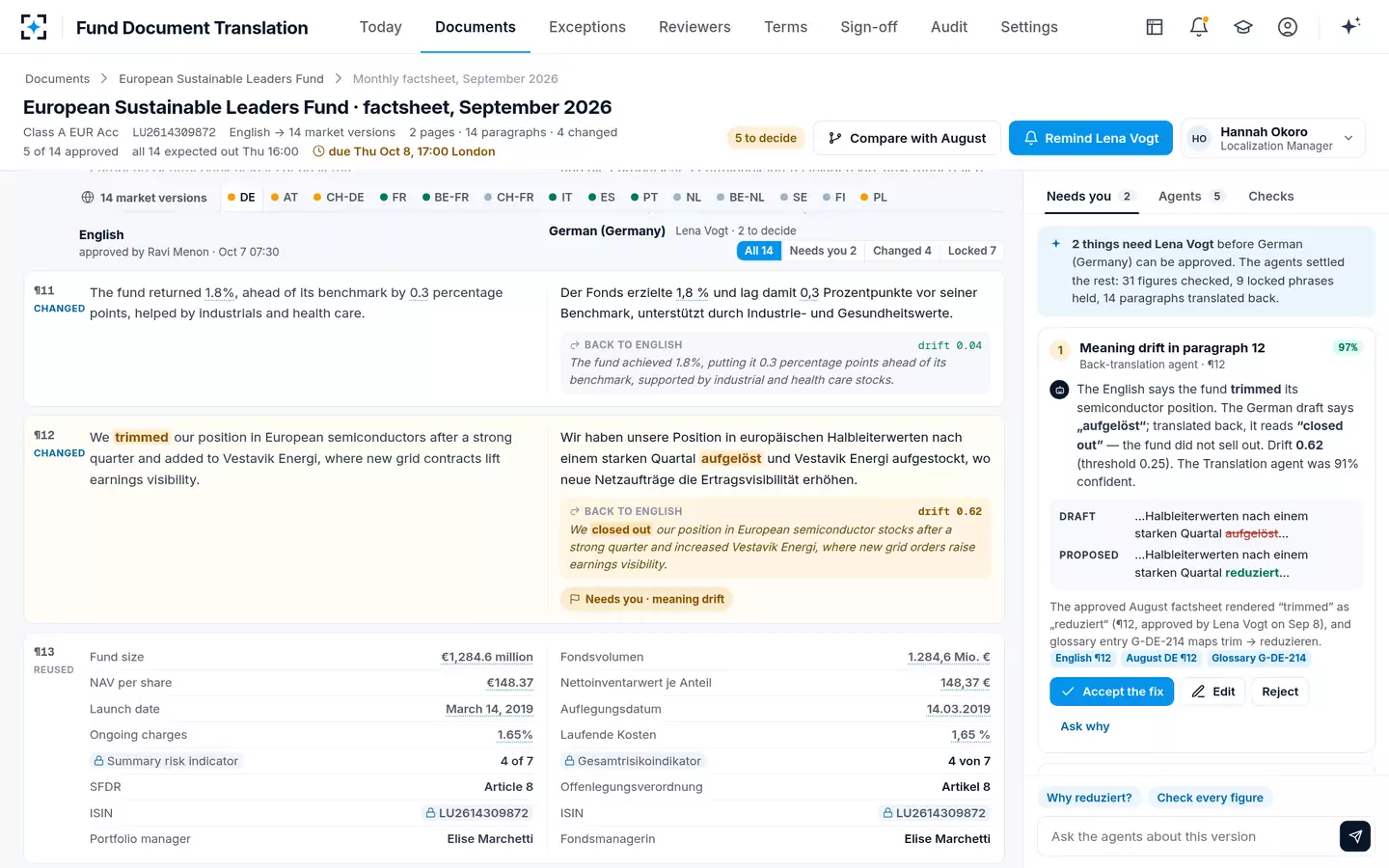
Fourteen market versions of one factsheet, one tab per market
Does a UCITS KID have to be translated? Article 94 and the passport
Yes. The UCITS Directive's host-state rule makes the key investor information the one document that must be translated: it "shall be translated into the official language, or one of the official languages, of the UCITS host Member State or into a language approved by the competent authorities of that Member State" (Directive 2009/65/EC, Art. 94(1)(b)). Every other document, the prospectus and the reports included, may at the UCITS's choice be given in the host language, an approved language or a language customary in international finance, which in practice means English.
The translation is also part of the passport. Article 93(2) requires the translated key investor information to go with the notification letter itself (the cost of a week's delay follows what that does to a launch). A host market cannot be opened with an English KID and a promise. Article 94(2) then applies the same rules "to any changes to the information and documents", so a revised KID is a new translation in every host language, and Article 94(1)(d) says those translations "shall be produced under the responsibility of the UCITS and shall faithfully reflect the content of the original information".
National rules sometimes go further than the Directive. ESMA's 2026 report to the EU institutions found, from the supervisors' own answers, "Translations rules that differ between the Key Information Document (KID) and other marketing communications and/or certain offering documents" in Bulgaria, Estonia, Greece, Italy, Liechtenstein, Lithuania, Portugal and Slovenia (ESMA report, 6 January 2026). Bulgaria is a clear example: the KID must be in Bulgarian, other information may be in Bulgarian or English, and on an investor's request anything the fund discloses in Bulgaria must be translated into Bulgarian.
Six countries want the KID before it is used: ex ante notification
Article 5(2) lets a country require "the ex ante notification of the key information document" to its regulator, and six do. In Belgium the FSMA wants it for any PRIIP marketed there, with four exceptions; Finland's FIN-FSA for "the KID and updated KIDs for all PRIIPs"; France's AMF for PRIIPs that are UCITS or AIFs; Italy's CONSOB for new products and updates; Slovenia's regulators by product type; and in Portugal manufacturers must notify KIDs "at least two working days before making the product available to retail investors".
For a translation calendar, ex ante notification is a deadline that sits before the deadline. A Portuguese KID that is approved on the day the English changes still cannot be used for two working days, and an Italian update must reach CONSOB before it reaches investors. The ESAs add that UCITS KIDs must in any case be sent to the home regulator under Article 82 of the UCITS Directive, which is why the table lists only the additional, country-specific notifications.
What does "faithfully and accurately" mean for a KID translation?
It means the translation must say what the original says, no more and no less, and the manufacturer carries the consequences if it does not. The Regulation's other articles show what is at stake. Article 6(1) requires the KID to be "accurate, fair, clear and not misleading". Article 11 says the manufacturer "shall not incur civil liability solely on the basis of the key information document, including any translation thereof, unless it is misleading, inaccurate or inconsistent" with the binding documents or Article 8. A translated KID is therefore as capable of founding a damages claim as the English one.
The administrative side is in Article 24, which applies to "infringements of Article 5(1), Articles 6 and 7" among others. National regulators must be able to order "an order prohibiting the marketing of a PRIIP", "an order prohibiting the provision of a key information document which does not comply with the requirement of Articles 6, 7, 8 or 10", and "administrative fines of at least" up to EUR 5 000 000 or "up to 3 % of the total annual turnover" for a legal entity. A KID in the wrong language, or a translation that does not reflect the original, is an Article 7 breach, not a style issue.
Fidelity in a KID has a mechanical half and a semantic half. The mechanical half is the figures: four performance scenarios, cost tables and a risk class that must match the original digit for digit, written in each market's number format. The semantic half is everything a reader takes from the words, which is where a translation that is fluent can still be wrong. In the sample, a German draft said a position had been „aufgelöst", closed out, where the English said trimmed. How a back translation catches a sentence like that, and what it misses, is a method of its own.
What language must fund marketing be in? A different rule, and a different list
Marketing communications follow ESMA's guidelines rather than Article 7, and the wording is close but not the same: "The marketing communication should be written in the official languages, or in one of the official languages, used in the part of the Member State where the fund is distributed, or in another language accepted by the national competent authorities of that Member State" (ESMA34-45-1272, ¶17). Guidelines are not regulations, and the national lists of accepted languages for marketing material differ from the KID lists: ESMA's report found that for marketing documentation "some NCAs refer to either the official language of the Member State or English (BG, EE, EL, LT)", while France requires managers "to seek the consent of investors" to receive marketing documentation in another language.
The KID and the factsheet answer to different language rules
PRIIPs KID: Regulation (EU) 1286/2014, Art. 7: binding in every EEA state.
Marketing communication (factsheet, commentary): ESMA guidelines ¶17, applied through national rules; Regulation (EU) 2019/1156 Art. 4 for content.
PRIIPs KID: Official language of the part of the state where distributed, or one the regulator accepts.
Marketing communication (factsheet, commentary): The same formula, but national lists differ: Bulgaria, Estonia, Greece and Lithuania refer to the official language or English.
PRIIPs KID: Translation "shall faithfully and accurately reflect" the original.
Marketing communication (factsheet, commentary): Must not "contradict or diminish the significance" of the prospectus and key information.
PRIIPs KID: None required on the KID itself.
Marketing communication (factsheet, commentary): Must say "where, how and in which language" investors can obtain the prospectus and key information.
PRIIPs KID: Article 24 orders and fines; civil liability under Article 11.
Marketing communication (factsheet, commentary): Supervisors' requests for amendment and national sanctions.
One marketing obligation is about language directly. Regulation (EU) 2019/1156 requires every UCITS marketing communication to tell investors how, where and in what languages the prospectus and key investor information are available (Art. 4(2)), and supervisors check it: ESMA's report lists, among the most frequent breaches, communications in Austria, Bulgaria and Luxembourg that left out that language statement. A factsheet translated perfectly into Austrian German can still breach the rule if its footer does not say which languages the KID exists in. The cross-border distribution rules behind that footer also explain why the number of language versions grows so fast.
What replaces the PRIIPs KID in the UK? The CCI product summary, from 2027
In the UK the PRIIPs KID is being replaced by the Consumer Composite Investments regime. The FCA's policy statement PS25/20 says "the optional transition period for the CCI regime will begin when the legislation commences on 6 April 2026", from which manufacturers "will be able to choose between producing a product summary or following the disclosure requirements that currently apply to them", and "the rules in this PS will come into effect on 8 June 2027" (FCA PS25/20). For a manager selling into both, that means two document families from mid-2027: EU KIDs under Article 7 and UK product summaries in English. The UK side of a fund's language list gets simpler; its content list does not.
How Fund Document Translation turns the language map into a work list
The language map only becomes work when it meets the fund registrations. In Botminds' Fund Document Translation, the Coordinator agent reads the fund registration system, which records where each fund and share class is registered, and derives the languages each document owes from it. The sample factsheet for the European Sustainable Leaders Fund is registered in twelve countries and owes fourteen market versions. Across the sample manager's 64 funds and 21 market versions, one monthly cycle owes 1,284 language versions from 135 English sources.
The cycle in four numbers: language versions owed, published, with reviewers and needing a person
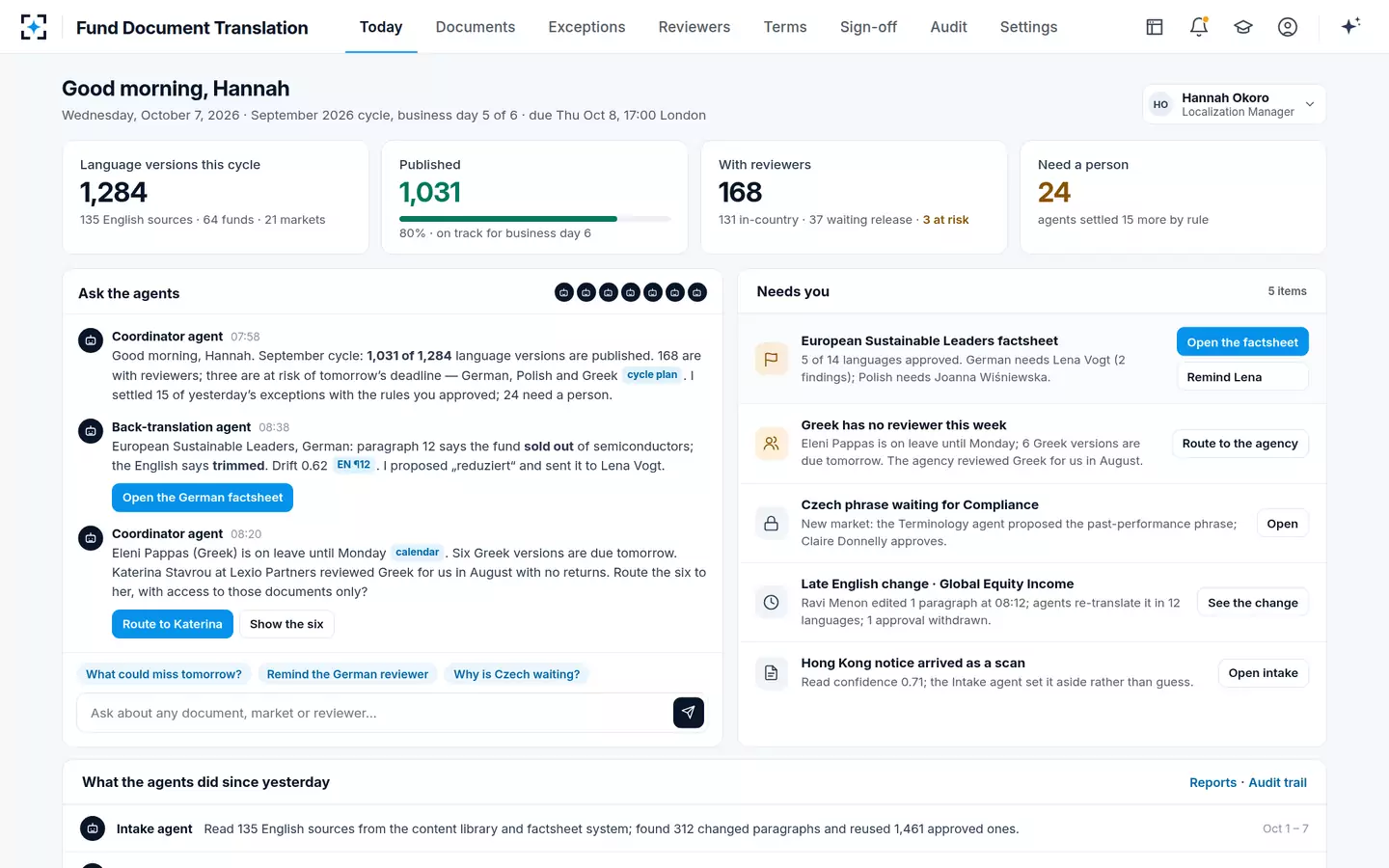
From there the work runs on rules rather than memory. The Coordinator agent routes each version to the in-country reviewer for its market and time zone and watches the deadline; a late English edit reopens only the paragraphs it changed. Registered fund names and ISINs are never translated, every figure is proven against the fund's data in the market's own number format, and a version is approved by the in-country reviewer for that market and released by Marketing Compliance as a second person. When a new country is added, the Terminology agent proposes its first regulated phrases with their source, and Compliance approves them.
Before a fund's KID goes into a new market: a language checklist
- Read the market's row in the ESAs' table, then the national link
The table summarises; the national rule decides. Note the date of the version you read.
- List every part of the country you will sell in
Belgium and Spain are not one language market. Article 7 counts the part of the state where the product is distributed.
- Match the KID languages to the marketing languages
Article 7(2): a factsheet in an official language requires a KID in that language too.
- Decide whether you rely on an English exception
If yes, write the investor declaration into the distribution agreement and check that distributors collect it.
- Put ex ante notification in the calendar
Belgium, Finland, France (UCITS and AIFs), Italy, Portugal and Slovenia. Portugal needs two working days.
- Enclose the translated KID with the passport notification
UCITS Directive Art. 93(2). Plan the translation before the filing, not after.
- Re-translate on every change
Article 94(2) applies the rules to changes; a KID is reviewed at least every 12 months under the RTS.
- Check the factsheet footer names the KID's languages
Regulation 2019/1156 Art. 4(2); a breach supervisors in Austria, Bulgaria and Luxembourg have found.
For the agents that do this work and the limits written for each, see what an AI translation tool for regulated fund documents must never do. To see the language map applied to your own registrations, start from Fund Document Translation.
Questions people ask
Does a fund prospectus have to be translated?
For a UCITS, usually not by EU law. Article 94(1)(c) of the UCITS Directive lets the UCITS choose the host language, an approved language or a language customary in international finance for documents other than the key investor information. National rules can differ: Bulgaria, for example, accepts other information in Bulgarian or English but requires translation into Bulgarian at an investor's request.
Must a KID be translated into every language of a multilingual country?
Into the official language of each part of the country where it is distributed, because Article 7 looks at "the part of the Member State where the PRIIP is distributed". A fund marketed in both Flanders and Wallonia therefore needs a Dutch and a French KID; Spain accepts Catalan, Basque and Galician where they are official in the region. Article 7(2) adds any official language the fund markets in.
Does a KID need re-translating every time it is updated?
Yes. The PRIIPs technical standards require a review whenever a change significantly affects the KID and at least every 12 months, and a revision "without undue delay" where the review finds one is needed (Delegated Regulation 2017/653, Arts. 15–16). For UCITS, Article 94(2) applies the translation rules to every change.
Who is responsible for the translation of a KID?
The manufacturer. Article 11 of the PRIIPs Regulation extends civil liability to the KID "including any translation thereof", and the UCITS Directive says translations "shall be produced under the responsibility of the UCITS". Using an agency or a tool does not move that responsibility.
What happens if a KID is not in an accepted language?
It is a breach of Article 7, one of the articles Article 24 sanctions. National regulators must be able to prohibit the marketing of the product, prohibit the provision of a non-compliant KID and require a new version, and fine a firm up to at least €5 million or 3% of annual turnover.
Can one KID carry several languages?
The Regulation limits a KID to "a maximum of three sides of A4-sized paper when printed" (Art. 6(4)), which leaves no room for parallel text. In practice each language is a separate KID with the same figures, and each must fit three pages on its own, which is why a translation that runs longer than the English needs a layout check before it is approved.