Machine translation and post editing, often shortened to MTPE, means a machine drafts the translation and a professional linguist corrects it, instead of translating from scratch. In a study run in translators' own working environment, it cut translation time by about 15–20%, with quality at least as good as conventional translation. For regulated fund documents it has one structural weakness: the post-editor is the only check, reading for language while figures, fixed regulatory wording and subtle shifts of meaning have to be caught by eye in fifteen languages. A third approach, agents, keeps the machine draft and the human approval but puts independent checks between them, so the linguist sees only what needs a decision. Botminds' Fund Document Translation takes that third approach, with seven agents and an in-country reviewer and a compliance releaser for every language. This guide compares all three on a fund KID.
The examples come from the solution running on fictional sample data, a manager with 64 cross-border funds.
Three ways to produce a fund KID in every language, compared on seven questions
Who drafts
Agency translationA professional translator, from scratch or from translation memory
Machine translation and post-editingA machine translation engine
Agents with independent checksA Translation agent, only for paragraphs that changed
Checked before a person reads it
Agency translationNothing, beyond the translator's own tools
Machine translation and post-editingNothing: the post-editor is the first check
Agents with independent checksFigures, regulated phrases, meaning by back translation, page length
Who catches a wrong figure
Agency translationThe translator or reviewer, by reading
Machine translation and post-editingThe post-editor, by reading
Agents with independent checksThe Numbers agent, against the source and the fund's data; release blocks
Who holds fixed wording
Agency translationTranslation memory and the translator's care
Machine translation and post-editingA term list, if the engine supports one
Agents with independent checksExact comparison with Compliance's approved wording per market
What the reviewer sees
Agency translationThe whole translated document
Machine translation and post-editingThe whole post-edited document
Agents with independent checksChanged paragraphs and findings, each with its source
A late English edit
Agency translationAnother round for every language
Machine translation and post-editingAnother round, faster
Agents with independent checksReopens one paragraph in the languages that carry it
Days, English to last language
Agency translationAbout 11 business days in Botminds' estimate
Machine translation and post-editingNo independent figure; research shows post-editing time savings of 15–20%
Agents with independent checksAbout 2 business days in Botminds' estimate
What is machine translation and post editing?
Machine translation and post editing is a two-step workflow: an engine translates, and a person edits the output until it meets the required quality. The US Bureau of Labor Statistics describes how it changed the occupation: software now produces the first draft in the target language, and translators review and correct it, a process the Bureau calls post-editing (BLS Occupational Outlook Handbook).
The post-editor's job differs from a translator's. A translator writes; a post-editor reads a draft that is often fluent and decides what is wrong with it. That makes the quality of MTPE depend heavily on what the post-editor is asked to look for and what tools they have, and it makes the post-editor the last line of defence for everything the engine got wrong.
How much faster is post editing? The evidence from a realistic study
Faster, but by less than early studies suggested. Läubli and colleagues at the University of Zurich and the Zurich University of Applied Sciences tested post-editing in the translators' own workbench, with translation memory and terminology available, rather than in a stripped-down test interface. "Overall, translating a word took participants 27.5 seconds in TM-Only and 22.1 seconds in Post-Edit on average (−19.9%)", and they concluded that "actual time savings lie within a range of 15–20%, which is, however, considerably lower than numbers reported in other studies" (Läubli et al., MT Summit 2013), the other studies having isolated translators from their usual translation memory and terminology tools.
Post-editing saved most time on dense, list-like text and none on prose
Two details in the study matter for fund documents. The gains varied by text: dense documents "consisting primarily of bullet points" gained most, up to 30.9%, while one prose text was slightly slower to post-edit. A KID's tables and scenarios resemble the dense texts; a portfolio manager's commentary resembles the prose. And quality held up: the study found post-edited translations "at least equivalent to conventionally produced translations". The study is small, six participants, all translation students or graduates, and four texts in one language pair, and it predates today's engines, so read it as evidence about the workflow rather than about any current system.
Post-editing in a realistic setting: faster, as good, and not liked
27.5 → 22.1s
average seconds per word, translation memory only versus post-editing
15–20%
the authors' estimate of actual time savings in a realistic environment
5 of 6
translators rated the machine drafts "not useful" or "not at all useful" despite working faster with them
The last finding is the one buyers forget. Five of the six participants rated the machine drafts as not useful, although they were faster and no worse with them, and the authors note that "the discrepancy between translators' perceptions and post-editing performance is a well-known phenomenon". A switch to MTPE, or to agents, is a change for linguists and reviewers as much as a change of tool, and it should be measured rather than argued.
Is MTPE good enough for regulated documents?
It can be, if the post-editor's reading is backed by checks the post-editor cannot do reliably by eye. The legal standard is the result: a KID translation must reflect the original faithfully and accurately (PRIIPs Regulation, Art. 7(1)), whoever or whatever produced the draft. MTPE meets it when the post-editor catches every error that matters; the risk is in the errors a fluent draft hides.
Two kinds of error are hard to catch by reading. The first is figures: tests of machine translation have found numbers mistranslated by commercial and research engines alike (Wang et al., 2021), and a transposed digit in a performance scenario looks as plausible as the right one. The second is fixed wording: a fluent engine improves a regulated phrase into a sentence that means the same thing and is not the approved text. A post-editor working at a fifth less time per word is not the person to rely on for either.
What a post-editor cannot see on the page
A post-editor sees the source and the draft, and judges whether the draft is a good translation. They cannot see whether a figure matches the fund's data rather than the English, whether a phrase matches the version Compliance approved last quarter, or whether the same paragraph was approved with a different rendering in August. In the sample cycle, one of six figure problems was in the English itself: a Dutch factsheet said 1.9% because the English did, while the performance system said 1.8%. A perfect post-edit would have kept the error.
Meaning is the third blind spot, for a different reason. A post-editor who reads German reads the German; but a reviewer at head office who must sign off fifteen languages cannot. Back translation, done independently, gives that reviewer a view of meaning in languages they do not read. It needs care: translating forward and back with the same system was found "a poor predictor of quality" (Somers, 2005), so the check must use a different model.
One error, three workflows: a figure carried over from last month
The sample cycle contains an error that shows the difference clearly. The French KID for Belgium of the fictional Global High Yield Bond Fund showed "9 421 €" in its moderate scenario after one year, where the English and the fund's KID data said €9,412. The draft had come from the August KID, in which the figure had been €9,421. Any workflow that reuses last month's approved sentence can carry last month's figure: a translator accepting a memory match, an engine drafting from the same memory, or an agent drafting from the approved version.
What differs is who is positioned to notice. Under agency translation and under MTPE the catch depends on a person comparing every figure in every language with this month's English while also reading for language; the format, a space and the euro sign after the number, is correct for French in Belgium, so nothing looks wrong. Under the agent approach the Numbers agent compared the figure with the fund's data, found the digits transposed and blocked the version, and the reviewer saw both readings with their sources and could correct the figure or send it back to Product Governance. The error was the same; the control was not.
Agents: independent checks between the machine and the linguist
The agent approach keeps the machine draft and the human decision and adds what MTPE lacks: checks that run before any person reads, each by a separate agent with its own limits, each citing what it checked against. In Fund Document Translation, a Terminology agent holds each market's regulated phrases to Compliance's approved wording; a Back-translation agent translates every paragraph back on a different model family and scores meaning drift; a Numbers agent proves every figure, date, currency and ISIN against the source and the fund's data in the market's format; and a Layout agent checks the KID still fits three pages.
Draft, four checks and a hand-off, on one factsheet in fourteen markets
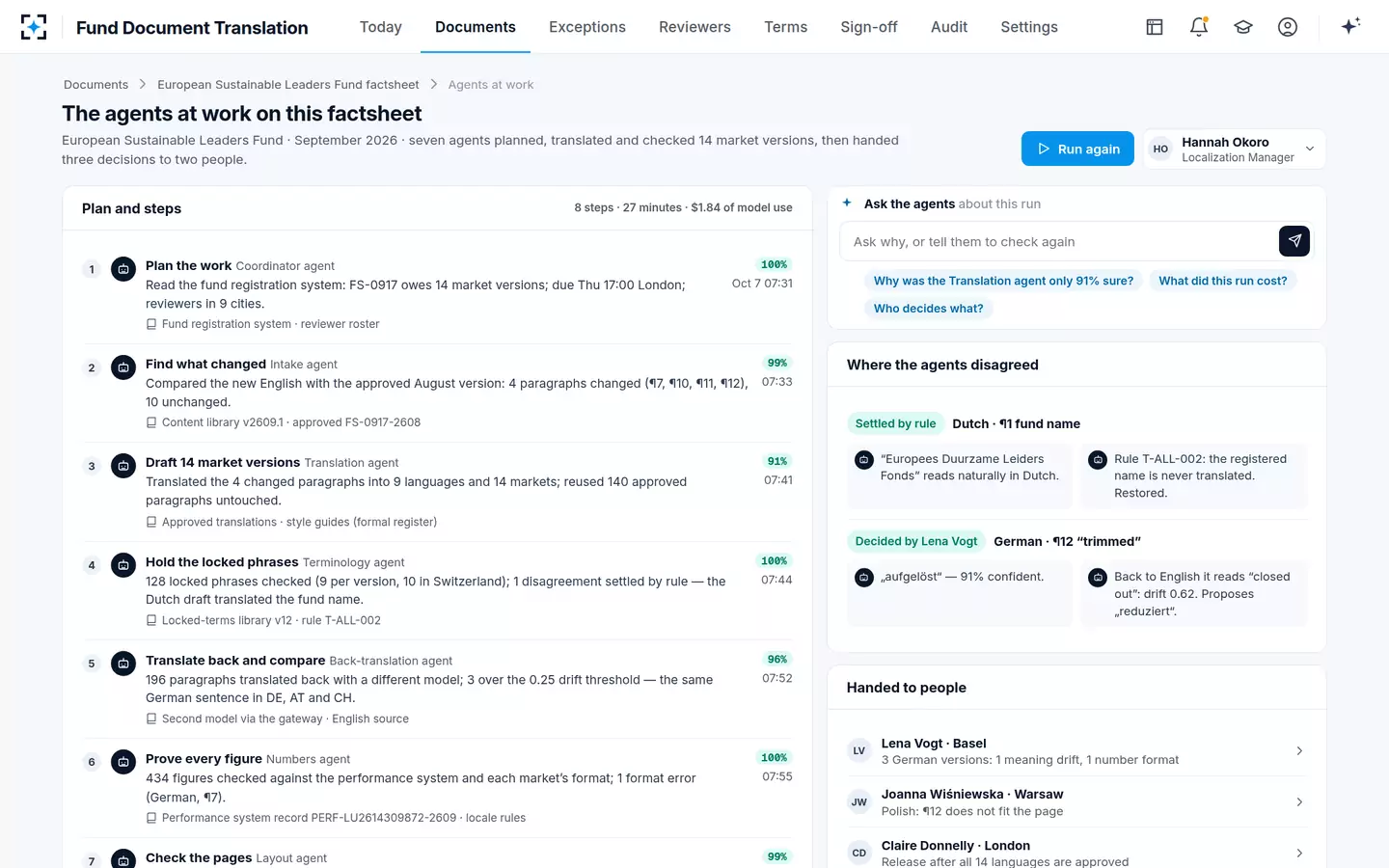
The effect on the linguist's work is the point. In the sample factsheet cycle the agents translated the four changed paragraphs into fourteen market versions, left the other 140 approved paragraphs alone, checked 434 figures and 128 regulated phrases and translated 196 paragraphs back in one 27-minute run, then handed three decisions to people. The German reviewer had two findings to decide instead of a whole document to read. That is the same human approval MTPE ends with, applied to a much smaller and better-defined set of questions.
Post-editing and agents divide the same work differently
Machine translation and post-editing: The post-editor, reading every sentence of the draft.
Agents with independent checks: Four agents, checking every figure, phrase, paragraph and page.
Machine translation and post-editing: Reading for everything at once: language, figures, wording, layout.
Agents with independent checks: Deciding findings, each explained with its source.
Machine translation and post-editing: Translated faithfully into every language.
Agents with independent checks: Found when a figure differs from the fund's data.
Machine translation and post-editing: Settled silently in the post-edit.
Agents with independent checks: Shown with both readings to the reviewer.
Machine translation and post-editing: The edited file.
Agents with independent checks: Each finding, decision and reason, kept seven years.
Machine translation post editing rates, and why per-word rates mislead
Where MTPE is quoted per word, any discount on the rate is narrow compared with the total cost of a fund document. Vendors don't publish comparable prices, so a buyer can only compare quotes, and a per-word rate prices the cheapest part of the work. The research saving, 15–20% of translation time, applies to the translation step; in Botminds' estimate of a monthly cycle, waiting for agency rounds, re-sending late edits and reviewing whole PDFs take most of the eleven business days, and post-editing changes none of them.
A better comparison counts three things per cycle: business days from English sign-off to the last approved language, reviewer hours, and errors found after release. MTPE may lower the first slightly and leave the others where they were; an approach that checks before review lowers reviewer hours and post-release errors too. Pricing translation by the days each market waits sets out the method.
Translation management system: where it sits in each approach
A translation management system runs the workflow: it holds the translation memory and termbase, sends jobs to translators or engines, tracks deadlines and returns files. In agency translation it usually sits with the supplier; in MTPE it connects the engine to the post-editors; in either case it moves files and does not check figures against the fund's data or hold regulated phrases to approved wording.
Fund Document Translation works at the level of paragraphs and checks rather than files, and exchanges what a translation management system holds in the standard formats. Translation memory and glossary come in and go out as TMX or XLIFF; English factsheets and KID texts arrive from the factsheet and KID production systems as XLIFF; the fund registration system says which languages each document owes. A manager can keep its translation management system for documents outside the regulated cycle.
What the reviewer works from: the English, the draft and the back-translation, paragraph by paragraph
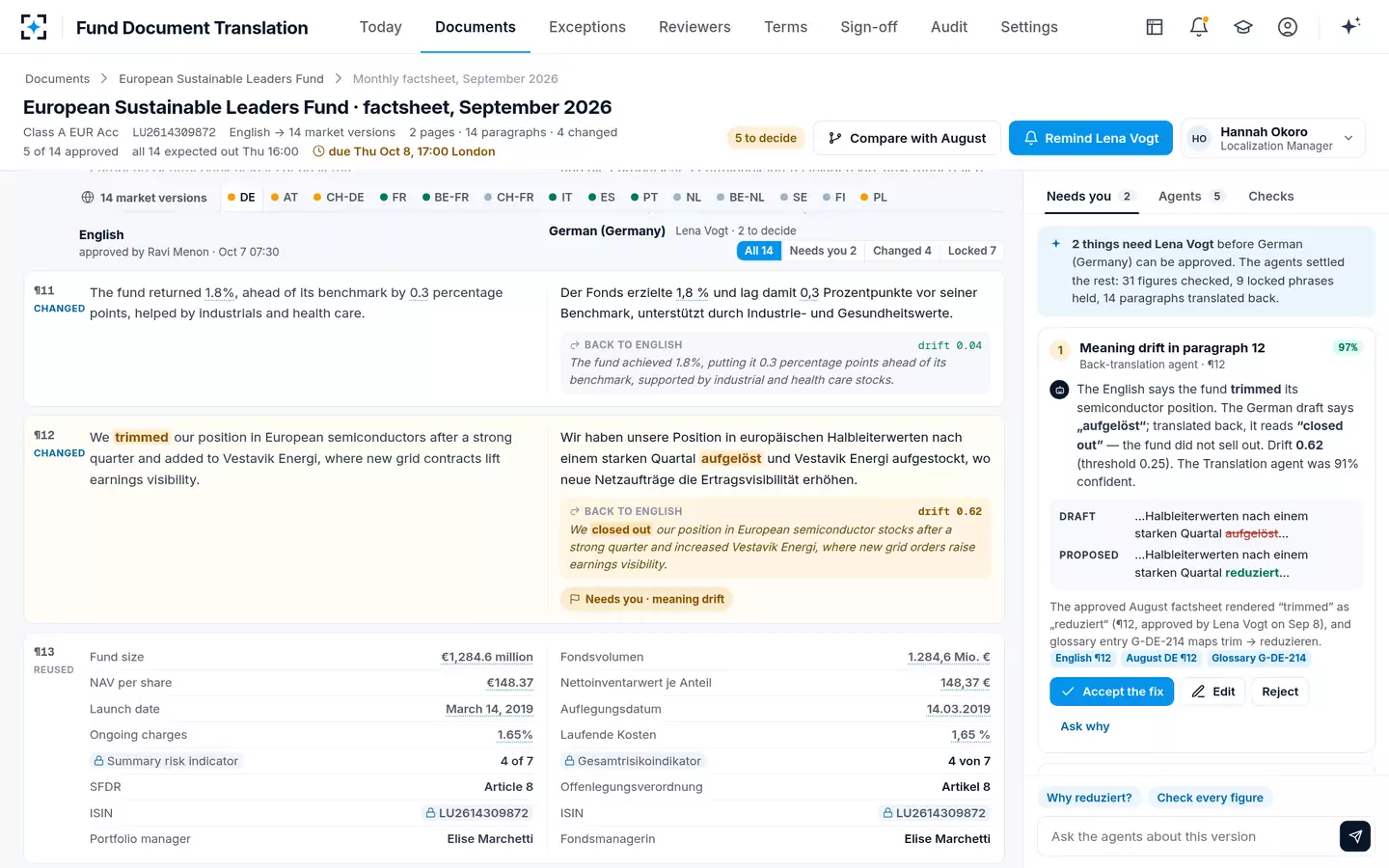
Switching from agency or MTPE without losing what you have
A switch should keep the assets and change the workflow. The translation memory and glossary built over years are the most valuable thing a manager owns in this area: they carry every approved rendering. They should move with the manager, in TMX or XLIFF, into whatever comes next. The in-country reviewers stay; what changes for them is what they see. Agencies can stay too, for overflow and for languages without a reviewer: in the sample cycle six Greek versions went to an agency reviewer, with access to those documents only, while the Greek reviewer was on leave.
The safe way to switch is to run the new approach on a closed cycle first, with last cycle's approved versions as the answer key, and compare days, reviewer hours, figure and phrase errors and meaning flags. Four measures of translation accuracy on your own documents describes that test.
Choosing between agency, MTPE and agents
Each approach fits a different situation, and many managers will use more than one. The checklist below is a way to decide per document family rather than for the whole firm.
Which approach for which fund documents
- One-off documents translated once
A prospectus a distributor asks for, a legal opinion: agency translation, with legal review, priced per word.
- High-volume text with little fixed wording
Website copy, internal material: MTPE can save translation time; the 15–20% from realistic studies is a fair expectation.
- Recurring regulated documents that change in places
KIDs, factsheets, commentary, notices: agents with independent checks, reviewer approval and compliance release.
- Languages with no in-house reviewer
An agency reviewer under the same approval rules, with access to the documents in question only.
- Wherever figures appear
Check every one against the fund's data in the market's format, whatever drafted the text.
- Wherever fixed wording appears
Compare exactly with the approved version; a term list is not enough.
- Before switching
Run a closed cycle and compare days, reviewer hours and errors with what you released.
Fund Document Translation is built for the third row. To compare it with your current supplier on your own documents, start from Fund Document Translation.
Questions people ask
What is MTPE?
MTPE stands for machine translation post-editing: an engine drafts the translation and a professional linguist corrects it. The machine supplies speed and the linguist the judgement, so the result depends on what the post-editor is asked to check.
Does post-editing reduce translation quality?
Not in the realistic study by Läubli and colleagues, where specialist ratings and pairwise rankings found post-edited translations consistent with, and in some cases better than, conventionally produced ones. For fund documents, quality also depends on checks a post-editor cannot do by eye, such as proving figures against the fund's data.
What does a post-editor do?
A post-editor reads the machine draft against the source and corrects errors of meaning, terminology, grammar and style until the text meets the agreed standard. They are the first and usually only check in an MTPE workflow.
Can agents replace post-editors?
Not for approval. Agents can draft and run the checks a post-editor finds hardest, figures, fixed wording and meaning in languages a reviewer does not read, but a person who reads the language should still decide what the agents flag and approve the version.
Is machine translation good enough on its own now?
Not for regulated documents. In the 2024 Conference on Machine Translation, human translations were still in the top group for seven of eleven language pairs, and the test domains were chosen not to need specialist translators (WMT24). A KID needs a check and an approval whatever drafts it.