Prospectus translation services for funds are usually quoted per word, but per-word rates miss the larger cost, which is time. For an open-ended fund, EU law often does not require the prospectus to be translated at all: a UCITS may provide it in "a language customary in the sphere of international finance". What it must translate is the key information document, into a language each host country accepts, and the translated KID is part of the file that opens the market. So the useful question for a buyer is not the rate per word but how many business days pass between the English being signed off and the last language being approved, released and usable, every time the English changes. Botminds' Fund Document Translation is built to be judged on that measure: its agents translate only what changed, check every figure and regulated phrase, and route each version to its reviewer, with a design target of every language out by business day 6 of the monthly cycle.
The sample figures come from the solution running on fictional data, a manager called Quillfield Capital with 64 cross-border funds. Vendors don't publish comparable prices, so this guide shows how to measure the cost on your own calendar.
Eleven business days from English sign-off to the last language, and where nine of them go
- Export, batch1
- Waiting for agencies4
- Late edits1.5
- Review by PDF2.5
- Compliance1
- Publish1
- Drafts, checks0.8
- Review1
- Publish0.2
What do prospectus translation services cost? The rate is per word; the bill is in days
No regulator or independent study publishes the price of fund document translation, and vendors don't publish comparable prices, so any figure a buyer sees is a quote. What can be measured is where the money and the days go. The estimate above, Botminds' own for a manager of about 60 cross-border funds, puts eleven business days between English sign-off and the last language released under agency rounds, and nine of them are waiting: for an agency, for a second round after a late edit, for a reviewer who reads PDFs between client calls, for a compliance spot-check.
Per-word pricing rewards none of that. It charges for words translated, so it charges again for paragraphs that did not change since last month, and it says nothing about the days a market waits. A buyer comparing suppliers on rate per word is comparing the cheapest part of the cost. Comparing them on business days from sign-off to the last approved language, and on what a late edit costs in days, compares the expensive part.
Where the waiting days come from, and which ones software can remove
Each phase of the estimate has a different cause, and only some of them are translation. Batching takes a day because files have to be exported, sorted by language and sent to the right agency; when the languages each document owes are read from the fund registration system and each version is routed to its reviewer automatically, that day becomes an hour or two. The four days of agency waiting are queue time, not translation time: on the sample factsheet, drafting and checking fourteen market versions took one run of 27 minutes, and the estimate with agents puts all drafting and checking in the cycle at under a day.
The day and a half of late edits disappears when an edit reopens one paragraph instead of a batch. Compliance's spot-checks shrink from a day to a third of one when every regulated phrase has already been compared exactly and every figure proven, so the release decision is made on evidence rather than on sampling. What does not shrink much is in-country review, two and a half days down to one, because people still read and approve every language. That is the part a buyer should want to keep: the estimate saves days by removing waiting, not by removing the reviewer.
Does a fund prospectus need to be translated?
For a UCITS, usually not by EU law; the KID does. The UCITS Directive makes the key investor information speak the host country's language, or one its regulator allows, while the prospectus and reports may be translated "at the choice of the UCITS" into the host language, an approved language "or into a language customary in the sphere of international finance" (Directive 2009/65/EC, Art. 94(1)(b)–(c)). For open-ended funds the general EU prospectus rules do not apply either: the Prospectus Regulation "shall not apply to ... units issued by collective investment undertakings other than the closed-end type" (Regulation (EU) 2017/1129, Art. 1(2)(a)).
National practice can still ask for more, and a distributor may want a local-language prospectus for its own reasons. ESMA's publication of national rules shows the range: Greece asks for the KID in Greek and for the prospectus "in Greek or English depending on UCITS' choice" (ESMA, March 2026). A buyer looking for prospectus translation services should therefore start with the host countries' rules: in many markets the prospectus can stay in English, and the budget and the calendar belong to the KID, the factsheet and the notices.
The documents that hold up a market, and the language each needs
A host market waits for different documents for different reasons. Some open the market, some are needed before a given use, and some must follow every change. The table sorts them by what a delay blocks.
What a late translation blocks, document by document
| Document | Language rule | What a late translation blocks |
|---|---|---|
| KID, first version | Official or accepted language of the host (PRIIPs Art. 7; UCITS Art. 94(1)(b)) | The passport: the translated KID goes in the notification file (UCITS Art. 93(2)). |
| KID, revised | Same; rules apply to every change (UCITS Art. 94(2)) | Distribution with a current KID; revision is due "without undue delay" (RTS Art. 16). |
| KID where notified ex ante | Same | Use until notified: six EEA states; Portugal at least two working days before. |
| Prospectus and reports | Host language, approved language or a language customary in international finance, at the UCITS's choice (Art. 94(1)(c)) | Usually nothing, unless national rules or distributors ask. |
| Factsheet and other marketing | Official or accepted language (ESMA guidelines ¶17, national rules) | Marketing in that market; ex-ante review adds up to 10 working days where required. |
| Facilities information and exit notices | Host official or approved language (Directive 2019/1160) | Investor services; an orderly withdrawal from a market. |
The first row is the one that turns a translation delay into a lost market. Article 93(2) requires the UCITS to enclose with its notification letter "its key investor information referred to in Article 78, translated in accordance with Article 94(1)(b) and (d)". The home regulator then has up to ten working days to transmit the file, and the fund may enter the host market from the date of that transmission (Art. 93(3); cross-border distribution in seven numbers walks through both clocks). Every day the KID translation takes is a day added in front of that clock. Which language each country accepts for the KID sets the size of the job.
What does a week of delay cost a fund launch?
A week of delay costs the fees on the assets a market would have raised that week, for as long as they would have stayed, plus whatever share of those investors buys something else instead and never comes back. No regulator or independent study publishes that number, and it depends entirely on the fund, so the useful thing is a method a head of distribution can fill in from the distribution plan.
The cost of one week's delay in one market: a calculator to fill in
A · Net subscriptions the market would bring in a week
From the distribution plan or the first month's flows in a comparable market
€2,000,000
B · Annual management fee on those assets
The share class's fee rate
0.75%
C · Fees deferred by a one-week delay
A × B ÷ 52: the assets arrive a week later
€288
D · Share of the week's investors who buy elsewhere
The distributor's view; the most uncertain input
25%
E · Years an investor typically stays
From your own redemption data
4
F · Fees lost for good
A × D × B × E
€15,000
G · Cost of the extra translation round, if any
From your own invoices: a late edit re-sent to every language
your figure
The arithmetic makes one thing plain: the deferred fee is small, and the lost investors are not. In the illustration a week's delay defers under €300 of fees but loses €15,000 if a quarter of that week's investors go elsewhere. Input D is the one to argue about with distribution, and it is larger for a launch, when the fund is competing for a slot on a platform, than for a monthly factsheet update. The same method prices a late KID revision: replace A with the subscriptions that would pause while distributors wait for a current KID.
Four deadlines that turn translation days into market days
10days
working days for the home regulator to transmit a passport file that already contains the translated KID
2days
working days before use that Portugal wants a KID notified
12months
at most between KID reviews; revision follows "without undue delay"
10days
working days a regulator has to ask for changes to marketing material it reviews ex ante
Late English edits: the second round nobody budgets
The most expensive day in a translation calendar is the one after a late English edit. Under agency rounds a one-sentence change to the English costs another round in every language: the file is re-sent, re-translated, re-reviewed and re-approved, and the estimate above gives late edits a day and a half of the eleven. Product marketing feels it as "I changed one sentence. Why does that cost another agency round?", which is how the sample manager's product marketing manager put it.
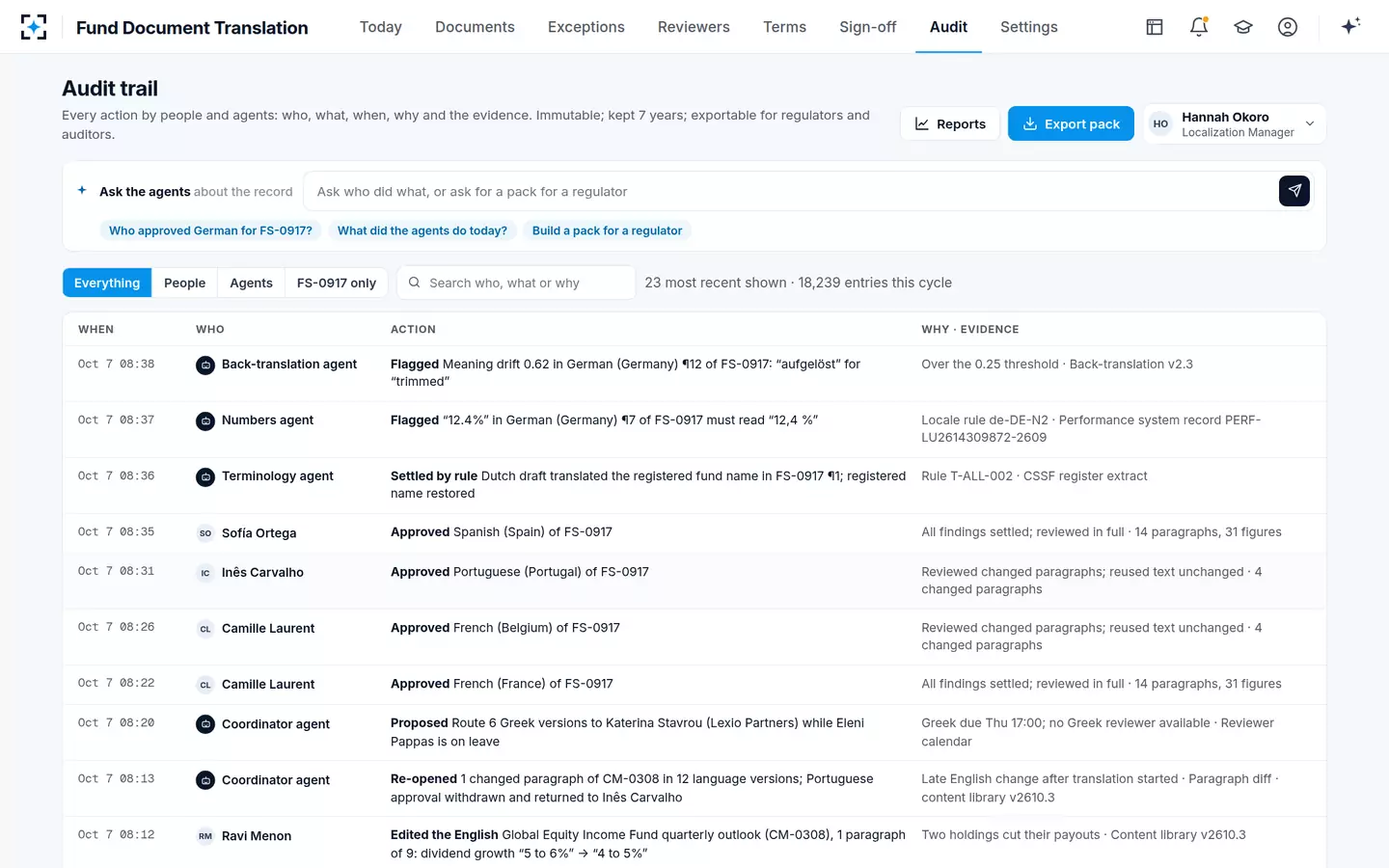
Translating at paragraph level removes most of that cost. In Fund Document Translation an English edit reopens only the paragraphs it changed, in only the languages that carry them. In the sample cycle, a late edit to the Global Equity Income Fund's quarterly outlook, dividend growth changed from "5 to 6%" to "4 to 5%", reopened one paragraph in twelve language versions; the Portuguese approval that had already been given was withdrawn and the paragraph returned to the Portuguese reviewer, and nothing else moved.
One English edit, one paragraph reopened in twelve languages, and every step in the audit trail
How long does fund document translation take?
It depends on the document and on how much of it changed, so a buyer should ask for turnaround per language per document type rather than per project. The solution's settings make the targets explicit: a factsheet one business day per language, a KID two, a shareholder notice three and an annual report five, with reminders at 50% and 80% of the clock and escalation at 100%. Those are design values a manager sets, not measured results.
The calendar measure that matters is the business day of the cycle on which the last language is released. In the sample, the June cycle under agency rounds released its last language on business day 14; the design target with the solution is business day 6. On the day shown in the sample, business day 5 of the September cycle, 1,031 of 1,284 language versions were already published, 80% and on track. A buyer can measure the same number for any supplier from the release dates of the last three cycles.
Price translation by days to every language
Ask suppliers to commit to days, not only to rates, and to show how they handle the work that does not change. The checklist turns that into questions for a request for proposal, whether the supplier is an agency, a machine translation and post-editing service or software. The three ways of producing fund translations compared sets the options side by side.
Buying fund translation by the day: what to put in the request for proposal
- Business days from English sign-off to the last approved language
Per document type, for your actual language list, with the last three cycles as the baseline.
- What a late English edit costs
In days and in money: does it reopen the paragraph, the document or the whole batch?
- How unchanged text is handled
Approved paragraphs reused untouched, not re-translated and re-charged.
- How figures are checked
Against the English and the fund's data, in each market's format, before review.
- How regulated phrases are held
Exact match to your approved wording per market, with changes only through Compliance.
- How reviewers are supported
Do they see only changed and flagged items, or whole PDFs?
- What evidence you get
Who approved which version, when, why, and the exact text released.
- How you leave
Translation memory and glossary returned in TMX or XLIFF, so your approved translations stay yours.
Financial translation software or a translation agency: where each fits
Agencies bring linguists; financial translation software brings reuse of earlier translations and consistency. Whichever a manager buys, three jobs sit between them and need an owner: proving every figure against the fund's data, holding each market's regulated phrases exactly, and showing the reviewer only what needs a decision. If the contract does not give those jobs to the supplier, they fall to the manager's own reviewers.
Fund Document Translation fills that middle and keeps the other two. Agencies remain useful for overflow and for languages the manager cannot staff with a reviewer: in the sample, six Greek versions went to an agency reviewer while the Greek in-country reviewer was on leave. Existing translation memory and glossaries come in as TMX or XLIFF and stay exportable. The solution does not file passport notifications or decide registrations, and it is not a sworn-translation service.
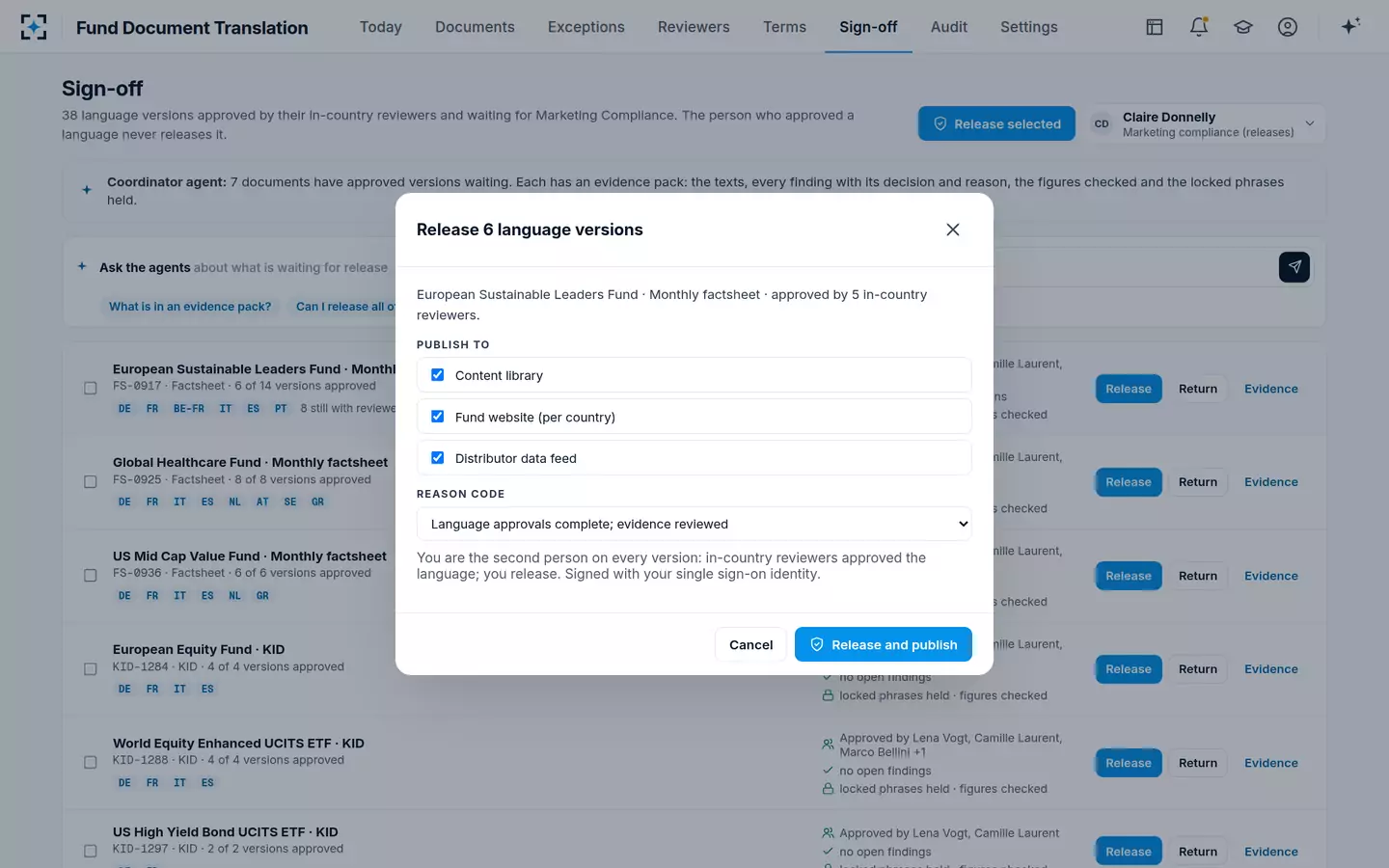
Release to the website and distributor feeds, as a second person
To measure your own week, take the last three cycles' sign-off and release dates, count the business days per language, and price them with the calculator above. Then see the same cycle run on your documents in Fund Document Translation.
Questions people ask
How much do prospectus translation services cost?
There is no published benchmark: agencies quote per word, per page or per project, and vendors don't publish comparable prices. Ask for a quote per language version and a committed number of business days to the last approved language, and ask what a late English edit costs in each.
Do the annual and half-yearly reports of a UCITS need translating?
Under EU law, at the UCITS's choice: Article 94(1)(c) of the UCITS Directive allows the host language, an approved language or a language customary in international finance. National rules and distributors may ask for more; Bulgaria, for example, requires translation into Bulgarian at an investor's request.
Can a fund launch in a market with an English KID?
Only where the host accepts it. In the ESAs' December 2025 table, Ireland and Malta have English as an official language and Cyprus accepts it; nine more accept English or another language only on conditions, usually an investor declaration; the other eighteen require the official language.
How long does a KID translation take?
The translation itself is the short part; review, approval and any ex ante notification take longer. The solution's design value is two business days per language for a KID, and Portugal requires notification at least two working days before the KID is used.
Is per-word pricing ever the right measure?
For a one-off document translated once, such as a prospectus a distributor asks for, it is a fair way to compare quotes. For documents that recur monthly and change in places, it charges again for unchanged text and ignores the days a market waits, so cost per version and days to release are better measures.