Terminology management software stores a company's approved terms, their translations and the rules for using them, so that every translator renders "ongoing charges" or "swing pricing" the same way. For regulated fund documents that is necessary and not enough, because some of the text is not a term to be translated well but a sentence the law or Compliance has fixed word for word. The PRIIPs Regulation says the explanatory statement under a KID's title "shall read" a set text; the past-performance information published with a UCITS KID must use a prescribed statement "in bold letters"; and each market's approved version of such sentences must then be used exactly, every month, in every language. A termbase suggests; a locked phrase must be enforced. Botminds' Fund Document Translation holds each regulated phrase word for word: its Terminology agent compares every fixed sentence character for character with the wording Compliance approved for that market, and any difference blocks release.
The examples come from the solution running on fictional sample data, a manager with 64 cross-border funds whose monthly cycle used 9,368 regulated phrases.
How much of a KID's risk narrative is fixed by law: an example by character count
With the currency warning (Elements A, B and C)
- Prescribed wording · 63%
- Chosen from a list · 1%
- Free explanation, at most · 36%
Without the currency warning (Elements A and B)
- Prescribed wording · 50%
- Chosen from a list · 1%
- Free explanation, at most · 49%
What is terminology management software, and what does it miss in fund documents?
Terminology management software keeps a termbase: a database of concepts, each with its approved term in every language, definitions, forbidden variants and usage notes, which translation tools consult while a translator works. It is how a firm makes sure "ongoing charges" is never rendered three different ways in Italian. O*NET's description of translators' work includes the habit it supports: "Refer to reference materials, such as dictionaries, lexicons, encyclopedias, and computerized terminology banks, as needed to ensure translation accuracy" (O*NET 27-3091.00).
What a termbase does not do is hold a whole sentence still. It works at the level of terms, it advises rather than enforces, and its checks typically tolerate small variations so that inflection and spelling do not raise false alarms. A fund document contains sentences that must not vary at all: the KID's explanatory statement, a comprehension alert, a market's past-performance warning, a sustainability disclosure sentence Compliance approved. For those, "close" is a breach, and a tool built to accept close matches is the wrong control.
Four kinds of wording in a fund document: locked, templated, controlled and free
A KID or factsheet mixes four kinds of text, and each needs a different control. Getting the classification right is most of the work: a phrase treated as free gets paraphrased, and free text treated as locked cannot be translated well.
Four kinds of wording, and the check each one needs
Locked
Text the law, a guideline or Compliance fixes word for word in each language.
Examples
The KID's title and explanatory statement; a market's approved past-performance warning; the registered fund name.
The check
Exact match to the approved version; any difference blocks release.
Templated
A fixed sentence with a slot filled from a defined list or the fund's data.
Examples
"We have classified this product as [4] out of 7, which is [a medium] risk class."
The check
The fixed words exact; the slot value checked against the data and the allowed list.
Controlled
Free sentences whose key terms must follow the approved glossary.
Examples
Swing pricing, ongoing charges, summary risk indicator, recommended holding period.
The check
Glossary term used; consistent across the document and with earlier versions.
Free
Ordinary prose, translated for meaning in the market's register.
Examples
The portfolio manager's commentary; the explanation of the risk class, up to 300 characters.
The check
Meaning checked by back translation; figures checked separately.
The ratio between them varies by document. The risk narrative of a KID is mostly prescribed, as the figure above shows; a factsheet's commentary is almost entirely free; a shareholder notice may carry a legally required sentence in an otherwise free letter. The sample factsheet in the solution carried nine locked phrases per market version, ten in Switzerland, including the registered fund name, the marketing communication statement and its sustainability wording.
"Shall read": the phrases the law writes for you
Some regulated phrases are written into the regulation itself. Article 8 of the PRIIPs Regulation requires "the title 'Key Information Document'" to appear "prominently at the top of the first page", and says the explanatory statement directly underneath "shall read: 'This document provides you with key information about this investment product. It is not marketing material. The information is required by law to help you understand the nature, risks, costs, potential gains and losses of this product and to help you compare it with other products.'" (PRIIPs Regulation, Art. 8(1)–(2)). Where it applies, a comprehension alert "shall read: 'You are about to purchase a product that is not simple and may be difficult to understand.'"
"Shall read" means the translator has nothing to choose. Each EU language version of the Regulation, published in the Official Journal, contains the statement in that language, and the KID in that language should carry it. A translation tool that renders the English statement afresh, however well, produces a sentence that is not the one the law prescribes. The control is to hold each language's official sentence as a locked phrase, sourced to the article, and compare it exactly.
Example wording is not fixed wording: ESMA's "such as"
Not every model sentence in a regulatory text is fixed, and treating an example as a rule over-constrains the translation. ESMA's guidelines on marketing communications say a communication "should include a disclaimer such as the following: 'This is a marketing communication. Please refer to the [prospectus of the [UCITS/
A firm can still decide to lock its own version of that disclaimer in every language, and many reasons favour it: consistency, review once rather than monthly, and evidence. The distinction matters for the source column of the phrase library. A phrase locked because the law prescribes it cannot be changed without a change in the law; one locked because Compliance chose it can be changed by Compliance, through a controlled proposal.
Locked phrases inside the text, with their back-translations
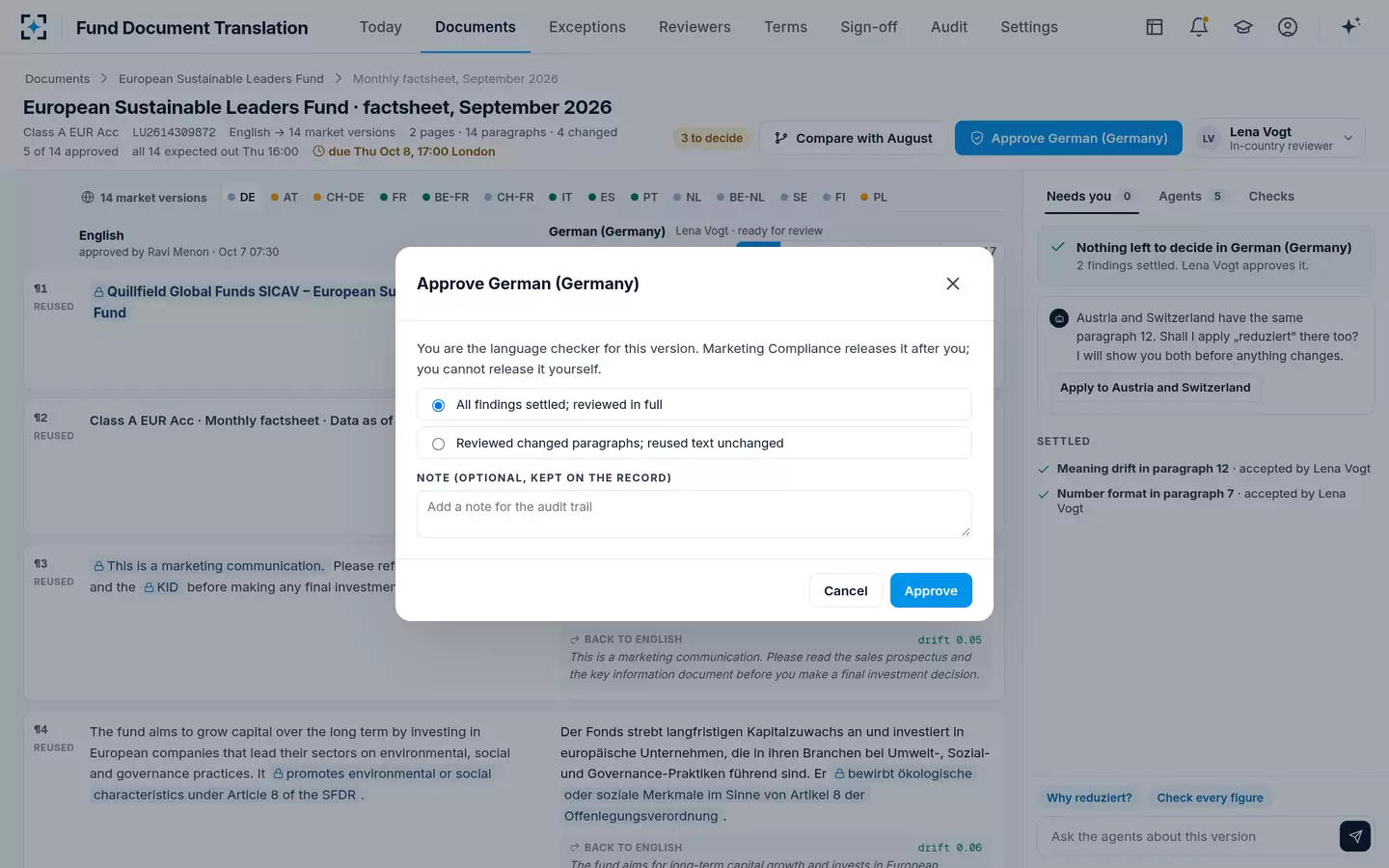
One warning, three wordings: why the source of a phrase matters
The past-performance warning is the clearest case of why a phrase library must record where each phrase comes from. Three EU texts each require a warning about past performance, for three kinds of document, in three different forms. Only one of them is a sentence to copy; one is a statement in guidelines; one describes what the warning must say and leaves the words to the firm.
Three texts, three forms of the past-performance warning
| Document | Source | What the text requires | Kind of wording |
|---|---|---|---|
| Past performance information published with a UCITS or AIF KID | Delegated Regulation 2017/653, Annex VIII point 9(a) | "using the following statement in bold letters: 'Past performance is not a reliable indicator of future performance. Markets could develop very differently in the future. It can help you to assess how the fund has been managed in the past'" | Prescribed sentence: lock it |
| Fund marketing communication, such as a factsheet | ESMA guidelines ESMA34-45-1272, ¶47 | Past performance "should be preceded by the following statement: 'Past performance does not predict future returns'" | Statement in guidelines: lock it |
| Information from an investment firm to retail clients | Delegated Regulation 2017/565, Art. 44(4)(d) | "a prominent warning that the figures refer to the past and that past performance is not a reliable indicator of future results" | Required content, wording free: approve and lock your own |
A phrase library that stores one "past performance warning" per language will put the wrong one somewhere. The statement published with the KID is longer and different from the factsheet's; the investment-firm rule fixes meaning, not words. Each locked phrase therefore needs four attributes beyond its text: the document types it applies to, its source, the approved wording in each language, and a version. In Fund Document Translation each locked phrase carries its rule and version, and the Terminology agent applies it only where the rule applies.
Templated phrases: the risk class sentence
Between locked and free sits the templated sentence: fixed words around a value chosen from a defined set. The KID's risk narrative shows the pattern. Element B reads "We have classified this product as [1/2/3/4/5/6/7] out of 7, which is [1='the lowest'/2='a low'/3='a medium-low'/4='a medium'/5='a medium-high'/6='the second-highest'/7='the highest'] risk class", and it is followed by an instruction to "insert a brief explanation of the classification of the product with a maximum of 300 characters in plain language" (Delegated Regulation 2017/653, Annex III point 7). The number in that slot is the one a reader then checks on the fund's factsheet, where it must match the KID exactly.
A templated sentence needs two checks, not one. The fixed words are compared exactly, like a locked phrase. The slot is checked against the fund's data, so a class-4 fund reads 4 and "a medium" in English and the corresponding official words in every other language, and never a 3 copied from last year. The free explanation that follows is then translated for meaning, with its 300-character limit checked in each language, since a translation that runs longer than the English can break it.
Termbase vs glossary vs translation memory
The three tools hold different units. A glossary is a list of terms and their approved translations, usually simple and often a spreadsheet. A termbase is a structured glossary: concepts with terms in each language, definitions, status and forbidden variants, queried by the translation tool as the translator works. A translation memory stores whole segments, usually sentences, as they were translated before, and offers them again when the same or a similar sentence appears.
None of them is a locked-phrase library, though a translation memory comes closest because it holds whole sentences. The difference is enforcement. A memory offers a match that the translator may accept or edit; a locked phrase may not be edited at all, and a version that differs from it must not be released. In the solution the glossary and memory are imported and exported as TMX or XLIFF, and the locked phrases sit beside them with their source and version, held by a separate agent whose only job is to compare and block.
What the research says about giving machines a term list
Giving a machine translation system a terminology list helps, and it is still not a guarantee. The 2023 Conference on Machine Translation ran a shared task in which systems were given segment-level terminology dictionaries for three language pairs. Measuring whether the dictionary's terms appeared in the output, the organisers found that "most systems translate 60%-70% of terminologies correctly" (Semenov et al., WMT 2023), and they illustrated "how even in the same document the terminology can be translated differently, which is undesired."
The way the task scored success is itself instructive. To avoid penalising "minor orthographic variants", it used a fuzzy search "with threshold of 90%" to decide whether a term had been translated correctly. That is a sensible tolerance for terms, and the wrong one for a locked sentence: a 90% match to the KID's explanatory statement is a different sentence. Terminology and locked phrases need separate checks with separate tolerances, which is why a termbase alone cannot carry regulated wording.
How do you keep regulatory wording consistent across languages?
By approving it once per market, locking it with its source and version, and comparing every use against it exactly, so consistency is enforced rather than hoped for. The steps are simple to state. Compliance approves each market's wording for each fixed phrase, citing the rule or decision behind it. The library stores it as a locked phrase with a version. Every draft is checked against it character for character, and any difference blocks release. And a change goes through a proposal and a second person's approval, never an edit in place.
The sample cycle shows what that delivers at scale: 9,368 regulated phrases used across the month's versions, none altered. When a new market is added, the gap shows up as a finding rather than an improvisation. In the sample, Czech had no approved past-performance phrase yet, so the Terminology agent proposed one with its source and Czech waited for Compliance to approve it.
Names and identifiers that must never be translated
A fund's registered name, ISIN and ticker are identifiers, and a translated identifier is a different identifier. They belong in the locked category even though they look like terms. In the sample, the Dutch draft of a factsheet rendered the fund's registered name in natural Dutch; a rule that registered fund names are never translated restored the registered name and recorded why, and a separate rule keeps ISINs and tickers untranslated. In Fund Document Translation a translated fund name or identifier is one of four conditions that always block release.
Changing a locked phrase: two people, with a source
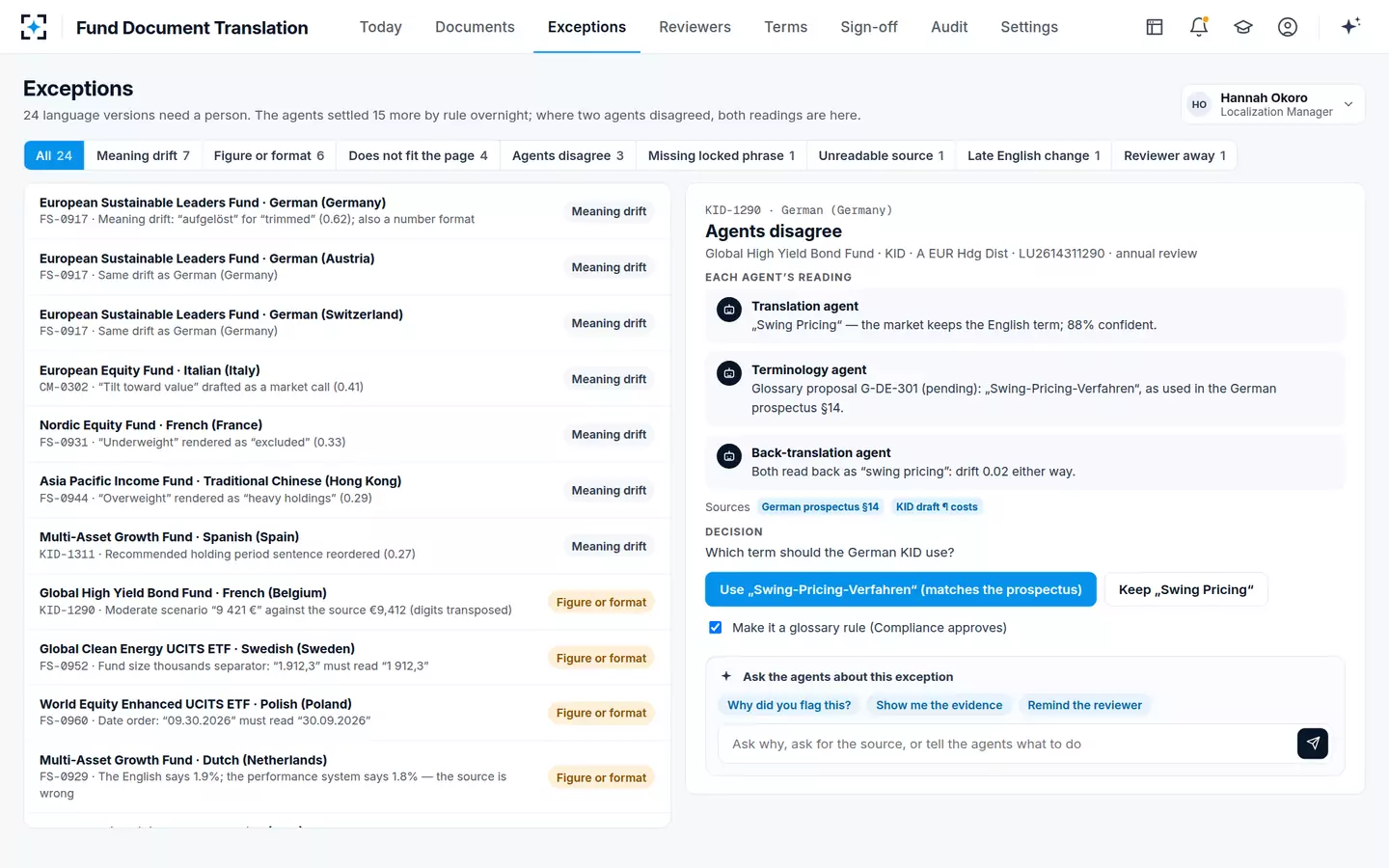
A locked phrase should be changed only by a proposal that cites its source and is approved by someone other than the proposer. In the solution, nobody edits a locked phrase in place, people or agents. The Terminology agent can propose a missing or changed entry, as it did for Czech; it "cannot approve a new or changed locked phrase; Compliance does", and Compliance never approves its own proposal. The same route turns a reviewer's terminology decision into a rule: when the Translation and Terminology agents disagreed over a German KID's term for swing pricing, the reviewer chose, and the choice could become a glossary rule once Compliance approved it.
A terminology disagreement becomes a rule only with Compliance's approval
Choosing terminology management software for regulated fund documents
Choose it for what it can enforce and prove, not only for what it can store. The checklist below separates the termbase features every translation team needs from the controls regulated documents add. Checking meaning by back translation covers the free text the library does not.
Terminology management for regulated fund documents: what to require
- Separate locked phrases from terms
Exact comparison for phrases; tolerant matching only for terms.
- Record the source of every locked phrase
The article, guideline paragraph or Compliance decision, and the document types it applies to.
- Version each phrase in each language
So you can show which wording a version released on a given date carried.
- Block release on any difference
A warning that a reviewer can dismiss is not a lock.
- Hold templated sentences as text plus slot
Fixed words exact; slot values checked against the fund's data.
- Never translate identifiers
Registered fund names, ISINs and tickers locked by rule.
- Require two people to change a phrase
A proposer and a different approver in Compliance.
- Find gaps when a market is added
A missing phrase should stop the version, not be improvised.
- Import and export TMX and XLIFF
So the glossary and memory are yours to move.
Botminds' Fund Document Translation meets them with a separate agent for terminology, a library of locked phrases kept by Compliance, and release blocked on any difference. To see your own phrases held across your markets, start from Fund Document Translation; for what else to require of an AI tool, see the limits an AI translation tool should work under.
Questions people ask
What is terminology management for translators?
It is the practice of deciding approved terms per language and making them available while translating, usually through a termbase in the translation tool. For translators of fund documents it also means knowing which sentences are not theirs to translate at all, because a regulation or Compliance fixes them.
What is a locked phrase in translation?
A sentence or name whose wording in each language is fixed and must be used exactly, such as a KID's explanatory statement or a fund's registered name. It is approved once, stored with its source and version, compared character for character in every draft, and changed only through a controlled proposal.
Can a glossary enforce exact regulatory wording?
Not on its own. A glossary or termbase works at term level and tolerates small variations; in the WMT 2023 terminology task, systems given term dictionaries still rendered only 60–70% of terms as listed. Fixed sentences need an exact comparison that blocks release.
Who should own regulated wording in each language?
Compliance, with the in-country reviewer advising on language. The owner approves each market's wording and every change to it; the person who proposes a change should not approve it.
How many locked phrases does a fund factsheet carry?
It depends on the fund and the market. In the fictional sample, a factsheet carried nine per market version, ten in Switzerland, and the month's 1,284 language versions used 9,368 in all.