The back translation process takes a finished translation, has a second translator who has not seen the original translate it back into the source language, and compares the two source-language texts for differences of meaning. In a fund's key information document or factsheet it answers one question a reviewer who does not read the target language cannot otherwise answer: does the German, Polish or Greek still say what the English says? That matters because Article 7 of the PRIIPs Regulation requires a KID translation to reflect the original faithfully and accurately, and because a fluent sentence can be wrong. Botminds' Fund Document Translation runs back translation on every paragraph of every market version, on a different model from the one that translated it, scores the drift in meaning and sends anything above a threshold to the reviewer for that market. This guide explains the method, shows what it catches on real-looking fund text, and is plain about what it cannot see.
The examples come from the solution running on fictional sample data: Quillfield Capital's monthly cycle, in which one factsheet owes fourteen market versions.
Back translation checks meaning; figures, formats and fixed wording need literal checks
Back translation catches: "Trimmed" drafted as aufgelöst reads back as "closed out": the meaning moved.
A literal check catches: Nothing: every word is a valid translation of something.
Back translation catches: "Underweight" rendered as "excluded" reads back wrong and scores high drift.
A literal check catches: Only if the term is in the glossary.
Back translation catches: Rarely: "9 421 €" reads back as €9,421, a near-identical sentence.
A literal check catches: Always: the figure is compared with €9,412 in the fund's data.
Back translation catches: No: "12.4%" in German reads back as 12.4%, which looks right.
A literal check catches: Yes: German needs a decimal comma and a space, 12,4 %.
Back translation catches: Often not: a paraphrase can mean the same thing and still breach the approved wording.
A literal check catches: Yes: compared character for character with the approved text.
Back translation catches: No: both candidates read back as "swing pricing".
A literal check catches: Only with a glossary decision, which a person makes.
What is back translation? The process in five steps
Back translation is a test of equivalence: if a text translated into German and then back into English says what the English original said, the German probably does too. The method was developed by researchers who needed one questionnaire to mean the same in every language it was asked in. Brislin's 1970 study in the Journal of Cross-Cultural Psychology set out to establish "how equivalence between source and target versions can be evaluated", and its criteria for equivalence "were based on comparisons of meaning or predictions of similar responses to original or translated versions" (Brislin, 1970). Fund documents borrow the first half of that idea: compare meaning, sentence by sentence.
The back translation process for one market version
Agent
Forward translationThe Translation agent drafts the market version paragraph by paragraph, from the approved translations and the market's style guide.
Never: Never rewords a locked phrase or translates a registered fund name
Agent
Back translationThe Back-translation agent, on a different model family, translates every paragraph back into English without seeing the original English.
Never: Never edits the translation
Agent
Compare and scoreEach back-translation is compared with the English paragraph and given a drift score from 0 to 1, with the difference explained in plain words.
Agent
Flag and proposeDrift above the threshold, 0.25 here, goes to the reviewer with a proposed fix and its source, such as an approved earlier translation.
A person decides
Reviewer decidesThe in-country reviewer accepts, edits or rejects the finding with a reason, and approves the market version once every finding is settled.
Two rules in that sequence make it a test rather than a ritual. The back-translator must not see the original, or it will reproduce the original instead of reading the translation. And it must be independent of the forward translator, which for people means a second linguist and for machines a different model. The reason is the subject of the section after next.
Back translation examples: what moved in one month's fund documents
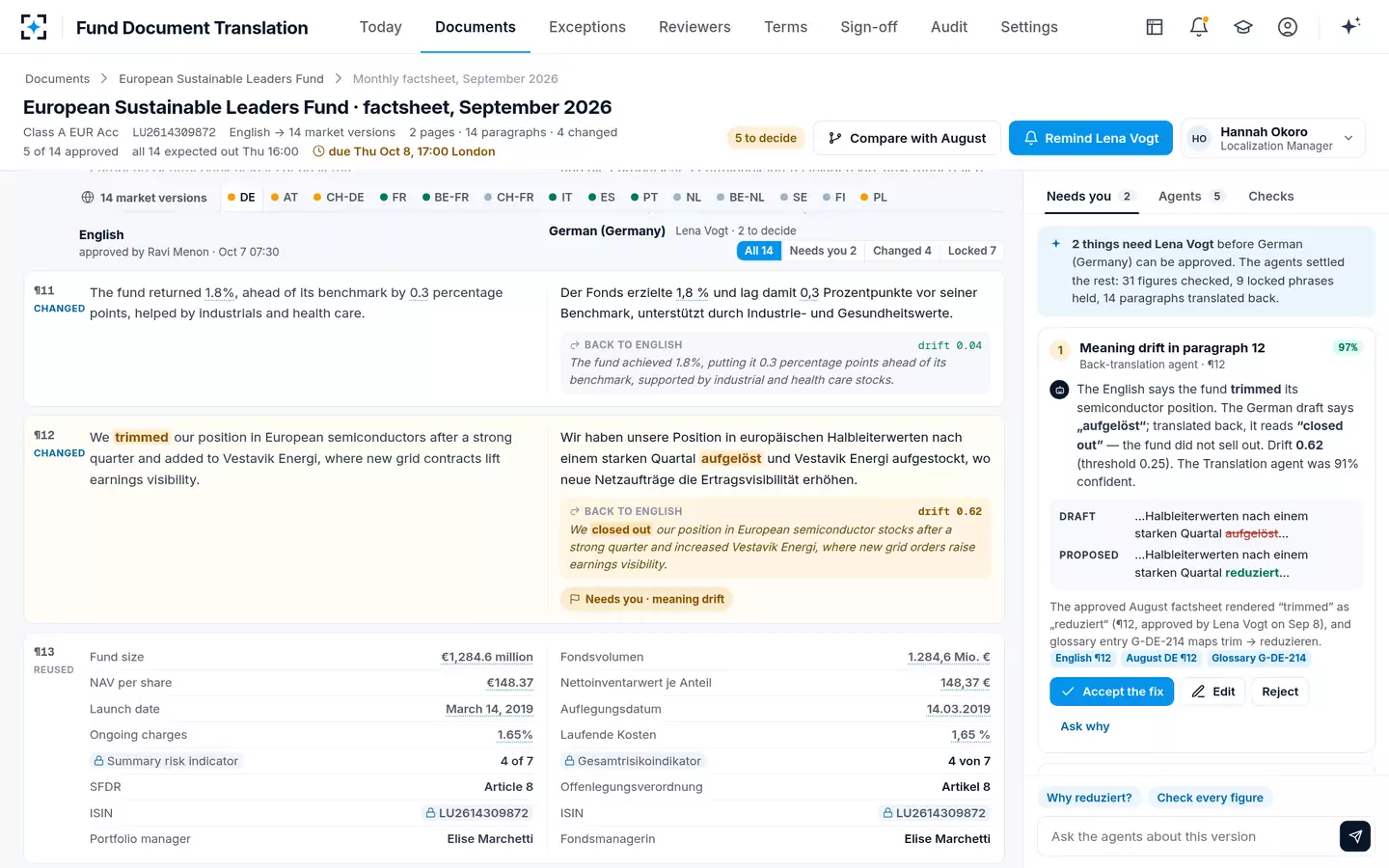
Back translation earns its place on the sentences a reader could act on. In the sample cycle, seven market versions went to a person for meaning drift, and every one changed what the text told an investor rather than how it read. The worst was the German factsheet's paragraph 12: the English said the fund had "trimmed" its semiconductor position, the draft said the position was „aufgelöst", and the back translation read "closed out". Drift was 0.62 against a threshold of 0.25, although the Translation agent had been 91% confident in its draft.
One paragraph, three readings: the English, the German draft and what came back
English, approved
We trimmed our position in European semiconductors after a strong quarter and added to Vestavik Energi, where new grid contracts lift earnings visibility.
German draft
Wir haben unsere Position in europäischen Halbleiterwerten nach einem starken Quartal aufgelöst und Vestavik Energi aufgestockt …
Back to English · drift 0.62
We closed out our position in European semiconductor stocks after a strong quarter and increased Vestavik Energi …
Proposed fix · drift 0.04
… nach einem starken Quartal reduziert … (the rendering approved in August)
The rest of the month's meaning findings look the same. An Italian draft turned "tilt toward value" into a market call (drift 0.41). A French version rendered "underweight" as "excluded" (0.33). A Traditional Chinese version for Hong Kong turned "overweight" into "heavy holdings" (0.29). A Spanish KID reordered the sentence about the recommended holding period (0.27). Each is a sentence that reads fluently and would pass any grammar check, and each tells an investor something the English does not.
Meaning drift on the month's flagged paragraphs, against a 0.25 threshold
Why must the back translation come from a different translator?
Because a system checking its own work tends to undo its own mistakes. Harold Somers tested round-trip translation, the same system translating forward and back, as a way to judge machine translation, and found it "a poor predictor of quality, with high BLEU and F-scores for RTTs when the forward translation was poor" (Somers, Australasian Language Technology Workshop, 2005). A bad translation came back looking good. The paper's diagnosis applies to any back translation: "for a single given sentence, we cannot know for sure if a good (or bad) RTT indicates that the FT was good (or bad) or vice versa."
"In both cases, we find RTT to be a poor predictor of quality, with high BLEU and F-scores for RTTs when the forward translation was poor."
Harold Somers, 'Round-Trip Translation: What Is It Good For?', 2005
Two design choices answer that finding. The first is independence: the Back-translation agent in Fund Document Translation always runs on a different model family from the Translation agent, so a misreading in the draft is not quietly reversed by the same model on the way back. The second is that back translation flags rather than decides. A low drift score does not approve a paragraph, and a high one does not reject it: it sends the paragraph to the reviewer with the difference explained, and the reviewer, who reads German, decides. Somers' point that a good round trip can hide a bad translation is exactly why a person keeps the decision.
Every translated paragraph with its back-translation and drift score underneath
What back translation misses: figures, formats and fixed wording
Back translation compares meaning, and three of the most serious errors in a fund document barely change meaning at all. The first is a figure. On the sample Global High Yield Bond Fund KID in French for Belgium, the moderate scenario after one year read "9 421 €" where the English and the fund's KID data said €9,412: the digits were transposed. A back translation reads "€9,421", a sentence nearly identical to the original. Research on machine translation explains why scores built on wording miss this: to a standard metric a wrong number is one wrong token among many, so it barely moves the score (Wang et al., Findings of ACL 2021).
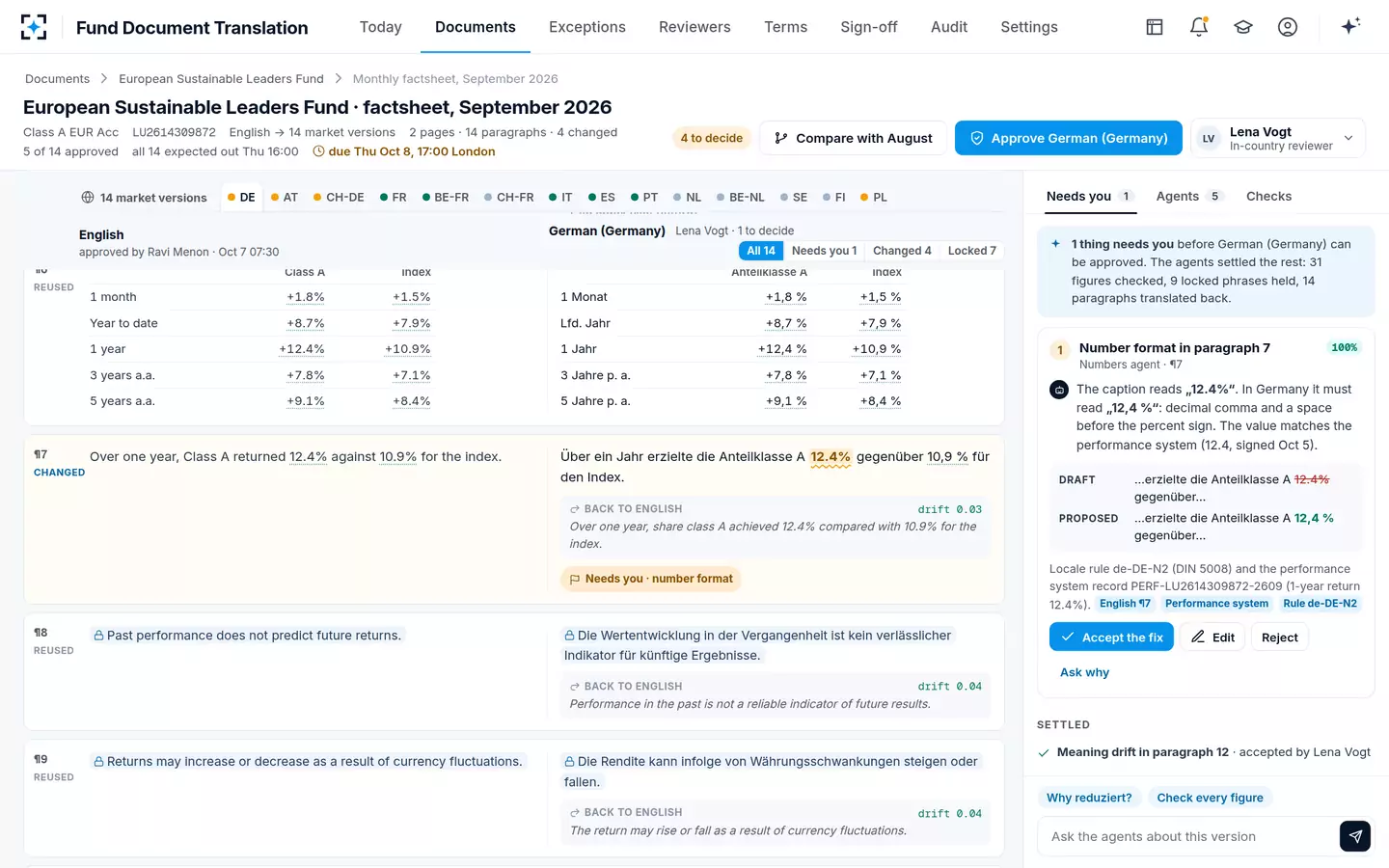
The second is the number format. The German factsheet's paragraph 7 said Class A returned "12.4%" over one year. Back-translated, that is a perfect sentence, drift 0.03. It is still wrong in Germany, where the figure must read 12,4 %, with a decimal comma and a space before the percent sign, while in German for Switzerland the same figure correctly reads 12.4 %. Only a check that knows each market's format, and compares the value with the performance system's figure, finds it.
A paragraph that passes back translation and still fails: 12.4% in a German factsheet
The third is fixed wording. A regulated phrase, such as the PRIIPs KID's explanatory statement or a market's past-performance warning, must match the wording Compliance approved for that market, not merely mean the same thing. A paraphrase scores low drift precisely because it preserves meaning, so back translation is the wrong test for it. The solution compares those phrases character for character instead, and how locked phrases are held in every language is a separate discipline from meaning checks.
Back translation vs forward translation: two jobs, two translators
Forward translation produces the document investors read; back translation produces a document nobody reads except the reviewer, whose only purpose is to expose the forward translation's meaning. The two are judged by different standards. A forward translation must be idiomatic, in the market's formal register, consistent with the approved glossary and within three pages for a KID. A back translation should be literal, so that a change in the target shows up as a change in the English, and it is never published.
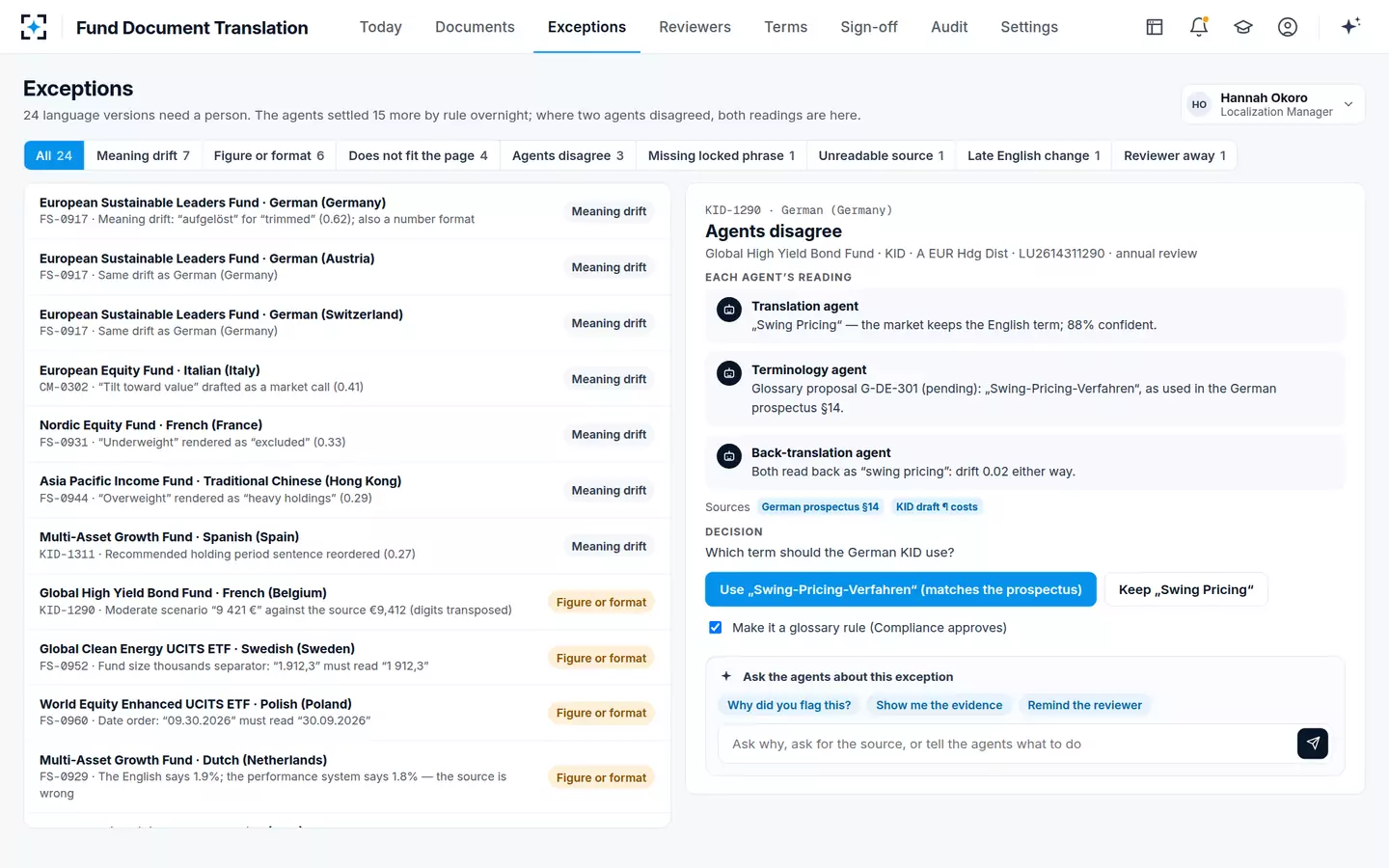
That difference changes how each is done well. A good forward translator smooths; a good back-translator resists smoothing, because "the fund reduced" and "the fund closed out" must stay visibly different. It also explains a limit: when two correct terms compete, back translation cannot choose. On the sample Global High Yield Bond Fund KID, the Translation agent kept the market's English loanword „Swing Pricing" and the Terminology agent proposed „Swing-Pricing-Verfahren", the wording in the German prospectus. Both read back as "swing pricing", drift 0.02 either way. The decision goes to the German reviewer, and becomes a glossary rule only when Compliance approves it.
Where back translation cannot decide: two correct terms, one decision for a person
Is back translation required for a KID?
No EU text requires back translation by name. Article 7 of the PRIIPs Regulation requires the result, a translation that reflects the original KID faithfully and accurately (Art. 7(1)), and the UCITS Directive asks the same fidelity of every translated document. Neither says how a manager should show that. Back translation is one method a manager can point to when asked how it knows the Polish says what the English says, and for a reviewer who reads only some of a fund's languages it is often the only method that works.
Regulators' recent statements about AI add a reason to have one. ESMA's public statement on AI in investment services warns that text-generating AI can "hallucinate", producing output that sounds accurate and is wrong (ESMA, 30 May 2024). The statement concerns investment firms under MiFID II rather than fund documents as such, but its point applies directly: a fluent machine translation is exactly the kind of output that sounds right. An independent back translation is a way of testing the sound against the sense.
Does back translation prove a translation is correct?
No: it shows where meaning probably moved, and it is silent where it did not look. A clean back translation is evidence that the meaning held, not proof that the document is right, because it can miss figures, formats and fixed wording entirely, and because, as Somers found, a good round trip can coexist with a poor forward translation. That is why a sound process treats back translation as one of several checks rather than as the approval.
In Fund Document Translation the four checks run side by side on every version. The Terminology agent holds locked phrases; the Back-translation agent scores meaning; the Numbers agent checks each figure, date, currency and ISIN against both the English and the fund's data, formatted as the market writes it; the Layout agent checks the KID still fits three pages. A version reaches its reviewer with those results attached, and the reviewer approves it only when every finding is settled.
Every paragraph, not a sample: what changes when back translation is cheap
Done by people, back translation is a second full translation per language, so in practice it is used on samples: the KID's risk section, a launch document, a market the team does not trust. Sampling decides in advance where the errors will be, and the month's findings suggest they are not where anyone would have sampled. The worst one sat in a factsheet's portfolio commentary, not in the KID.
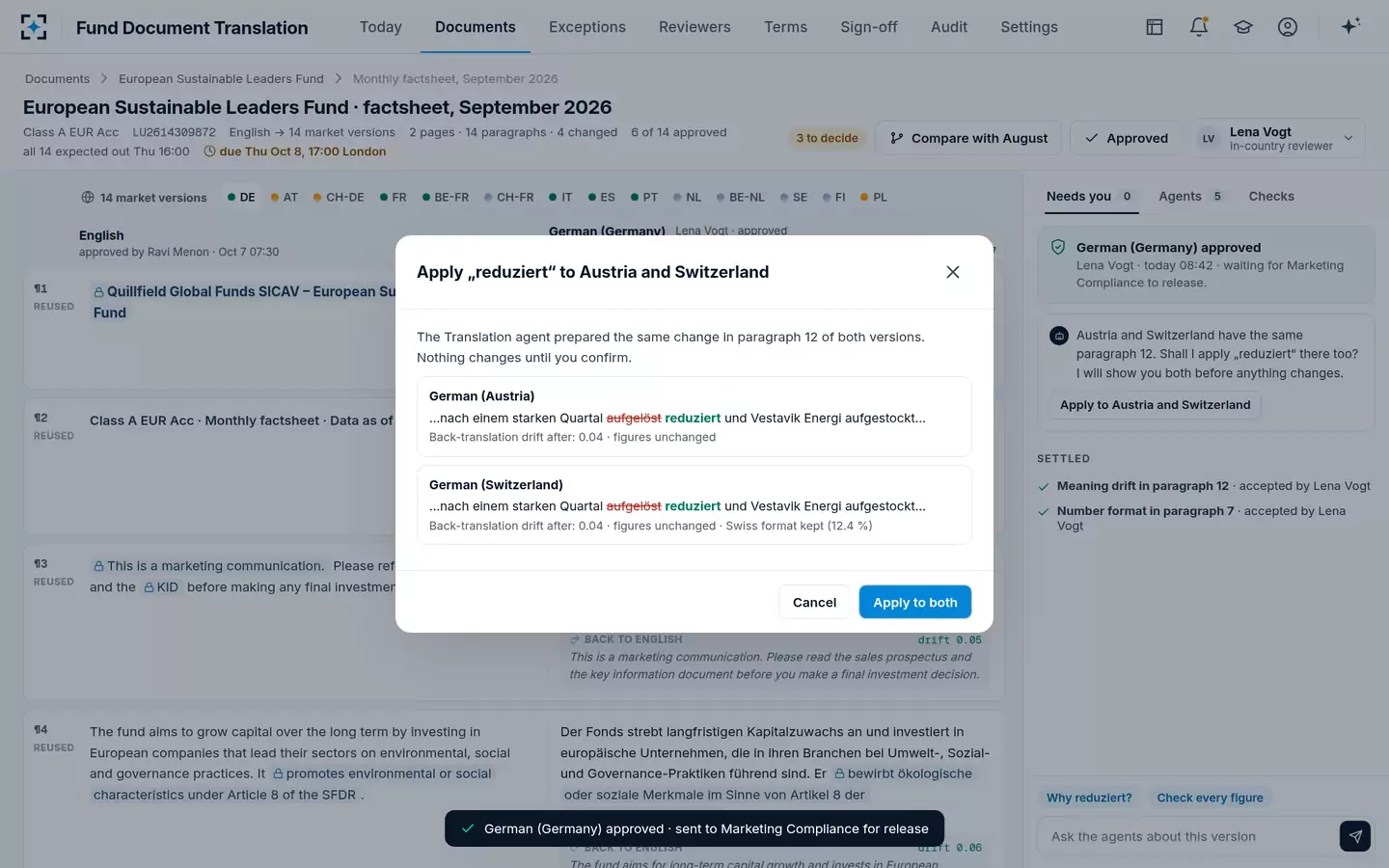
When back translation is run by an agent, it can cover every paragraph of every version. On the sample factsheet only four paragraphs had changed; the agents translated those into fourteen market versions, left 140 approved paragraphs as they were, and back-translated all 196 in a single 27-minute run. Coverage also makes the result useful in a second way: a fix approved once can be offered to sister markets with the same paragraph. The German reviewer's „reduziert" was prepared for Austria and Switzerland too, with drift after the change of 0.04 in both, and applied only when she confirmed.
One fix, two more markets: the change shown before it is applied
Setting the drift threshold: what 0.25 means and who may move it
A drift threshold is a policy choice about reviewer time. Set low, it sends paragraphs with harmless rewording to people; set high, it lets real shifts in meaning through. On the day shown, the sample setting of 0.25 left seven of 1,284 versions with a person for meaning drift and caught every change of meaning described here, while a correct German paragraph scored 0.04. Nothing published supports a universal number, and the right value differs by language pair and document type, so the honest method is to test it on your own approved translations: run the back translation on last quarter's released versions and see what a given threshold would have sent to people.
Because the threshold decides what people see, changing it is itself a controlled act. In the solution it is a setting from 0 to 1 that Compliance must approve before it takes effect, and the change is kept on the audit trail with its reason. Measuring an AI translation on your own fund documents sets out how to test this and the other measures before going live.
Running back translation on fund documents: eight rules
- Back-translate without the original
A back-translator who has seen the English reproduces it.
- Use an independent translator or model
A system reversing its own output hides its own errors (Somers, 2005).
- Keep the back translation literal
Smoothing in the return leg hides the shift you are looking for.
- Compare paragraph by paragraph, aligned to the source
A document-level score cannot tell a reviewer where to look.
- Explain each flag in plain words
"The fund did not sell out" is actionable; a score alone is not.
- Never let it approve
A low score is evidence; the reviewer for the market decides.
- Run literal checks beside it
Figures, formats, ISINs and locked phrases need exact comparison.
- Calibrate the threshold on approved translations
And require a second approver to change it.
Questions people ask
What is the meaning of back translation?
Back translation means translating a translated text back into its original language, independently, so the two original-language versions can be compared. Differences show where the translation's meaning moved. It is used in cross-cultural research for questionnaires and in regulated industries for documents whose translations must match the original.
What is the process of back translation in research?
A first translator translates the source; a second, who has not seen the source, translates it back; the two source-language versions are compared and each discrepancy is resolved. Brislin's 1970 study set out criteria for judging equivalence based on comparisons of meaning or predictions of similar responses.
Who should do the back translation?
Someone independent of the forward translation who has not seen the original. For people that means a second linguist; for machines a different model, since a system translating its own output back tends to hide its errors. The reviewer who decides on the differences should read the target language.
Can back translation check numbers in a KID?
Not reliably. A transposed digit or a wrong decimal separator barely changes meaning, so it barely changes a back translation. Every figure should be compared with the source and the fund's data directly, in the market's number format: 12,4 % in Germany, 12.4 % in Switzerland.
How long does back translation take?
Done by people it adds a second translation pass per language. Run by an agent it is part of the translation run: on the fictional sample factsheet, all 196 paragraphs across fourteen market versions were translated back within a 27-minute run that also drafted and checked them.