A monthly market commentary is rarely published once. The paragraph a writer drafts for a fund's monthly report is cut into a factsheet paragraph, adapted into letters for institutional clients whose accounts returned slightly different numbers, simplified for wealth advisers and translated for every market the fund is sold in. Each cut is a new audience, and with a new audience comes a different rule: a fund's own report is not a marketing communication in the EU, its factsheet is; an institutional letter is treated differently from a retail one under FINRA's rules; and the Consumer Duty asks for plainer words for retail readers. The safe way to produce five versions is to write one master and tie every version's claims to it, so a change in one is a change in all. Botminds' Portfolio Commentary Generation drafts each version from the master and compares them before release.
The examples come from a fictional manager, Quillfield Capital, whose Global Core Equity commentary for the third quarter of 2026 went out in nine versions through the solution, on sample data. The same mechanics apply to a monthly cycle, only faster.
One master, five cuts: what changes in each, and which rules come with it
Master commentary
Read byFund shareholders
What changesThe full account: return, drivers, actions, positioning, every figure tied to the attribution
The rules that come with itShareholder-report standards; in the EU, a fund’s reports are not marketing communications
Factsheet paragraph
Read byInvestors and prospects
What changesCut to a character limit (900 in the sample); the same figures, fewer of them
The rules that come with itMarketing: identifiable, risks beside rewards; in the US, usually a retail communication
Mandate letters
Read byInstitutional clients
What changesEach account’s own return replaces the fund’s; the message stays the master’s
The rules that come with itClient reporting; anti-fraud rules; an advertisement only if it offers something new
Adviser version
Read byWealth advisers and their clients
What changesPlainer words, fewer effects, no jargon (140 words in the sample)
The rules that come with itRetail standards; in the UK, the Consumer Duty’s understanding test
Translations
Read byInvestors in other markets
What changesSame claims in another language; local number formats; local disclosures
The rules that come with itLocal-language rules; the same figures as the legal documents
What is monthly market commentary, and who reads it?
Monthly market commentary is a short account of the month for a fund or strategy: how it performed against its benchmark, the main drivers, and any change in positioning, often set beside a paragraph on markets. It sits on factsheets, in monthly fund reports and on fund web pages, and it is read by a wider mix of readers than most of what a manager writes: existing shareholders, prospective investors, consultants, advisers and, through translations, investors in other countries.
That breadth is the difficulty. A sentence that suits an institutional consultant ("selection in cyclicals added 21 basis points") can be jargon to a retail reader; a positioning line that is fair to a shareholder who receives the full report can mislead in a 900-character factsheet with no room for the risk beside it. Monthly fund commentary, performance commentary and the monthly market review overlap in content but differ in audience, and the audience decides the rules.
Global Core Equity's nine versions, by the audience each one serves
Nine versions of one quarter
- Shareholders (master, offshore class) · 22%
- Factsheet · 11%
- Institutional clients (3 letters) · 34%
- Advisers · 11%
- Other languages (2) · 22%
Is a factsheet commentary a marketing communication?
Usually yes, while the fund's own periodic report usually is not, and the same paragraph can be both. ESMA's guidelines on fund marketing communications list, among communications that should not be considered marketing, a fund's legal and regulatory documents including "the annual and half-yearly reports of a UCITS or an AIF" (ESMA34-45-1272, scope). A factsheet distributed to investors is a different matter, and under Article 4(1) of Regulation (EU) 2019/1156 a marketing communication must be recognisable as one, give risks the same prominence as rewards and be fair, clear and not misleading (Regulation (EU) 2019/1156; the factsheet rules guide sets out what that means for a factsheet).
So the commentary paragraph changes status when it is cut. In the report, it answers to the report's standards; on the factsheet, it is marketing, and the shorter text has to carry the risk beside every benefit within its character limit. A factsheet paragraph cut by deleting the master's risks and detractors to save space is the version most likely to fail. In the US, a fund factsheet that quotes performance is subject to the SEC's rules on fund advertisements (17 CFR 230.482), which the factsheet's own production process handles.
Retail, institutional or correspondence: the FINRA test for each version
When a broker-dealer distributes the versions, FINRA Rule 2210 sorts them by audience and size, and the category decides approval and filing. A retail communication is one "distributed or made available to more than 25 retail investors within any 30 calendar-day period"; correspondence reaches 25 or fewer retail investors in that period; and an institutional communication is "distributed or made available only to institutional investors" (FINRA Rule 2210(a)).
The factsheet and the adviser version are almost always retail communications: each needs a registered principal's approval before use, and one promoting a registered fund is filed with FINRA within ten business days of first use. A mandate letter sent only to an institutional client is an institutional communication, with lighter approval requirements but the same content standards, including fair and balanced treatment and the bar on predicting performance outside narrow exceptions. The category follows the version, not the master: the same sentence can be institutional in a letter and retail on the factsheet.
Who approves each version, and why
| Version | FINRA category, when a member distributes it | Usually approved by | The check that matters most |
|---|---|---|---|
| Master commentary | Part of the fund report, or retail if posted publicly | The portfolio manager of record | Every figure tied to the final attribution |
| Factsheet paragraph | Retail communication | PM, then compliance or a registered principal | Risks beside benefits within the character limit |
| Mandate letters | Institutional communication | Product specialist, with compliance for flagged lines | The account’s own return, with the master’s message |
| Adviser version | Retail communication | Compliance or a registered principal | Plain words, no prediction, detractors kept |
| Translations | As the version it translates | The version’s owner, after in-country review | Every figure matches the source cell |
Mandate letters: the client's own numbers, and when a letter is an advertisement
A mandate letter carries the master's message with the client's own return. In the sample, the fund's Class I returned 3.93% net, while three institutional accounts in the same strategy returned 4.02%, 4.06% and 4.08% net, and the offshore UCITS class 3.95%. Each figure is right for its reader; the letter must use the account's number for the return and the master's effects for the explanation, and say which is which.
Whether such a letter is an advertisement under the SEC's marketing rule depends on what it does. In adopting the rule, the SEC drew the line at whether a message to a current investor offers it new or additional advisory services, so that advisers can keep giving existing clients timely information about their accounts and markets outside the rule; the anti-fraud provisions apply either way (SEC, investment adviser marketing, adopting release, 2021). A mandate letter that slips in an invitation to a new strategy has changed category, and the paragraph that does it should go to compliance.
The adviser version: plain words under the Consumer Duty
The adviser version exists because the institutional text does not suit retail readers, and in the UK the Consumer Duty makes that a requirement rather than a courtesy. Firms must tailor retail communications, "taking into account: (1) the characteristics of retail customers, including any characteristics of vulnerability; (2) the complexity of the product; (3) the communication channel(s) used; and (4) the role of the firm" (PRIN 2A.5.8R).
In the sample, the adviser version runs to 140 words against the master's 236. It drops two of the master's effects, and keeps the Health Care detractor, the Japan positioning and the disclosures. Its Tone checker setting is strict, as it is for every retail version. What it may not do is change a figure or soften a risk: shorter is allowed, different is not.
A firm must ensure that information in a marketing communication "is consistent with any information the firm provides to clients in the course of carrying on investment services and ancillary services".
FCA Handbook, COBS 4.5A.9R
Can the factsheet commentary differ from the letter?
In length, emphasis and wording, yes; in facts, no. A factsheet paragraph may leave out effects a mandate letter explains, and a letter may add the account's own numbers, but the figures they share must be the same, from the same source, and the message must not change. The FCA's consistency rule for MiFID business, quoted above, says so for marketing communications, and ESMA's guidelines expect performance figures in fund marketing to use the same methodology and values as the fund's legal documents, even where the presentation differs.
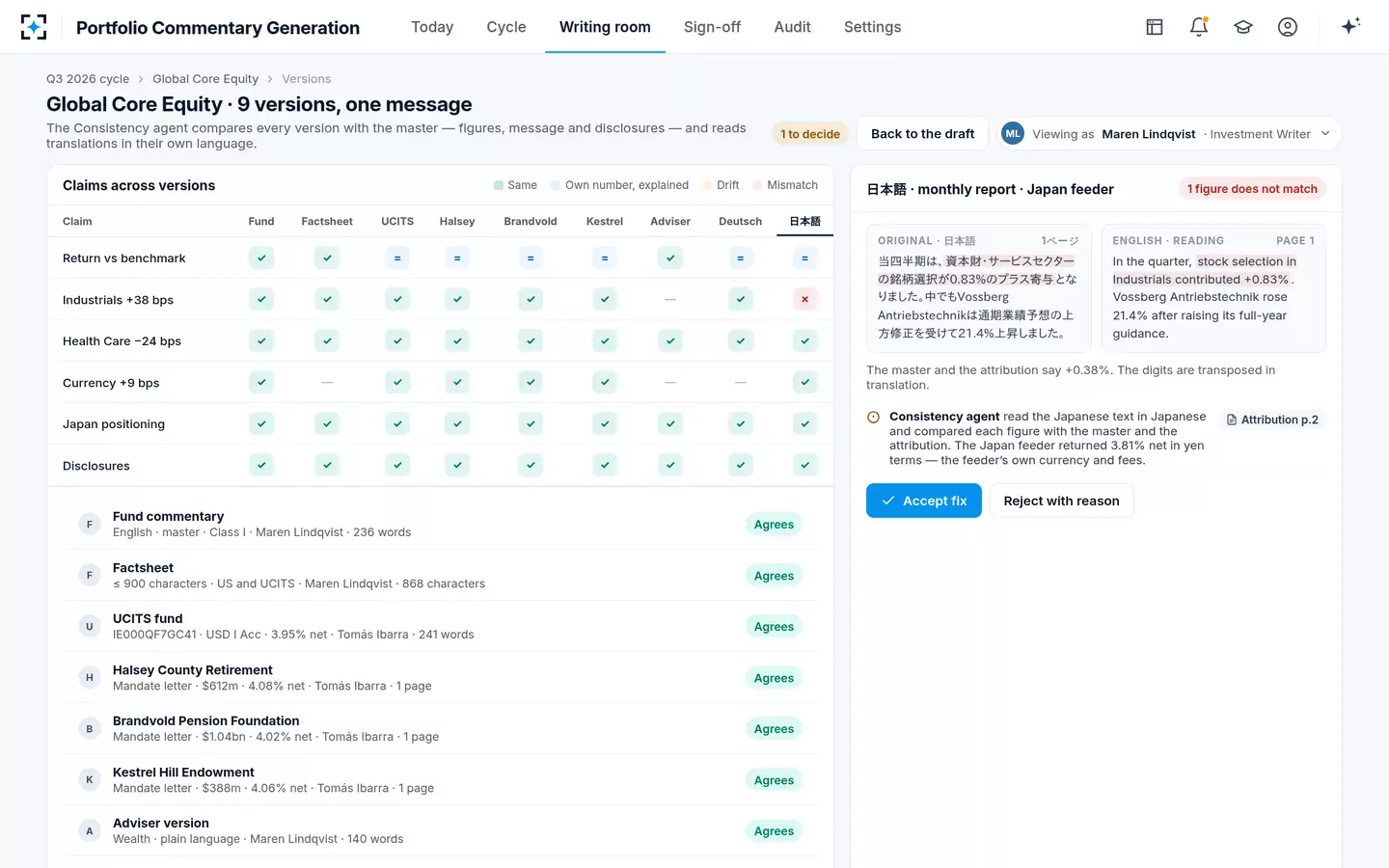
The hard case is the late change. If the PM edits the master after the versions are cut, every version that repeats the edited claim is now different from the master, and nothing in the version shows it. In the sample, one PM rewrite left six of the other eight versions carrying the old line. One figure followed through nine versions shows the same problem with a number.
Each claim across every version: same, rightly different, or wrong
Monthly market review, monthly fund commentary, performance commentary: one master or three?
One master per strategy, with the market review kept separate. A monthly market review describes what markets did, and the firm can write it once for everyone. Monthly fund commentary and performance commentary are the same text under two names: an explanation of this fund's month against its benchmark, which should be written once per strategy and then cut. Writing a separate "performance commentary" for the factsheet and a "fund commentary" for the report doubles the work and guarantees drift.
At quarter end, the monthly cut and the quarterly master collide, because the third month's factsheet is due while the quarter's commentary is being written. Cutting the month's factsheet paragraph from the quarterly master, rather than writing it separately, leaves one text to approve; where the days after quarter end go sets out the season.
Cutting a commentary without changing it: rules for the versions
The rules below keep five versions saying one thing. They work by hand, with a version log, and they are the rules the sample process enforces.
Six rules for cutting one commentary into many versions
- Approve the master first
Versions are cut from approved text, or re-checked when the master changes.
- Map every claim to every version
A version log that says which version repeats which claim.
- Shorten by dropping, never by rewording figures
A factsheet may leave an effect out; it may not restate it.
- Keep the risk with the benefit
If a version keeps a positive claim, its risk or detractor stays beside it.
- Explain rightly different numbers
Each class, account or currency return labelled as its own.
- Check translations against the source, not the English
Every translated figure compared with the attribution cell.
Tie, don't retype: how Portfolio Commentary Generation keeps the versions in line
In the solution, the Drafting agent writes every version from the master in house style: the factsheet paragraph within its character limit, mandate letters with each account's own returns, the adviser version and briefs for the translation vendor. The Consistency agent compares each version with the master, figures, message and disclosures, reads the German and Japanese versions in their own language, explains rightly different numbers, and proposes aligned text when the master changes. It never changes a version without its owner's approval. In the sample cycle it found 31 version inconsistencies across 214 strategies.
All versions released together, each to its own channel
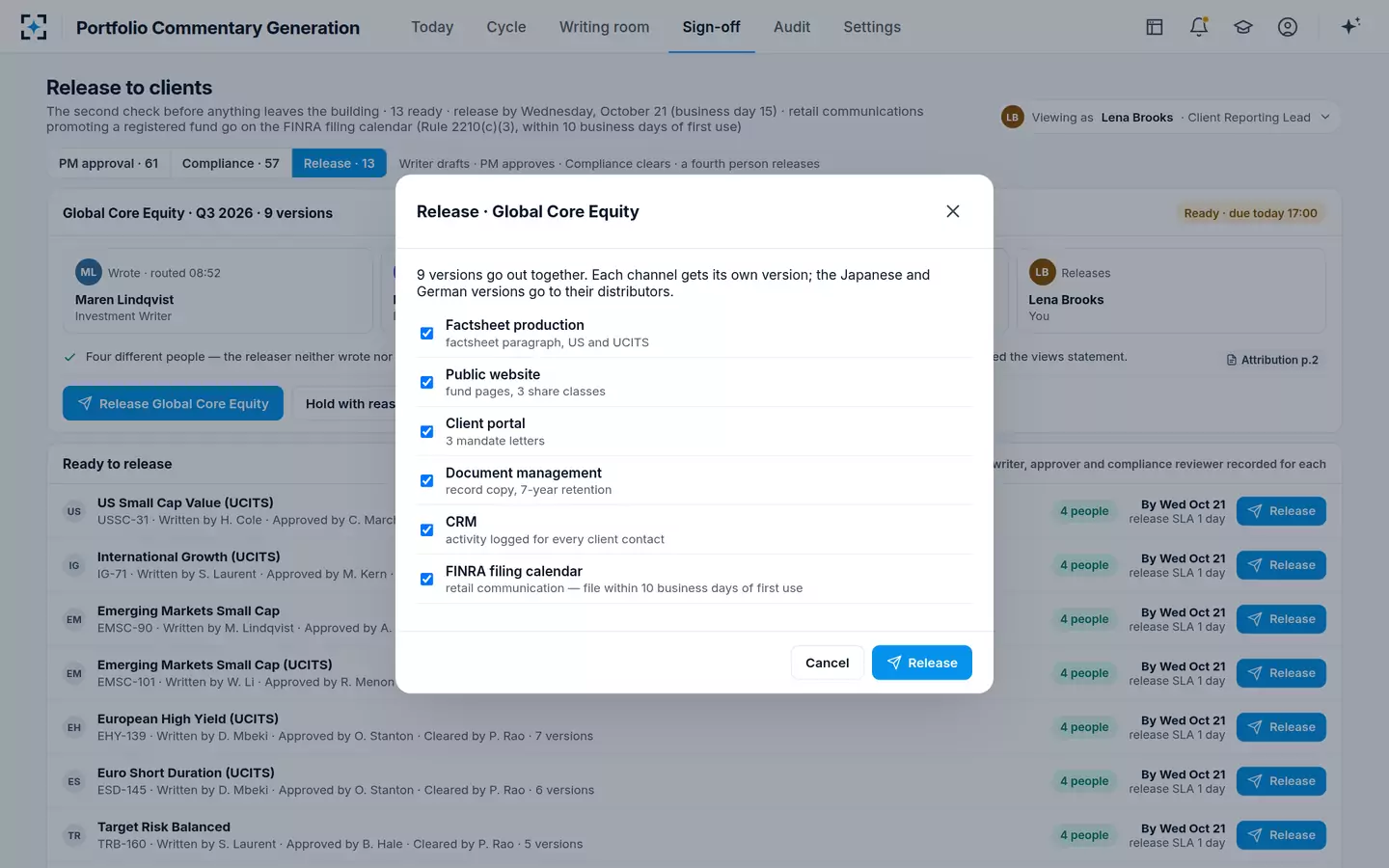
At release, every version leaves at the same moment for each place that uses it, and any retail communication lands on the FINRA filing calendar. To see one master become five audiences on your own strategies, start from Portfolio Commentary Generation.
Questions people ask
How many versions of a commentary are there?
As many as the strategy has audiences: share classes and offshore vehicles, institutional mandates, retail and adviser channels, and languages. There is no public count across the industry; in the fictional sample, 214 strategies produced 1,221 versions in one quarter, and one global equity strategy produced nine.
Who should approve the factsheet commentary?
The PM approves the master it is cut from, and the factsheet itself is approved under the firm's marketing review: at a FINRA member, a registered principal approves each retail communication before use. The factsheet paragraph should not be approved separately from the master, or the two will drift.
Does a monthly commentary need a past performance warning?
If it shows past performance in a marketing communication, generally yes. UK rules require a prominent warning that past results do not reliably predict future ones, and ESMA's guidelines set the wording for EU fund marketing. A periodic statement to a portfolio client may lead with performance, but a factsheet does not get that exception.
Can a translation say something the English master does not?
It should not, beyond the local disclosures each market requires. The figures and the message must match the master; number formats and required local legends may differ. The safest check reads the translation in its own language and compares each figure with the source cell, not with the English text.
What is performance commentary?
It is the part of a fund commentary that explains the fund's return against its benchmark, usually from the performance attribution: which allocation and selection decisions added or cost, in basis points, and why. It is the core of every version, from the master to the factsheet paragraph.