AI portfolio commentary pays for itself when four numbers move: the business days from final attribution to approved text, the writer hours per strategy, the corrections caught before a portfolio manager reads the draft, and the versions released per strategy without rework. No regulator or independent study publishes those figures for fund commentary, and vendors' estimates of hours saved are not evidence, so the only honest business case is one built on your own baseline, taken over one quarter before you buy and measured the same way after. Botminds' Portfolio Commentary Generation, AI portfolio commentary software that drafts from signed-final attribution and checks every figure with a separate agent, is designed to move all four; this guide shows how to measure whether it does.
Where this page uses product figures, they come from a fictional manager, Quillfield Capital, in a third-quarter 2026 cycle of 214 strategies run through the solution on sample data, or they are Botminds' design targets and estimates, called so. None is a measured result at a client.
The four numbers: what each measures, how to take a baseline, and the reference point
1Days from final attribution to approved text
DefinitionBusiness days from the attribution being signed final to the PM’s approval, per strategy: median and the slowest tenth.
How to take the baselineTimestamps from last quarter’s email or workflow: when attribution was signed, when the PM approved.
Reference pointSample: 3.0 business days median to publication, 1.3 of them in PM approval
2Writer hours per strategy
DefinitionWriter time on one strategy’s commentary, all versions included, excluding waiting.
How to take the baselineA time log for one cycle: gather, draft, check, versions, translations.
Reference pointBotminds’ estimate 2.5 hours by hand; target 15 minutes of review
3Corrections caught before the PM reads
DefinitionFigure and claim corrections made before PM review, per 100 figure sentences; plus those the PM or compliance still found.
How to take the baselineCount last quarter’s PM and compliance corrections; seed known errors into a published commentary.
Reference pointSample: 286 corrections in 18,940 sentences; target 100% of figure sentences checked
4Versions released without rework
DefinitionVersions released per strategy, less those corrected or reissued after release.
How to take the baselineCount reissues and post-release corrections in the last four quarters.
Reference pointSample: 1,221 versions for 214 strategies
What is AI portfolio commentary, and what does it change?
AI portfolio commentary is software that drafts a portfolio's performance commentary from its attribution, returns, holdings, trades and the manager's notes, and, in the systems worth buying, checks every figure against those sources before a person reads it. It changes three things: who writes the first draft, how much of the checking is complete rather than sampled, and how long the commentary waits between steps.
The third is easy to miss in a business case built on writer hours. A commentary that takes two hours to write may take two weeks to publish, because it waits for final attribution, for the writer, for the PM and for compliance. The four numbers in the scorecard are chosen to catch each kind of change: one measures the calendar, one the writing labour, one the quality of what reaches the PM, and one the rework after release.
Why there is no industry benchmark to borrow
No regulator or independent study has measured how long fund commentary takes or what it costs. The US Bureau of Labor Statistics has no occupation for investment writers; regulators publish rules about what commentary may say, not how long it takes; and the figures that circulate, such as hours per strategy, come from vendors and surveys run by firms with something to sell. A business case built on them borrows someone else's baseline and someone else's incentive.
The closest rigorous evidence is general. In a preregistered experiment, 453 college-educated professionals given occupation-specific writing tasks finished faster and better with a chat assistant: "The average time taken decreased by 40% and output quality rose by 18%" (Noy and Zhang, Science, 2023). That is a useful prior for drafting, and nothing more: the tasks were not fund commentary, nobody checked figures against an attribution file, and drafting is the smallest part of a commentary's cost. Measure your own.
KPI 1: days from final attribution to approved text
This is the number clients and distributors feel. Measure it per strategy in business days, from the moment the performance team signs the attribution final to the moment the PM approves the commentary, and report both the median and the slowest tenth, because the deadline is set by the slowest strategies, not the typical one. Last quarter's email timestamps are usually enough for a baseline.
In the sample cycle, the median from final attribution to publication was 3.0 business days, of which PM approval took 1.3 and writer review 0.6; 88% of PM approvals came within a two-day service level. The drafting itself took minutes: 207 of 214 drafts were written within an hour of their attribution being signed final. That pattern is the point of the KPI. Once drafting stops being the bottleneck, the days that remain belong to people's queues, and the next improvement comes from shortening those, such as by giving the PM a change summary instead of a document. Where the days after quarter end go breaks the calendar down step by step.
How much time does commentary take? KPI 2, writer hours per strategy
Measure it with a time log, not a survey. For one cycle, have each writer log time per strategy in five buckets: gathering inputs, drafting, checking figures, rewriting versions and checking translations. Exclude waiting. Two weeks of logs from a team are more reliable than any estimate, including ours.
Botminds' design estimate, which the solution's own pages use, is 2.5 writer hours per strategy by hand, of which drafting is 45 minutes and checking and versions take most of the rest, against a target of 15 minutes of review once agents draft and check. Treat both as hypotheses your log will confirm or replace. The method matters more than the number: if your log shows that drafting is 20% of the time and checking 40%, a tool that only drafts will save a fifth of the hours, and a tool that also checks can save most of them.
Turning writer hours into money: an illustration at the median US writer wage
| Line | Arithmetic | Result |
|---|---|---|
| Writer hours per quarter, by hand | 214 strategies × 2.5 hours (Botminds’ estimate) | 535 hours |
| Writer hours per quarter, with agents | 214 strategies × 0.25 hours (design target) | 53.5 hours |
| Hours released per quarter | 535 − 53.5 | 481.5 hours |
| At the median wage for writers and authors | 481.5 × $36.98 an hour (BLS, May 2025) | about $17,800 a quarter |
| A year | × 4 quarters | about $71,000, before benefits and overhead |
The table makes an honest point: on writer wages alone, the case is modest. At the median writer wage, releasing 480 hours a quarter is worth a little less than one median writer's annual pay. Loaded costs, London and New York pay, and senior writers raise it; the median financial and investment analyst earned $102,740 in 2025, about $49 an hour (BLS employment projections), and O*NET lists portfolio manager among that occupation's titles (O*NET 13-2051.00), so PM hours spent rewriting drafts are worth counting too. But a business case that rests only on hours is selling the least valuable part of the change.
KPI 3: corrections caught before the PM reads the draft
This is the quality number, and the one most business cases leave out. Count, per 100 figure sentences, the corrections made before the PM reads the draft, and separately the ones the PM, compliance or a client still found. The first number should go up and the second down. A rise in the first with no fall in the second means the checker is busy on things that did not matter.
What the quality numbers look like in one sample cycle
18,940
sentences checked across 214 strategies
286
corrections before any PM read a draft
45
sent to writers with both agents’ positions shown
98.5%
of figure sentences unchanged by people so far
Two further measures make the number trustworthy. The first is a seeded test: plant known errors, such as a total effect labelled as allocation or two transposed digits in a translation, in a commentary you have already published, and count what the checker catches. The second is the share of figure sentences that people change after the agents have checked them; in the sample it was 1.5% part-way through the cycle. A low number means the checks are right; a high one means writers are redoing the agents' work, and the hours in KPI 2 are not really saved.
KPI 4: versions released without rework
Every strategy's commentary becomes several versions: a factsheet paragraph, mandate letters, an adviser version, translations. The sample cycle produced 1,221 versions for 214 strategies, nearly six each. Rework happens when a version goes out with an old figure or an old sentence because the master changed after it was cut, or because a translation changed a digit. Measure versions released per strategy, and subtract those corrected or reissued after release, over the last four quarters.
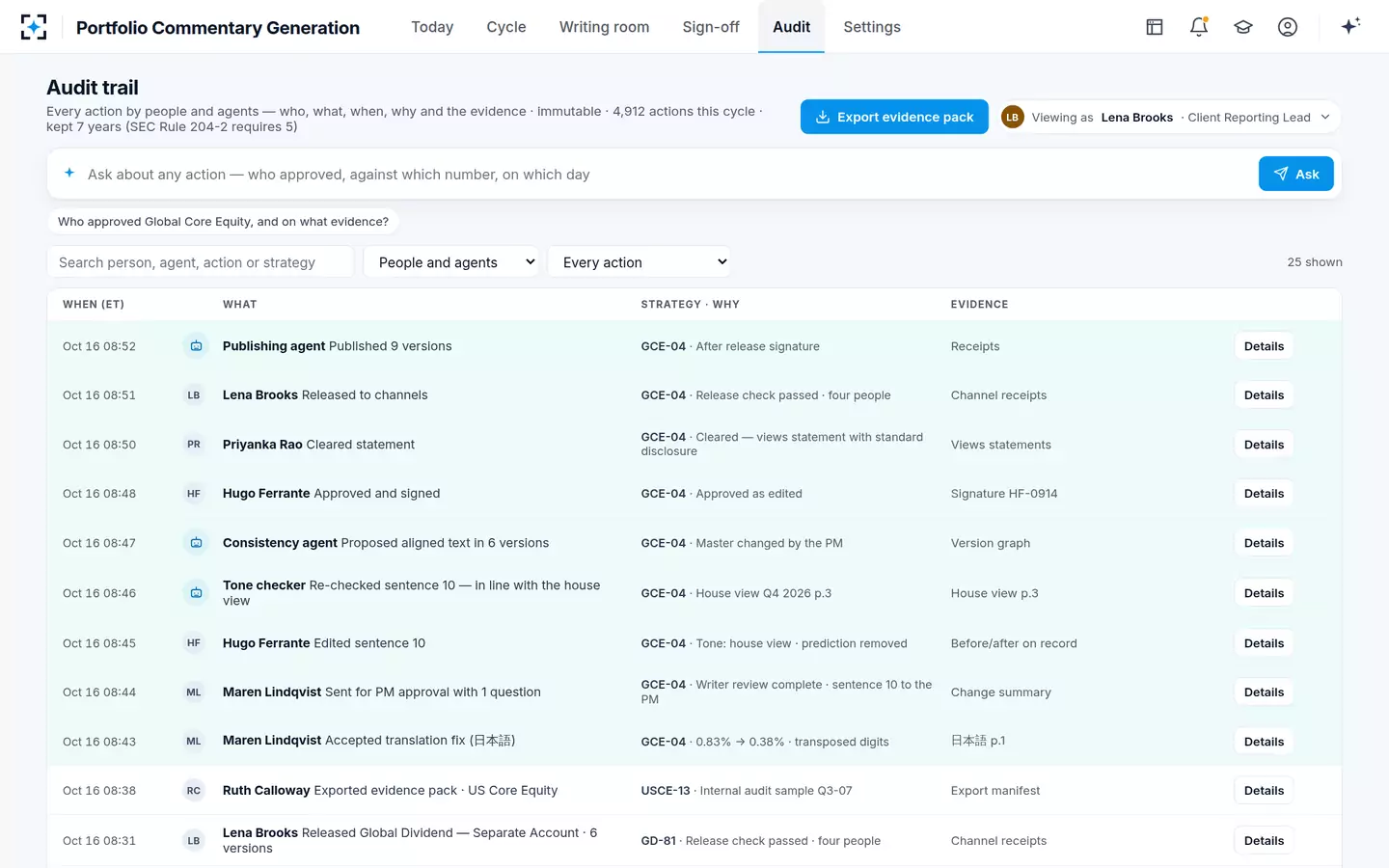
A reissue has costs a time log does not see: a client who received two versions of the same quarter, a distributor who printed the wrong one, and a records problem, because the firm must be able to show how each performance figure it sent was calculated (17 CFR 275.204-2(a)(16)). The target for this KPI is simple: no version released that disagrees with its master. In the sample cycle the Consistency agent found 31 version inconsistencies before release, including a Japanese report whose 0.83% should have read 0.38%.
The cycle as a pipeline: where 214 strategies are, and which are late
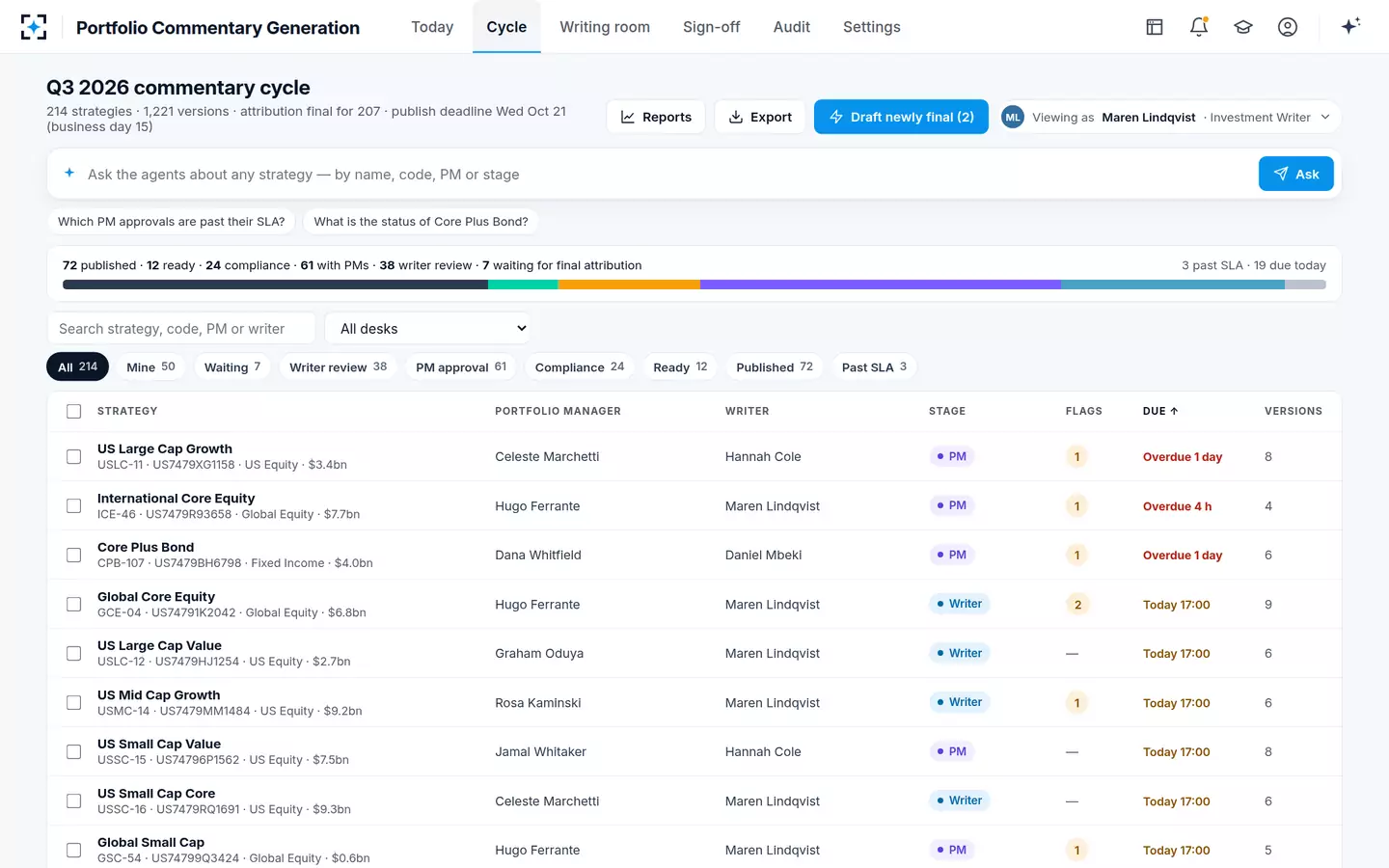
What is the ROI of commentary automation?
The return comes from three places, and only the first is easy to price. Capacity: writer and PM hours released, from KPI 2. Calendar: commentary approved days earlier, from KPI 1, which matters most where factsheets, client reports and distributors wait on it. Risk: errors caught before they reach a client, from KPIs 3 and 4, which avoids reissues, client complaints and examination findings.
Risk is the largest and the hardest to put a number on, because the cost of an error depends on who received it and what they did. No public study prices a commentary error. The defensible approach is to count your own: reissues and post-release corrections over the last four quarters, the hours each took, and any that reached a regulator or a complaint. That count, multiplied forward, is the risk line of the business case, and it is usually more persuasive to a COO than any hours estimate.
A business case built on writer hours sells the cheapest part of the change. The calendar and the corrections are where the money is, and you can only see them by measuring last quarter first.
How do you measure commentary quality?
Quality has three measurable parts: correctness, balance and stability. Correctness is KPI 3, figure by figure. Balance is whether detractors are explained as fully as contributors and whether views avoid predictions; count compliance returns per 100 commentaries, by reason. Stability is how much the PM changes: the share of drafts the PM approves with only his own view edited is a direct measure of whether the draft is good enough to trust, and getting PMs to sign an automated draft sets out how that share rises over two quarters.
ESMA's expectations for AI in client information give the quality programme a regulatory frame: controls before information reaches clients, and regular checks after the fact on any process in which AI helps deliver information to them (ESMA public statement, May 2024, ¶16). The four KPIs, reported each cycle, are those ex-post controls.
The record behind every number: who did what, when, why and on what evidence
Reading a vendor's ROI claim, ours included
Every AI portfolio commentary vendor will show an ROI slide, and most of them are built the same way: an hours-per-strategy figure from a survey or the vendor's own estimate, multiplied by strategies and a salary, with a large percentage saving applied. Four questions separate a claim you can use from one you cannot.
Whose baseline is it? If the hours before come from anyone but your own writers, the saving is a guess about your firm made by someone who wants the sale. Botminds' 2.5-hour figure is in that category, which is why this page calls it an estimate and asks you to replace it.
What does the after include? A saving that counts drafting time but not the time writers spend checking and correcting the tool's drafts is overstated by exactly the part of the job that matters. Ask for the after to include review, corrections and versions, measured on a quarter you have published.
Where are the errors? A claim that says nothing about the corrections the tool made, and missed, is a claim about speed only. Ask for KPI 3 on seeded errors, and for the share of figure sentences that people changed after the tool had checked them.
Does the calendar move? If the tool drafts in minutes but the commentary still publishes on the same day, the hours were saved and the deadline was not. Ask for KPI 1 on the trial strategies, median and slowest tenth.
A one-quarter plan for the baseline and the trial
The business case takes two quarters: one to measure, one to compare. The checklist below is the plan we would follow, and it works whichever tool you evaluate.
Measure, then trial: six steps over two quarters
- Pick 10 to 20 strategies that represent the book
Equity, fixed income and multi-asset; at least one with translations and mandate letters.
- Log one quarter by hand
Timestamps for KPI 1, a writer time log for KPI 2, PM and compliance corrections for KPI 3.
- Count four quarters of rework
Reissues, post-release corrections and late version fixes, with the hours each took.
- Run the tool on the quarter you just published
Same attribution, notes and house view; compare its drafts and catches with what actually went out.
- Seed errors and count catches
Known mistakes in a copy of a published commentary, of every type you have seen in rework.
- Run the next live quarter on the same strategies
Measure all four KPIs the same way; the difference is the business case.
A tool that cannot be measured this way should not be bought on a promise. To run the trial on a quarter you have already published, start from Portfolio Commentary Generation; the questions to ask any AI commentary generator cover what to look for before the numbers.
Questions people ask
What are the best AI tools for asset management commentary?
The best fit is a tool that drafts from your signed attribution and checks every figure against it with an independent check, rather than a general writing assistant. Judge candidates on the four KPIs on your own data: days to approval, writer hours, corrections caught before PM review and versions without rework.
How long does it take to write fund commentary by hand?
No independent study has measured it. Botminds' own design estimate is about 2.5 writer hours per strategy, most of it gathering, checking and rewriting versions rather than drafting, but the reliable figure is your own: a two-week time log across a team in one cycle.
How many versions of a commentary does a manager produce?
It depends on share classes, mandates, audiences and languages; there is no public count. In the fictional sample cycle, 214 strategies produced 1,221 versions, nearly six each, from factsheet paragraphs to mandate letters and translations. Every version is a place for a figure to drift from its master.
Does AI portfolio commentary reduce compliance review time?
It changes what compliance reviews. In the sample design, a Disclosure agent sends each flagged statement with the rule, the reason and proposed wording, so the reviewer works a queue of specific sentences rather than reading every commentary in full. Measure it as compliance hours per 100 commentaries, before and after.
What should a pilot of AI portfolio commentary measure?
The same four numbers as the business case, on a quarter you have already published: how fast drafts follow final attribution, how many writer hours remain, how many corrections the checker makes and how many it misses on seeded errors, and whether every version matches its master.