Under the SEC Marketing Rule, Rule 206(4)-1 under the Investment Advisers Act, an adviser's advertisement may show gross performance only if it also shows net performance "with at least equal prominence to, and in a format designed to facilitate comparison with, the gross performance" and "calculated over the same time period, and using the same type of return and methodology" (17 CFR 275.206(4)-1(d)(1)). Attribution sits awkwardly in that rule, because its effects are generally measured before fees, and the SEC staff accept that restating them after fees may be impossible. In a March 19, 2025 answer the SEC staff said they would not recommend enforcement if an advertisement shows gross attribution while the whole portfolio's gross and net returns are shown with it under four conditions. Botminds' Performance Attribution Analysis pairs before- and after-fee figures in every answer it drafts and sends any answer that may be an advertisement to Marketing Compliance before it can leave.
The examples come from the solution's sample data on the fictional Quillfield Capital; the rule text, staff guidance and enforcement figures are the SEC's own, linked where they appear. This page is about attribution; the rest of the Marketing Rule, from testimonials to hypothetical performance, is covered by the separate SEC Marketing Rule Compliance solution.
The staff's four conditions for gross attribution, tested on one outgoing answer
- Pass: the attribution is clearly identified as gross
The answer says its effects are "before fees" and refers the reader to the portfolio's after-fee return for the effect of fees.
- Pass: the total portfolio's gross and net returns accompany it
1.84% before fees and 1.65% after, against 3.26% for the index: the official returns, calculated under the rule.
- Pass: those returns are at least as prominent and easy to compare
They come first, in the same type size, before any effect is quoted.
- Pass: the portfolio returns cover the whole attribution period
Both are the third quarter of 2026; a year-to-date attribution would need year-to-date returns.
- And still: if it is an advertisement, the one-, five- and ten-year returns
The FAQ relieves the period requirement for the attribution itself, not for the total portfolio's returns shown with it.
What the SEC Marketing Rule says about gross and net performance
The rule forbids an advertisement from including "Any presentation of gross performance, unless the advertisement also presents net performance" meeting two tests: equal prominence in a comparable format, and the same period, type of return and methodology. Gross performance is defined as results "before the deduction of all fees and expenses that a client or investor has paid or would have paid in connection with the investment adviser's investment advisory services to the relevant portfolio"; net performance is the same after those deductions (Rule 206(4)-1(d)(1), (e)(7), (e)(10)). The rule was adopted in December 2020, took effect on May 4, 2021, and has been mandatory since November 4, 2022.
Two features matter for performance teams. The rule does not prescribe how to calculate either figure, only that they match; the staff confirmed in a February 6, 2024 answer that net must be "calculated over the same time period and using the same type of return and methodology as the gross performance" (SEC staff FAQ). And it applies to advertisements only, a defined term, which is where most of the practical questions about attribution begin.
Marketing rule net vs gross performance: the four requirements in (d)(1)
Read as a checklist, paragraph (d)(1) asks four things of any gross figure in an advertisement: is net shown, is it at least as prominent, is it in a format that makes comparison easy, and is it calculated on the same basis. Examiners have found firms whose written policies met the test and whose advertisements did not.
For example, the staff observed advisers’ policies that required net of fees performance to be included with any performance advertisement; however, the staff observed those same advisers including only gross performance in advertisements.
SEC Division of Examinations, Risk Alert, April 17, 2024
The same alert listed advertisements that used "lower fees in calculations for net of fees performance returns than were offered to the intended audience." That is the failure most likely to come from a performance team rather than a marketing team, because the fee used to compute net is a performance calculation choice. An answer that pairs gross with net is only as good as the net figure, which should come from the official net-of-fee returns, not from subtracting an assumed fee in a spreadsheet.
Is an attribution table an advertisement?
Only if the communication it sits in is one. The rule defines an advertisement, in its first prong, as "Any direct or indirect communication an investment adviser makes to more than one person ... that offers the investment adviser's investment advisory services with regard to securities to prospective clients" or private fund investors, "or offers new investment advisory services" to current ones (Rule 206(4)-1(e)(1)). An attribution table in a pitch book, on a website or in a consultant database entry offered to prospects is inside that definition. The same table in a quarterly letter to an existing client about that client's own account generally is not.
Consultants are named in the adopting release. The Commission wrote that "investment advisers often provide intermediaries, such as consultants, other advisers ..., and promoters, with advertisements for dissemination. Those advertisements are indirect communications because they are statements provided by the adviser for dissemination by a third party" (86 FR 13024, March 5, 2021). An attribution answer written for one consultant about one pension fund's account is a reply; the same answer loaded into the consultant's manager database for its clients to read can be an advertisement.
Same attribution, different communication: is it an advertisement?
Generally not an advertisement: One consultant asking about an existing client's account.
Can be an advertisement: A consultant database, many prospects, or a mailing to clients offering a new strategy.
Generally not an advertisement: Explaining the client's own results; retaining an existing investor.
Can be an advertisement: Offering the adviser's services to prospects, or new services to current clients.
Generally not an advertisement: A customised reply written for that question.
Can be an advertisement: A standard insert or table reused across many otherwise customised replies.
Generally not an advertisement: Hartwell Consulting's question about Lakeshore's Global Equity account.
Can be an advertisement: The same Global Equity commentary loaded into a consultant database for its subscribers.
When does a one-on-one answer become an advertisement?
When it is not really one-on-one. The Commission kept the old rule's exclusion for communications to one person, and said plainly that answering an existing investor about their account is outside the rule: "Of course, if the adviser provides an existing investor with performance information pertaining to the investor's account, the rule would not apply because this is a one-on-one communication" (adopting release). It then closed the obvious route around it.
"For example, if an adviser maintains a database of performance information inserts or tables that it uses in otherwise customized investor communications, the adviser must treat the duplicated inserts as advertisements subject to the rule." That sentence is aimed directly at the way performance teams work after a busy quarter: a prepared paragraph on a strategy's drivers, pasted into dozens of individual answers. In the solution's sample, the prepared Global Equity answer had been reused four times, and the same drivers went to three consultants in four days. Each reply was individual; the paragraph they shared is the kind of insert the release describes.
The release also excludes "communications designed to retain existing investors," and a response to a request for proposal does not become an advertisement merely because the client later publishes it. What it does not do is exempt a communication because it was sent one at a time. Bulk emails and templates "nominally directed at or 'addressed to' only one person" are, in the Commission's words, "in fact widely disseminated to numerous investors and therefore would be subject to the final rule."
Can you show gross attribution? The staff's four conditions
Yes, in an advertisement, on the staff's terms. The rule does not define performance, and the staff acknowledged in a March 19, 2025 answer that advisers "may be unsure whether certain characteristics (e.g., yield, coupon rate, contribution to return, volatility, sector or geographic returns, attribution analyses, the Sharpe ratio, the Sortino ratio, and other similar metrics) ... are 'performance' under the rule," and that "calculating these characteristics net of fees and expenses may be impossible or lead to misleading or confusing results" (SEC staff, Marketing Compliance FAQ).
The staff's position on gross characteristics such as attribution, condition by condition
| Condition, in the staff's words | What it means for an attribution answer |
|---|---|
| "the gross characteristic is clearly identified as being calculated without the deduction of fees and expenses" | Label the effects "before fees" and point to the after-fee portfolio return for the effect of fees. |
| "the characteristic is accompanied by a presentation of the total portfolio’s gross and net performance consistent with the requirements of the rule" | Show the strategy's official gross and net returns, calculated as the rule requires, in the same document. |
| "the total portfolio’s gross and net performance is presented with at least equal prominence to, and in a manner designed to facilitate comparison with, the gross characteristic" | Put the returns first or beside the effects; not in a footnote. They need not be on the same page if comparison is easy. |
| "the gross and net performance of the total portfolio is calculated over a period that includes the entire period over which the characteristic is calculated" | A third-quarter attribution needs at least third-quarter returns; a since-inception attribution needs since-inception returns. |
Three limits come with the position. The staff took no view on whether attribution is performance at all; the relief applies "if" it is. It does not extend to total return, time-weighted return, internal rate of return and similar measures, "regardless of how such metrics are labelled," so a "sector return" that is really a time-weighted return of a sleeve is not a characteristic. And because the period for a characteristic "may not easily align" with the rule's one-, five- and ten-year periods, the staff accepted a characteristic calculated "over a single, clearly disclosed period," while the total portfolio's own returns still follow the rule's periods.
What is extracted performance, and how is it different from attribution?
Extracted performance is "the performance results of a subset of investments extracted from a portfolio" (Rule 206(4)-1(e)(6)): the return of a sleeve, a sector or a single position, shown on its own. It is close to attribution, and the Commission said so when it adopted the rule.
We continue to believe that extracted performance can provide important information to investors about performance actually achieved within a portfolio. It can also provide investors with information about performance attribution within a portfolio.
SEC, Investment Adviser Marketing, adopting release, 86 FR 13024 (2021)
The difference is what is shown. A sleeve's return, "our Health Care holdings returned −6.39%," is an extract; the staff's March 2025 FAQ says that gross extracted performance may be shown without the extract's own net figure if the total portfolio's gross and net accompany it on conditions that mirror those for characteristics. An effect, "Health Care selection cost 96bp," is an attribution characteristic. An answer that quotes both is meeting both positions at once, which in practice means the same discipline: total portfolio gross and net, prominent, over a period that covers everything else on the page.
SEC Marketing Rule performance time periods: one, five and ten years
Any advertisement with performance results of a portfolio other than a private fund must show the same portfolio's results "for one-, five-, and ten-year periods, each presented with equal prominence and ending on a date that is no less recent than the most recent calendar year-end," with the portfolio's life substituted for a period it did not exist (Rule 206(4)-1(d)(2)). A quarterly attribution in an advertisement therefore travels with three standardised returns that end at the last December, not at the quarter.
Dates that set the rules for attribution in advertisements
| Date | What happened | Why it matters for attribution |
|---|---|---|
| May 4, 2021 | Amended Rule 206(4)-1 effective | Gross needs net, on the same basis, in advertisements. |
| November 4, 2022 | Compliance date | The rule applies to every advertisement from this date. |
| September 19, 2022 | First exam risk alert on the rule | Examiners list gross without net and extracted performance among review areas. |
| April 17, 2024 | Risk alert with initial observations | Policies required net; advertisements showed gross only. |
| March 19, 2025 | Staff FAQ on characteristics and extracts | Gross attribution allowed on four conditions; staff takes no view on whether it is performance. |
| January 15, 2026 | Staff FAQ on model fees | Net performance using actual fees judged on the facts, including disclosures. |
Can net performance use actual fees? The January 2026 answer
Sometimes. The adopting release said that where the fee to be charged to an advertisement's audience "is anticipated to be higher than the actual fees charged, the adviser must use a model fee that reflects the anticipated fee." In a January 15, 2026 answer, the staff noted that some advisers had read this as always requiring a model fee, and said instead that "whether the use of actual fees violates the general prohibitions depends on all of the facts and circumstances of a specific advertisement, including, but not limited to, relevant disclosures" (SEC staff FAQ).
For a performance team the practical point is the one the 2024 risk alert made: the net figure beside gross attribution must reflect fees the reader could actually pay, or say clearly why not. The after-fee return of the institutional share class is not the after-fee return a retail prospect would earn.
What examiners and enforcement have found
The Division of Examinations announced in September 2022 that it would review whether advertisements included "gross performance, unless the advertisement also presents net performance" and extracted performance without the total portfolio (Risk Alert, September 19, 2022). Its April 2024 observations, quoted above, found the gap between policy and practice. Enforcement has followed, mostly on other parts of the rule so far.
SEC Marketing Rule sweeps in 2024: fourteen advisers, $1.44 million
$200,000
combined penalties, five advisers, April 12, 2024: hypothetical performance on public websites
$1,240,000
combined penalties, nine advisers, September 9, 2024: untrue or unsubstantiated claims and undisclosed ratings or testimonials
Neither sweep was about attribution, and that is the point for performance teams: the cases so far are about claims that could not be backed up. An attribution answer that pairs gross with net, cites the official returns and keeps the workings is the opposite of that profile. One that quotes a preliminary figure, or a reason the portfolio manager never gave, is closer to it than it looks.
Where Performance Attribution Analysis applies the test, and where Marketing Compliance takes over
The solution applies three rules to every answer and leaves the legal judgment to people. Its Consistency agent adds the official after-fee figures whenever before-fee figures appear, with equal prominence, over the same period. Its Disclosure agent applies the firm's advertisement test, which by default treats any answer going to more than one recipient as an advertisement and routes it to Marketing Compliance before it can be sent: a deliberately cautious setting, broader than the rule's definition. And it blocks any statement or implication of future returns.
Answer rules in Performance Attribution Analysis: gross with net, the advertisement test, no forecasts
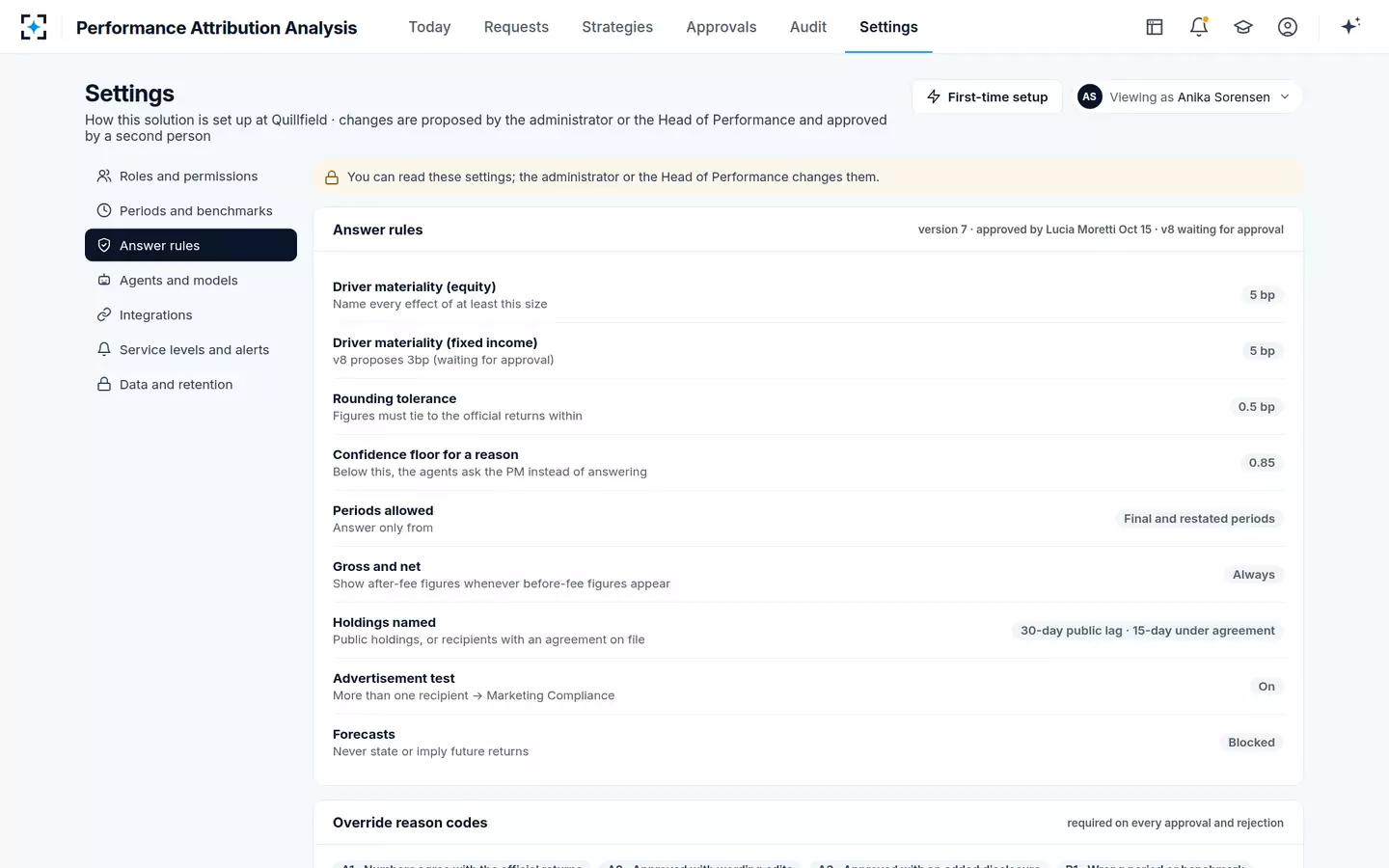
What the recipient count does not catch is the duplicated insert. A prepared paragraph reused across many single-recipient answers passes a "more than one recipient" test each time while, in the Commission's terms, it may be an advertisement as a whole. Firms that reuse prepared answers heavily should agree with Marketing Compliance how reuse is treated; the solution logs every reuse and every sent answer, which is what that review needs.
The advertisement test on one answer: one recipient, a reply to an unsolicited request
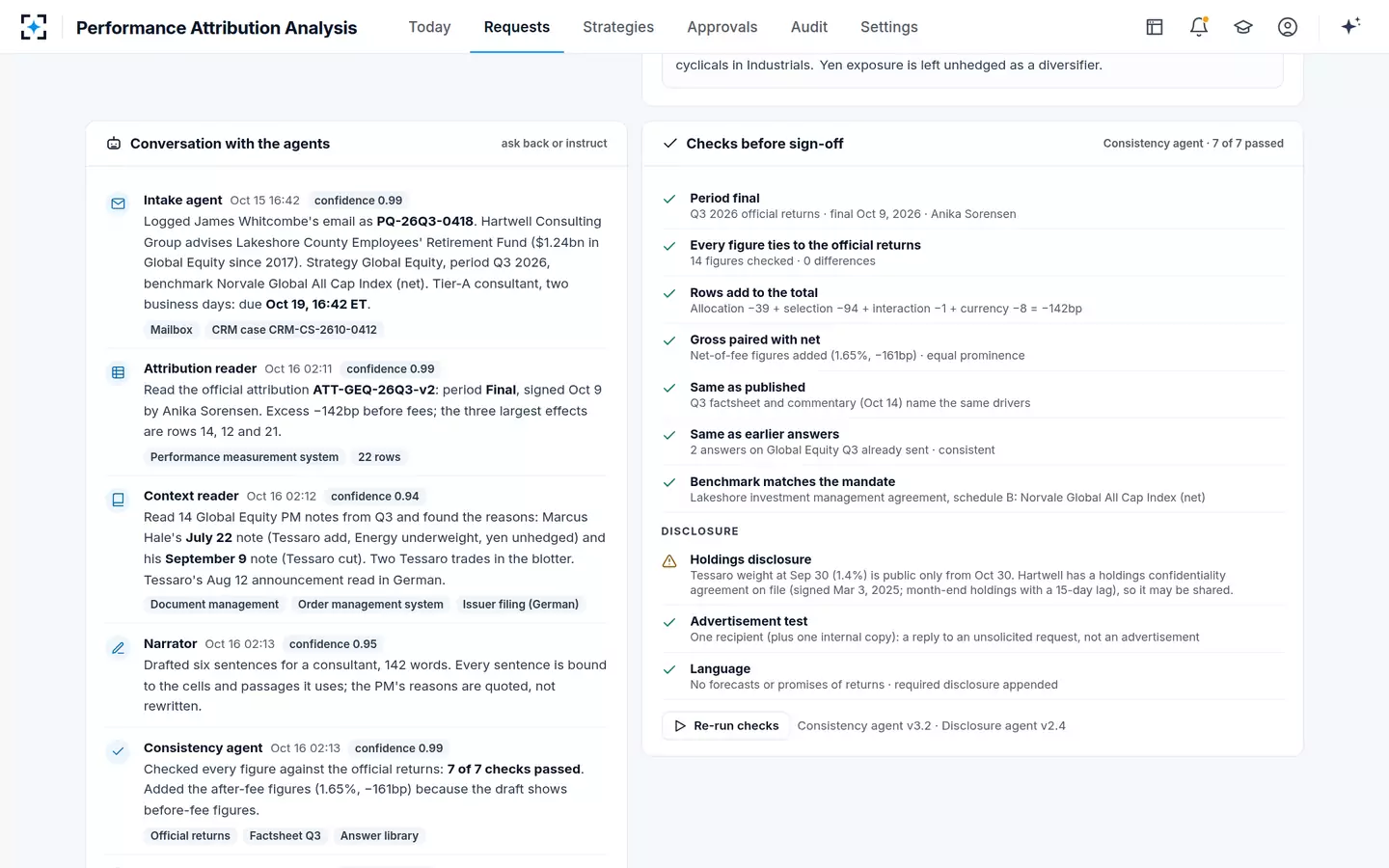
How the solution checks figures before anyone signs is set out in why the writer is never the checker; the difference between attribution and contribution, both on the staff's list, is in performance attribution vs contribution. The solution is at Performance Attribution Analysis.
Questions people ask
Does the Marketing Rule apply to mutual fund advertisements?
No. The adopting release says the rule "will not apply to advertisements about registered investment companies or business development companies"; those are governed by the rules for investment company advertising. It applies to advertisements of SEC-registered investment advisers, including those for separately managed accounts and private funds.
Must attribution be shown net of fees?
Not if the staff's four conditions are met: the attribution is labelled gross, and the total portfolio's gross and net returns accompany it with at least equal prominence over a period covering the attribution. The staff noted that calculating such characteristics net "may be impossible or lead to misleading or confusing results."
Is a consultant's questionnaire response an advertisement?
A reply to one consultant about an existing client is generally not. A response that the consultant loads into a database for its clients, or that offers the adviser's services to prospects through the consultant, can be, because the rule covers indirect communications made through intermediaries.
Which workings must back gross and net figures in an answer?
Rule 204-2 requires the workings that demonstrate any performance figure in a communication the adviser disseminates to any person, advertisement or not, kept for five years from the end of the fiscal year in which the communication was last sent. The official returns, the attribution version and the calculation of net are the core of that file.
Do the staff positions apply to private funds?
The characteristics and extracted performance positions apply to advertisements generally, including private fund advertisements; the one-, five- and ten-year period requirement in (d)(2) does not apply to private fund performance.