Pilot performance attribution software on last quarter's real questions: take the consultant and client questions your team already answered, have the software answer them again from your official attribution and your portfolio managers' notes, and compare its answers with what you sent, figure by figure and reason by reason. The questions are realistic, the right answers are known, and the comparison tests what matters: every figure tied to the official returns, gross paired with net, the material drivers named, and no reason the manager did not give. A demo on a vendor's data tests none of that. Botminds' Performance Attribution Analysis is piloted this way, on a sample of your own attribution reports, PM notes and past consultant questions, with your people scoring and nothing sent to a client. What the software must never do alone, check its own drafts, is the subject of the performance attribution tool guide, and the measures to baseline first have theirs.
The five-week plan below is our recommendation, not a regulatory requirement; the solution's figures quoted are its sample data on the fictional Quillfield Capital, or design targets, and are labelled as such.
Five weeks from last quarter's data to a verdict on performance attribution software
- Gather last quarterWeek 1
- Connect and mapWeek 2
- Replay, scored blindWeek 3
- Live, side by sideWeek 4
- Verdict and sign-offWeek 5
Why pilot performance attribution software on last quarter's questions
Because the answer key already exists. Every question your team answered last quarter has a sent reply, an official attribution behind it and, usually, a portfolio manager's note. A pilot that replays those questions measures the software against work your firm has already signed, on your strategies, your benchmarks and your report formats. A pilot on fresh questions has no answer key, and a demo on the vendor's sample has neither your data nor your rules.
Your report formats matter more than they seem. Attribution is not standardised across firms, and the Central Bank of Brazil's performance team began its account of its own framework with exactly that point.
There is no standard format for performance attribution reports, and each methodology is developed to capture some specific issues of the investment process.
de Almeida da Silva Junior, Central Bank of Brazil, in Risk Management for Central Bank Foreign Reserves (ECB, 2004)
Software that reads one firm's Brinson-Fachler grid by sector, another's by region, and a third's carry-duration-curve-spread fixed income report has to be tested on the formats it will meet, including the awkward ones: the strategy measured against a blended benchmark, the account-level report for a separate account, the fixed income grid whose selection line is a remainder.
What data does a pilot need?
A pilot needs the questions, the answers that were sent, and everything the answers were built from: official returns and attribution with their period status, the portfolio managers' notes and committee minutes, the trade blotter, the factsheets and commentary, and the firm's answer rules. A registered adviser should already have the core of it on file, because Rule 204-2 requires the workings behind performance in any communication to be kept for at least five years from the end of the fiscal year in which the adviser last sent it out, the first two in its own office (17 CFR 275.204-2(e)(3)(i); how long each adviser record is kept).
What to bring to a pilot of performance attribution software
- Last quarter's questions
Emails, CRM cases, consultant-portal requests and meeting notes, with arrival times and the clock each one had.
- What was sent
The final text of every answer, its sender, its date and its recipients; corrections, if any, and why.
- Official returns and attribution
From the performance measurement system, with period status: final, preliminary, restated.
- The reasons on file
PM positioning notes, investment committee minutes, the trade blotter and the issuer documents behind the main drivers.
- Published materials
Factsheets and commentary for the quarter, so consistency can be tested.
- Your answer rules
Materiality, rounding tolerance, gross and net, holdings disclosure lag, the advertisement test, forecasts: written down before scoring starts.
How long is a performance software pilot? Five weeks, week by week
Five weeks is enough for an answer tool, because it reads data your systems already produce rather than recalculating it. Week one gathers last quarter's material and writes the answer rules down. Week two connects the performance measurement system, document management, the order management system and the CRM, and maps strategies to benchmarks and mandates. Week three is the replay. Week four runs the software beside the team on new questions, with nothing sent. Week five scores and decides.
Timing matters as much as length. A pilot that collides with a quarter close competes with the people it needs; one that starts a few weeks after a close has a full quarter of questions and answers to replay and time for the analysts to score them. For year-end, the SEC staff consider that a reasonable time to calculate performance after a calendar year-end "generally would not exceed one month" (SEC staff Marketing Compliance FAQ, posted April 14, 2021), a useful marker for when the performance team is least available.
How many questions should a pilot use?
Enough to cover every kind of question your team answers, and small enough that analysts can score each answer carefully: in practice, a few dozen. There is no standard number. For a sense of scale, the researchers who tested a GPT-4 attribution agent used twelve quarterly reports for three sample funds and 140 exam-style questions (de Melo and Sheikh, arXiv 2403.10482, 2024, not peer reviewed); a firm's own pilot is better spent on fewer, harder, real questions than on many easy ones.
A pilot sample that covers the hard cases, not just the common ones
| Question type | Why include it | What a good answer does |
|---|---|---|
| Largest gaps of the quarter, equity | The questions boards ask about | Names the two or three cells that explain the gap, with the PM's reason quoted |
| Fixed income strategy | A different model and evidence | Uses carry, duration, curve and spread, with the direction of each bet |
| A period that was preliminary when asked | Tests refusal | Refuses, says when the period will be final |
| A period later restated | Tests correction | Finds every answer that quoted the old figure |
| A driver with no note on file | Tests invention | Asks the PM rather than writing a reason |
| A holding not yet public | Tests disclosure | Withholds the name unless the recipient has an agreement on file |
| The same question from several consultants | Tests consistency | Gives the same drivers to each, and flags a reused insert for review |
| Year to date or since inception | Tests linking | Quotes the official linked figures, not summed quarters |
How do you compare pilot answers with what was sent?
Compare them blind, line by line, on the same rubric. The software answers each question without seeing the sent answer; an analyst who did not write either then scores both against the official returns and the PM's notes. Scoring both matters: a replay often finds errors in what was sent, and the honest verdict is software against the truth, not software against the team.
The replay and the live week test different things
Week 3: replay of last quarter: Last quarter's, with known answers.
Week 4: live, side by side: This week's, as they arrive.
Week 3: replay of last quarter: Accuracy against the official numbers and the reasons on file.
Week 4: live, side by side: Elapsed time, the PM's and analyst's review effort, and how the agents behave on a live period.
Week 3: replay of last quarter: Nothing; answers are scored.
Week 4: live, side by side: Nothing from the pilot; your own team answers and sends as usual.
Week 3: replay of last quarter: An analyst who wrote neither answer, and the PM for reasons.
Week 4: live, side by side: The analysts who would have signed, noting time saved and edits made.
The scorecard counts errors by type, because their costs differ. A figure outside the rounding tolerance, a before-fee number without its after-fee pair, an answer from a preliminary period and a reason not found on file are each a fail for that answer. A different but defensible choice of which drivers to name is a note for the rules, not a fail. The KPIs that show attribution software pays sets out the full scorecard and how to baseline it.
Score first attempts, not best attempts
Score the software's first answer to each question, not the best of several runs. The same GPT-4 study shows why. Calculating attribution at the parent level of a multi-level report, the agent "eventually was able to obtain perfect accuracy ... but not before several attempts"; in the runs where it did not follow the instructions, its accuracy on two of the three funds' parent-level effects fell to between 50% and 75%, or 75% to 78% overall (de Melo and Sheikh, 2024).
One study, one task: the difference between eventually right and right first time
100%
parent-level attribution accuracy, eventually, after several attempts
78%
allocation accuracy on a run where the instructions were not followed
75%
selection accuracy on the same run
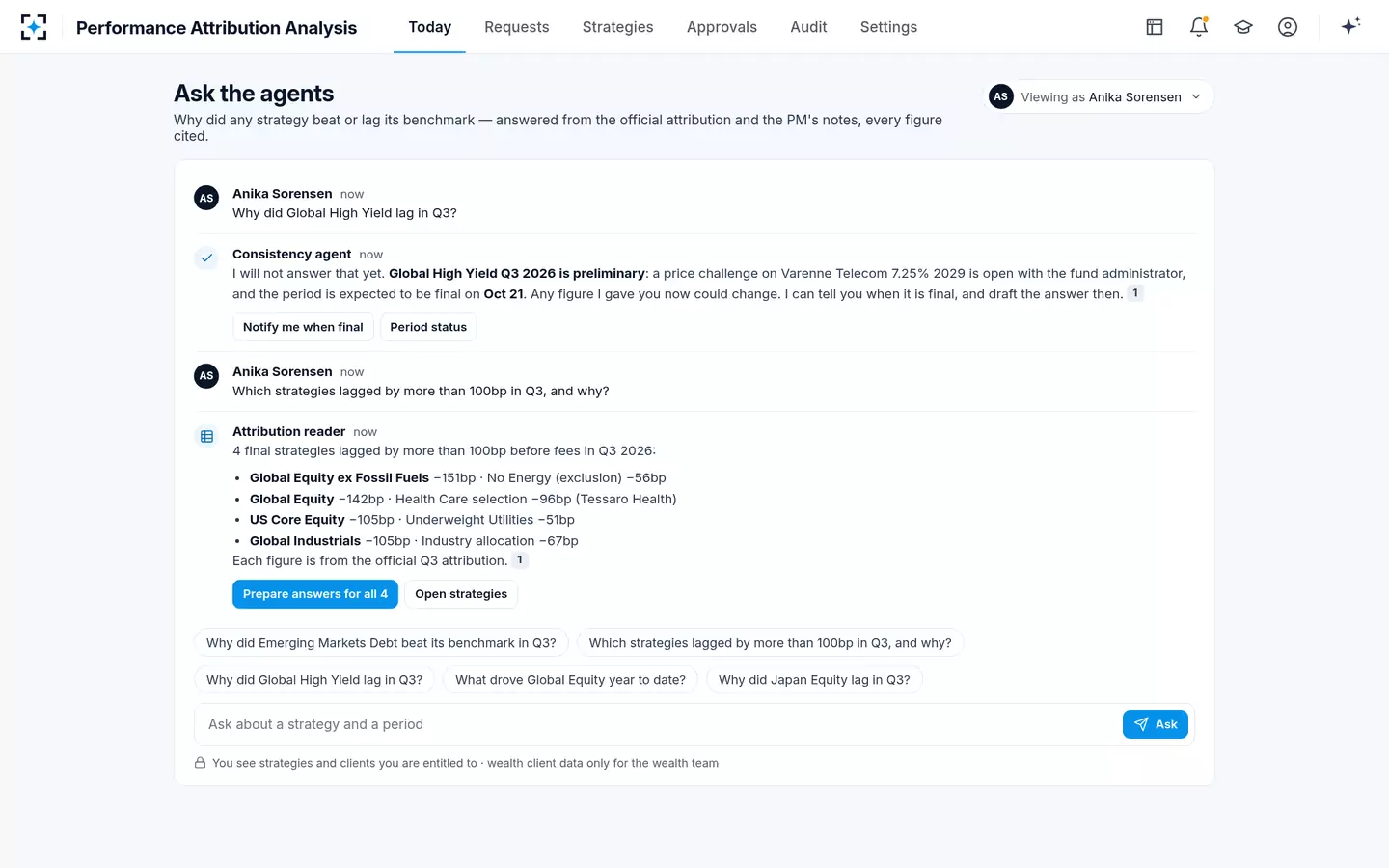
In practice, first-attempt scoring means the pilot runs the software once per question, logs the output before anyone edits it, and scores that. It also means scoring what the software does when it cannot answer. In the solution's sample, asked why Global High Yield lagged, its first and only answer was a refusal: the period was preliminary, a price challenge was open with the fund administrator, and it would be final on October 21. A refusal with a date is a pass; a confident answer from an open period is a fail, however accurate it turns out to be.
A first answer can be a refusal: Performance Attribution Analysis says when a preliminary period will be final
Who signs off a pilot?
The head of performance measurement, who answers for every figure that leaves the firm, signs the verdict on accuracy; the portfolio managers whose notes were used confirm the reasons were theirs; Marketing Compliance confirms the gross and net pairing, the holdings disclosure and the advertisement routing; and the head of client service confirms the elapsed-time results. One signature is not enough, because the pilot tests four different promises.
Compliance belongs in the room for a reason the SEC's examiners have spelled out. Their fiscal 2027 priorities say the Division is working harder to understand how what it calls super intelligence, or SI, shapes outcomes, and whether firms using it still meet their existing obligations, which it calls "technology-neutral" (SEC Division of Examinations, Fiscal Year 2027 Examination Priorities, October 2026). A pilot's scored answers, rules and sign-offs are the first evidence that a firm checked those obligations before going live.
What should a pilot of attribution software prove?
Four things, each with a number: that every figure in its answers ties to the official returns, that it never answers from a preliminary period, that it never gives a reason the portfolio manager did not, and that answers reach a signature faster than today. If any of the first three fails on real questions, faster is irrelevant.
A pilot passes if it proves these, on your own questions
- Every figure ties to the official returns
Within your rounding tolerance, before and after fees. The solution's design target is 100%.
- No answers from open periods
Preliminary and open periods refused with the date they will be final; restated periods answered with both figures.
- No invented reasons
Every reason found in a note, minute, trade or the PM's reply; otherwise the PM is asked.
- Consistent with what was published
Same drivers as the factsheet, the commentary and earlier answers for the same strategy and period.
- Faster to a signature
Elapsed time and analyst hours below the baseline, measured in the live week.
- Every step can be shown
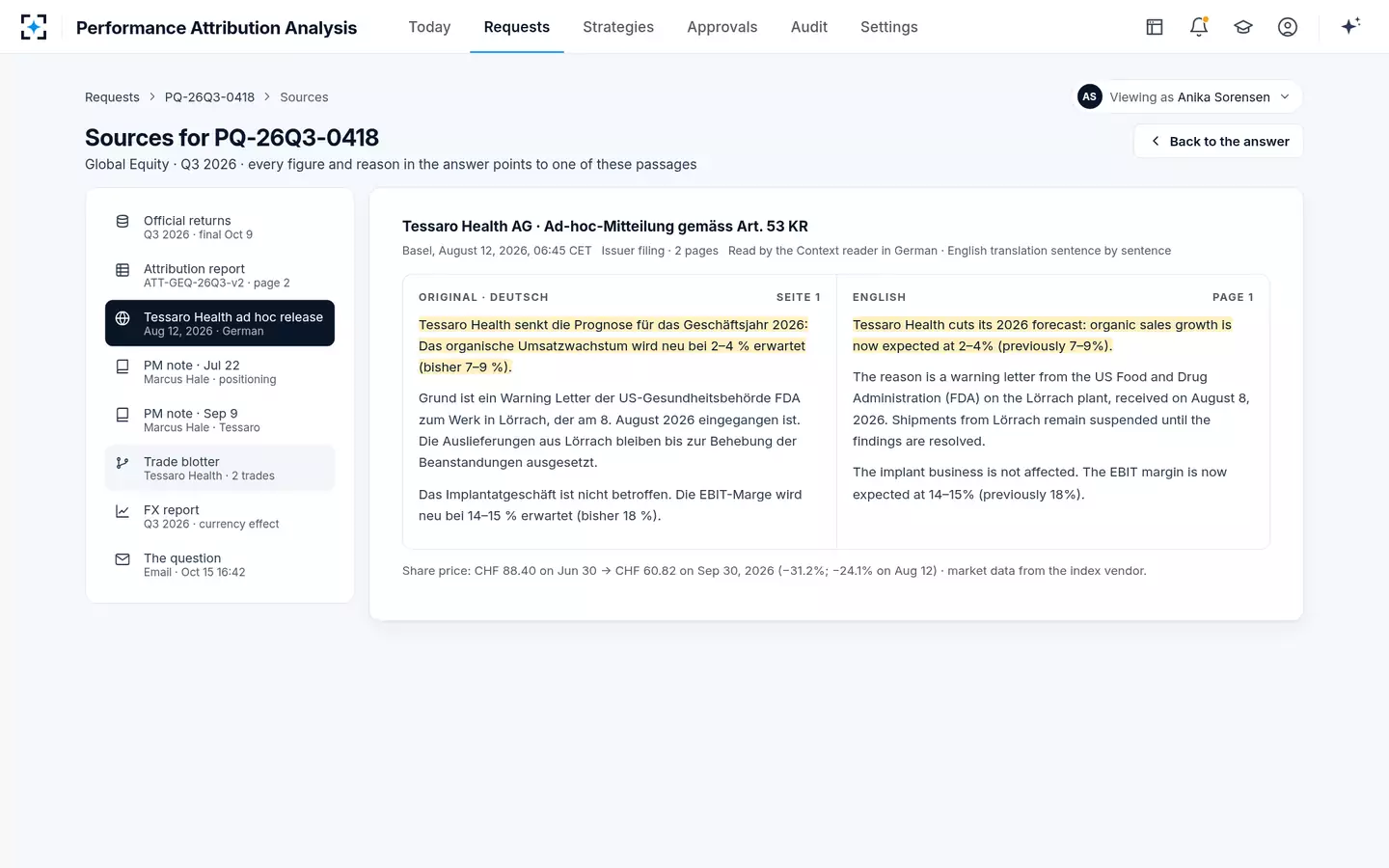
For any answer: the attribution version read, the sources, the checks, the approvals, exportable.
Every figure and reason points to a source an examiner can open
Attribution software that fits beside your systems, and where it does not
Performance Attribution Analysis sits beside the systems a performance team already runs; it does not replace any of them. It reads official returns, attribution and period status from the performance measurement system, holdings and transactions from portfolio accounting, the blotter from the order management system, notes and published materials from document management, and questions and agreements from the CRM and mailbox. It does not calculate attribution, and it is not the right purchase if your attribution itself does not reconcile; fix that first.
It also does not decide what counts as an advertisement. Its Disclosure agent routes any answer for more than one recipient to Marketing Compliance by default, and a pilot is the time to agree with compliance how reused prepared answers are treated. The difference between an answer tool and a calculation engine, and the controls a tool must have, are in why the writer is never the checker.
Running the Performance Attribution Analysis pilot
A pilot of the solution follows the five weeks above. Setup connects the systems, maps strategies and benchmarks, and tests the agents on a question already answered by hand; the replay then covers the sampled questions; and the live week runs side by side with your own answers. Answer rules, such as materiality, rounding tolerance and the confidence floor at which the agents ask the PM instead of answering, are set as versioned settings before scoring starts; in the solution, any change to them is replayed on past answers and approved by a second person before it applies.
What you see at the end is your own quarter, answered twice, with every difference explained. For how one of those answers is built from the grid, see the performance attribution analysis example. To arrange a pilot on your own attribution reports, PM notes and past consultant questions, start from Performance Attribution Analysis.
Questions people ask
What is attribution software?
The term covers two kinds of product: systems that calculate performance attribution from holdings, transactions and benchmark data, and tools that explain the result in answers and commentary. A pilot should be designed for the kind you are buying; an answer tool is tested against sent answers, a calculation system against reconciled returns.
Can a pilot use real client data?
It should, under the same access rules your team works under, because synthetic questions miss the hard cases. Nothing produced in the pilot is sent to a client; the replay compares with answers already sent, and the live week runs in parallel with your own process.
What if the replay shows our sent answers were wrong?
Treat it as a finding, not an embarrassment: correct what needs correcting through your normal process, and count it in the baseline. A replay that finds a figure sent from a period later restated has shown exactly the failure the software is meant to prevent.
How much of our team's time does a pilot take?
Most of it falls in week one, gathering the material, and week three, scoring. A few dozen answers scored carefully by one or two analysts, with the PMs confirming reasons for their own strategies, is a realistic load outside a quarter close.
What happens after a successful pilot?
The answer rules agreed in the pilot become the starting settings, the first live weeks run with the same scorecard, and the baseline becomes the yardstick for the first full quarter. In the solution, later changes to rules are proposed, replayed on past answers and approved by a second person.