An investment performance analyst calculates, checks and signs a firm's official returns and attribution, and then answers the questions those numbers raise, the most common being "why did we lag the benchmark?" The analyst can explain the basis points within minutes; what takes a day or more is getting the reason from the portfolio manager, making the answer match the factsheet the client portfolio manager has already published, and handing it to consultant relations to send. Those four seats, analyst, portfolio manager, client portfolio manager and consultant relations, carry every answer, and most delays and contradictions happen between them. Botminds' Performance Attribution Analysis drafts the answer from the official attribution and the manager's own notes, so each seat reviews instead of chasing.
The people and figures from the solution on this page are sample data: Quillfield Capital and its staff are fictional, and the hours quoted are the solution's own estimate on the sample firm's volume of about 1,100 questions a quarter across 148 strategies, not a measured result.
Four seats carry one answer, and each asks a different question
Today
Closes the quarter's official returns, then fields 30–40 "why" questions a week: finds the right report and period, emails the PM, drafts, and checks every number by hand.
With agents
Opens a draft already bound to the official cells, with the PM's reasons quoted and the checks run; reads, approves with a reason code and signs.
Still theirs: the signature: no answer leaves without it
Today
Answers the same question for every consultant by email, often from memory, weeks after the decision.
With agents
Reviews the reasons once, in his own words from his notes; is asked only when no note, minute or trade explains a driver.
Still theirs: the reason for every decision
Today
Speaks for the strategy to consultants and boards; needs every answer to match the factsheet and commentary already published.
With agents
Finds a prepared answer for each strategy's main drivers at period close, checked against the factsheet; asks follow-ups in plain words.
Still theirs: the relationship and the message
Today
Owns the request queue and its clocks; chases the analyst and the PM; logs what was sent, when it can be found.
With agents
Sends only answers an analyst has signed; the CRM case and the trail are written as Send is pressed.
Still theirs: the clock and the send button
What does an investment performance analyst do?
An investment performance analyst produces the numbers a firm stands behind: time-weighted returns for each portfolio and composite, the attribution that explains them against the benchmark, and the risk statistics around both. The quarter has a hard centre: the period close, when returns are reconciled with the accounting books, signed and published. In the solution's sample, the performance analyst for equities signed the third quarter's official returns on October 9, with 141 of 148 strategies final; the other seven waited on price challenges and restatements.
After the close, the work turns outward. Consultants, pension boards, wealth clients and the firm's own sales team ask why a strategy beat or lagged, and each question becomes a small project. The sample analyst describes it in one line: "I can explain the 142 basis points. What takes the day is finding the PM's reason and proving every number." That sentence is the job description most job postings leave out.
Four seats behind one answer to "why did we lag?"
A single consultant question touches four people in sequence, and each hand-off is a wait. The flow below is the path an answer takes at the sample firm; other firms name the seats differently, but the knowledge sits in the same four places.
One question, four seats, five hand-offs
A person decides
Consultant relations logs itNotes the strategy, account, period, benchmark and due date from an email, CRM case or consultant portal, and passes it to performance.
A person decides
Performance analyst finds the numbersPulls the official attribution for the exact strategy, period and benchmark, and identifies the two or three effects that explain the gap.
A person decides
Portfolio manager gives the reasonExplains the decisions behind those effects, from notes, minutes and trades, or from memory if the notes are thin.
A person decides
Analyst drafts and checks; CPM alignsWrites for the audience, checks every figure, gross and net, against the official returns; the client portfolio manager checks it matches the factsheet.
A person decides
Consultant relations sends and logsSends the approved answer, and logs it to the client's case so the next person who asks can find it.
Seat one: the performance and attribution analyst
The performance and attribution analyst is the one seat that can say whether a number is right. That makes the seat the natural owner of every answer, and also its bottleneck: the analyst who closed the quarter on Friday is the same person every consultant's question lands on the following Monday. The sample firm's analyst fields 30 to 40 such questions a week in the weeks after a close, on top of the restatements and late prices that keep some strategies open.
A 2024 study of AI agents for attribution notes that performance teams employ specialists with certifications such as the CIPM (Certificate in Investment Performance Measurement), and describes the independence the role is meant to have, which comes up again below. What the credential does not cover is the part of the job that takes the longest: getting a reason out of someone else and writing it for a reader who will repeat it to a board.
Where an answer's analyst hours go, by the solution's estimate
By hand: about 2.5 hours per answer
- Getting the reason from the PM · 24%
- Drafting for the audience · 24%
- Checking every figure, gross and net · 18%
- Finding the official attribution · 16%
- Logging the question · 10%
- Approval, send and CRM · 8%
Seat two: the portfolio manager, who holds the reason
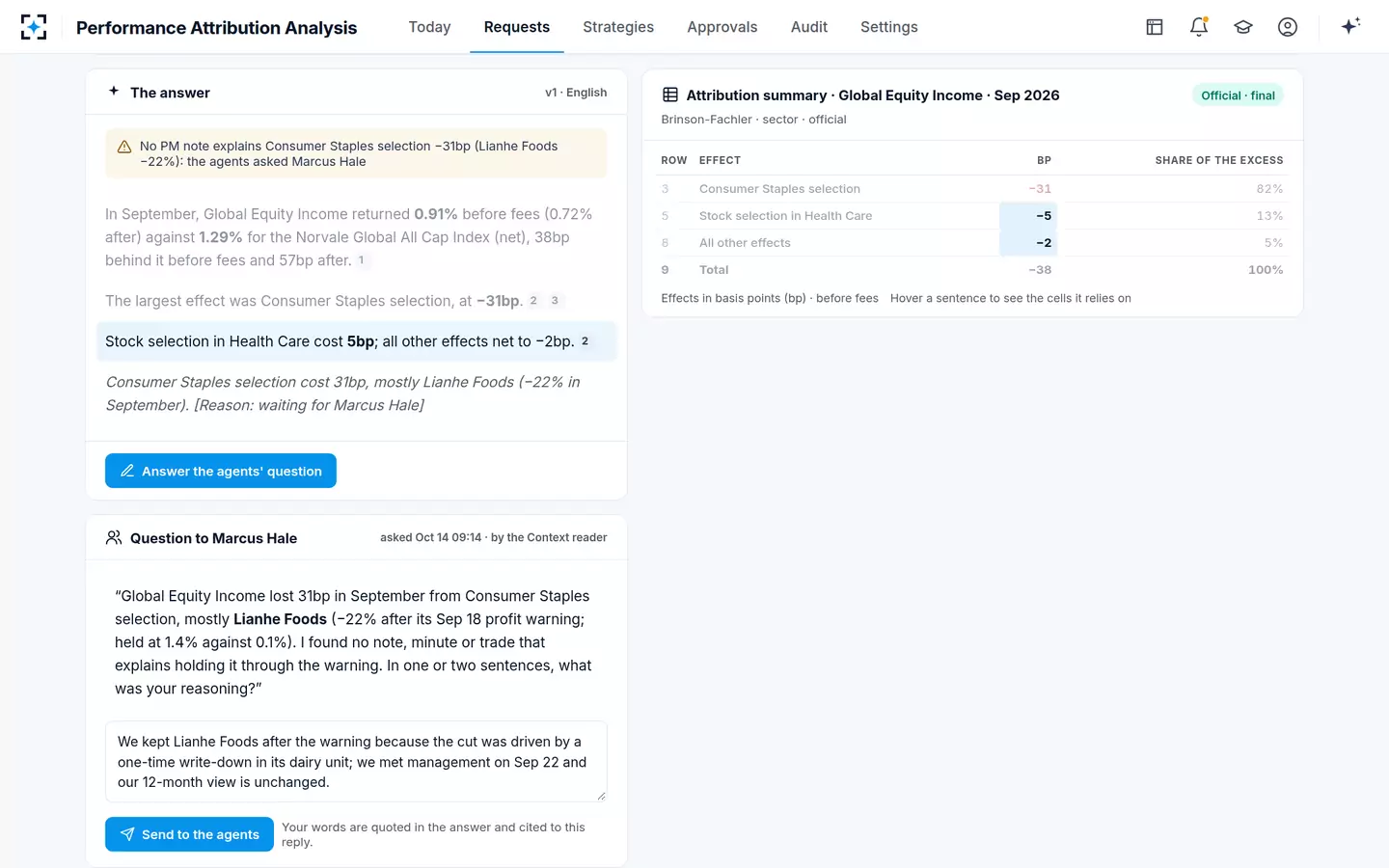
The portfolio manager is the only seat that knows why. An attribution report can show that Health Care stock selection cost 96bp; only the manager can say he added to Tessaro Health in July because he judged a product recall contained to one plant, and cut it in September after a profit warning. In the sample, both reasons were already written down, in his July 22 and September 9 notes. When they are not, the analyst's email to the manager becomes the wait; by the solution's estimate, getting the reason is the largest single share of an answer's analyst time.
The manager's own requirement is narrower than it sounds: use his words. In the sample he puts it as "I wrote down why I bought Tessaro on July 22. Use my words, don't make up new ones." A draft that paraphrases a note into a more confident reason is a statement the manager never made, and it is the kind of sentence a consultant quotes to a board.
When no note explains a driver, the question goes to the manager in one or two sentences
What is a client portfolio manager?
A client portfolio manager speaks for a strategy to clients, consultants and boards, without running its money day to day. The seat sits between the investment team and the client team: it owns the strategy's story, the commentary and the factsheet, and it is accountable when an answer to one consultant contradicts what another was told. In the sample, the client portfolio manager for Global Equity needs every answer to be readable by a board meeting on November 4 and to match the factsheet published on October 14.
That second need is where contradictions come from. A strategy's quarter is described in a factsheet, a commentary, the investment committee papers, and dozens of individual answers, written by different people over several weeks. If the factsheet names Health Care selection and an answer written in a hurry leads with currency, a consultant comparing the two will ask which is true. Both may be, but the conversation is now about the firm's consistency, not the strategy.
Seat four: consultant relations, who owns the clock
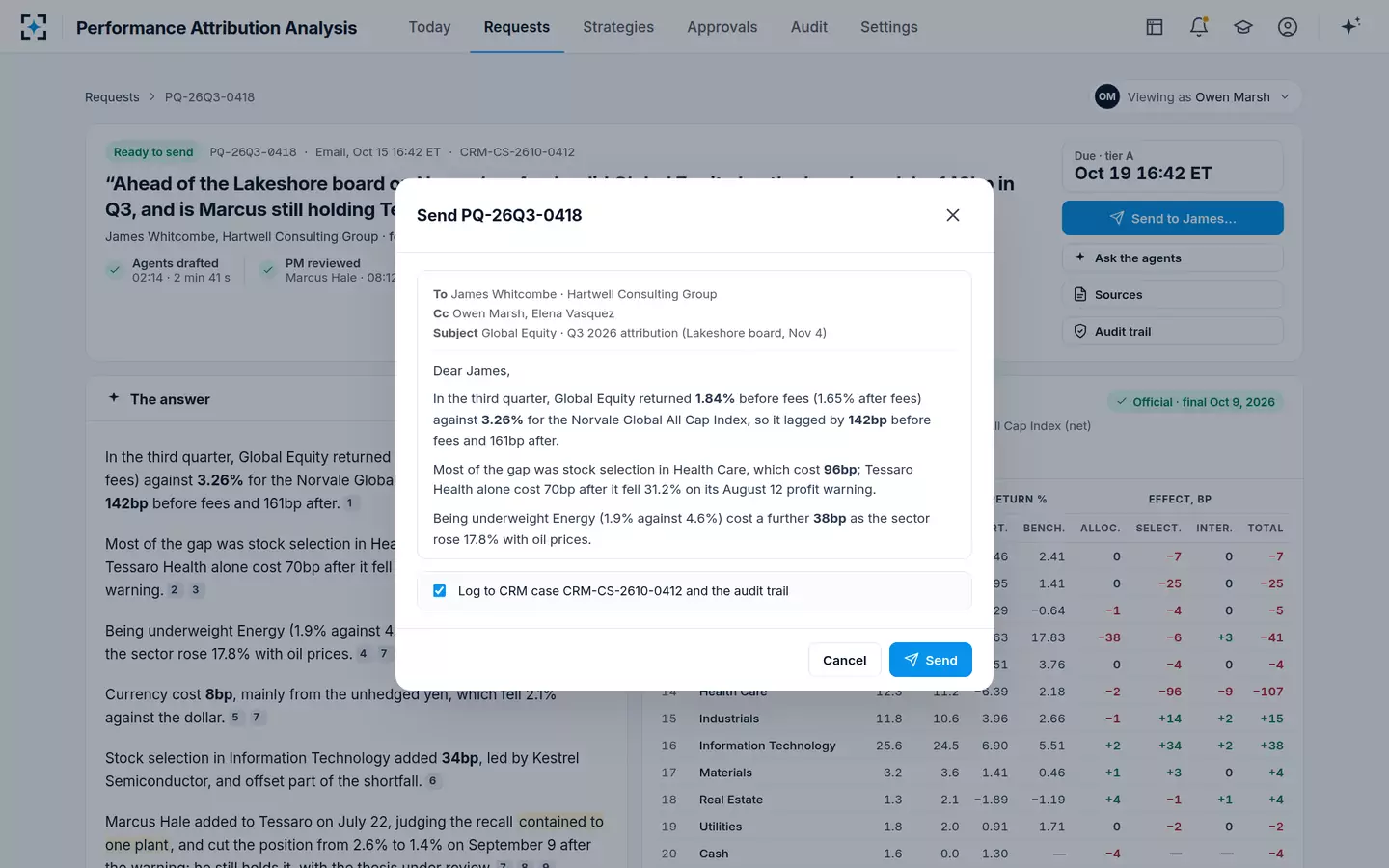
Consultant relations owns the request queue: who asked, on behalf of which client, by when. The sample firm's consultant relations manager covers 46 consultant relationships, and his tier-A consultants expect an answer within two business days. A question that arrives at 16:42 on a Thursday has until 16:42 on Monday; in the sample, the answer went on Friday morning.
His rule is the one that protects the firm: "If I send it, it is approved and it is logged. I never want to re-send a corrected number." A corrected number has to go to every consultant who received the first one, and finding them is only easy if every sent answer was logged with its figures. In the sample, a restatement of one strategy's second quarter, from −118bp to −137bp, meant correcting three answers already sent to three different consultants.
Only the client team sends, and only after an analyst has signed
How long does it take to answer a consultant?
No regulator or independent study publishes how long performance teams take to answer a consultant's "why" question, and service levels are set firm by firm and consultant by consultant. The sample firm's tier-A clock is two business days, and by the solution's estimate a hand-built answer uses about 2.5 hours of analyst time spread across those days: most of the elapsed time is waiting for the manager and for the client portfolio manager's review, not working.
The useful measure for a team is therefore not hours worked but elapsed time from question to signed answer, and how much of it was spent waiting on each seat. A team that measures only analyst hours will find little to save. One that measures waiting will find most of the delay in the PM's inbox and in re-checking numbers that someone else already checked. The KPIs that show whether attribution software pays sets out how to measure both.
Who writes portfolio commentary, and who checks it?
Who drafts portfolio commentary differs from firm to firm; what does not differ is where the knowledge sits: the portfolio manager has the reasons, performance has the numbers and the client portfolio manager has the message, so each has to check the part only they know. For registered funds, the shareholder report also has a regulator's specification. Form N-1A, as amended by the SEC in 2022, requires a fund's annual shareholder report to "Briefly summarize the key factors that materially affected the Fund's performance during the reporting period, including the relevant market conditions and the investment strategies and techniques used by the Fund's investment adviser" (Item 27A(d)(1), Tailored Shareholder Reports release, 2022).
The same disciplines apply to every consultant answer, whether or not a rule requires them: key factors, not all of them; market conditions and the adviser's own decisions, kept apart; and every figure checkable against the official returns. A central bank's reserve managers report the same way to their board. The Central Bank of Brazil's performance team described its own cadence plainly: "The Risk and Performance Report is presented on a quarterly basis to the Central Bank of Brazil’s board of directors" (ECB, 2004).
Performance attribution analyst salary and the numbers behind the role
The US Bureau of Labor Statistics does not count performance or attribution analysts separately; they fall under financial and investment analysts, whose 26 tasks in the O*NET occupational profile do not mention attribution, benchmarks or commentary at all (O*NET 13-2051.00). The pay and employment figures for the broader occupation are the nearest public guide.
Financial analysts, the occupation performance analysts are counted in
$103,570
median annual pay, 2025
443,100
jobs in 2025
7%
projected growth, 2025–35, much faster than average
24%
of financial and investment analysts work in securities, commodity contracts and other financial investment activities
For a business case the more useful number is the firm's own: analysts' loaded cost per hour times the hours an answer takes, times the questions a quarter. At the sample firm's volume of 1,100 questions and the solution's estimated saving of about 1.75 hours each, that is roughly 1,900 analyst hours a quarter by that estimate, close to a full-time analyst's year, available for the work the seat exists to do.
Who should the performance team report to?
Outside the investment team. The independence of performance measurement is the reason its numbers are trusted, and the same 2024 study of attribution summarises the long-standing recommendation from Carl Bacon's 2008 textbook in one sentence.
Ideally, the performance attribution team should be part of a risk control function, never reporting to the front office or the marketing department.
de Melo and Sheikh, arXiv 2403.10482 (2024, not peer reviewed), summarising Bacon (2008)
That independence is easy to keep on paper and easy to lose in practice. An analyst who drafts the commentary, takes the manager's edits and sends it on the client team's deadline is no longer checking the investment team's story; they are co-writing it. The control that keeps the line is a separation of duties inside each answer: the person who drafted or changed a number is not the person who approves it, and the person who approves it is in performance. Why the writer is never the checker sets out how an attribution tool should enforce that.
What changes at each seat with Performance Attribution Analysis
The seats stay; the reading, drafting and checking between them move to agents. In the solution, an Intake agent logs each question with its clock; an Attribution reader pulls the official attribution; a Context reader finds the reasons in the manager's notes, minutes, trades and the issuer's own filings; a Narrator drafts; a Consistency agent checks every figure; a Disclosure agent applies the holdings and advertisement rules; a Delivery agent prepares the email. The portfolio manager reviews the reasons, the analyst signs and the client team sends.
The analyst's morning in Performance Attribution Analysis: what the agents did overnight, and what needs her
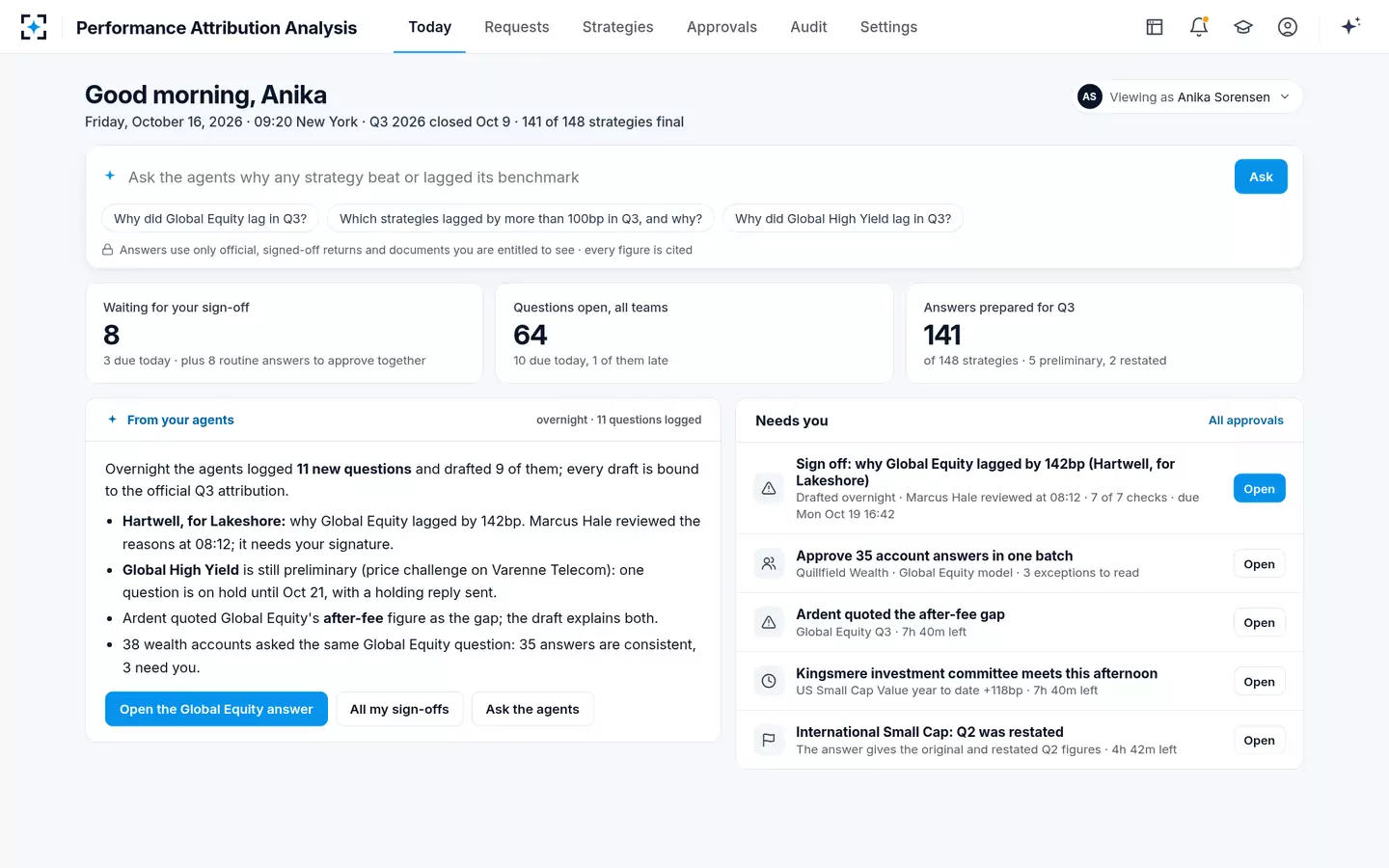
What does not change is accountability. The analyst who signs is still answering for every figure, which is why each sentence in the draft lights the cells it relies on. The worked report behind a typical answer is in the performance attribution analysis example, and the solution itself is at Performance Attribution Analysis.
Questions people ask
Is an investment performance analyst the same as a performance and attribution analyst?
Largely, yes. Firms use both titles for the seat that calculates returns and attribution, and some split it into a returns team and an attribution team. Either way the seat signs the official numbers and answers questions about them.
What qualifications do performance analysts have?
Performance teams employ specialists with certifications such as the CIPM, which is specific to performance measurement and attribution. The BLS notes that financial analysts may advance to portfolio or fund manager roles as they gain experience.
How many questions does a performance team answer?
It varies with the firm's client base; no regulator or independent study publishes a typical figure. The solution's fictional sample firm, with 148 strategies and a consultant-facing institutional business, receives about 1,100 questions a quarter, concentrated in the weeks after each period closes.
Should the portfolio manager write the answer?
The manager should supply the reason, in his own words, and review it; performance should own the numbers and the final check. When the manager writes the whole answer, the figures are rarely re-checked, and when performance writes the reasons, they are often paraphrased into claims the manager did not make.
What happens to sent answers when returns are restated?
Every answer that quoted the old figure has to be found and corrected. In the solution's sample, a strategy's second quarter moved from −118bp to −137bp after a late-booked spin-off, and the three answers already sent were found from the log and corrected with the head of performance's approval.