The best practice in client reporting software is to check each figure against its source, not the report against itself. Format rules, template validation and cross-footing prove that a report is internally consistent: the decimals are right, the tables add up, every required section is present. They cannot prove that the market value is the one in the accounting system, that the attribution ran on the basis the client's agreement requires, or that the commentary describes the final numbers. Most errors that lead to a reissued report are consistent and wrong. Botminds' Institutional Client Reporting was built on that distinction: its agents tie every figure to the book of record, trace each break to its cause, and leave the decision to the analyst and the release to someone who did not prepare the report.
The examples come from a fictional sample firm, Quillfield Capital, as it runs through the solution, and from SEC enforcement cases and examination findings.
How many of ten common client report errors each kind of check catches
What errors do client reports contain?
Client report errors fall into a small number of types, and they differ in what it takes to see them. Some are visible on the page: a total that does not add up, a field in the wrong format. Most are invisible on the page, because the figure is plausible and the report is internally consistent; only a comparison with the source, the agreement or the final numbers shows them.
Ten common client report errors, and which check catches each
| Error | Which checks catch it |
|---|---|
| Wrong decimal places or number format | Format or template check; tie to source |
| A required section or legend missing after a template change | Format or template check; client-terms check |
| A table whose rows do not add to its total | Cross-foot; tie to source |
| A figure keyed wrong in one cell, with the total keyed to match | Tie to source only |
| A stale figure carried from last quarter | Comparison with last quarter; tie to source |
| Attribution on the wrong fee basis: effects sum, total ≠ excess return | Cross-foot across pages; comparison with last quarter; tie to source |
| Market value at the wrong FX fixing for the client | Client-terms check only |
| Commentary that contradicts the final attribution | Commentary check against final figures only |
| Compliance certificate omitting a passive breach | Comparison with last quarter, sometimes; check against the compliance system |
| A deliberately altered figure in a plausible format | Tie to source only |
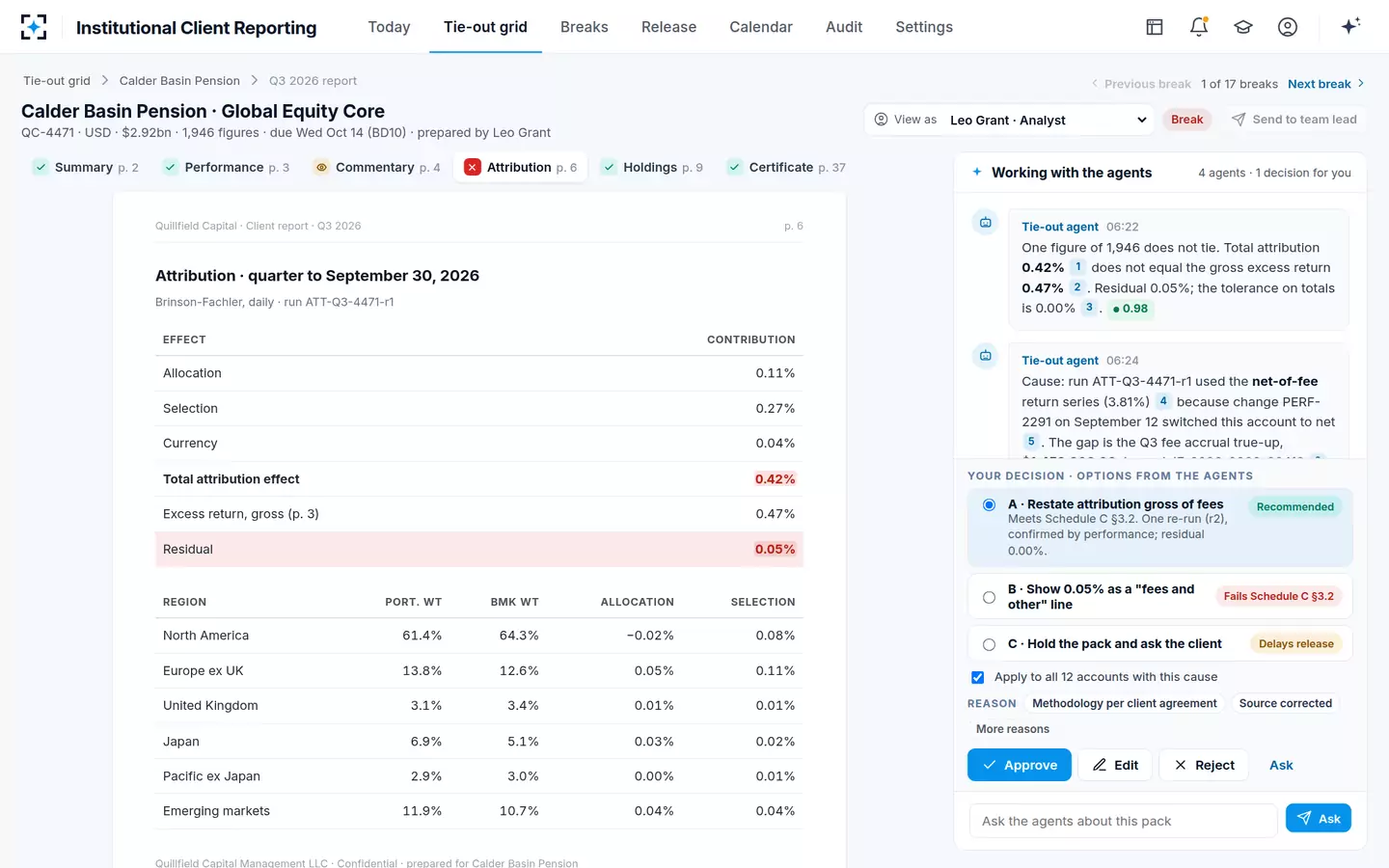
The attribution row is the most instructive, because it fooled a careful cross-foot at the sample firm. One mandate's attribution page showed allocation 0.11%, selection 0.27% and currency 0.04%: a total of 0.42%, correctly added. The performance page showed a gross excess return of 0.47%. Both pages were right about themselves. A template change on 12 September had pointed the attribution run at the net-of-fee return series, and the 0.05% residual was the quarter's fee accrual true-up. The client's agreement required attribution gross of fees, reconciled to the gross excess return, so the report broke a client term without containing a single arithmetic error.
How do you check a client report before release?
Check it in three layers, in this order: tie every figure to the system it came from; test the report against the client's own terms; then read the narrative and the certificate against the final figures. Format and cross-foot checks are worth running, but as housekeeping, not as the control. The order matters because each layer depends on the one before: commentary cannot be checked against figures that have not been tied, and terms cannot be checked against a report whose basis is unknown.
Checks that prove a report is consistent, and checks that prove it is right
Consistency checks: The report with itself: totals with rows, fields with formats, sections with the template.
Accuracy checks: Each figure with its system of record, each term with the agreement, each sentence with the final figures.
Consistency checks: The report was assembled without arithmetic or layout slips.
Accuracy checks: The report says what the books, the agreement and the compliance system say.
Consistency checks: Wrong basis, wrong source, wrong client term, stale commentary, altered numbers.
Accuracy checks: Errors in the source system itself, which need the source owner.
Consistency checks: A list of passed rules.
Accuracy checks: For each figure, the source value it was tied to and where it came from.
What is a tie-out in client reporting?
A tie-out is the check that a figure in a report equals the figure in its system of record, within a stated tolerance, for the same account, period and basis. Market value ties to portfolio accounting; positions tie to the custodian; returns tie to the performance system's run for that mandate and period; the benchmark ties to the index data for the version in the agreement; total attribution ties to the excess return; the certificate ties to the investment compliance system's rule results. A tie-out that fails is a break, and a break is resolved by finding its cause, not by adjusting the figure.
A break traced from the report figure to the accounting journal
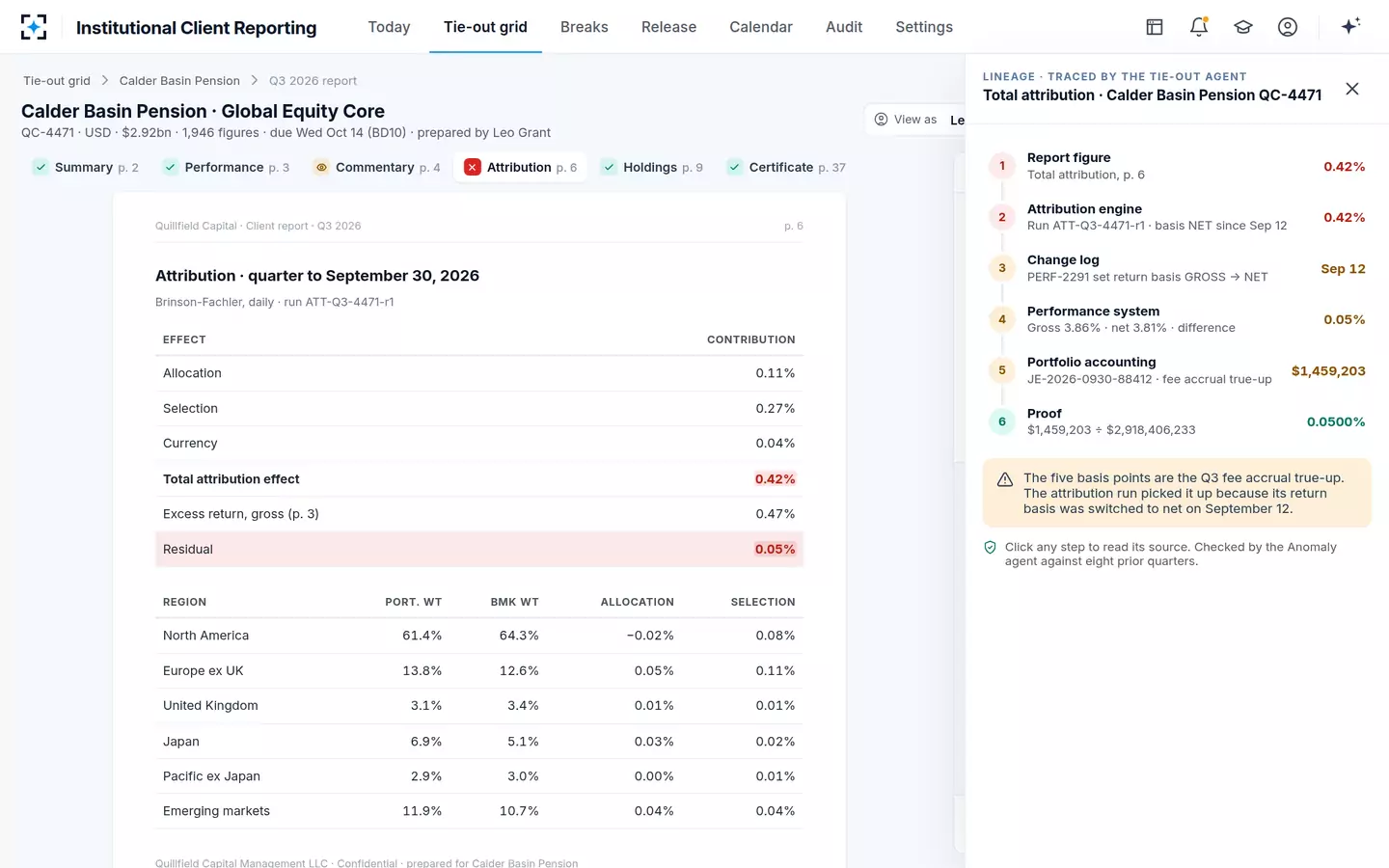
The lineage is what turns a break from an email thread into a decision. The performance analyst at the sample firm put the request plainly: tell me the account, the period and the cause. A tie-out that stops at "0.42% does not equal 0.47%" leaves the analyst to find the cause by hand. One that follows the figure through the attribution run, the change log, the performance system and the accounting journal arrives with it, and finds the eleven other mandates the same change touched.
Altered numbers pass every format check: the Allianz order
The clearest public evidence that format is not accuracy comes from the SEC's 2022 order against Allianz Global Investors U.S. The order describes a portfolio management team that altered risk reports, daily performance data, Greeks, attribution spreadsheets, expected-value sheets and open-position data sent to investors, and finds that nobody outside that team reviewed those communications in any meaningful way during the period (SEC order, Release No. 34-94927, 17 May 2022).
The alterations were built to look ordinary. In one example the order gives, a delta for 26 December 2018 was reduced "from 83.6041719850865% to 52.6041719850865%": one digit changed, thirteen decimal places kept. The team "caused at least 124 reports with altered Greeks to be sent to certain investors or prospective investors", and one member sent another "password-protected, step-by-step instructions on how to efficiently alter data to avoid detection by investors". Every one of those numbers would pass a format rule. None would survive a tie to the risk system that produced the original. Allianz Global Investors U.S. agreed to pay a $675 million civil penalty, with disgorgement and interest on top.
Deliberate alteration is rare. The structural lesson is not: a figure that has no independent counterpart, a risk statistic, an attribution effect, a stress-test result, is only as reliable as the tie between the report and the system of record, and the review by someone who did not prepare it.
What records must support performance in a report?
For an SEC-registered adviser, the working papers behind every performance figure it sends. Rule 204-2(a)(16) covers "all accounts, books, internal working papers, and any other records or documents that are necessary to form the basis for or demonstrate the calculation of any performance or rate of return" in a communication the adviser sends to any person, and the papers must last five years beyond the close of the fiscal year in which the figure was last used (17 CFR 275.204-2).
The SEC's examiners have shown what a gap looks like. In an April 2024 risk alert on the marketing rule, the staff reported advisers whose policies required net-of-fee performance alongside any gross figure while their advertisements showed gross only, and advisers that kept no documentation supporting performance claims in their advertisements (SEC Division of Examinations risk alert, 17 Apr 2024). Those observations concern advertisements, but the failure behind them, a policy that exists and is not applied, a figure that cannot be supported, is the same one a client report's tie-out is meant to prevent. A tie-out that keeps the source value for each figure produces the working papers as a by-product.
Why do client reports get reissued?
Reports are reissued when an error is found after release, and the errors that escape are the ones consistency checks cannot see: a wrong basis, a missed client term, commentary written on preliminary numbers, a certificate that omits something. No regulator or independent study publishes a reissue rate for institutional client reports, so the useful number is a firm's own: count wrong-figure reissues per quarter and classify each by the error type in the table above. The sample firm counted seven wrong-figure reissues in the second quarter of 2026, which is what made the case for checking differently.
The classification tells you where to put the control. If most reissues are wrong-basis or wrong-term errors, a stronger cross-foot will not help; a tie to the agreement will. If most are stale commentary, the fix is reading the narrative against final figures after any restatement, which is why the sample firm's commentary checker rewrote one sentence and sent the portfolio manager a redline when selection moved from 27 to 31 basis points.
Client reporting software features that matter, and the ones that don't
When comparing client reporting software, the features that decide accuracy are rarely on the first page of a brochure. Layout designers, chart libraries and portals matter to clients, but they do not prevent reissues. What prevents them is how the software knows where each figure came from and what each client agreed to.
Client reporting software best practices to test for in a comparison
- Every figure carries its source
Ask to click a number in a finished report and see the system, run and record it came from.
- Ties against the system of record, with tolerances you set
Totals exact, displayed returns to rounding, market value to a stated amount, positions exact.
- Client terms are checks, not template variants
Fee basis, benchmark version, FX fixing, sections and legends tested per mandate from the agreement.
- Breaks are traced to a cause, and grouped by cause
One template change that hits twelve mandates should be one decision, not twelve emails.
- Commentary is read against final figures
Direction, size and period, after every restatement, with a redline to the author.
- The preparer cannot release
And the releaser sees what was checked and decided, not just a status.
- Evidence is kept and exportable
Released reports, tie-out evidence, decisions and receipts, for as long as your retention policy requires.
One question cuts through a comparison: what happens when the source system changes? A methodology switch, a new benchmark version, a template update. Software that answers with a list of every affected mandate before the next release is checking accuracy; software that answers with a rebuilt template is checking layout.
Tolerances: how close is tied?
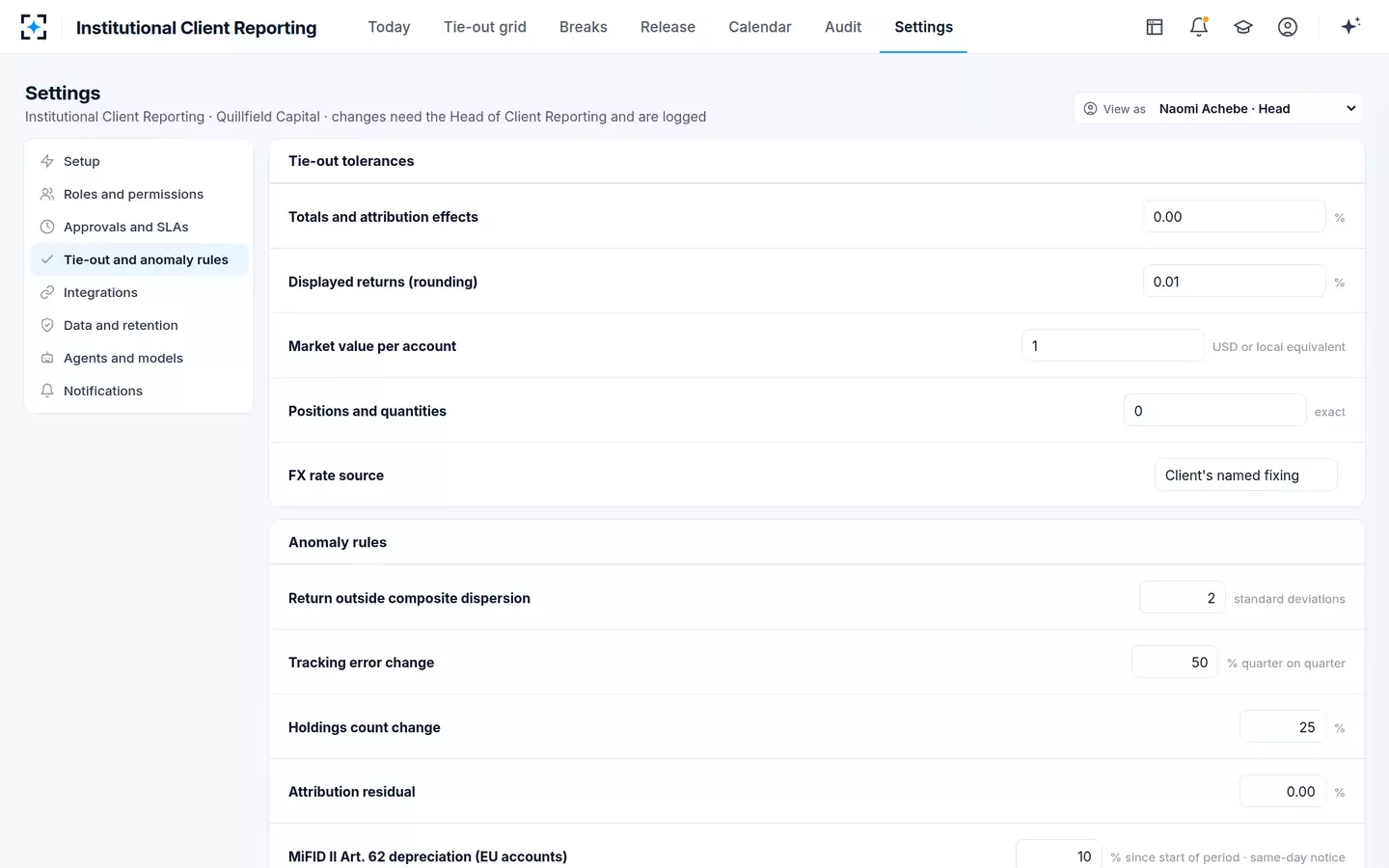
A tie-out needs a tolerance, and the tolerance should be set by figure type, not globally. Totals and attribution effects should tie exactly, because a residual is information. Displayed returns can tie to rounding, because a 3.855% return displayed as 3.86% is not a break. Market value can tie to a small currency amount per account, and positions must tie exactly.
Tolerances and anomaly rules as settings, approved and logged
Regulators have started to say the same about automated tools generally. ESMA's 2024 statement on artificial intelligence in investment services expects firms to put controls in place before the fact on the accuracy of the information AI systems are given and use, so that wrong information does not reach clients (ESMA public statement, 30 May 2024). A tie-out against the system of record, run before release, is that control.
Institutional Client Reporting runs all three layers on every report
Institutional Client Reporting runs all three layers on every report. The Tie-out agent recomputes and cross-foots every figure, compares accounting with the custodian, and follows each break's lineage to its cause; on the sample quarter it tied 1,184,316 figures and traced 17 breaks to five causes. The Requirements agent tests each client's terms; the Narrative check agent reads commentary and certificates against the figures and the compliance system. The Tie-out agent cannot change a figure. It proposes fixes with evidence, the analyst decides each break with a reason code, and a different person releases.
One break, three options, and the agreement clause that decides between them
What happens after the decision, the re-run, the redline and the release, is covered in automated client reporting, task by task. For the sections each figure sits in, see an investment performance report example, annotated; the solution is at Institutional Client Reporting.
Questions people ask
What is the difference between a cross-foot and a tie-out?
A cross-foot checks that a table's rows add up to its total, inside the report. A tie-out checks that a figure equals its value in the source system for the same account, period and basis. A report can cross-foot perfectly and fail a tie-out, as the sample attribution page did with effects summing to 0.42% against a 0.47% excess return.
Should a client report be checked by a second person?
Yes, and the second person should be the one who releases it, without having prepared or edited it. In the SEC's 2022 Allianz order, the altered investor reports went out with no meaningful review by anyone outside the team that produced them.
What tolerance should a client report tie-out use?
Exact for totals, attribution effects and positions; rounding for displayed returns; a small currency amount per account for market value. The sample firm uses 0.00%, ±0.01% rounding and ±$1 per account respectively, and treats any attribution residual above zero as a break.
Can AI check client reports?
AI agents can run the tie-outs, read agreements into checks and compare commentary with figures, at a scale no team can check by hand. ESMA expects ex-ante controls on the accuracy of information that AI systems use, and the decisions on breaks and the release should stay with people.
How do you measure client report accuracy?
Count wrong-figure reissues per quarter and classify each by error type, and track breaks found before release by cause. The first measures what escaped; the second shows which checks are doing the work. No regulator publishes an industry rate, so a firm's own trend is the benchmark.