The difference between a time weighted return and a money weighted return is the question each one answers. A time-weighted return (TWR) measures how the portfolio's investments performed, neutralising the size and timing of money the client added or withdrew, so it judges the manager and can be compared with a benchmark. A money-weighted return (MWR), usually an internal rate of return, measures what the client's money actually earned, so a well-timed contribution raises it and a badly timed one lowers it. On a quarter with a large cash flow the two can differ by several percentage points on the same account, and a client report that shows only one answers only one question. Botminds' Institutional Client Reporting reads which method each client's agreement requires and ties the figure it reports to the performance system's run for that method.
The worked example below is illustrative arithmetic, not a sample client. Product examples later on come from the fictional sample firm Quillfield Capital as it runs through the solution.
Time-weighted vs money-weighted return, row by row
Time-weighted return (TWR): How well did the manager invest the money it had, period by period?
Money-weighted return (MWR): What did the client's money earn, given when it went in and came out?
Time-weighted return (TWR): Neutralised: the period is split at each flow and the pieces are linked.
Money-weighted return (MWR): Included: size and timing of every flow change the result.
Time-weighted return (TWR): Usually the client, which is why the manager should not be judged on them.
Money-weighted return (MWR): Usually the manager, as in a closed-end fund that calls and returns capital.
Time-weighted return (TWR): "reflects the change in value and negates the effects of external cash flows"
Money-weighted return (MWR): "reflects the change in value and the timing and size of external cash flows"
Time-weighted return (TWR): Meaningful: an index has no cash flows either.
Money-weighted return (MWR): Not directly; a benchmark needs the same flows applied to it.
Time-weighted return (TWR): Segregated mandates, open-end funds, composites.
Money-weighted return (MWR): Private equity, real estate funds, closed-end vehicles, a client's own experience.
Two returns, one account: a worked example
Take a segregated equity mandate worth $100.0 million at the start of a 92-day quarter. Over the first 46 days the portfolio falls 8%, to $92.0 million. At the close on day 46 the client moves money. Over the remaining 46 days the portfolio rises 10%. The manager's investment decisions are identical in both cases below; only the client's cash flow differs.
The same investment results, two different client cash flows
| Day 46 cash flow | Case A: adds $50.0m | Case B: withdraws $40.0m |
|---|---|---|
| Value after the first half (−8%) | $92.0m | $92.0m |
| Value after the cash flow | $142.0m | $52.0m |
| Value at quarter-end (+10%) | $156.2m | $57.2m |
| Gain after cash flows | +$6.2m | −$2.8m |
| Time-weighted return: 0.92 × 1.10 − 1 | +1.20% | +1.20% |
| Modified Dietz for the whole quarter | +4.96% | −3.50% |
| Money-weighted return (IRR, for the quarter) | +4.97% | −3.51% |
The time-weighted return is +1.20% in both cases, because the manager's decisions were the same: lose 8%, then gain 10%. The money-weighted return swings from +4.97% to −3.51%, because in case A most of the client's money arrived just before the good half and in case B most of it left just before. Neither number is wrong. The first tells a trustee how the manager did; the second tells the trustee what the fund's money did.
Same manager, same quarter: the money-weighted return moves with the client's timing
Time weighted return calculation, step by step
A time-weighted return is calculated by valuing the portfolio immediately before each external cash flow, computing the return for each sub-period between flows, and linking the sub-period returns geometrically: (1 + r₁) × (1 + r₂) × … − 1. In the example, the sub-period returns are −8% and +10%, so the quarter's TWR is 0.92 × 1.10 − 1 = 1.20%. Dividends and interest earned inside the portfolio are not external cash flows: the GIPS glossary defines an external cash flow as capital, cash or investments, that enters or leaves the portfolio, and expressly leaves income payments out.
The hard part is the valuation, not the arithmetic. A true TWR needs a value on the date of every flow, and for liquid portfolios that is now routine with daily valuation. Where daily values are not available, the 2020 GIPS Standards for Firms set the floor for portfolios in composites: value them "At least monthly", at month-end, and "On the date of all large cash flows", which each firm must define for each composite (how big is significant works through that choice); calculate "sub-period returns at the time of all large cash flows, if daily returns are not calculated"; and "Geometrically link periodic and sub-period returns" (GIPS Standards for Firms 2020, provisions 2.A.23 and 2.A.24).
Modified Dietz method: a money-weighted shortcut inside a time-weighted return
The modified Dietz method estimates a period's return without a valuation on the day of each flow, by weighting each cash flow by the share of the period it was invested: return = (end value − start value − net flows) ÷ (start value + Σ flow × weight). That is a money-weighted formula, and over a short period with small flows it is very close to the true time-weighted return. Over a period with a large flow it is not: in case A, modified Dietz across the whole quarter gives 4.96%, almost exactly the IRR, while the true TWR is 1.20%.
This is why the standards allow a daily-weighted adjustment only for flows that are not large. GIPS provision 2.A.24(d) says: "For external cash flows that are not large cash flows, calculate portfolio returns that adjust for daily-weighted external cash flows, if daily returns are not calculated." A common way to meet this is to compute monthly modified Dietz returns, split the month at any large flow, and link the pieces. So the answer to "modified Dietz vs time weighted return" is that modified Dietz is a way of building a time-weighted return, valid only between large flows.
Is IRR time weighted or money weighted?
An internal rate of return is money-weighted. It is the single rate that makes the start value plus every cash flow, compounded to the end, equal the end value, so every flow's size and date affect it. The GIPS standards define a money-weighted return as one that "reflects the change in value and the timing and size of external cash flows", and when a firm presents one under the standards it must "Calculate annualized since-inception money-weighted returns" using "daily external cash flows" (GIPS 2020, glossary and provision 2.A.29).
The since-inception rule reflects how MWR is meant to be read. A one-quarter IRR, as in the example, is useful for explaining a quarter to a client, but the measure's natural home is the whole life of an investment whose flows the manager controlled: a private equity fund from first call to final distribution.
When does GIPS allow money weighted returns?
Under the 2020 GIPS Standards for Firms, time-weighted is the default, and money-weighted is permitted only when the manager controls the flows and the vehicle has a specific shape. Provision 1.A.35 says the firm "may present money-weighted returns only if the firm has control over the external cash flows into the portfolios in the composite or pooled fund" and the portfolios have, or the pooled fund has, at least one of four characteristics: "Closed-end", "Fixed life", "Fixed commitment" or "Illiquid investments as a significant part of the investment strategy." (GIPS 2020, 1.A.35).
The firm must present time-weighted returns unless certain criteria are met, in which case the firm may present money-weighted returns.
GIPS Standards for Firms, 2020, provision 1.A.35
Those rules govern how a firm claiming compliance presents composite and pooled-fund performance to prospective clients; they do not dictate what a manager puts in an existing client's own quarterly report, which the agreement decides. But they encode the right test for any report: whoever controls the cash flows should not be credited or blamed for their timing. Composite construction and the GIPS claim itself are covered by Botminds' GIPS Compliance Reporting.
Why does my return differ from the fund return?
Because a fund's published return is time-weighted and an investor's own return is money-weighted. Two investors in the same fund, in the same year, earn different returns if one bought before a rally and the other after it. The fund's figure is the same for both, because it neutralises their flows; each investor's own figure is not.
The gap is not only individual. Studying whole markets, Ilia Dichev found that "investor and security returns differ because of the timing and magnitude of investor capital flows into and out of these securities", and that "actual investor returns are systematically lower than buy-and-hold returns for nearly all major international stock markets" (Dichev, American Economic Review, 2007). Investors in aggregate tend to add money after good periods and withdraw after bad ones, which is case B in the example played out across a market. A pension fund that funds its mandates on a schedule faces the same arithmetic: its money-weighted experience can trail the manager's time-weighted record without anyone having made a mistake.
Which return should a client report show?
A client report should show the time-weighted return against the agreed benchmark, because that is the comparison that judges the manager and the one EU periodic statements are built around: Article 60(2)(e) requires the period's performance to be compared with the benchmark, if any, that the firm and the client agreed (Delegated Regulation (EU) 2017/565). Where the client moves money in and out, adding its money-weighted return answers the trustee's other question, what the fund's money earned, and heads off the call that follows a quarter like case A or B.
What a client report should say about its returns
- Name the method on the page
Time-weighted or money-weighted, and for TWR whether daily or monthly with large flows split.
- Show the time-weighted return beside the agreed benchmark
Gross and net of fees, as the agreement requires.
- Add the money-weighted return where the client's flows were large
And a sentence explaining why the two differ this period.
- State the periods and whether they are annualised
Since-inception returns name the inception date.
- Use the currency and FX fixing in the agreement
A euro-based client's return in euros, at the fixing it agreed.
- Keep the run behind each figure
The working papers that show how the return was calculated.
Currency, periods and annualising: three more ways one account shows two returns
Method is not the only choice that makes two honest returns differ. The reporting currency is the second. A global mandate that returned 1.20% in US dollars over a quarter in which the euro rose 2% against the dollar returned about −0.78% to a euro-based client: 1.012 ÷ 1.02 − 1. Both figures are time-weighted and both are right; only one is the client's. That is why a euro pension fund's agreement names the currency and the fixing, and why the sample firm's German client asks for returns "in euros" at the 16:00 London closing rate.
The period is the third. A quarter's 1.20% compounded over four quarters would be 4.89%, but that is a projection, not a return, and the 2020 GIPS standards forbid it in the presentations they govern: "Returns for periods of less than one year must not be annualized." (GIPS 2020, provision 2.A.12). The reverse step is required for longer periods: a three-year cumulative return of 21.0% is shown as 6.56% a year, (1.21)^(1/3) − 1, and a report should say which of the two the client is looking at. Since-inception figures need their inception date beside them, because a mandate funded in a falling market and one funded at the top can show very different since-inception returns for the same manager.
None of these choices is a matter of taste once the agreement is signed. Each one is a client term, and each one is a place where a report can be internally consistent and still not be the report the client agreed to receive.
How Institutional Client Reporting keeps each client's method
In Institutional Client Reporting the return method is a client term, read from the agreement and checked on every report. The sample firm's German client writes it into Ziffer 3.1 of its reporting annex: performance by the time-weighted method, in euros, gross and net. The Requirements agent turns that clause into a check, so a report drafted from a money-weighted series or in dollars would fail it before anyone read the report.
The return method as a client term: time-weighted, in euros, gross and net
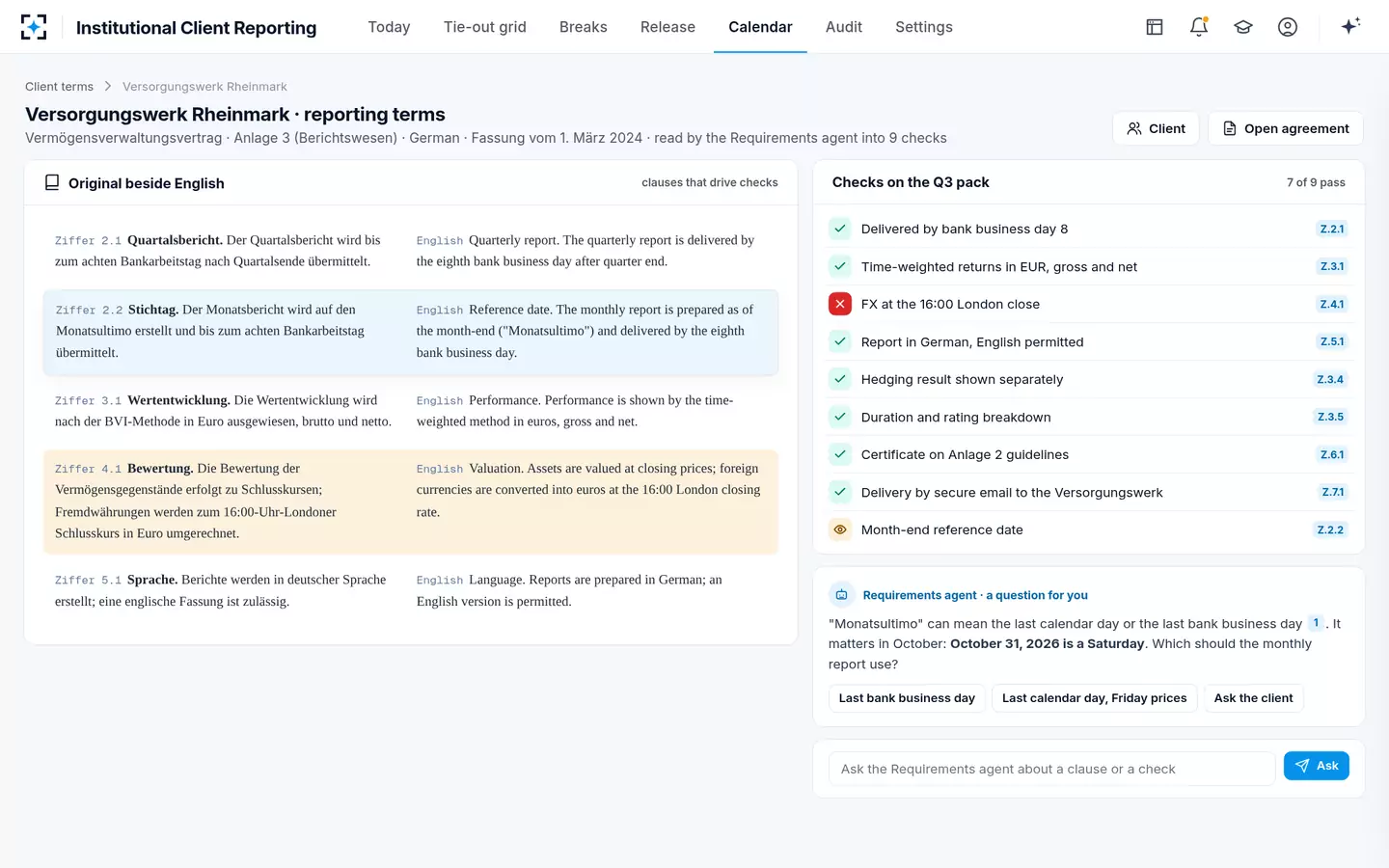
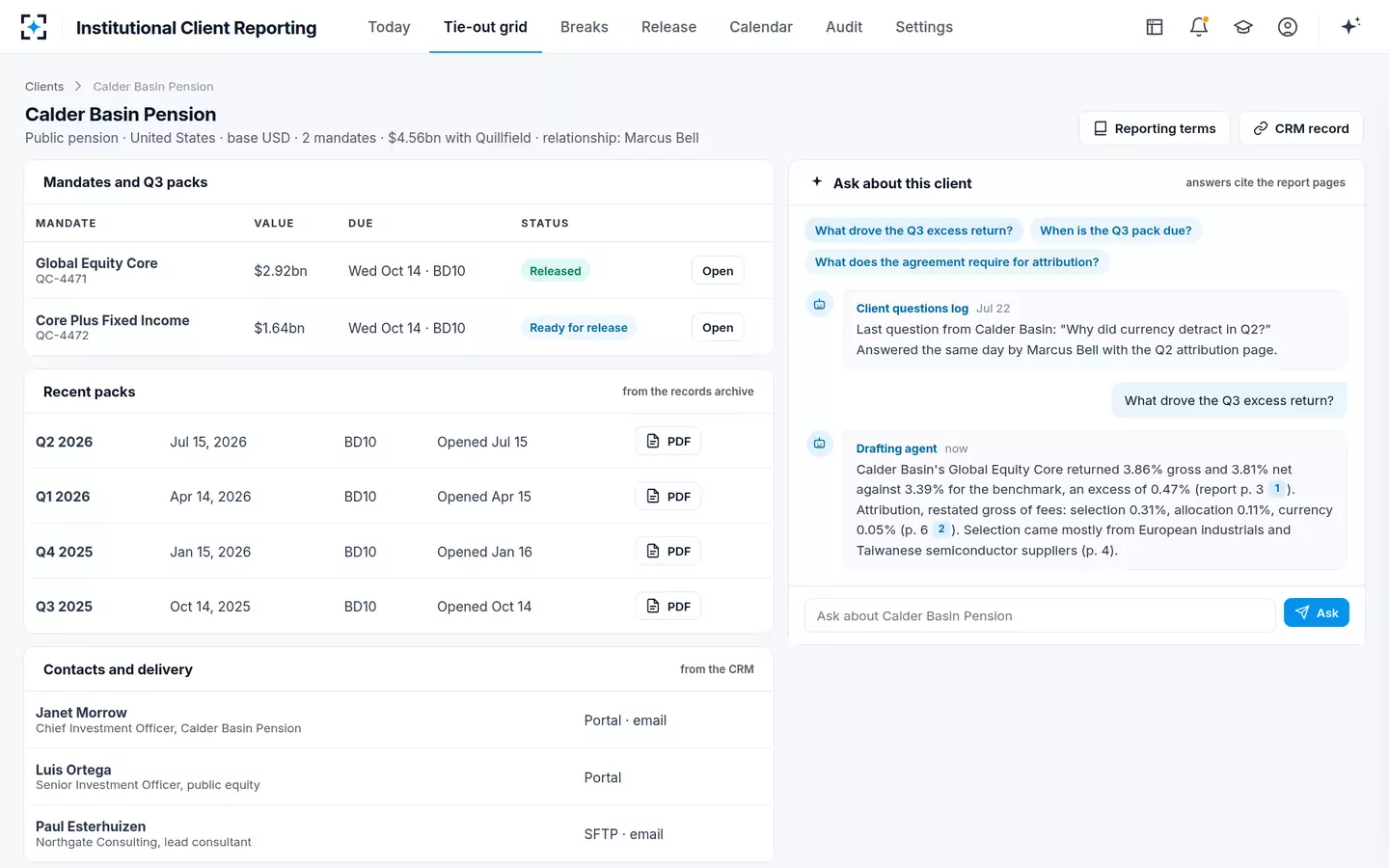
The Tie-out agent then ties each reported return to the performance system's run, gross and net, and the gap between them to the quarter's fee accrual. When a client or consultant asks why the return differs from what they computed themselves, the client-service view answers with the report pages it came from. For the rest of a report's sections, see an investment performance report example, annotated; for the solution itself, start from Institutional Client Reporting.
A client's question answered from the report's own pages
Questions people ask
Which is better, time-weighted or money-weighted return?
Neither is better; they answer different questions. Use time-weighted return to judge a manager who does not control the cash flows, as in most segregated mandates and open-end funds, and money-weighted return where the manager controls the flows, as in a closed-end private fund. The 2020 GIPS standards make time-weighted the default for exactly that reason.
Is time-weighted return the same as dollar-weighted return?
No. Dollar-weighted return is another name for money-weighted return, the IRR of the account's flows. Time-weighted return removes the effect of those flows.
Can a time-weighted return be positive when I lost money?
Yes. In case B of the example the time-weighted return is +1.20% while the client's money lost 3.51%, because the client withdrew $40 million after the fall and missed the recovery on it. The manager's investments rose overall; the client's timing did not help.
How often must a portfolio be valued for a time-weighted return?
For a true TWR, on the date of every external cash flow. Under the 2020 GIPS standards, portfolios in composites other than private market investments must be valued at least monthly and on the date of all large cash flows, with smaller flows adjusted by daily weighting.
Does MiFID II say which return method to use?
No. Article 60 of Delegated Regulation 2017/565 requires the performance of the portfolio during the period and a comparison with the agreed benchmark, without naming a method. The agreement usually does, and a benchmark comparison only makes sense on a time-weighted basis.