Custodian reconciliation compares a manager's records with the custodian statement: the periodic account statement sent by the qualified custodian, the bank, broker-dealer or trust company that holds a client's securities and cash, directly to the client. It lists what the custodian holds for the account at the end of the period and every transaction in the period. For clients of SEC-registered advisers with custody, the custody rule requires the adviser to have a reasonable basis for believing the custodian sends one at least quarterly, because it gives the client a record the manager did not produce. It almost never matches the manager's own report to the penny, for reasons that are explainable line by line, and a manager that explains them first earns the client's trust in everything else it reports. Botminds' Institutional Client Reporting compares accounting with the custodian on every mandate and carries the explanation into the report.
The examples on this page are illustrative or come from a fictional sample firm, Quillfield Capital, as it runs through the solution.
Five reasons a custodian statement and a manager's report differ, and how a report explains each
Trade date vs settlement date
Custodian statementA purchase traded on 29 September but settling on 1 October is not yet in the holdings; the cash is still there.
Manager's reportThe position is held from trade date and the cash is shown as committed.
How the report explains itList unsettled trades at period end with their settlement dates.
Accrued income
Custodian statementDividends and coupons appear when paid.
Manager's reportIncome earned but not yet received is accrued in the market value.
How the report explains itShow accrued income as its own line, so totals reconcile.
Valuation point and price source
Custodian statementPrices from the custodian's own pricing source at its own cut-off.
Manager's reportPrices at the valuation point the agreement names.
How the report explains itName the valuation point and source in the report's notes.
FX rate
Custodian statementForeign holdings converted at the custodian's standard rate.
Manager's reportConverted at the fixing the agreement names, such as a 16:00 London close.
How the report explains itName the fixing; quantify the difference when it is material.
Fees and pending corporate actions
Custodian statementManagement fees appear when debited; corporate actions when processed.
Manager's reportFees accrued in net returns; entitlements recognised on the ex-date.
How the report explains itReconcile net-of-fee value to the fee accrual; list pending actions.
What is a custodian statement?
A custodian statement, also called a custodial statement or custody statement, is the account statement from the institution that has legal custody of the assets. Under the SEC's custody rule, an adviser that has custody of client funds or securities must have "a reasonable basis, after due inquiry, for believing that the qualified custodian sends an account statement, at least quarterly, to each of your clients for which it maintains funds or securities, identifying the amount of funds and of each security in the account at the end of the period and setting forth all transactions in the account during that period" (17 CFR 275.206(4)-2(a)(3)).
That sentence defines the document's scope: holdings, cash and transactions. A custodian statement is not a performance report. It does not usually show returns against a benchmark, attribution, commentary or a compliance certificate, and where a custodian offers performance figures they are calculated on its data and conventions, not the manager's. For pooled vehicles the rule has its own delivery path: where the adviser or a related person is general partner, the statements go to each limited partner.
Why the custody rule makes someone else send it
The statement exists so that the client does not have to rely on the manager's word about where its assets are. The SEC put the reasoning plainly in the economic analysis of its October 2026 custody proposal: "An adviser is less likely to engage in unauthorized trading in a client's account when the adviser knows that the client will be receiving from the custodian an account statement detailing any trading activity." (SEC custody proposal, 91 FR 63870, 6 Oct 2026). The independence is the point: the statement comes from the party that holds the assets, not from the party that manages them.
How common custody, and custodian statements to fund investors, are among SEC-registered advisers
16,442
SEC-registered investment advisers, December 2025
9,926
reported custody of client funds or securities
1,446
had a qualified custodian send quarterly statements to investors in pooled vehicles
8.8%
of all registered advisers: that last group's share
The proposal would replace the current rule with a new one but keeps the client's two-statement check. It describes the current notice requirement, cites proposed rule 223-1(a)(2) beside it, and would also require the adviser's notice to a client on opening an account with a qualified custodian to include the client's account number. Until the Commission adopts a final rule, the rule quoted on this page is the one in force.
What does "urging the client to compare" mean?
It is a legend the custody rule requires on the adviser's own statements. If an adviser that must notify a client of the custodian's details also sends that client account statements, it must include in the notice and in every later statement a sentence urging the client to compare the two.
… include in the notification provided to that client and in any subsequent account statement you send that client a statement urging the client to compare the account statements from the custodian with those from the adviser.
17 CFR 275.206(4)-2(a)(2), the custody rule
For a reporting team the legend has two consequences. It is template content that must appear on every qualifying report, so a template redesign can drop it from hundreds of mandates at once; it belongs on the list of checks, not in the designer's memory. And it invites exactly the comparison this page is about. A client who follows the instruction will find differences, and the report that prompted the comparison should be the one that explains them.
Who sends quarterly statements to clients?
In a typical institutional arrangement, three parties send the client something each quarter. The qualified custodian sends the account statement of holdings, cash and transactions. The manager sends its quarterly investment report with performance, attribution, commentary and the certificate. And for a pooled vehicle, the fund administrator or the manager sends investor statements. Under the custody rule a client may also "designate an independent representative to receive, on his behalf, notices and account statements", which is how statements reach a pension plan's consultant or trustee rather than its staff.
In the EU, the duty to send a statement of assets follows whoever holds them. Article 63 of Delegated Regulation 2017/565 requires investment firms "that hold client financial instruments or client funds" to send each such client a statement of them "at least on a quarterly basis", and lets a portfolio manager that also holds the assets include that statement in its periodic report (Delegated Regulation (EU) 2017/565, Art. 63). A manager that does not hold the assets leaves that statement to the custodian, and the client again holds two documents.
Why is the custodian statement different from the manager's report?
Because the two are built on different conventions for the same assets, and almost every difference falls into one of five causes: trade date against settlement date, accrued income, the valuation point and price source, the FX rate, and fees or corporate actions recognised at different moments. None of them is an error. Each produces a difference that can be listed, sized and explained, and once listed they should account for the whole gap.
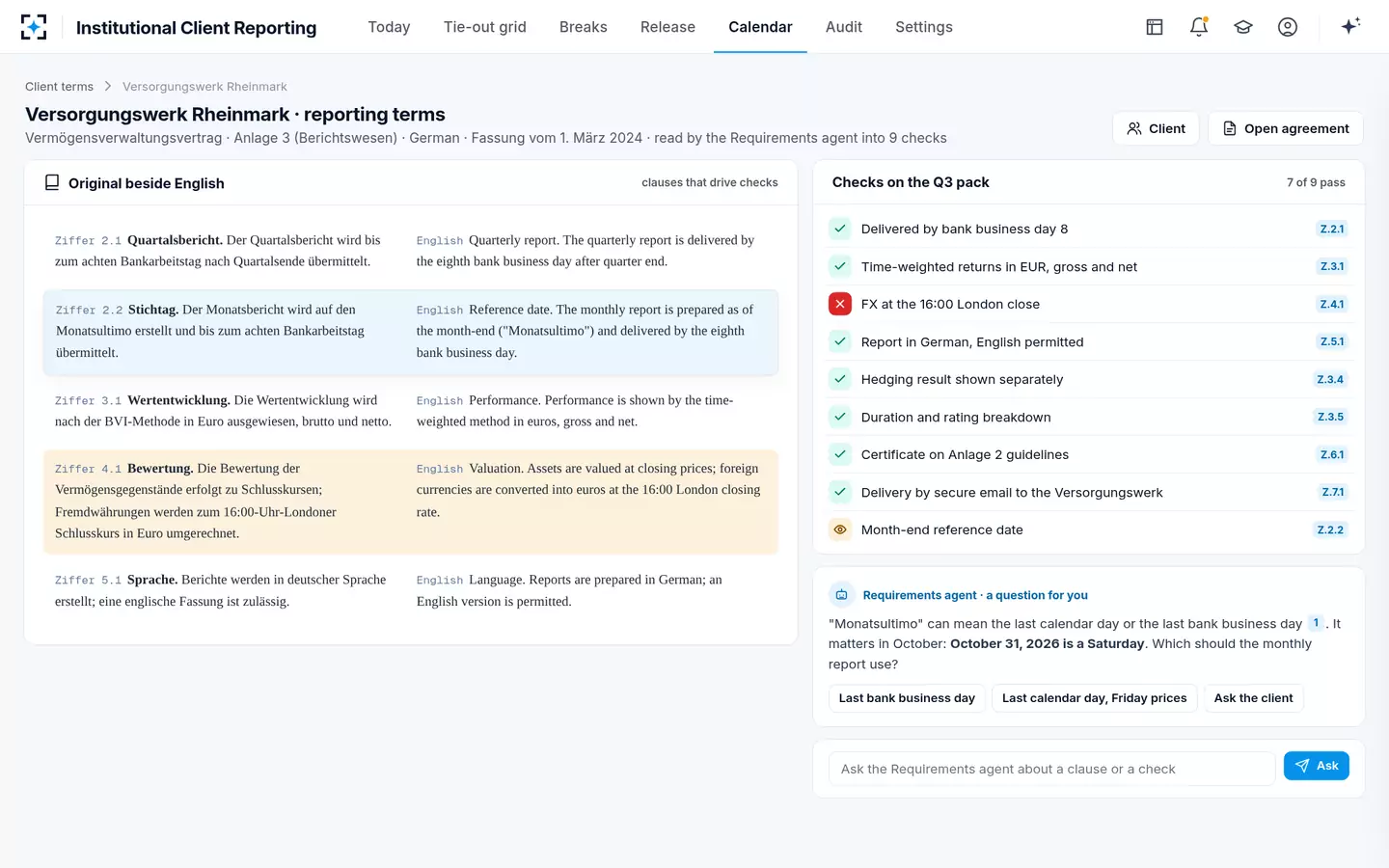
The FX difference is the one clients find hardest to accept, because it moves every foreign holding at once. At the sample firm, a German pension client's agreement requires foreign currencies to be converted into euros at the 16:00 London closing rate. The draft report had used the New York close, which put the portfolio's market value €184,221, or 0.02%, away from what the agreement requires. A custodian converting at its own standard rate would show a third figure. The manager's report should state its fixing, show the client's number, and be ready to quantify the difference from the custodian's.
One client's FX fixing, read from its agreement and checked on the report
Trade date vs settlement date on a statement
Trade-date accounting records a purchase or sale when it is executed; settlement-date accounting records it when the securities and cash change hands, one or more business days later. Investment managers usually report on trade date, because that is when the investment decision takes effect and when its market risk begins. Custodians often report holdings on settlement date, because that is when they hold the security. Every trade executed in the last days of a quarter therefore sits on one statement and not the other.
The EU's rule for statements of client assets shows the regulator's view: either basis is acceptable, but not both. Where a client's portfolio includes the proceeds of unsettled transactions, the information "may be based either on the trade date or the settlement date, provided that the same basis is applied consistently to all such information in the statement" (Delegated Regulation (EU) 2017/565, Art. 63(2)). A manager's report that lists its unsettled trades at period end, with settlement dates, lets the client bridge the two statements in a minute.
What a custodian statement cannot check
A custodian statement is an independent check of holdings, cash and transactions. It is not a check of performance, risk figures or commentary, which the custodian does not produce. Those parts of a report are only as reliable as the manager's own controls, and the SEC's case against Allianz Global Investors U.S. shows what happens when those controls are missing. The order describes risk reports, daily performance data, Greeks and attribution spreadsheets altered by the portfolio management team before investors received them, and finds that "There was no meaningful review of these investor communications by others at AGI US during the Relevant Period." (SEC order, Release No. 34-94927, 17 May 2022). In one example from the order, investors asking how the strategy had performed in periods of market stress received "smoothed" daily performance data, with one day's loss cut from about −18.26% to about −9.26%.
No custodian statement would have caught that, because the custodian never saw those reports. The lesson for a reporting team is to treat the figures with no independent counterpart, returns, risk and attribution, as the ones that most need a tie to the firm's own systems of record and a review by someone who did not prepare them.
Explaining the differences before the client asks
The cheapest reconciliation is the one the client never has to request. A report that already lists unsettled trades, accrued income, its valuation point and FX fixing, and the quarter's fee accrual lets a trustee bridge the custodian's total to the manager's without a call. A difference that the five causes do not explain is then visible as what it is: the one to investigate.
Reconciling the custodian statement before the report goes
Agent
Compare accounting with the custodianMatches positions, cash and transactions for every mandate at period end.
Never: forces a match or books a plug.
Agent
Classify each differenceAssigns each to timing, accrual, pricing, FX or fees, with the source records cited.
Never: classifies a difference it cannot evidence.
A person decides
Analyst decides the unexplainedInvestigates whatever the five causes do not cover and records the outcome with a reason.
Agent
Carry the explanation into the reportAdds unsettled trades, accruals and the FX fixing to the report's notes; checks the compare legend is present.
A person decides
Team lead releasesReleases a report they did not prepare, seeing what was reconciled and decided.
Reading a custodian statement beside a manager's report
- Start from the totals and list the five causes
Unsettled trades, accrued income, valuation point, FX fixing, fees and corporate actions.
- Check the positions count first
Positions should match exactly once unsettled trades are bridged; a missing or extra position is never a convention.
- Compare transactions, not just balances
The custodian lists every transaction; each should appear in the manager's report on trade date.
- Read the manager's notes for its valuation point and FX fixing
And compare them with the agreement.
- Ask about anything left over
A residual difference after the five causes is the question worth asking.
How Institutional Client Reporting compares accounting with the custodian
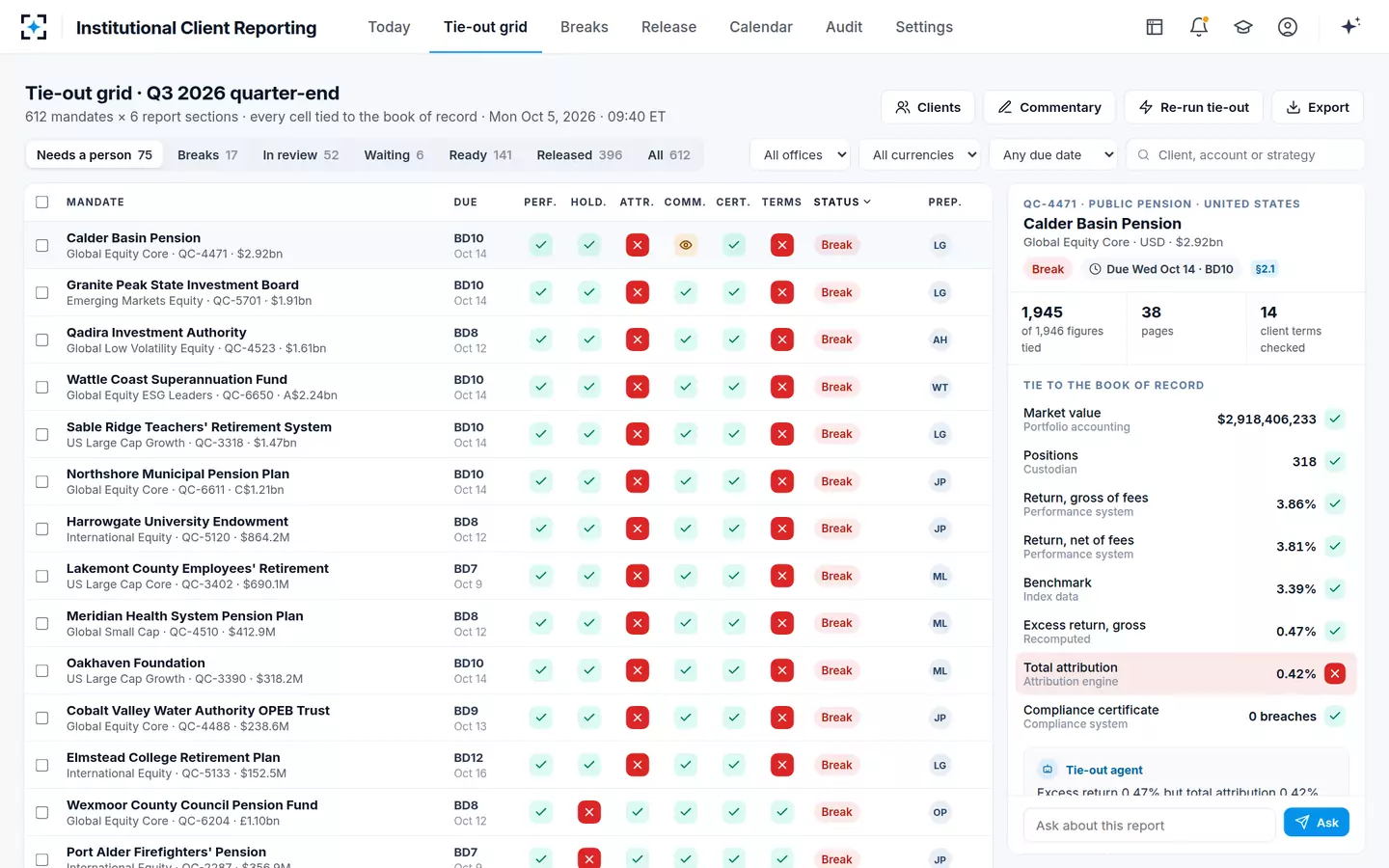
In Institutional Client Reporting the comparison is part of the tie-out that runs on every report. The tie-out grid shows, for the selected mandate, each figure tied to its system of record: market value to portfolio accounting, positions to the custodian, returns to the performance system, the benchmark to index data. A position count that does not match the custodian appears as a break with its cause, not as a surprise in the client's inbox.
Positions tied to the custodian, market value to accounting
The custody legend is a check too: the Requirements agent includes it among each client's terms, so a report without it fails before release. For how the rest of the report is built and checked, see an investment performance report example, annotated, and for the full set of duties behind a report, client reporting in asset management, mapped. The solution is at Institutional Client Reporting.
Questions people ask
What is a custodian report?
The custodian's report or statement lists the holdings, cash and transactions in an account as recorded by the institution that holds the assets. Custodians also produce other reports for managers and clients, such as income and corporate action reports, but the client's quarterly account statement is the one the SEC custody rule relies on.
Is a custodial statement the same as a brokerage statement?
When a broker-dealer acts as the qualified custodian, yes: its account statement is the custodian statement. For most institutional mandates the custodian is a bank or trust company, and the statement comes from its custody business rather than from a broker.
Which statement is right when they differ?
Often both, on different conventions: the custodian on settlement date at its own prices and FX rates, the manager on trade date at the valuation point and fixing in the agreement. Once those causes are bridged, the positions and transactions should agree exactly; a remaining difference needs an answer from the manager.
How often does the custodian send statements?
At least quarterly, under the SEC custody rule, for clients of advisers with custody; many custodians send monthly statements or give online access. In the EU, firms that hold client assets must send a statement of them at least quarterly unless it is included in another periodic statement or available online and accessed.
Does the SEC's 2026 custody proposal change the compare legend?
The proposal, published on 6 October 2026 with comments due 7 December 2026, carries the client notice and compare legend into a new proposed rule and would add the client's account number to the notice. It is a proposal; the current rule applies until a final rule is adopted and takes effect.