An investment performance report is the quarterly or monthly document an asset manager sends a client to show what its portfolio holds, how it performed against the agreed benchmark and why, what it cost, and whether it stayed within its guidelines. A good example has eight sections: a summary, performance, commentary, attribution, holdings, transactions with income and fees, a compliance certificate, and disclosures. Each one answers to a source, usually the client's agreement and, for EU and UK clients, the periodic-statement rules, and each one draws its numbers from a different system, which is why the sections drift apart. Botminds' Institutional Client Reporting drafts every section from the book of record and ties each figure to its source before a person decides and releases.
The example below is the third-quarter 2026 report for a fictional client, Calder Basin Pension, on its Global Equity Core mandate of $2.92 billion, from the sample firm Quillfield Capital as it runs through the solution. It is 38 pages and carries 1,946 figures. The annotations say what each section must prove, which rule or term requires it, and where its numbers come from.
An investment performance report example, section by section: what it proves and where it comes from
p. 2
Summary
What it must proveWhat the client owns, what it returned against its benchmark, and anything it must know this quarter.
Required or shaped byAgreement; MiFID Art. 60(2)(a)–(c)
Numbers come fromPortfolio accounting, performance system
p. 3
Performance
What it must proveReturns gross and net of fees for the periods the agreement names, beside the agreed benchmark.
Required or shaped byArt. 60(2)(c), (e); COBS 16A.4.1R; agreement
Numbers come fromPerformance system, index data
p. 4
Commentary
What it must proveWhy the quarter went as it did, in sentences that match the figures.
Required or shaped byFair and balanced review, Art. 60(2) and COBS 16A.4.1R(2)(a)
Numbers come fromPortfolio manager, attribution
p. 6
Attribution
What it must proveWhere the excess return came from; effects that sum to the excess return on page 3.
Required or shaped byAgreement (basis, method, gross or net)
Numbers come fromAttribution engine
p. 9
Holdings and valuation
What it must proveEach instrument, its market value and the cash at the start and end of the period.
Required or shaped byArt. 60(2)(c); Art. 63 where the firm holds assets
Numbers come fromPortfolio accounting, custodian
later pages
Transactions, income, fees
What it must proveEvery trade, the dividends and interest received, and fees itemised.
Required or shaped byArt. 60(2)(d), (f), (g), (h)
Numbers come fromAccounting, fee billing
p. 37
Compliance certificate
What it must proveThe mandate stayed inside its guidelines, or exactly where and when it did not.
Required or shaped byAgreement
Numbers come fromInvestment compliance system
back page
Disclosures and legends
What it must proveThe definitions, methods and legends the rules require.
Required or shaped byCustody rule (a)(2) legend; agreement
Numbers come fromCompliance, template
What should be included in a quarterly investment report?
A quarterly investment report should include, at minimum, the portfolio's holdings and valuation, its performance for the period against the agreed benchmark, the fees and costs charged, the income received, the transactions made, and a fair explanation of the period. For EU clients who receive MiFID II periodic statements, those items are written into law; for most institutional clients the agreement adds attribution, risk figures, commentary and a compliance certificate.
The order matters less than the links between sections. The performance page states an excess return; the attribution page must explain exactly that excess return; the commentary must describe the attribution in words; the holdings page must add up to the market value the performance was calculated on. A report is right when its sections agree with their sources and with each other, and the sections most likely to disagree are the ones drawn from different systems on different days.
What must a periodic statement contain? Article 60, mapped to the report
For EU clients covered by MiFID II, Article 60(2) of Delegated Regulation 2017/565 says the periodic statement "shall provide a fair and balanced review of the activities undertaken and of the performance of the portfolio during the reporting period" and lists what it must include "where relevant" (Delegated Regulation (EU) 2017/565, Art. 60). Since 28 February 2022 a professional client in the EU receives it only if it asks; retail clients always do. In the UK, COBS 16A.4.1R(2)(b) sets out the same list for retail clients (FCA Handbook, COBS 16A.4).
Article 60(2)'s eight items and where each sits in the sample report
| Item | What Article 60(2) asks for | Where it sits in the report |
|---|---|---|
| (a) | the name of the investment firm | Cover and every page footer |
| (b) | the name or other designation of the client's account | Cover: client, mandate, account number |
| (c) | contents and valuation of the portfolio, each instrument's market value (or fair value), cash at the start and end of the period, and performance in the period | Summary, performance and holdings pages |
| (d) | total fees and charges, itemising at least total management fees and total costs associated with execution, with a statement that a fuller breakdown is available on request where relevant | Fees page |
| (e) | a comparison of performance with the investment performance benchmark (if any) agreed with the client | Performance page, beside each return |
| (f) | total dividends, interest and other payments received | Income page |
| (g) | other corporate actions giving rights in relation to instruments held | Corporate actions page or holdings notes |
| (h) | for each transaction in the period, the details in Article 59(4)(c) to (l), unless the client takes trade-by-trade confirmations | Transactions pages |
Two items are worth reading twice. Item (e) compares performance with "the investment performance benchmark (if any) agreed between the investment firm and the client": the benchmark is the one in the agreement, not the one the strategy uses for marketing, and if the client agreed a hedged or a custom blend, that is the comparison owed. Item (d) asks for costs associated with execution as well as management fees, which many institutional templates do not show by default. A firm that also holds the client's assets may fold the Article 63 statement of client assets into the same document, which Article 63(3) allows.
The performance page: returns gross and net, for the right periods
The performance page is what most readers turn to first, and in the UK it may legitimately be the most prominent thing in the report. The FCA's past-performance rules for retail communications require that past performance not be the most prominent feature, but the guidance carves out exactly this document.
… a periodic statement in relation to managing investments that is sent in accordance with the rules on reporting information to clients (see COBS 16) may include past performance as its most prominent feature.
FCA Handbook, COBS 4.6.3G
What the page must get right is set mostly by the agreement. In the sample report the quarter's return was 3.86% gross of fees and 3.81% net, against 3.39% for the benchmark, an excess return of 0.47% gross. Each of those figures comes from the performance system for the period the agreement names, and each must tie: the gross return to the performance run, the net return to gross less the quarter's fee accrual, and the benchmark to the index data for the version in the agreement. The method matters as much as the number; time-weighted and money-weighted returns answer different questions, and a German client in the sample firm's book has written "time-weighted, in euros, gross and net" into its agreement.
Attribution and commentary: two sections that must agree with each other
Attribution explains the excess return; commentary explains the attribution in words (one attribution figure followed into a sentence shows the mechanics); and they are produced by different people from different runs, often days apart. In the sample report the attribution page first showed allocation 0.11%, selection 0.27% and currency 0.04%, a total of 0.42%. The effects summed correctly, yet the total did not equal the 0.47% excess return on page 3: the attribution run had been switched to the net-of-fee return series by a template change, and the 0.05% difference was the quarter's fee accrual true-up of $1,459,203 on $2,918,406,233 of assets.
The attribution page, with the residual that a cross-foot cannot see
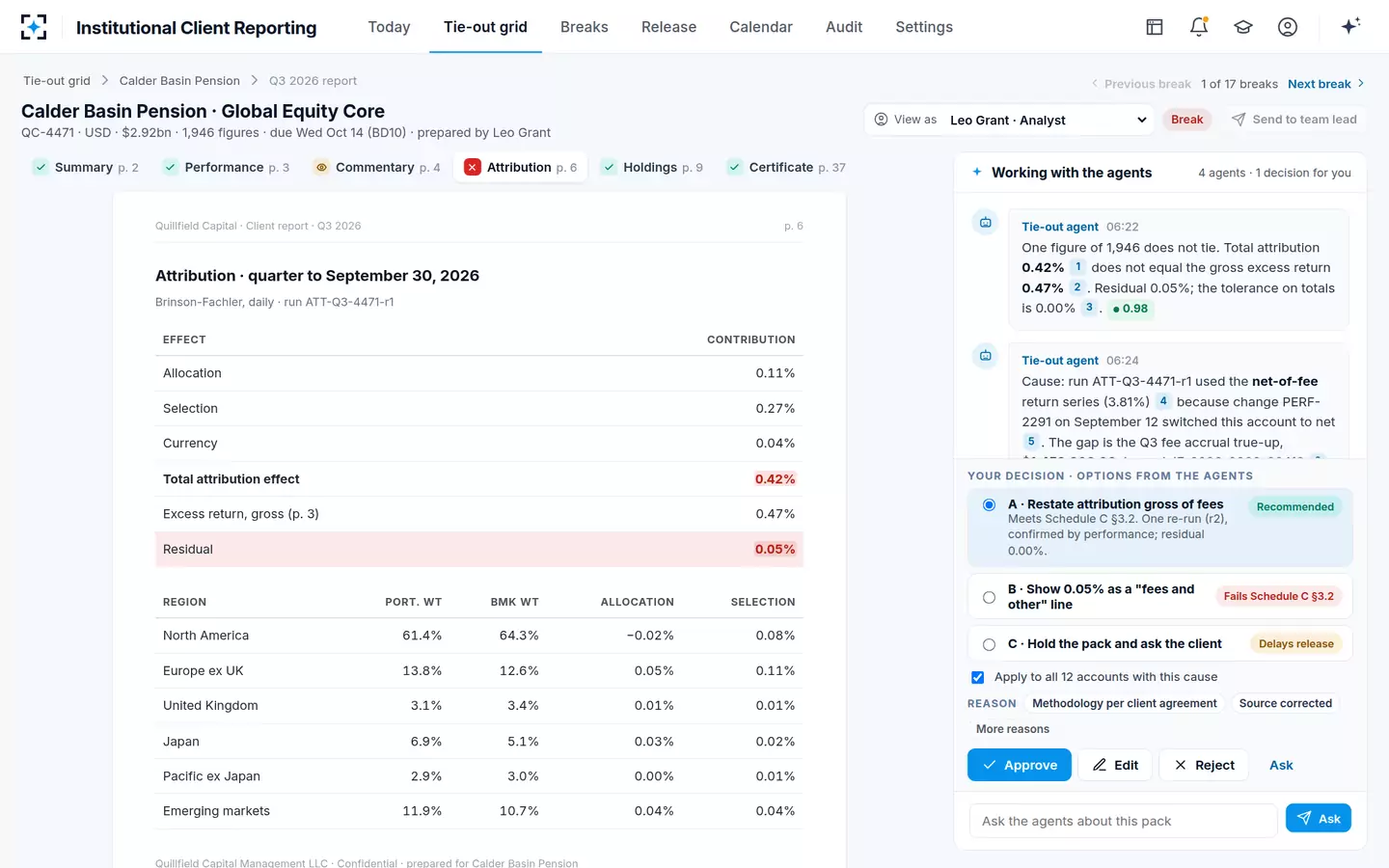
Once attribution was restated gross of fees, selection rose from 0.27% to 0.31%, and the commentary sentence "Stock selection added 27 basis points" became wrong. It was written correctly on the numbers available when the portfolio manager approved it. That is the common pattern: commentary errors are rarely invented, they are stale. A report checker that reads commentary against the final figures, for direction, size and period, catches them; one that reads commentary for tone does not.
Holdings, transactions, income and fees: the pages the custodian can check
The holdings, transactions and income pages are the ones a client can test against an independent document, because in the US the custody rule has the qualified custodian send its own statement at least quarterly, listing the cash and every security in the account at period end and every transaction during the period (17 CFR 275.206(4)-2(a)(3)). The manager's pages will not match the custodian's line for line, for reasons that are explainable: trade date against settlement date, accrued income, a different valuation point or FX fixing. The custodian statement and the manager's report compared walks through each difference.
The fees page carries a different risk: it is often the least automated page in the report, built from the billing system after the rest. At the sample firm, the net-of-fee return, the fee accrual in the accounting journal and the fees page must all tell the same story, and when the attribution run used the wrong series the gap showed up as five basis points on page 6, not on the fees page at all.
The compliance certificate: true and still incomplete
The compliance certificate states that the mandate was managed within its guidelines for the period, or lists the exceptions. Its failure mode is omission rather than error. A passive breach, a limit crossed because the market moved rather than because the manager traded, may have been cured within the agreement's cure period and still need to be reported under the agreement's wording. At the sample firm one quarterly report's certificate left out exactly such a passive breach, and was flagged because the certificate was read against the investment compliance system's rule results rather than against last quarter's certificate.
The certificate is also the section where the agreement's language matters most. "No breaches" and "no active breaches" are different statements, and the client's guideline schedule decides which one it is entitled to. A certificate with an exception at the sample firm cannot go out until a compliance reviewer approves it.
Disclosures and legends: the small print has its own rules
The back pages carry the definitions, the calculation methods and the legends, and some of them are required. For a US-registered adviser that sends account statements to a client whose assets a qualified custodian holds, the custody rule requires every such statement to carry a sentence urging the client to compare it with the custodian's statement (17 CFR 275.206(4)-2(a)(2)). The agreement may require others: the benchmark's definition, the fee basis, the source of FX rates.
The reason to treat the back page as part of the check is that legends are template content, and template changes break them for every client at once. They are also part of what the firm must be able to show it sent: for an SEC-registered adviser, Rule 204-2 requires copies of written communications about the performance of managed accounts and the working papers behind each performance figure (17 CFR 275.204-2).
Investment performance report template: building one that survives the next mandate
A template is not a layout; it is a set of sections, each with its source, its tie and its owner. Teams that treat the template as a layout end up with a template per client and no way to tell which ones a methodology change has broken. Teams that treat it as sections with rules can change the attribution basis on twelve mandates and know, before release, which twelve.
An investment performance report template that holds up across mandates
- Name the source system and the tie for every figure
Market value to accounting, returns to the performance run, attribution to the excess return, certificate to the compliance system.
- Take each client's terms from its agreement, not from the template
Gross or net, benchmark version, valuation point, FX fixing, sections, language.
- Make the agreed benchmark the comparison, and label its version
Article 60(2)(e) asks for the benchmark agreed with the client, if any.
- State the return method and the periods on the page
Time-weighted or money-weighted, annualised or not, since which inception date.
- Read commentary against the final figures, not the preliminary ones
Direction, size and period for every sentence that cites a number.
- Keep the legends as checked content
The custody compare legend, method notes and any wording the agreement prescribes.
- Version the template and log who changed it
A template change is a methodology change for every client that uses it.
How Institutional Client Reporting drafts and ties each section
Institutional Client Reporting builds each report section by section from the systems of record, then checks each section against its source, the client's terms and the other sections. On the sample quarter the agents tied 1,184,316 figures across 612 quarterly reports and found 17 breaks from five causes; the analyst decided each one with a reason code, and a team lead who prepared nothing released. The client-service view shows the same report from the other side: a client director can ask what drove the quarter and get the answer with the page numbers it came from.
The same report, as client service sees it
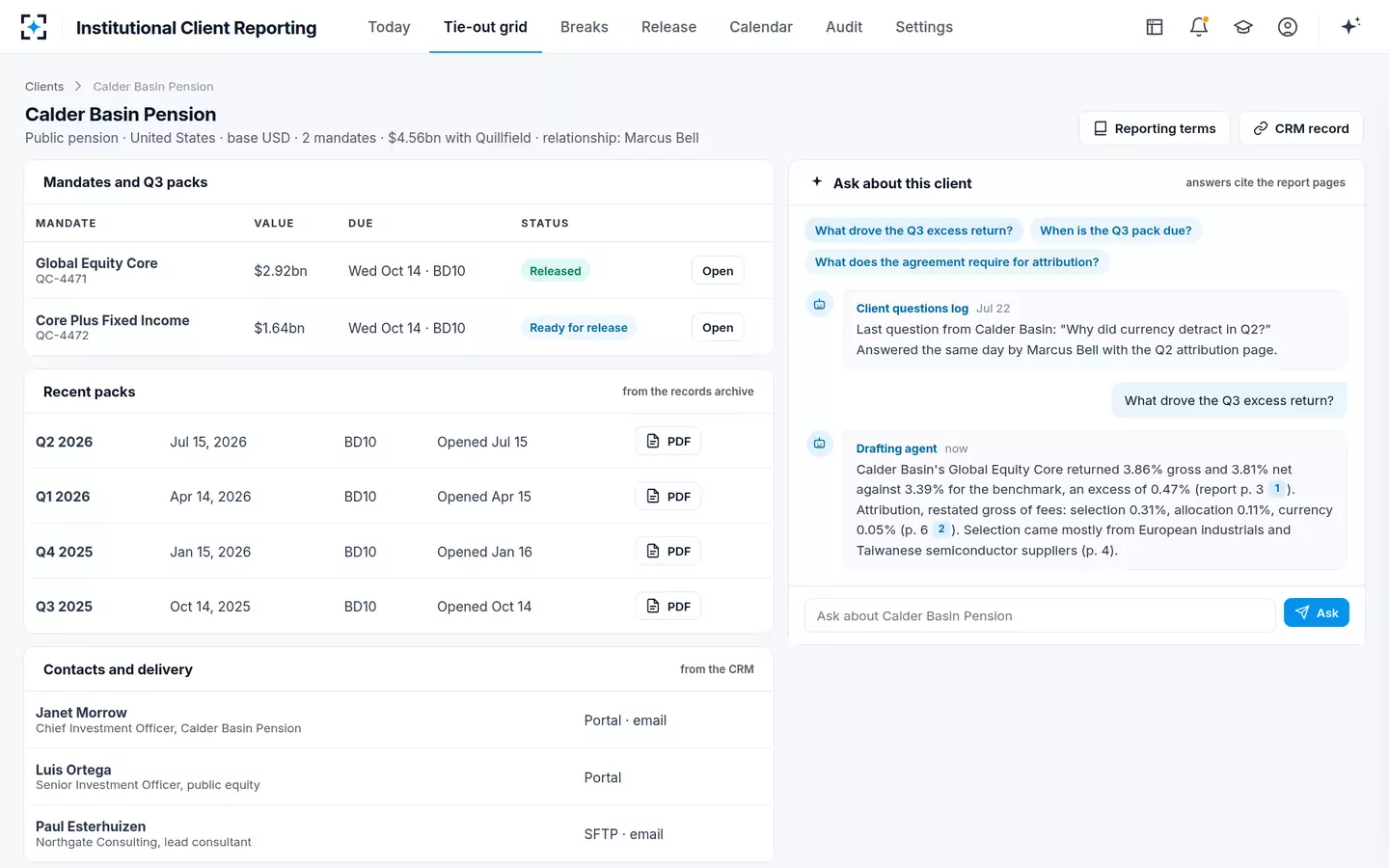
The annotation in this guide is the solution's working model of a report: sections with sources, ties and owners. For how the quarter-end changes for the people who produce it, see the client reporting analyst's business days 1 to 10; to see the report itself, start from Institutional Client Reporting.
Questions people ask
What is in a client investment report?
Holdings and valuation, performance against the agreed benchmark, fees and income, transactions and an explanation of the period, plus, for most institutional clients, attribution, commentary and a compliance certificate. For EU retail clients and professional clients who opted in, Article 60(2) of Delegated Regulation 2017/565 lists the minimum contents.
What does a quarterly investment report show?
It shows what the portfolio held at the start and end of the quarter, what it returned gross and net of fees against its benchmark, where the difference came from, and what happened in the portfolio: trades, income, corporate actions and fees. It also states whether the portfolio stayed within its guidelines.
Is there a standard investment performance report template?
No regulator prescribes a layout for institutional reports; the EU and UK rules prescribe contents for periodic statements, and the client's agreement prescribes the rest. Firms that claim compliance with the GIPS standards follow separate rules for composite reports to prospective clients, which are a different document from a client's own quarterly report.
How long is a quarterly investment report?
No rule sets a length: it follows the mandate and the agreement, and full holdings and transaction listings make up much of it for a diversified portfolio. The sample report in this guide, one global equity mandate with 318 positions, is 38 pages and carries 1,946 figures.
Should a client report show gross or net performance?
Usually both, and the agreement decides which basis each section uses: the sample client's agreement requires attribution gross of fees, reconciled to the gross excess return. Net-of-fee returns show what the client kept; gross returns show what the manager produced before fees.