Client reporting software pricing is hard to compare: vendors don't publish price lists, and they quote in different units, per account, per report, per user or as a platform licence, and bundle different amounts of set-up and data work. The figure that makes any quote comparable is your own cost of producing one quarterly client report today: the people-hours each report takes, step by step, times what those hours cost, plus the cost of the reports that have to be reissued. That number is the ceiling any software or agent proposal has to beat for the reports it will touch. Botminds' Institutional Client Reporting is built to cut the steps that dominate it, gathering, checking and chasing breaks, while leaving the decisions and the release with your team.
The worked example below uses round inputs we chose to show the method, and the US government's wage data; it is not a benchmark. Product examples come from a fictional sample firm, Quillfield Capital, as it runs through the solution.
What one quarterly report costs, step by step: a worked example with round inputs
Why client reporting software pricing is hard to find
Client reporting software is sold to a small number of institutional buyers with very different needs, so prices are negotiated rather than listed. No regulator or independent study publishes what managers pay for it, or what a client report costs to produce. The quotes a buyer does receive are hard to line up: one prices per account per year, another per report, another per user, another as a platform fee with professional services for templates and data feeds on top.
That makes the comparison a buyer can do for itself more useful than any price list. A firm that knows what each of its reports costs to produce, and which steps the cost sits in, can turn any quote into a cost per report and see which steps the product actually changes. A quote that only replaces the layout step cannot save more than that step costs.
How much does client reporting cost? Start with one report
Calculate it for one report and then multiply. The cost of a quarterly client report is the sum, over the steps of the cycle, of the hours each step takes for that report times the loaded cost of the people doing it, plus that report's share of the cost of reissues, plus the software and data costs the firm already pays for reporting.
The cost of one quarterly client report, written as a sum
People time by step
Σ hours × loaded rate
From a time log of one quarter-end: pull, check, chase, terms, review, release. Rate: wage plus employer costs and overhead.
Your time log and finance team
Reissues
+ reissues ÷ reports × cost per reissue
Rework, re-review and re-delivery for each report sent again with a wrong figure.
Your reissue count
Systems and data
+ annual cost ÷ reports a year
Reporting tool, data feeds and portal, spread over the reports they serve.
Your contracts
Cost per report
= today's ceiling
The number any proposal must beat, net of its own price, for the reports it touches.
The comparison every quote is held to
The worked example puts the people time at $395 a report on wages alone, from eight person-hours. The inputs are round on purpose: a firm with bespoke mandates in several languages may spend much more per report, a firm with uniform pooled-fund reports much less. What transfers from the example is the shape. In it, more than half the cost sits in pulling, checking and chasing, which are the steps that produce nothing the client sees.
How many hours does a quarterly report take?
No regulator or independent study publishes the hours an institutional quarterly report takes, and the answer varies widely between a templated pooled-fund report and a bespoke 40-page segregated-mandate report. The only reliable figure is the firm's own. Log one quarter-end in half-day blocks against six steps, for every person who touches the reports, including performance, portfolio managers and compliance, and divide by the reports produced.
Two cautions make the log honest. Count the waiting: an analyst who cannot start a mandate until performance signs off is not idle, but the hours are part of the cycle's cost. And count the people outside the reporting team. At the sample firm a performance analyst described his quarter-end as break emails all week; those hours belong to the report as much as the analyst's.
The scale behind a cost-per-report calculation
$49.39
an hour: the 2025 median wage of financial and investment analysts over 2,080 hours
$102,740
median annual wage for the same occupation
16,442
SEC-registered investment advisers, December 2025
$477.0m
median regulatory assets under management per adviser
What drives the cost of a client report?
Five things drive it, and only one of them is the software's layout engine. The first is how bespoke the mandates are: every client-specific term, a fee basis, an FX fixing, a benchmark variant, a language, is a check someone must run. The second is how the figures are checked: by eye against exports, or by a tie to the system of record. The third is how breaks are resolved: one email thread per break, or one decision per cause. The fourth is how many people must touch each report before release. The fifth is what is kept afterwards: an SEC-registered adviser must keep the working papers behind every performance figure it sends (17 CFR 275.204-2), and assembling them by hand after the fact is a cost of its own.
The sample firm shows how the second and third drivers interact. Twelve mandates' attribution broke for one cause, a template change that switched the attribution basis from gross to net of fees. Found by eye, that is twelve breaks, twelve emails to performance and twelve re-runs, spread over days. Traced to its cause, it is one decision and one re-run.
How much does a reissued client report cost?
In hours, less than people fear; in everything else, more. A reissue repeats part of the cycle for one report, the fix, the re-check, a fresh review and release, and adds a conversation with the client and often its consultant. In the cost formula it is a small term: at the sample firm's seven wrong-figure reissues in a quarter of 612 reports, even a full working day of rework per reissue, at the median analyst wage, comes to under $5 per report across the quarter. The larger cost does not appear in the formula: a client that receives a corrected report reads every later one more sceptically, and an examiner can ask for the working papers behind both versions.
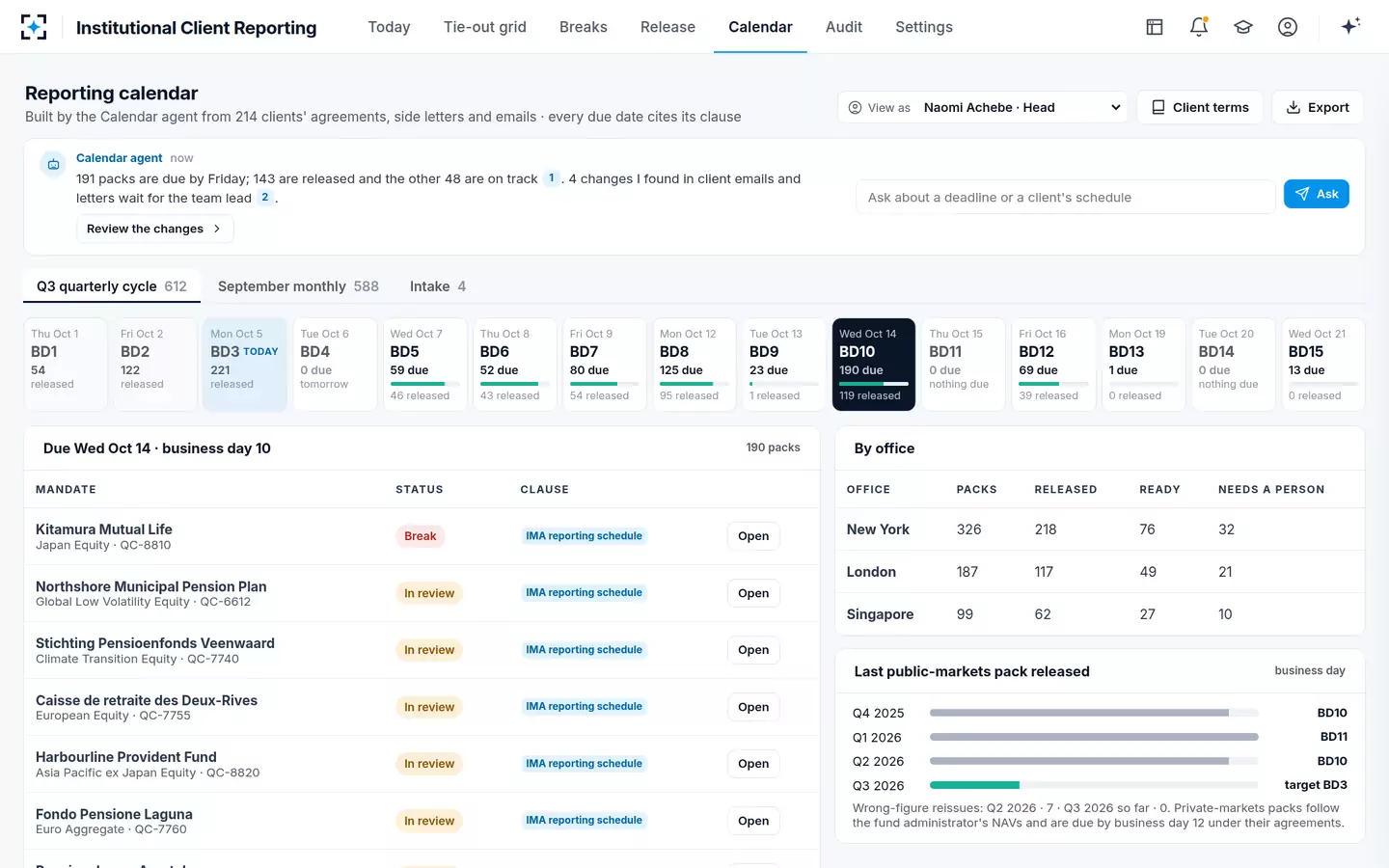
That is why the reissue count deserves a line of its own in any business case. The sample firm went from seven wrong-figure reissues in the second quarter of 2026 to none in the third quarter so far, against a design target of zero for every figure tied before release; a firm evaluating any reporting change should track the same count before and after.
The cycle, the deadline and the reissue count on one screen
The price structures a quote can take, and what each rewards
Quotes for client reporting software and services come in a few structures, and each one rewards a different kind of firm. Converting each into a cost per report, using your own report count, is what makes them comparable.
Turning a quote into a cost per report
How the quote is written: A fee for each mandate reported on, whatever the report frequency.
How to convert it, and what to watch: Divide by reports per mandate per year. Watch the definition of an account: a mandate with two share classes or two sleeves may count twice.
How the quote is written: A fee per monthly or quarterly report.
How to convert it, and what to watch: Already a unit cost; add the people time it does not remove. Watch re-runs and reissues: are they charged again?
How the quote is written: A fee per person with access.
How to convert it, and what to watch: Divide by reports per year. Watch who must have access: client service and compliance as well as the reporting team.
How the quote is written: An annual fee plus set-up for templates and data feeds.
How to convert it, and what to watch: Spread the set-up over the years you expect to keep it. Watch template changes after go-live, which may be billed as services.
What should a client reporting software quote include?
A quote you can compare names the units, the set-up, the data work and the steps of your cycle it changes. The last item is the one most quotes leave out, and it is the one that determines the saving.
What to ask for before comparing client reporting software prices
- The unit and how it counts
Per mandate, report, user or platform; and how sleeves, share classes and language versions count.
- Set-up: templates, data feeds and client terms
Who reads your agreements into the system, and what each new client costs to add.
- Which steps of your cycle it changes
Layout only, or also gathering, tie-out, break tracing, term checks and commentary checks.
- What evidence it keeps
Source values for each figure, decisions on breaks, release approvals and delivery receipts, for your retention period.
- How it handles a change at the source
A methodology or template change: is every affected mandate listed before release?
- A run on your own last quarter
Your agreements, templates and source data, and the breaks it finds compared with what your team found.
Reading client reporting software reviews with the cost in mind
Reviews and references describe what a product is like to use; they rarely give the number that matters, which is what it did to a firm's cost per report and its reissue count. When speaking to a reference client, ask for those two figures before and after, and for the business day on which their last quarterly report goes out. A product that made the layout prettier and left the quarter-end at business day 10 has not changed the cost.
Ask, too, how the reference's mandates compare with yours. A product that works well for a manager whose clients all receive the same pooled-fund report may do little for one whose clients each have their own agreement, benchmark and language, and the reverse is also true.
Where Institutional Client Reporting fits in the arithmetic
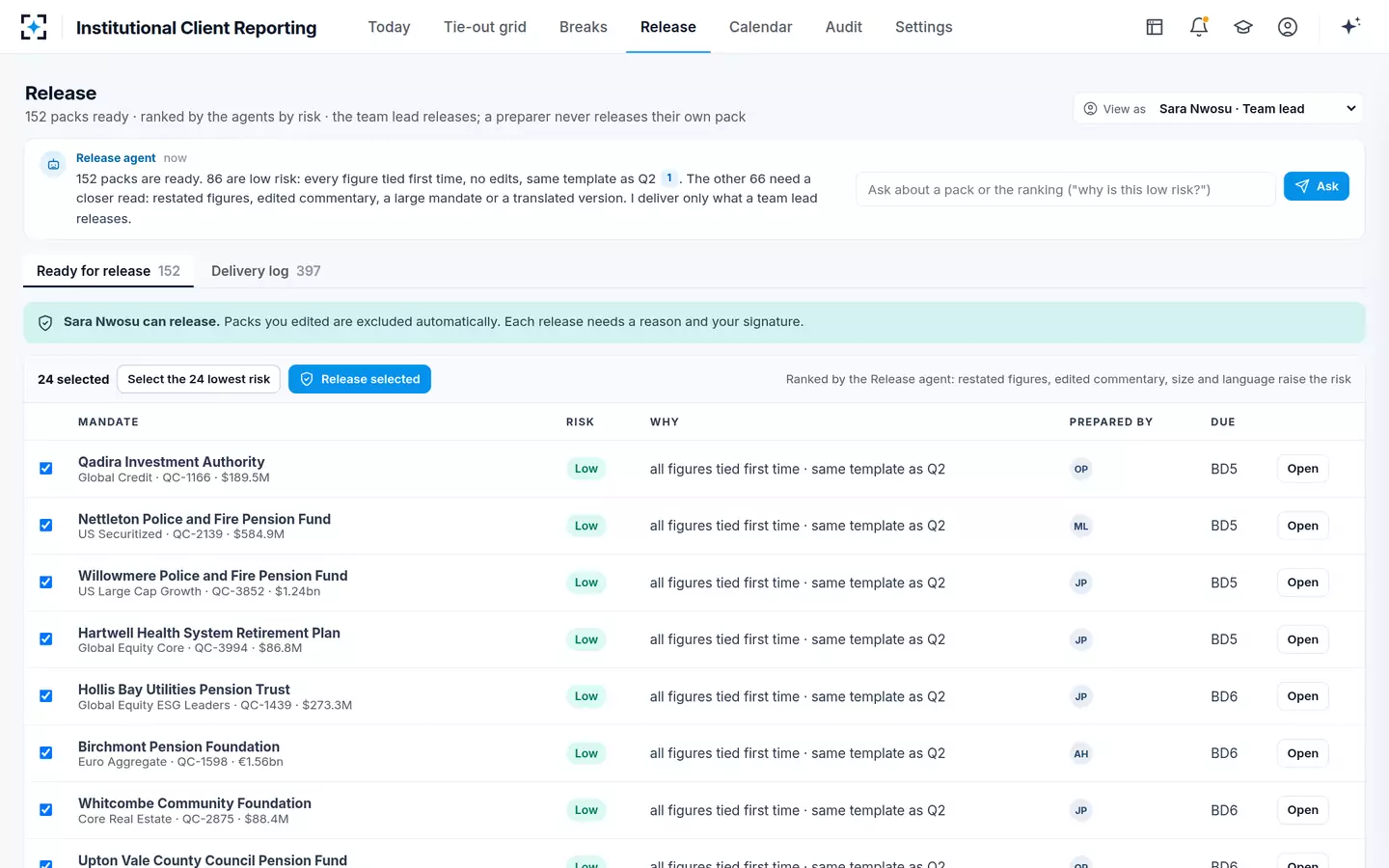
Institutional Client Reporting aims at the largest terms in the formula. Its agents draft every report from the book of record and tie every figure overnight, so the pull and check steps shrink to reviewing what broke; they trace each break to its cause and find every mandate with the same cause, so chasing becomes a few decisions; and they read each client's terms into checks, so the terms step runs on every report. The team keeps the commentary, the decisions and the release. Botminds' estimate for a quarter-end like the sample firm's is the last report out by business day 3 rather than about business day 10; that is a design target, to be measured on your own reports.
Where the review time goes once the checking is done
The fair test of that claim is the one this guide recommends for any vendor: your own last quarter. Botminds runs Institutional Client Reporting on a sample of a firm's past quarterly reports, agreements and source data, so the cost per report can be measured on the firm's own work. How the cycle's tasks divide between agents and people is in automated client reporting, task by task, and where the time goes for the analyst in the client reporting analyst's quarter-end. The solution is at Institutional Client Reporting.
Questions people ask
How much does client reporting software cost?
Vendors don't publish prices, and quotes come per mandate, per report, per user or as a platform licence with set-up services. Convert each into a cost per report with your own report count, and compare it with what each report costs you today, step by step.
What is the cost of producing one client report?
It is the hours each step takes for that report, times the loaded cost of the people doing it, plus its share of reissues and of the reporting systems. In a worked example with round inputs, eight person-hours at the 2025 median wage of financial and investment analysts, about $49.39 an hour, come to about $395 per report before employer costs.
Is it cheaper to outsource client reporting?
It can be for uniform reports, where an outsourcer's scale lowers the unit cost. For bespoke institutional mandates, the client-specific terms, the break resolution and the release still need people who know the clients, so compare the outsourcer's price per report with your own cost for the steps it would actually take over.
How do you build a business case for client reporting software?
Measure three numbers for one quarter-end before any change: cost per report by step, the business day the last report goes out, and wrong-figure reissues. Then run the proposed product on your last closed quarter and measure the same three on its output.
Do agents reduce the cost of client reporting?
They reduce the steps that are reading, copying, recomputing and comparing, which in most quarter-ends are the larger share. The steps that are judgement, decisions on breaks, commentary and release, stay with people, so the saving depends on how much of today's cost sits in the first kind.