In the client reporting process at an asset manager, an analyst prepares the monthly and quarterly reports each institutional client receives on its own mandate: performance gross and net against the agreed benchmark, attribution, holdings, transactions, commentary and a compliance certificate, each built to the client's agreement. The work is hard less for its complexity than for its shape. Nothing can start until performance signs off, every mandate has its own terms, and every figure has to be checked against the system it came from before the report goes. Botminds' Institutional Client Reporting was built around that seat: agents draft each report from the book of record and tie every figure overnight, so the analyst's quarter-end starts with the breaks, already traced, instead of with an empty template.
This guide is the analyst's quarter-end, business day by business day, as it usually runs by hand and as it runs with agents. The worked examples come from a fictional sample firm, Quillfield Capital, and its analyst Leo Grant, who prepares about 40 mandate reports a quarter.
Most of the quarter-end is pulling, checking and chasing, not writing
- Pull figures into each template
- Check by eye, cross-foot totals
- Chase breaks with performance
- Check client terms and deadlines
- Commentary, compliance, relationship review
- Release, delivery, filing
- Pull
- Check
- Chase breaks
- Terms
- Commentary, compliance, review
- Release, delivery, filing
What does a client reporting analyst do?
A client reporting analyst turns signed-off performance and accounting data into each client's report, checks that every figure agrees with its source and with the client's terms, chases whatever does not, and sends the report for review and release. The job sits between the performance team, which owns returns and attribution; the portfolio managers, who own the commentary; client service, which owns the relationship and the agreement; and compliance, which reviews disclosures and certificates.
The day-to-day tasks are concrete. Pull the mandate's holdings, transactions and valuations from portfolio accounting; returns, benchmark and attribution from the performance system; the certificate's rule results from the investment compliance system. Place them in the client's template, which may be a reporting tool, a spreadsheet or a word-processing file. Cross-foot every table. Compare each figure with last quarter and with the composite. Check the client's terms: the fee basis, the FX fixing, the sections the agreement requires, the legend the custody rule requires. Then track the report through commentary, review and delivery to the portal, the consultant's SFTP site or secure email.
The brochure is where the job's output becomes a firm-wide promise. An SEC-registered adviser describes, in Item 13C of Form ADV Part 2A, what its regular client reports contain, how often they go and whether they are written (SEC Form ADV Part 2). The analyst is the person who delivers that promise, one mandate at a time, four times a year.
Business day 1 to 10: where the analyst's quarter-end goes
The quarter-end by hand runs on a fixed sequence, and the analyst controls almost none of its start. On business day 1, accounting closes the books and the custodians' files arrive. Performance runs the returns and the attribution and signs them off over business days 1 and 2, often mandate by mandate. Until a mandate's numbers are signed, the analyst can format pages but cannot fill them, so the first two days are spent on the mandates that signed early and on everything that does not depend on the quarter's numbers.
Business days 3 to 6 are the build and the check. The analyst pulls each mandate's figures into its template and then checks them: by eye against printouts or exports, by cross-footing every table, by comparing with last quarter. A figure that does not agree goes back to performance or accounting by email, with the account, the period and the number. A question back about which run was used costs another half day. Meanwhile the portfolio managers' commentary arrives, written on preliminary numbers.
Business days 7 to 10 are review and release. The team lead reads the reports, compliance signs the certificates, client service checks the relationship-sensitive pages, and the analyst re-checks anything that changed. At the sample firm the last public-markets report went out on business day 10, 11 and 10 in the three quarters before the one shown here. The cost was the analyst's first two weeks of every quarter, and the reissues that still got through: seven wrong-figure reissues in the second quarter alone.
The waits: who the analyst depends on
An analyst's quarter-end is a chain of dependencies, and the slowest link sets the date. Four people hold something the analyst needs, and each of them is answering many analysts at once.
The client reporting analyst waits on four people at quarter-end
Today
Signs off returns and attribution, then receives break emails from reporting all week: "Tell me the account, the period and the cause."
With agents
Receives one traced cause per break with the journal behind it; one re-run can cover every account with that cause.
Still theirs: Confirms every restated return or attribution.
Today
Writes commentary on preliminary numbers and is asked to re-read it when a figure moves.
With agents
Gets a redline only for the sentence that depended on a changed figure.
Still theirs: Owns and approves the commentary.
Today
Reviews certificates and disclosures in the last days of the cycle.
With agents
Sees certificates already checked against the compliance system, with exceptions flagged.
Still theirs: Approves any certificate with an exception.
Today
Reads reports before release and answers for every reissue.
With agents
Sees what was checked and decided on one page, and releases what someone else prepared.
Still theirs: Releases; never a report they prepared or edited.
Most of the waiting is not anyone's fault. A performance analyst who must confirm a break needs the account, the period and the cause, and a reporting analyst checking by eye usually has only the first two. The exchange that follows, a question, an answer, a re-run, a second question, is where the business days go.
I need to know which three numbers are wrong and why.
Leo Grant, client reporting analyst at the fictional sample firm
Which figures must an analyst tie before release?
Every figure in the report should tie to its source, but some ties catch more errors than others. The list below is the one a careful analyst works through on each mandate; the order follows how often each tie finds a break in practice, from totals that must reconcile to the terms only that client has.
Ties a client reporting analyst checks before a report goes
- Market value to portfolio accounting, and positions to the custodian
To the dollar or the client's tolerance; positions exact. Differences with the custodian need an explanation, not a plug.
- Returns gross and net to the performance system, for the period the agreement names
And the net-minus-gross gap to the fee accrual for the quarter.
- Total attribution to the gross (or net) excess return
The effects can add up perfectly and still not equal the excess return if the attribution ran on a different basis.
- Benchmark return to the index data, for the benchmark version in the agreement
Net or gross dividends, hedged or unhedged, the right currency.
- Every sentence of commentary to the figure it describes
Direction, size and period: "selection added 27 basis points" is wrong if the restated figure is 31.
- The compliance certificate to the compliance system
Including passive breaches and their cure dates.
- The client's own terms
FX fixing, valuation point, fee basis, required sections, language, the custody legend.
The third tie is the one hand checks most often miss. At the sample firm, one mandate's attribution summed correctly, 0.11% allocation, 0.27% selection and 0.04% currency to 0.42%, while the gross excess return on page 3 was 0.47%. Cross-footing passed. Only the tie to the excess return showed the 0.05% residual, which traced to an attribution run switched from gross to net of fees by a template change on 12 September. The same change had touched eleven other mandates.
How many mandates does one analyst cover?
No regulator or independent study publishes a ratio of mandates to analysts, and the number varies with how alike the mandates are. A team running mostly pooled-fund reports on one template can carry many more per person than a team serving bespoke segregated mandates with their own agreements, languages and consultants. The sample firm's analyst prepares about 40 mandate reports a quarter, and its 612 quarterly reports are run from offices in New York, London and Singapore.
The useful measure for a team is not mandates per analyst but analyst-hours per report, by step, which is how to see where a new hire or a new tool would go. Log one quarter-end in half-day blocks against the steps in the timeline above, divide by the reports produced, and the result shows whether the team's constraint is the build, the check, the chase or the review. The same log is the starting point for what one quarterly report costs.
Associate, analyst, team lead: who decides what in client reporting
The titles change faster than the work. A client reporting associate is usually the entry or second-year seat, building reports and running the checks; the analyst owns a book of mandates end to end and handles the breaks; a client reporting manager or team lead owns a region or client segment, reviews and releases, and answers for reissues; the head of client reporting owns the calendar, the templates and the policy across the firm.
The client reporting seats, and the decision each one owns
| Seat | Usually owns | The decision that is theirs |
|---|---|---|
| Associate | Building reports from templates, running checks, assembling data files | Whether a figure is ready to send for review |
| Analyst | A book of mandates end to end, breaks, client terms | How each break is resolved, with a reason |
| Team lead or manager | A region or client segment, review and release | Whether a report is released to the client |
| Head of client reporting | The calendar, templates, tolerances and policy | New client terms and every change to the reporting rules |
What separates the seats is not the volume of reports but the decision each one is allowed to make. That is also the line agents should not cross: an agent can prepare and check, and it can propose how a break should be fixed, but the analyst decides the break and the team lead releases.
What the working papers rule asks of the analyst
For an SEC-registered adviser, the analyst's checks are also the firm's evidence. Rule 204-2 requires the adviser to keep whatever is needed to show how each performance figure it sends was calculated, and, where those records are kept electronically, requires procedures that protect them from being lost, altered or destroyed and that restrict who can get at them (17 CFR 275.204-2(g)(3)). A spreadsheet of hand checks in an analyst's personal folder meets neither test well.
In practice this means the analyst's resolution of a break, who decided, why and on what evidence, belongs with the report, not in an email thread. An examiner who asks why a quarter's attribution was restated should be able to see the original figure, the cause, the decision and the re-run in one place. At the sample firm that trail is kept for seven years by policy, longer than the rule's five.
What changes when agents draft and tie the reports
With Institutional Client Reporting, the build and the first check happen overnight after performance signs off. Each report is drafted from the book of record by the Drafting agent; the Tie-out agent recomputes and cross-foots every figure, compares accounting with the custodian, traces each break to its cause and finds every mandate with the same cause. The analyst's morning starts with what needs a person.
The analyst's day starts with the breaks, already traced
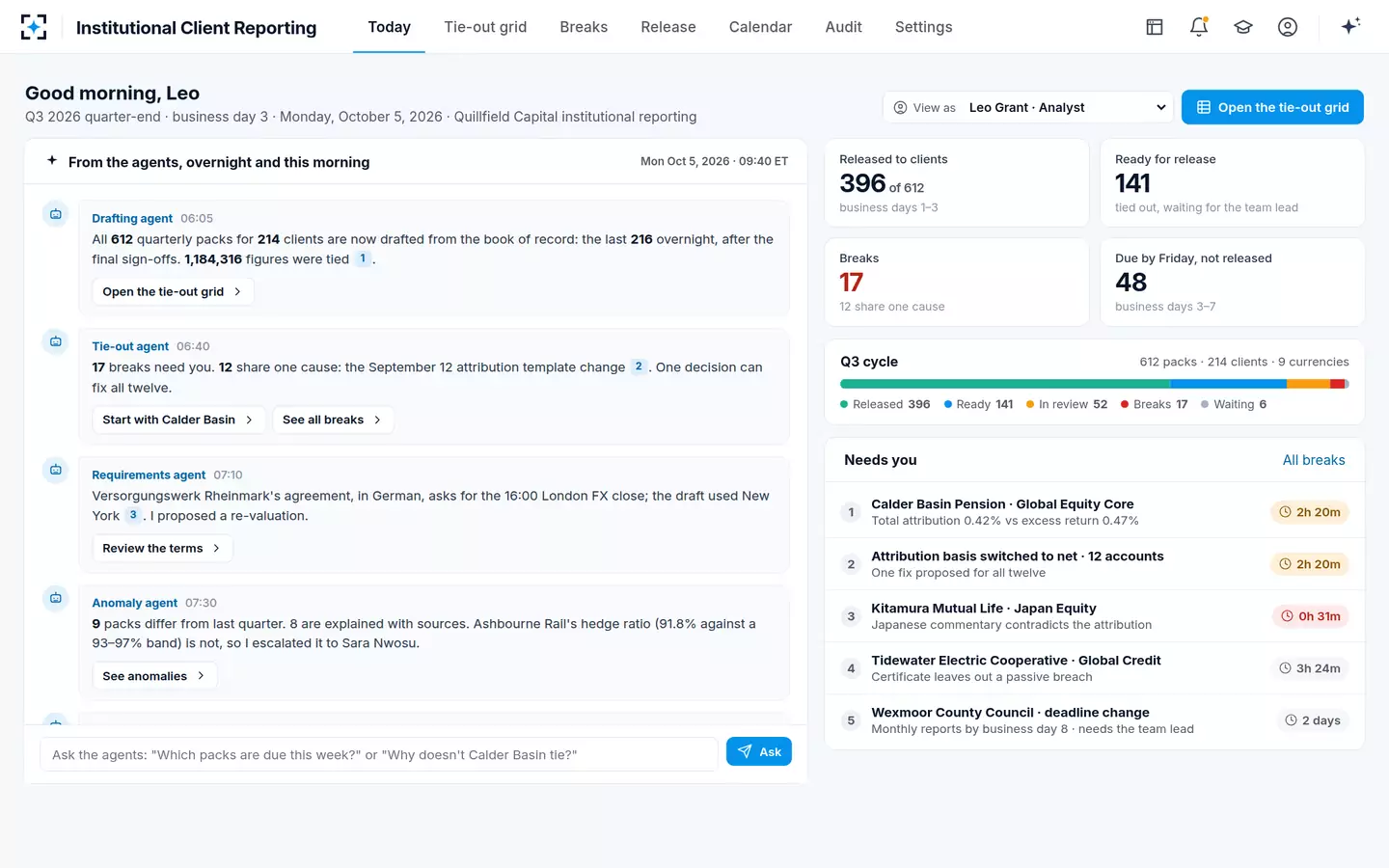
The analyst's work becomes the decisions. Leo approves one restatement for all twelve mandates hit by the template change, with the reason code "Methodology per client agreement"; the performance analyst confirms one re-run; the portfolio manager accepts a one-sentence redline. Then he sends the report to the team lead, because he cannot release a report he prepared. The release queue ranks the ready reports by risk, so the team lead reads closely where it matters.
Ready reports ranked by risk, released by someone who did not prepare them
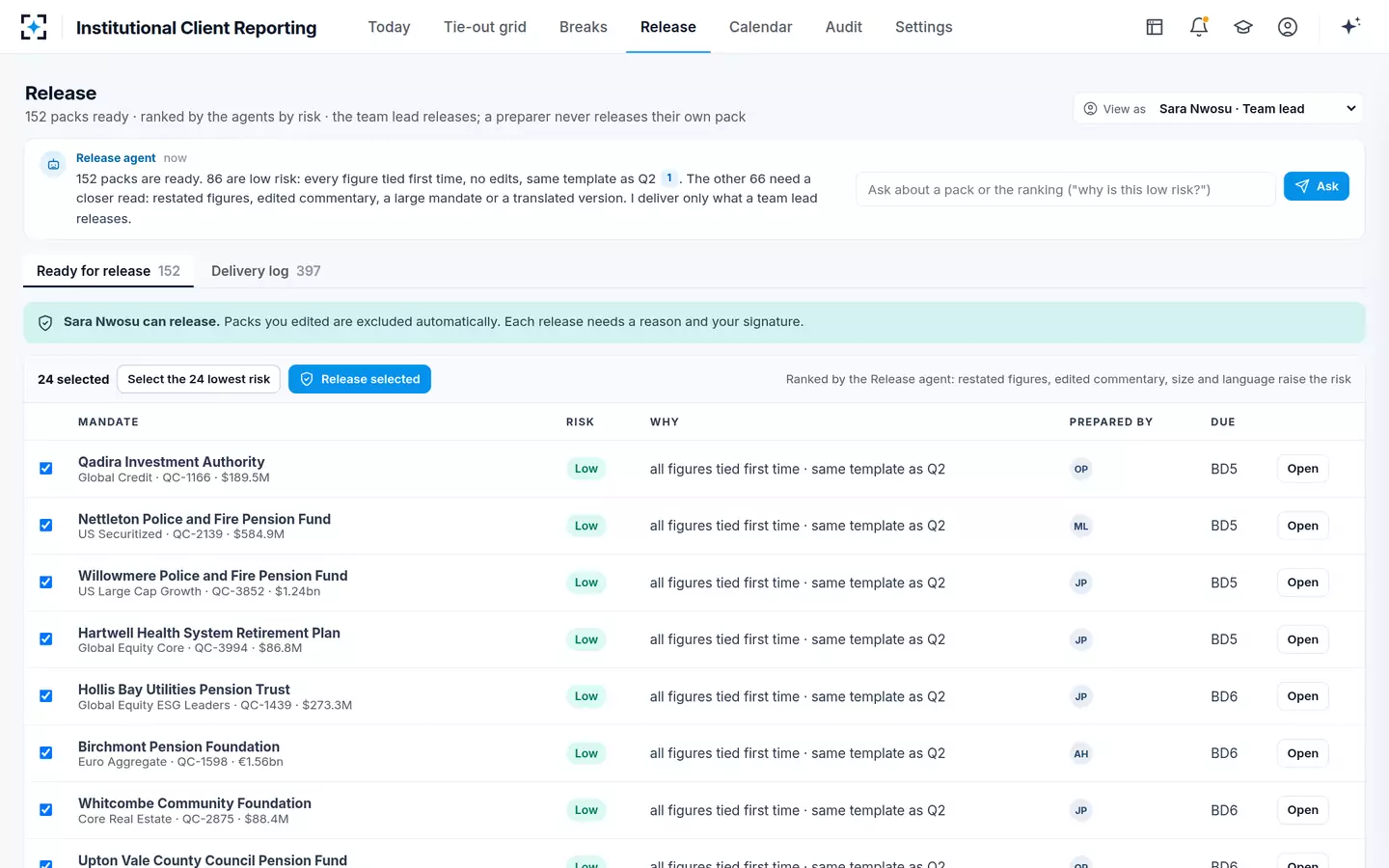
None of this removes the analyst. It removes the part of the job that is copying and re-checking, which is the part that made the quarter-end two weeks long. How the fourteen tasks of a cycle split between agents and people is set out in automated client reporting, task by task.
What skills does a client reporting analyst need?
The skills that matter most are the ones agents do not replace: reading an agreement and noticing what it does not say, knowing how a return is calculated well enough to see why two numbers differ, and judging when a break needs the portfolio manager rather than a re-run. Performance measurement is the core technical knowledge, time-weighted and money-weighted returns above all; which of the two a client report should show is a question analysts are asked every quarter.
The rest is craft: accuracy under deadline, writing a clear break note, and a habit of asking the client when a term is ambiguous instead of choosing the convenient reading. Data skills help, from SQL to a reporting tool's template language, but they are increasingly the part the tooling absorbs. To see the analyst's day on the sample firm's quarter-end, start from Institutional Client Reporting.
Questions people ask
What is the difference between a client reporting analyst and a performance analyst?
The performance analyst calculates and signs off returns and attribution; the client reporting analyst builds the client's report from them and checks every figure against its source and the client's terms. When a figure breaks, the reporting analyst finds it and the performance analyst confirms any re-run.
Does a team need more analysts as mandates grow?
Not necessarily: demand for the reporting seat follows how many separately managed mandates a firm runs, but the constraint is usually one step, not headcount. Logging one quarter-end in half-day blocks, divided by reports produced, shows whether that step is the build, the check, the chase or the review.
What does a client reporting manager do?
A client reporting manager or team lead reviews and releases reports for a region or client segment, sets the team's priorities through the quarter-end and answers for reissues. In a well-run team the manager releases only reports someone else prepared, and sees what was checked rather than being told.
How does the analyst's seat change as agents take the drafting?
It shifts toward judgement: breaks, client terms and release. The analyst still sees every number a client sees and every reason one changes, which makes the seat a direct line into performance measurement and client service.