MiFID II 10% depreciation reporting is the duty, in Article 62(1) of Delegated Regulation (EU) 2017/565, for a firm providing portfolio management to inform the client when the overall value of the portfolio, as evaluated at the beginning of each reporting period, has fallen by 10%, and again at each further 10%, no later than the end of that business day. In 2026 it is still EU law, but since 28 February 2022 it applies to a professional client only if that client has asked for MiFID reporting, and the UK has removed it altogether: for professional clients in 2021, for retail clients of MiFID firms in January 2023, and for the last firms that still had it, on 23 October 2025. The same market fall can therefore trigger a same-day notice for one mandate, nothing for the mandate beside it, and an obligation that exists only in the agreement for a third. Botminds' Institutional Client Reporting checks each mandate against the regime and the terms that actually apply to it.
The examples use illustrative figures and, where noted, a fictional sample firm, Quillfield Capital, as it runs through the solution. EU rules are given as published in the Official Journal; UK rules as they stand in the FCA Handbook and in UK legislation, with the dates each version applied.
One portfolio fall, three duties: EU retail, EU professional and UK clients
EU: retail client, or professional client that opted in: Inform the client by the end of the business day the threshold is crossed, and at each further 10% (Art. 62(1)).
UK, and EU professional clients that did not opt in: No regulatory notice. In the UK the rule is gone; for an EU professional client it does not apply unless the client asked.
EU: retail client, or professional client that opted in: For retail accounts, a notice per instrument at each 10% fall from its initial value (Art. 62(2)).
UK, and EU professional clients that did not opt in: No regulatory notice; the UK omitted Article 62 in full in January 2023.
EU: retail client, or professional client that opted in: Every three months, with the Article 60(2) contents, with limited exceptions.
UK, and EU professional clients that did not opt in: UK: required for retail and professional clients (COBS 16A.4.1R), with itemised contents and quarterly frequency for retail. EU professional, no opt-in: as the agreement says.
EU: retail client, or professional client that opted in: A professional client's request to receive these reports must be kept on record (Art. 29a(3) MiFID II).
UK, and EU professional clients that did not opt in: The agreement decides; the reporting terms should say so.
What Article 62 actually says
Article 62 has two paragraphs, and only the first concerns most institutional mandates. Paragraph 1 reaches every firm "providing the service of portfolio management"; paragraph 2 reaches firms that hold a retail client account with leveraged or contingent-liability positions, and works instrument by instrument.
Investment firms providing the service of portfolio management shall inform the client where the overall value of the portfolio, as evaluated at the beginning of each reporting period, depreciates by 10 % and thereafter at multiples of 10 %, no later than the end of the business day in which the threshold is exceeded or, in a case where the threshold is exceeded on a non-business day, the close of the next business day.
Delegated Regulation (EU) 2017/565, Article 62(1)
Four details in that sentence decide how the check is built. The measure is "the overall value of the portfolio", not any one holding. The reference value is the value "at the beginning of each reporting period", so it resets each period. The thresholds are 10% "and thereafter at multiples of 10 %", so a portfolio that falls 25% in a quarter produces two notices, at 10% and 20%. And the deadline is the end of the business day the threshold is crossed, with the close of the next business day only when it is crossed on a non-business day. The Article does not prescribe the notice's content or channel; it requires that the client be informed.
How is the 10 percent drop calculated?
The drop is measured against the portfolio's value at the start of the reporting period, the quarter for most mandates, and each new reporting period starts a new reference value. Take an illustrative EU retail portfolio worth €250.0 million at the close on 30 June 2026, at the start of the third-quarter reporting period. The thresholds are €225.0 million (−10%), €200.0 million (−20%) and €175.0 million (−30%).
Two notices in one quarter: an illustrative portfolio's fall from its start-of-period value
Three choices the text leaves to the firm need a written policy. First, client cash flows: a withdrawal lowers the portfolio's value without any depreciation, so a firm will usually measure the fall net of contributions and withdrawals and should say how. Second, the valuation used intraday: the threshold is crossed when the portfolio's value crosses it, which for a firm valuing once a day means at its daily valuation. Third, the reporting period: for a leveraged portfolio whose statement is monthly, the reference value resets monthly. None of these is answered in Article 62; each should be answered in the firm's procedures and applied the same way to every mandate.
Is the 10 percent drop rule still in force?
In the EU, yes: Article 62 of Delegated Regulation 2017/565 has not been repealed, and it applies to retail clients and to professional clients who opted in. In the UK, no. The UK version of Article 62 was first narrowed to retail clients with effect from 26 July 2021, by the Markets in Financial Instruments (Capital Markets) (Amendment) Regulations 2021 (SI 2021/774), which substituted the words "portfolio management to a retail client must" into paragraph 1. It was then omitted entirely with effect from 18 January 2023 by the Markets in Financial Instruments (Investor Reporting) (Amendment) Regulations 2022 (SI 2022/1297) (legislation.gov.uk, Delegated Regulation 2017/565, Art. 62, versions and annotations).
How the 10% notice was narrowed and removed, date by date
| Date | Change | Who it affected |
|---|---|---|
| 31 Mar 2017 | Delegated Regulation 2017/565 published in the Official Journal; Article 62 covers every portfolio management client | EU and UK firms (the UK kept it after Brexit) |
| 26 Jul 2021 | UK: Article 62(1) narrowed to retail clients (SI 2021/774) | UK professional clients lose the notice |
| 28 Feb 2022 | EU: Article 25(6) reporting, including Articles 60 and 62, applies to professional clients only if they ask (Directive 2021/338) | EU professional clients |
| 18 Jan 2023 | UK: Article 62 omitted (SI 2022/1297) | Retail clients of UK MiFID firms |
| 23 Oct 2025 | UK: COBS 16A.4.3UK deleted; Delegated Regulation revoked in the UK and restated in FCA rules | Retail clients of optional exempt (Article 3) firms |
The FCA explained the sequence when it removed the last UK remnant. In 2022 the Treasury's changes "Removed the requirement for firms providing portfolio management services to inform a retail client when the value of their portfolio fell by 10%", and "These requirements had already been changed for MiFID investment firms trading with professional clients (reflected for professional clients in our Handbook in 2022)". Its 2024 consultation proposed removing the requirement from COBS 16A.4.3UK "so it no longer applies as a rule to optional exempt (Article 3) firms, in line with MiFID firms"; it received three responses, "which all supported deleting COBS 16A.4.3UK", and the deletion took effect on 23 October 2025 (FCA PS25/13, October 2025).
Do professional clients get quarterly statements?
In the EU, only if they ask. Article 29a(2) of MiFID II, inserted by Directive (EU) 2021/338 and applied from 28 February 2022, says the requirements "in Article 25(6) shall not apply to services provided to professional clients, unless those clients inform the investment firm either in electronic format or on paper that they wish to benefit from the rights provided for in those provisions" (Directive (EU) 2021/338). Article 60, the periodic statement, and Article 62, the 10% notice, are both made under Article 25(6), so an EU professional client that has not opted in is owed whatever its agreement says, which is usually a quarterly report anyway.
In the UK, yes, in principle. COBS 16A.4.1R(1) applies when a firm "is providing a portfolio management service on behalf of a retail client or professional client", and the statement must give a fair and balanced review of the firm's activity and the portfolio's performance over the period. The itemised contents in (2)(b) and the rule that the statement "must be provided to a retail client once every 3 months" are written for retail clients (FCA Handbook, COBS 16A.4.1R), so for a UK professional client the frequency and the detail again come from the agreement.
COBS 16A.4 and the deleted COBS 16A.4.3
COBS 16A.4 is the FCA Handbook section on periodic reporting for portfolio management, last updated on 23 October 2025, when the FCA restated the UK version of Delegated Regulation 2017/565 in its own rules. COBS 16A.4.1R carries the old Article 60: who gets a periodic statement, what it contains and how often. COBS 16A.4.3 was the FCA's copy of the 10% rule for optional exempt firms, and it now appears as deleted. A search for "cobs 16a.4.3 uk" therefore leads to a rule that no longer applies to anyone.
The practical consequence for a UK firm is to check that its procedures, its client agreements and its reporting system no longer cite a regulatory 10% duty, while keeping any 10% notice a client has contracted for. An institutional agreement written before 2023 may still contain a drawdown notice clause, at 10% or at a level of its own; such a clause survives the rule's deletion because it is contractual.
How often must a portfolio manager report?
Under EU and UK rules, quarterly for retail clients, with three exceptions. Article 60(3) of Delegated Regulation 2017/565 says the periodic statement "shall be provided once every three months", except where the firm offers an online system that qualifies as a durable medium with up-to-date valuations and has evidence the client looked at least once in the quarter; where the client takes transaction-by-transaction confirmations, in which case at least every twelve months outside derivatives; and where the agreement "authorises a leveraged portfolio", in which case "at least once a month" (Art. 60(3)). COBS 16A.4.1R(3) repeats the same pattern for UK retail clients.
For institutional mandates, the agreement usually sets a tighter cadence than any rule, with a business-day deadline for each report: the sample firm's German pension client, for instance, wants its quarterly report by the eighth bank business day after quarter-end. Those contractual dates are what a reporting calendar runs on. The regulatory minimum matters most for the EU professional clients who opted in, because for them the Article 60 contents become a floor the agreement cannot lower.
The opt-in is a record you must keep
Because the EU duties for professional clients turn on the client's own request, the request is a fact the reporting team must know, mandate by mandate. Article 29a(3) says: "Member States shall ensure that investment firms keep a record of the client communications referred to in paragraph 2." An opt-in that arrived as a letter to the relationship manager in 2022 and never reached the reporting terms is the commonest way a firm misses a 10% notice it owes.
The fix is to treat the opt-in like any other client term: captured from the letter or email, attached to the mandate with its date, and checked on every report. The same applies in reverse in the UK, where a pre-2023 agreement may still promise a 10% notice the rules no longer require.
Running the 10% check across a mixed EU and UK book
- Classify every mandate
EU retail; EU professional with opt-in (date and evidence); EU professional without; UK; and whether the agreement itself promises a drawdown notice.
- Fix the reference value at the start of each reporting period
Monthly for leveraged portfolios whose statement is monthly; quarterly otherwise.
- Write down how client flows are treated
A withdrawal is not a depreciation. Apply the same method to every mandate.
- Run the check on every valuation
At each 10% multiple, with the deadline set to the close of that business day.
- Prepare the notice for a person to send
The rule does not prescribe content; state the start value, current value, fall and date.
- Keep the evidence
The valuation, the time the threshold was crossed and the time the client was told.
How Institutional Client Reporting runs the depreciation check
In Institutional Client Reporting, the 10% check is one of the anomaly rules the Anomaly agent applies to EU accounts, alongside return outliers, tracking-error changes, holdings-count changes and attribution residuals. Like every rule it is a setting the Head of Client Reporting approves, and every change is logged. Which mandates it applies to comes from each client's terms, read by the Requirements agent, so a professional client's opt-in, which arrives as a letter or an email like any other term, can be captured with the mandate's terms rather than left in an inbox.
The depreciation check as a setting, beside the other anomaly rules
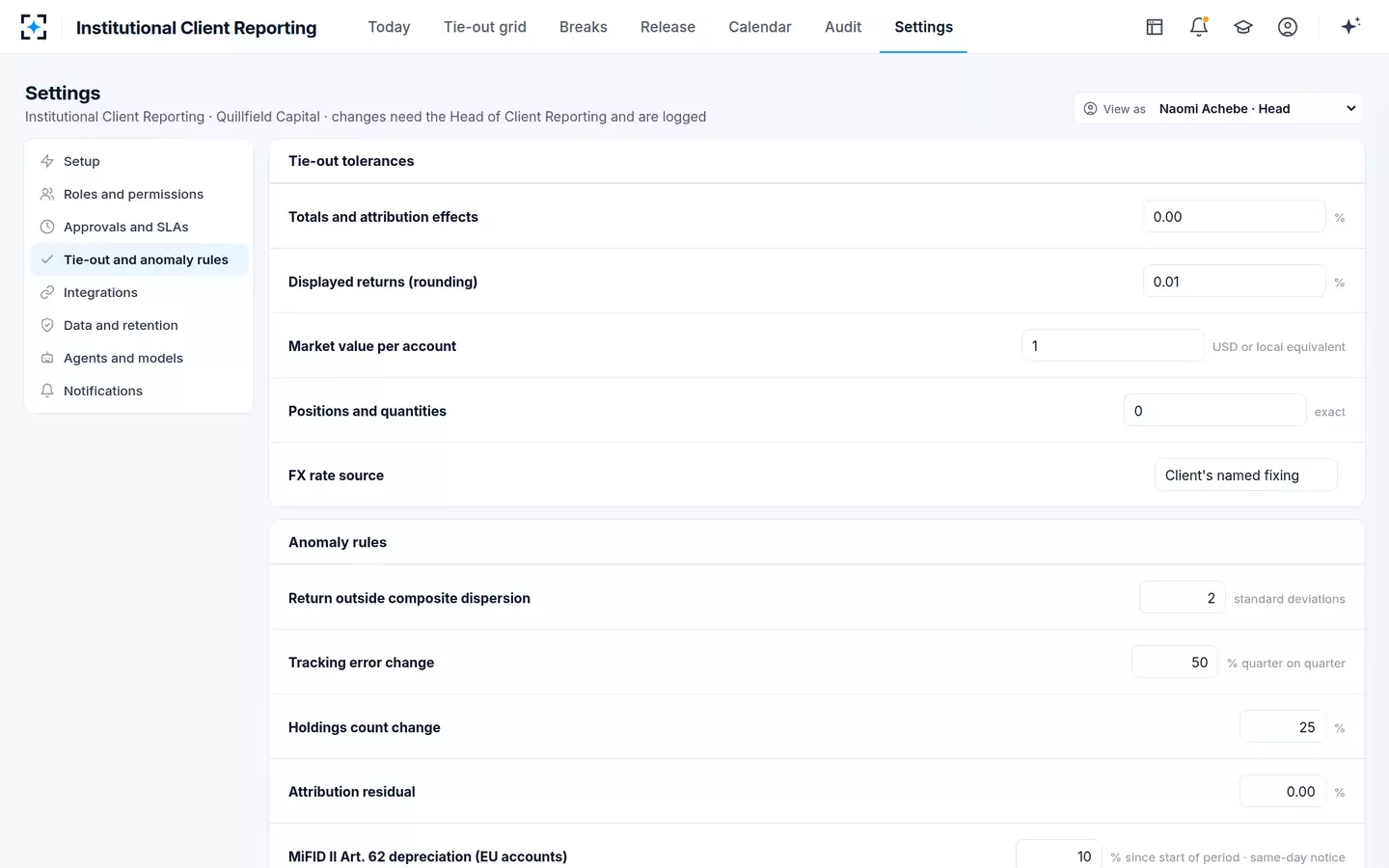
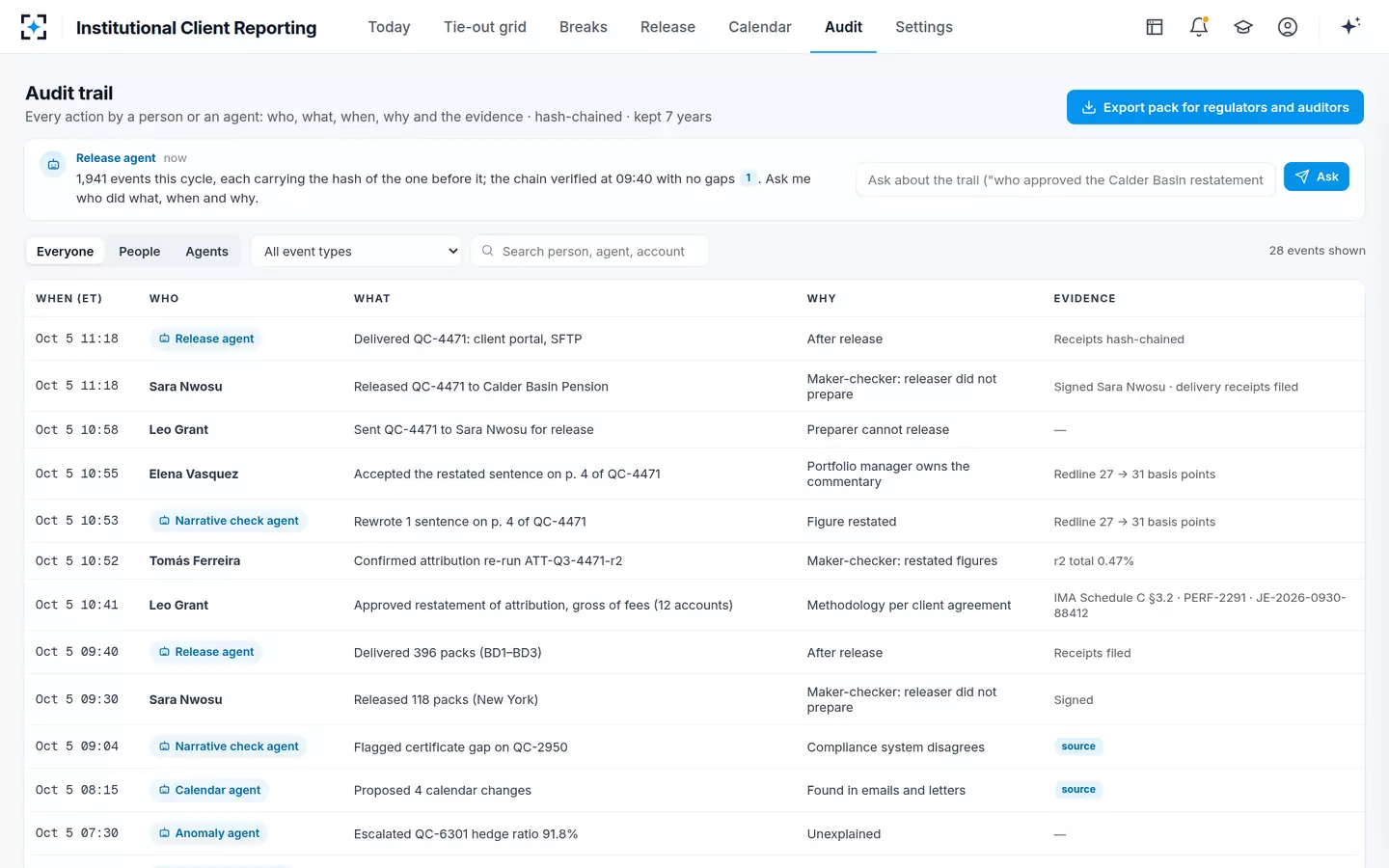
When the check fires, the agents prepare; people decide and send. The audit trail keeps who did what and when, which is the evidence a firm needs if it is ever asked when a client was told.
Every action on the trail: who, what, when, why and the evidence
The 10% notice is one of several duties that differ by client; client reporting in asset management, mapped sets out the rest. For the report the notice sits beside, see an investment performance report example, annotated, and for the solution, Institutional Client Reporting.
Questions people ask
What is a 10% depreciation notification?
It is the notice a portfolio manager subject to MiFID II must send a client when the portfolio's overall value has fallen 10% from its value at the start of the reporting period, and again at 20%, 30% and so on. It is due by the end of the business day the threshold is crossed. In the EU it still applies to retail clients and to professional clients who asked for it.
Does the 10% rule apply to fund investors?
No. Article 62(1) applies to firms "providing the service of portfolio management", that is, managing a client's own portfolio under a mandate. Investors in a UCITS or other fund receive the fund's own reports, not Article 62 notices.
What if the threshold is crossed on a weekend or holiday?
Article 62 gives until the close of the next business day when the threshold is exceeded on a non-business day. Otherwise the deadline is the end of the business day on which it was crossed.
Can a professional client opt back in to the 10% notice?
Yes, in the EU. Under Article 29a(2) of MiFID II, a professional client that informs the firm, electronically or on paper, that it wishes to benefit from the Article 25(6) reporting rights receives them, including the Article 62 notice. The firm must keep a record of that communication.
Does a UK firm still have to send 10% drop notices?
Not under the rules: the UK removed the requirement for MiFID firms in January 2023 and for optional exempt firms on 23 October 2025. A UK firm must still honour any drawdown notice its client agreements promise.