Client reporting in asset management is the work of sending every institutional client a regular, accurate account of its own mandate: what it holds, what it returned against the agreed benchmark, why, what it cost, and whether the manager stayed inside the guidelines. It is hard because no two clients are owed the same report. A pension fund's investment management agreement sets one valuation point and one fee basis, an endowment's side letter adds a section, an EU client may have asked for MiFID II statements while another has not, and the manager's own brochure has told the SEC what reports every client gets. Botminds' Institutional Client Reporting exists for that problem: agents read each client's terms into checks, draft each monthly and quarterly report from the book of record, tie every figure to its source and leave the decisions and the release to people.
This guide starts one step before any report is built. It sets out the six places a reporting duty comes from, what each one actually requires in the regulator's or the agreement's words, and how a head of client reporting turns them into a map, mandate by mandate. The product examples come from a fictional sample firm, Quillfield Capital, as it runs through the solution.
The scale of the promise: US-registered advisers alone
16,442
investment advisers registered with the SEC, December 2025
$177.0tn
regulatory assets under management they reported
$477.0m
median assets under management per adviser
9,926
advisers that reported custody of client funds or securities
What is client reporting in asset management?
Client reporting in asset management is the scheduled, client-specific reporting a manager sends on each separately managed mandate, as distinct from the public reporting a fund files for all its shareholders. A mutual fund sends every shareholder the same annual report; a segregated mandate for a state pension plan gets a report built for that plan alone. Most institutional clients receive a short monthly report on performance and holdings and a full quarterly investment report, with returns gross and net of fees, the benchmark comparison, attribution, holdings and transactions, portfolio commentary and a compliance certificate.
What makes the work institutional is that the client sets the terms. The investment management agreement, usually with a reporting schedule attached, says what the report contains, by which business day it arrives, in which language, through which channel and to whom, often including the client's investment consultant. A manager with a few hundred mandates is therefore not producing one report a few hundred times. It is producing a few hundred different reports that share a template, a performance system and a quarter-end. The sample firm in this guide owes 612 quarterly reports to 214 clients in nine currencies, and the terms behind them are spread across 731 agreements and side letters.
The regulators come second, but they set floors the agreement cannot lower. The brochure rule says the manager must describe its reports to clients in advance; the EU and UK rules prescribe what a periodic statement must contain; the custody rule makes someone else send the client an independent statement; and the books and records rule makes every figure in every report something the manager must be able to rebuild years later.
Six sources of a reporting duty, and what each one asks for
Every line of a client report traces back to one of six sources, and the first job of a reporting team is to know which applies to which mandate. The map below is the one we would start from; the rows are ordered from the most specific duty, the client's own agreement, to the most general.
The obligation map: where each client reporting duty comes from
The investment management agreement, its schedules and side letters
What it requiresContents, basis (gross or net, time-weighted or money-weighted), benchmark, valuation point and FX fixing, language, deadline, recipients, channel, certificate wording.
Which mandatesEvery segregated mandate, each on its own terms
Form ADV Part 2A, Item 13C (SEC-registered advisers)
What it requiresThe brochure describes the content and frequency of regular reports and says whether they are written. The report you send must match what you told the client you would send.
Which mandatesEvery client of a US-registered adviser
MiFID II, Delegated Regulation 2017/565, Article 60 (EU)
What it requiresA periodic statement with a fair and balanced review, holdings and valuation, performance, fees, the agreed benchmark, income and transactions; once every three months, with exceptions.
Which mandatesEU retail clients; EU professional clients only if they asked (since 28 Feb 2022)
FCA COBS 16A.4.1R (UK, since 23 Oct 2025)
What it requiresA periodic statement with a fair and balanced review for retail and professional clients; the itemised contents and the three-month frequency are written for retail clients.
Which mandatesUK mandates of FCA-authorised managers
Custody rule, 17 CFR 275.206(4)-2
What it requiresThe qualified custodian sends its own statement at least quarterly; an adviser that also sends statements must urge the client to compare the two.
Which mandatesClients of US-registered advisers with custody
Books and records rule, 17 CFR 275.204-2
What it requiresKeep a copy of what was sent and the working papers behind every performance figure, five years from the end of the fiscal year.
Which mandatesEvery report a US-registered adviser sends
The agreement sits at the top for a practical reason: it is the only source that is different for every client, so it is where most breaks come from. Two clients in the same strategy can be owed different numbers for the same quarter because one agreement names the 16:00 London closing rate and the other uses the manager's standard valuation point, or because one wants attribution gross of fees and the other net. Those differences are not errors until the report ignores them.
What does Form ADV say about client reports?
For an SEC-registered adviser, Form ADV Part 2A turns the reporting promise into a public statement. Item 13C of the brochure asks the adviser to "Describe the content and indicate the frequency of regular reports you provide to clients regarding their accounts. State whether these reports are written." (SEC Form ADV Part 2, Item 13). Item 13A asks, in the same item, whether the adviser periodically reviews client accounts and who reviews them.
Item 13C matters to a reporting team for two reasons. It is written once, usually by compliance, and then forgotten, while the reports change every year; a brochure that still says clients receive a quarterly report with attribution, sent to every client, is out of date if a third of the mandates moved to a portal with no attribution page. And it is the firm's own description of what clients receive, which is the first thing an examiner can hold a sample of reports against. A useful annual check is to read Item 13C beside the current reporting calendar and change whichever is wrong.
Communications to existing clients about their accounts are generally not advertisements under the SEC's marketing rule, which reaches existing investors only when a communication offers new or additional advisory services; the Commission said the change lets advisers keep sending current investors timely information about their accounts (adopting release, 86 FR 13024, 2021). The anti-fraud provisions still apply to every report, which is why the questions about a report's accuracy are the same whether or not it is marketing.
How often must clients get reports? Quarterly, for different reasons in different places
Quarterly is the usual answer, but it comes from a different source in each jurisdiction, and the exceptions differ. In the EU, Article 60(3) of Delegated Regulation 2017/565 sets a three-month cycle for the periodic statement and allows three departures from it: no paper statement where the client has an online system with up-to-date valuations that counts as a durable medium and the firm can show the client looked during the quarter; a yearly statement where the client takes trade-by-trade confirmations, unless derivatives are involved; and a monthly statement where the agreement allows the portfolio to be leveraged (Delegated Regulation (EU) 2017/565, Art. 60).
In the UK, the FCA moved the same rule into its own Handbook when the Delegated Regulation stopped applying there on 23 October 2025: COBS 16A.4.1R(3) keeps the three-month cycle for retail clients and the same three departures (FCA Handbook, COBS 16A.4). In the US no rule fixes how often an adviser sends its own report; the agreement does, and Item 13C describes it. What the US does fix is the custodian's statement, which must go out at least every quarter, covered further down.
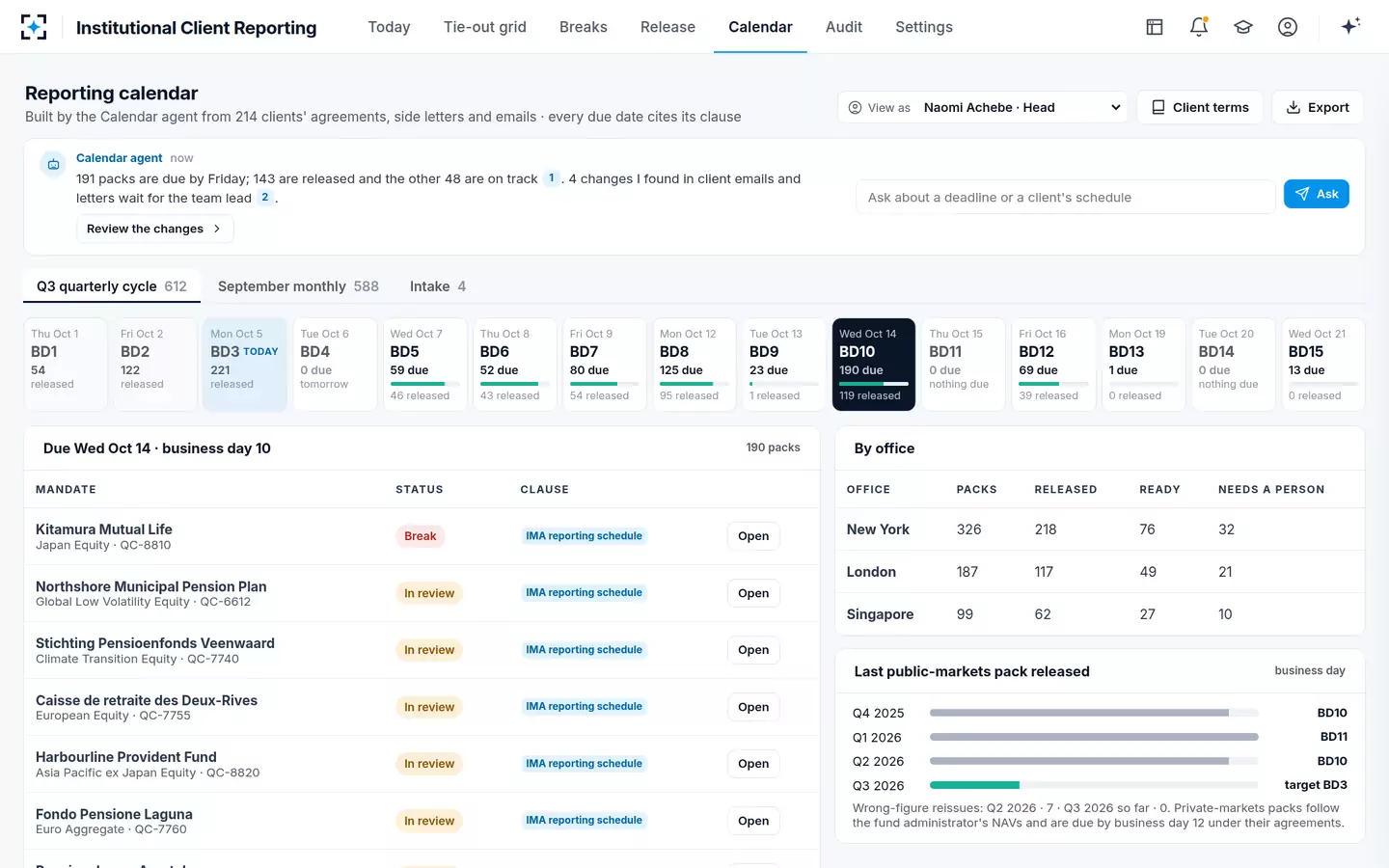
The agreement can always ask for more. Monthly reports by the eighth bank business day, a flash return by the third, quarterly reports by the tenth: those deadlines are contractual and they are what a reporting calendar is built from. The sample firm's calendar is built from 214 clients' agreements, side letters and emails, and every due date on it cites the clause it came from.
A reporting calendar built from the agreements, not from a spreadsheet
Do professional clients have to get a periodic statement? The EU opt-in and the UK rule
In the EU, not unless they ask. Since 28 February 2022, Article 29a(2) of MiFID II, inserted by Directive (EU) 2021/338, switches off the client-reporting duty in Article 25(6) for professional clients, unless a client tells the firm, on paper or electronically, that it wants those reports (Directive (EU) 2021/338, Art. 1(8)). Articles 60 and 62 of the Delegated Regulation are both made under Article 25(6), as each one's heading says: they are the detail of the duty that a professional client now has to ask for.
That has two consequences for a reporting team with EU institutional mandates. Most of its clients are professional clients, so for most of them the content and frequency of the report come from the agreement alone. And the firm needs to know which clients asked: Article 29a(3) requires firms to keep a record of those requests. An opt-in that sits in a client-service inbox rather than on the mandate's terms is a periodic statement the team does not know it owes. The 10% depreciation notice follows the same opt-in, which is where the difference bites hardest.
The UK went a different way. COBS 16A.4.1R(1) covers portfolio management for retail and professional clients alike, so a UK professional client gets a periodic statement without asking, and that statement must give a fair and balanced review of what the firm did and how the portfolio performed in the period. In the current text, though, the itemised list of contents in (2)(b) and the three-month frequency in (3) are written for retail clients, so for a UK professional client the agreement again decides how often and in what detail.
The custodian's statement is part of the promise too
A manager's report is not the only statement an institutional client receives, and in the US the other one is required. Under the custody rule, an adviser with custody must have a reasonable basis, after due inquiry, to believe that the client's qualified custodian sends it a statement at least every quarter, listing what the account held at period end and every transaction during the period. An adviser that sends its own statements as well must put a sentence in them urging the client to compare its statements with the custodian's (17 CFR 275.206(4)-2(a)(2)–(3)).
That legend is a reporting requirement hiding in a custody rule, and a report template that drops it in a redesign breaks it on every account at once. It also changes what the report has to survive: a client who compares the two statements will find differences, and the manager's report should be able to explain each of them. Why a custodian statement never quite matches the manager's report takes those differences one by one. The SEC proposed a rewrite of the custody rule on 6 October 2026, with comments due 7 December 2026; until it is adopted, the rule quoted here is the one in force.
Every figure sent must be rebuildable: the books and records rule
For a US-registered adviser, every performance figure in every client report creates a record-keeping duty. Rule 204-2(a)(16) requires the adviser to keep the accounts, books, internal working papers and other documents needed to show how any performance or rate of return it presents in a communication was calculated, and (a)(7) requires copies of written communications about the performance of managed accounts. Those performance working papers must be kept where they can be reached easily for at least five years, two of them in one of the adviser's own offices, and the five years start at the end of the fiscal year in which the adviser last sent the communication (17 CFR 275.204-2(e)(3)(i); the adviser recordkeeping guide sets out the rule's wording and its other record types).
The clock in that sentence runs from the last time the figure was sent, not from the quarter it describes, so a since-inception return repeated in every quarterly report keeps its working papers alive for as long as it keeps appearing. In practice the duty is met not by keeping more files but by keeping the right ones: the released report, the performance run it came from, the accounting entries behind any adjustment, and who decided what. A team that can produce those for any figure in any report from five years ago has met the rule; a team that would have to re-run the quarter has not.
Who owns the promise inside the firm
Inside an asset manager the reporting promise is split across five roles, and most reporting failures happen at the hand-offs between them. The analyst builds and checks the report; performance owns the returns and the attribution; the portfolio manager owns the commentary, which has rules of its own; client service owns the relationship and the agreement; and the head of client reporting owns the calendar, the template and the policy. Compliance reviews disclosures and certificates. Nobody owns the map of what each client was promised unless someone is given it.
Five roles stand behind each institutional client report
Today
Builds each mandate report from the performance and accounting systems, checks it by eye and chases breaks by email.
With agents
Starts from reports already drafted and tied; decides each break with a reason.
Still theirs: Decides every break and sends the report for release.
Today
Signs off returns, then answers break emails one account at a time.
With agents
Gets one traced cause per break, with the account, period and journal.
Still theirs: Confirms any restated return or attribution.
Today
Writes or approves commentary that can drift from the final numbers.
With agents
Receives a redline only where a figure the commentary relies on changed.
Still theirs: Owns every sentence of the commentary.
Today
Keeps the agreement and the side letters, and fields the client's questions.
With agents
Sees each client's terms as checks, with the clause beside them.
Still theirs: Owns the relationship and any change to the terms.
Today
Answers for late and reissued reports across the cycle.
With agents
Sees the cycle by business day and the terms behind every deadline.
Still theirs: Approves new client terms and every change to the reporting rules.
Mapping one mandate's promises: a worked example
A map is built one mandate at a time, from the documents rather than from memory. Take a sample German pension client of the fictional firm, Versorgungswerk Rheinmark, whose agreement is in German with a reporting annex (Anlage 3) dated March 2024. Read clause by clause, the annex produces nine checks the quarterly report must pass: delivered by the eighth bank business day; time-weighted returns in euros, gross and net; foreign currencies converted at the 16:00 London closing rate; written in German, with an English version permitted; hedging result shown separately; duration and rating breakdown; a certificate against the guidelines in Anlage 2; delivery by secure email; and a month-end reference date for the monthly report.
One client's reporting terms, read into nine checks
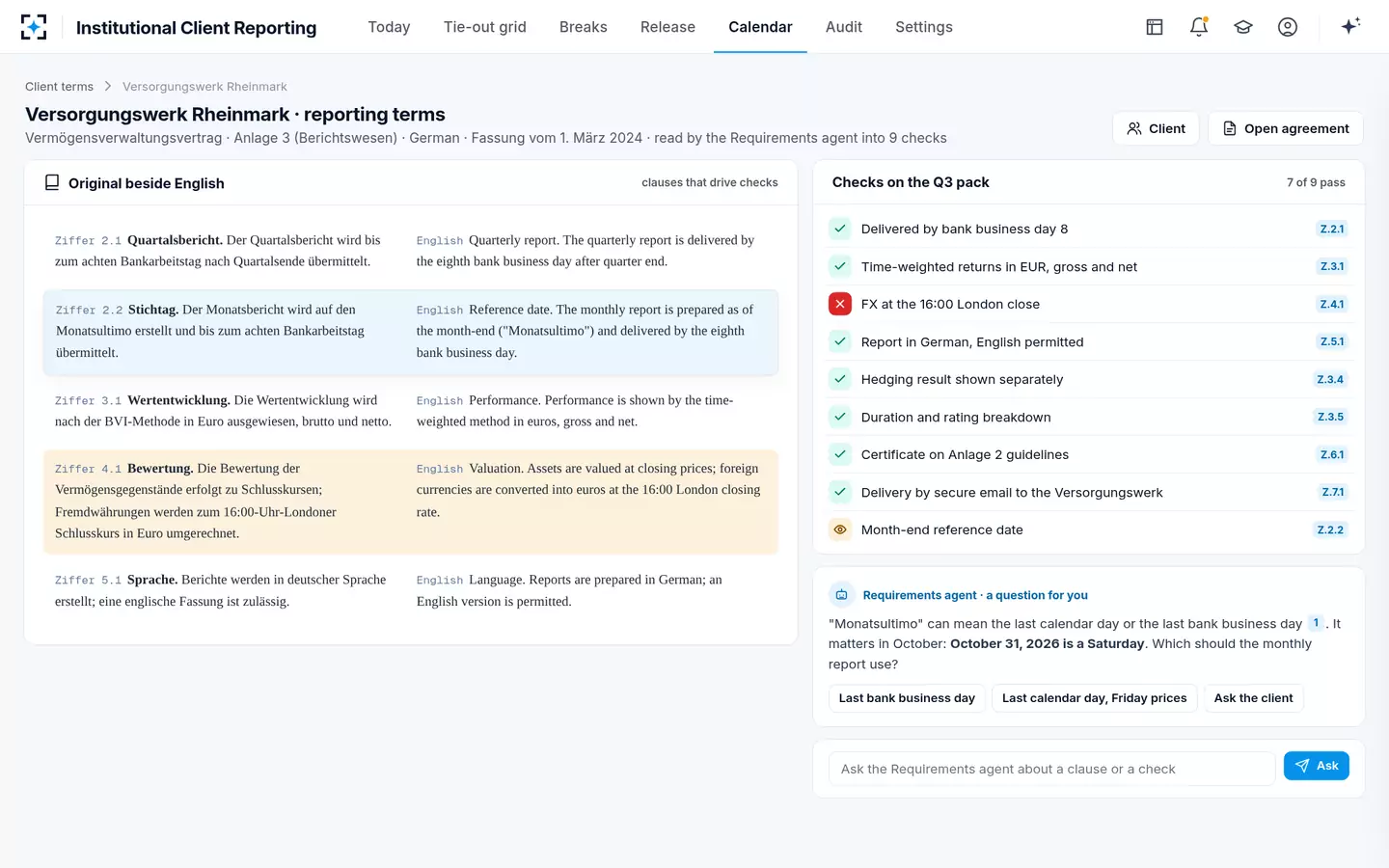
Two of the nine checks show why the map has to come from the text. The FX clause is unambiguous, and the draft broke it: valued at the New York close rather than the London fixing, the portfolio was €184,221, or 0.02%, off. No total in the report was wrong on its own terms. The other is the word Monatsultimo, month-end, which can mean the last calendar day or the last bank business day. In most months the two coincide or barely differ; in October 2026, when the 31st is a Saturday, they give different prices. The right response is a question to the client, recorded on the mandate, not an analyst's guess.
Building the obligation map for a new mandate
- Read the agreement, every schedule and every side letter
In the original language. Note each reporting term with its clause number: contents, basis, benchmark, valuation point, FX fixing, deadline, language, recipients, channel.
- Classify the client under each regime that applies
EU retail or professional, and whether a professional client asked for Article 25(6) reports; UK retail or professional; US custody arrangement.
- Check the promise against Form ADV Item 13C
If the mandate gets a report the brochure does not describe, or misses one it does, change one of them.
- Confirm who sends the custodian statement and whether your report carries the compare legend
And note the custodian's valuation point, which will differ from yours.
- List the ambiguous terms and ask the client
Month-end on a weekend, a benchmark with two versions, a fee basis described two ways. Record the answer on the mandate.
- Set each check, with its clause, before the first report is built
A term that exists only in someone's memory is broken the first time that person is away.
Where Institutional Client Reporting checks the obligation map
Institutional Client Reporting keeps the obligation map as the thing every report is checked against. A Calendar agent reads agreements, side letters, client emails and CRM preferences into each mandate's schedule, and proposes changes for the team lead to approve; at the sample firm it read 731 agreements and side letters and proposed four changes. A Requirements agent turns each client's terms, in their original language, into checks: gross or net, attribution basis, FX fixing, sections, disclosures, the custody legend and the certificate wording. It never decides an ambiguous clause; it asks, and records the answer.
The obligation map as checks, at the sample firm
| Source | Becomes a check that | Who decides if it fails |
|---|---|---|
| Agreement and side letters | the report uses the client's basis, benchmark, valuation point, FX fixing, language and deadline | Analyst, with a reason code; ambiguous terms go to the client |
| Form ADV Item 13C | the mandate's report matches what the brochure describes | Head of client reporting and compliance |
| EU Article 60 / UK COBS 16A.4 | opted-in and retail mandates get the prescribed contents at the prescribed frequency | Head of client reporting |
| Custody rule | the compare legend is present wherever the adviser sends statements | Compliance reviewer |
| Books and records rule | every released figure keeps its lineage, decisions and receipts | Kept by the system; exported for examiners |
The rest of the cycle follows from the map: the Drafting agent builds each report from the book of record, the Tie-out agent ties every figure to its source, and a team lead who prepared nothing releases. How that changes the client reporting analyst's quarter-end is the next step; the whole solution is at Institutional Client Reporting.
Questions people ask
What is client reporting?
Client reporting is the regular, client-specific reporting a financial firm sends on an account it manages: holdings, performance against the agreed benchmark, fees, transactions and commentary. In asset management it is governed first by each client's agreement, then by rules such as Form ADV Item 13C in the US and the periodic-statement rules in the EU and UK.
What reports do institutional clients get?
Typically a monthly report on performance and holdings and a fuller quarterly investment report with returns gross and net, the benchmark comparison, attribution, holdings, transactions, commentary and a compliance certificate. Many also receive a data file for their consultant and an annual cost statement. The exact contents and deadlines are set in each investment management agreement.
Is a client report an advertisement under the SEC marketing rule?
Generally not, when it reports on the client's existing account. The 2021 adopting release says a communication to a current investor is an advertisement when it offers new or additional advisory services. The anti-fraud provisions of the Advisers Act apply either way, so the accuracy duty is the same.
How long must an adviser keep client reports and their working papers?
Under SEC Rule 204-2, at least five years where they can be reached easily, with the first two years' records kept at one of the adviser's offices. For the working papers behind performance figures, the five-year count restarts at the end of every fiscal year in which the figure goes out again, so a figure that keeps being repeated keeps its papers alive.
Who is responsible for client reporting in an asset manager?
The head of client reporting usually owns the calendar, templates and policy, and analysts build and check each report. Performance owns returns and attribution, portfolio managers own commentary and client service owns the agreement. The firm as a whole answers for every report it sends, which is why the person who releases a report should not be the person who prepared it.