Client reporting tools in asset management are the systems that turn a manager's books into each client's report: portfolio accounting, which holds the book of record; the system that calculates returns and attribution; the custodians' and fund administrators' feeds; the investment compliance system; the CRM with each client's contacts and preferences; and the reporting tool or templates that lay the report out. A firm rarely lacks any of them. What it lacks is the work between them, reading each client's agreement, tying each figure back to its source, tracing why a number breaks, which is still done by analysts with exports and email. Botminds' Institutional Client Reporting adds agents that do that work beside the existing systems: they read from the systems of record, write only drafts and evidence, and leave every decision and release to people, so nothing has to be migrated.
Product examples come from a fictional sample firm, Quillfield Capital, as it runs through the solution. The rules on service providers and records are the SEC's, quoted where they apply.
Agents beside the client reporting stack: they read, draft and prove; people decide and release
Agent
Read the systems of recordAccounting, performance, custodians, compliance, the agreements and the CRM, each for what it owns.
Never: writes back to a system of record.
Agent
Draft each reportBuilds every report and its data file from those sources, in the firm's own templates.
Never: writes a figure that has no source.
Agent
Tie and traceTies every figure to its source and follows each break to its cause, citing the record at each step.
Never: changes a figure. It proposes fixes, with evidence.
A person decides
DecideThe analyst decides each break; performance confirms restated figures; compliance approves certificate exceptions.
A person decides
ReleaseA team lead who did not prepare the report releases it with a signature.
Agent
Deliver and keep the evidenceTo the client portal, the consultant's SFTP site or secure email; receipts and the audit trail filed.
Never: delivers a report a person has not released.
What client reporting tools does an asset manager already run?
A manager with institutional mandates already runs six kinds of client reporting systems, even if none of them is called that. Each one owns a part of the report, and each one is the system of record for what it owns. The reporting tool, where there is one, is usually the last link: it lays out figures that came from the other five.
What client reporting needs from each system, and who owns it
| System | What it keeps | What the report takes from it | Owner |
|---|---|---|---|
| Portfolio accounting | The book of record: holdings, transactions, valuations, journals | Market value, holdings, transactions, income, fee accruals | Investment accounting |
| Performance and attribution system | Returns gross and net, benchmark returns, attribution effects, the change log | Every return, the benchmark comparison, the attribution page | Performance team |
| Custodians and fund administrators | Positions and cash as held; valuations for private assets | The position tie and the independent check the client also receives | Operations |
| Investment compliance system | Rule results, breaches and cures | The compliance certificate and its exceptions | Investment compliance |
| Agreements, side letters and client emails | Each client's reporting terms, in the original language | Contents, basis, benchmark, FX fixing, deadline, language, legends | Client service and legal |
| CRM and delivery channels | Contacts, consultants, preferences; the portal, SFTP and secure email | Recipients and the delivery route for each report | Client service |
What data does client reporting need?
Client reporting needs every number in the report, from the system that owns it, for the account, period and basis the client agreed, plus the terms that say what the client agreed. That last part is the one most firms keep outside any system: in a spreadsheet copied from agreements and side letters, sometimes in German or Japanese, updated when someone remembers an email. It is also the part that causes the breaks that matter, because a figure can be right in its own system and wrong for the client.
At the sample firm the terms behind 612 quarterly reports came from 731 agreements and side letters. Read clause by clause, one German client's reporting annex produced nine checks, including a 16:00 London FX fixing that the draft report had missed. A reporting tool that holds layouts per client cannot hold that; a reporting process that reads the agreement can.
Do we need to replace our reporting system?
Usually not. The reporting tool lays out figures; the slow and error-prone work happens before and around it, in gathering, tying, tracing and checking terms. Replacing the layout tool moves templates from one product to another and leaves that work where it was. Adding agents that read the systems of record and produce drafts and evidence changes the work without touching the systems.
Replacing the client reporting platform vs adding agents beside it
Replace the reporting platform: Every template, mapping and data feed, re-built in the new product.
Add agents beside the existing systems: Nothing: agents read the systems you already run.
Replace the reporting platform: The layout step, once the migration is done.
Add agents beside the existing systems: The gathering, tie-out, tracing and term checks, from the first cycle.
Replace the reporting platform: Parallel running of two platforms; mapping errors in hundreds of templates.
Add agents beside the existing systems: Agents write only drafts and evidence; people still release.
Replace the reporting platform: Still kept as template variants or a spreadsheet.
Add agents beside the existing systems: Read from the agreements into checks, clause by clause.
Replace the reporting platform: When the layout tool itself has reached its end of life.
Add agents beside the existing systems: When the time goes on checking and chasing, not on layout.
Systems of record stay the systems of record
The rule that makes agents safe beside the stack is that they never become a second book of record. They read from accounting, performance, the custodians and the compliance system, and they write only two things: draft reports and evidence about them. When a figure is wrong in its source, the fix goes back to the source's owner. At the sample firm the Tie-out agent cannot change a figure, and the Drafting agent never edits a signed-off return; when attribution had to be restated, performance re-ran it in the performance system and confirmed the new run.
One client, answered from the systems it came from
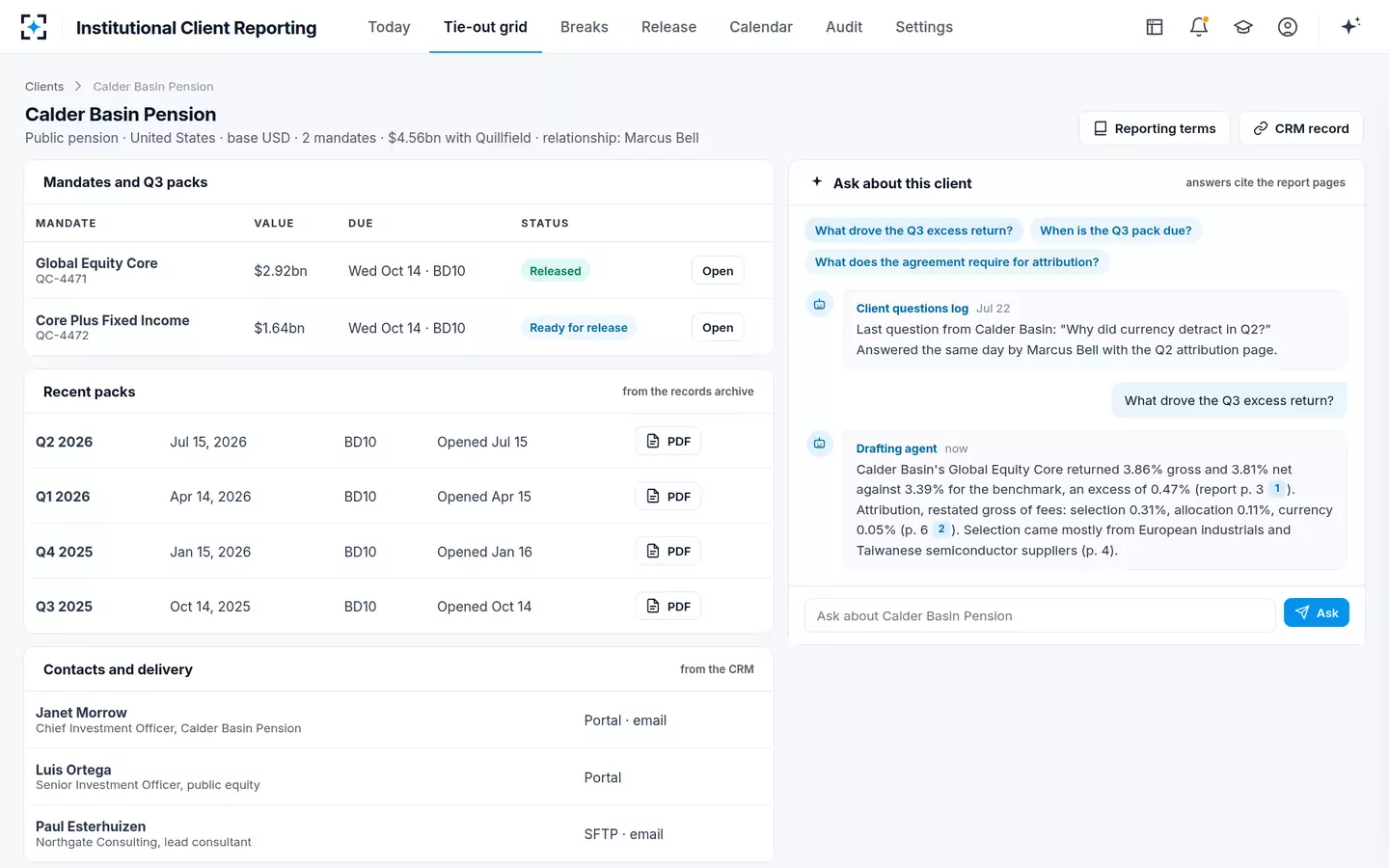
That boundary also decides the integration's shape: read access to the systems of record, write access only to the solution's own drafts and evidence, and delivery through the channels the firm already uses. Each connection is a service-provider relationship in the regulator's terms, and the next two sections are about what that brings with it.
What must a reporting vendor do after a data breach?
For an SEC-registered adviser, the vendor's duty is set by the adviser's own policies, which Regulation S-P now requires to cover service providers. Under the 2024 amendments, a covered institution's incident response program must include written policies and procedures "reasonably designed to require oversight, including through due diligence and monitoring, of service providers", and reasonably designed to ensure that each provider will "Provide notification to the covered institution as soon as possible, but no later than 72 hours after becoming aware that a breach in security has occurred resulting in unauthorized access to a customer information system maintained by the service provider" (17 CFR 248.30(a)(5)). On receiving that notice, the firm must start its own incident response.
The amendments, published on 3 June 2024, gave larger entities, including registered advisers with "$1.5 billion or more in assets under management", an 18-month compliance period and smaller ones 24 months (Regulation S-P amendments, 89 FR 47688). The SEC's examiners have said they will look at exactly this: for fiscal year 2027 the staff "will evaluate response program policies and procedures for unauthorized access to or use of customer information, including customer notification procedures and oversight of service providers" (SEC Division of Examinations, FY2027 Examination Priorities). A reporting integration that reads client data must therefore come with a contract and a process that meet the 72-hour notice, and a log that lets the firm say what was accessed.
The records an integration must be able to produce
Every report an SEC-registered adviser sends, and the working papers behind its performance figures, is a record under Rule 204-2, and records kept electronically have to meet the rule's storage conditions. The adviser must organise and index electronic records so that any one of them can be found and retrieved easily, and must be able to hand the SEC's examiners, promptly, a legible, complete and accurate copy of any record in the form in which it is kept (17 CFR 275.204-2(g)(2)).
The evidence an examiner asks for, in one export
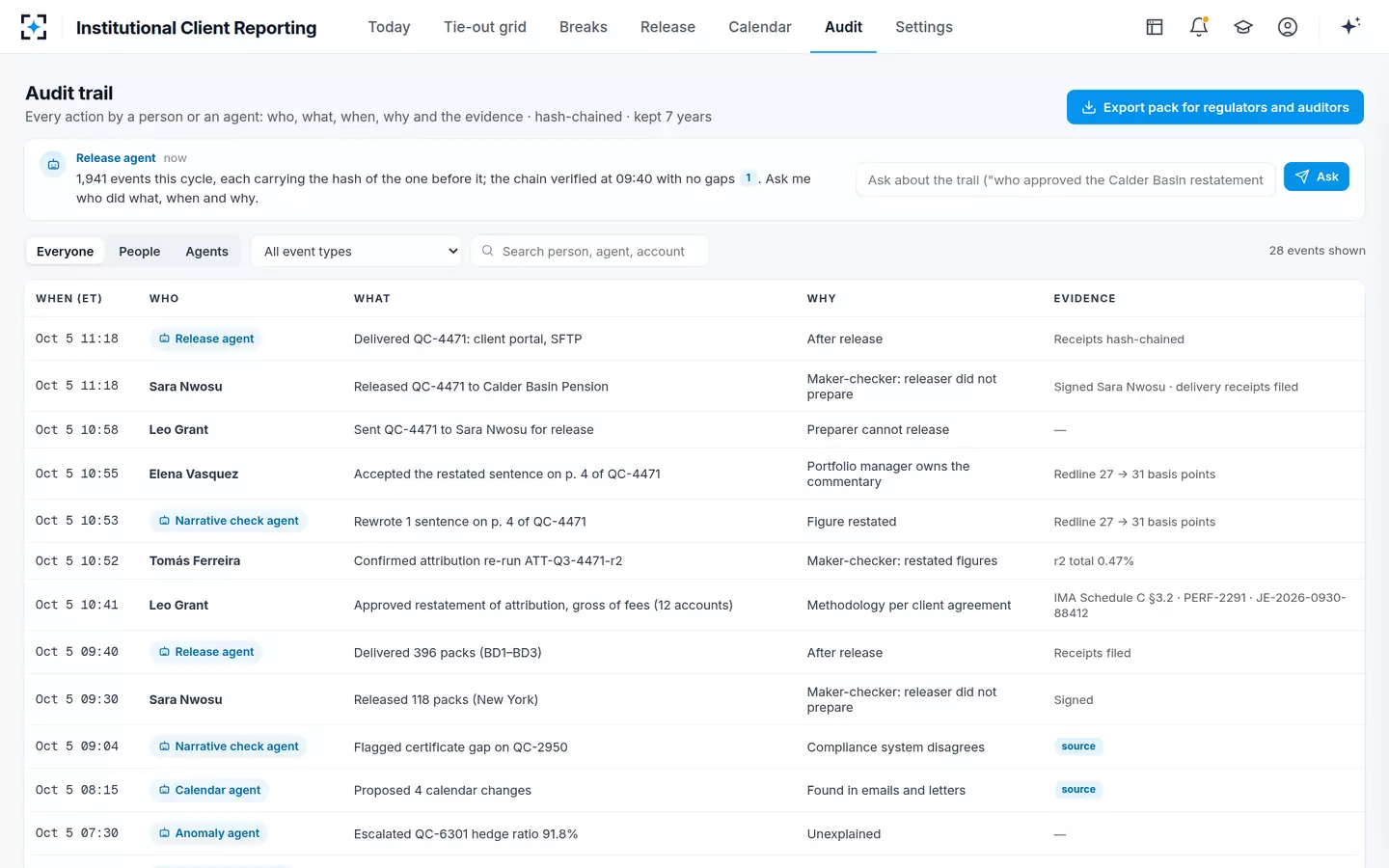
For a reporting integration that means three things. The released report, not just the draft, is kept as sent. Each figure's tie-out evidence and each decision on a break is kept with it, indexed by client, mandate and period. And access is limited to the people who should see it: at the sample firm a client service director sees only their own clients.
Residency, access and retention: what IT will be asked
Three questions come up in every architecture review of a reporting integration, and each has a regulatory floor and a policy choice above it. Where does the data sit? At the sample firm, reports, working papers and agent runs stay in region: US-East, EU-Central or Singapore. Who can see what? Client service directors see only their own clients, reporting staff see the mandates they work on, and every action by a person or an agent lands on the audit trail. How long is it kept? Rule 204-2 sets five years for most of an adviser's books and records, with the first two years' records held at one of the adviser's offices; the sample firm keeps released reports, working papers and receipts for seven years, with a legal hold for named clients or accounts.
The scale is worth stating up front too, because it decides the integration's load. In the sample quarter the agents read 731 agreements and side letters, drafted 612 quarterly reports for 214 clients in nine currencies across three offices, the last 216 of them overnight after the final performance sign-offs, tied 1,184,316 figures and checked 23,940 sentences of commentary in four languages. An integration sized for that is read-heavy and bursty: quiet for most of the quarter and busy for the first few business days after it closes.
Going live beside the stack, without a migration
Because nothing is replaced, going live is a question of proving the agents on the firm's own work, not of cutting over. The fairest test is last quarter: give the agents the closed quarter's agreements, templates and source data, let them draft and tie every report, and compare their breaks with what the team found, and with what the clients later queried. A quarter run beside the team, with the team still releasing, comes next.
Integration questions to settle before the first live quarter
- Read access to each system of record, and nothing more
Accounting, performance, custodian and administrator feeds, compliance, agreements, CRM.
- Where drafts and evidence live, and for how long
In region, for your retention period, with an export for examiners.
- Who can see which clients
Client service directors limited to their own clients; reporting staff by region or desk.
- Breach notice and incident process
A contract and a procedure that meet Regulation S-P's 72-hour service-provider notice.
- Which templates the agents fill
Your own, so the client sees no change; the custody compare legend checked on each.
- How a change in a source system reaches the reports
A methodology or template change should list every mandate it affects before release.
- The replay result
Last quarter's reports drafted and tied by the agents, compared with what the team released.
Where Institutional Client Reporting fits, and what it will not replace
Institutional Client Reporting works with the systems a firm's reports already come from: portfolio accounting, the performance and attribution system, custodians and fund administrators, the investment compliance system, the agreements and client emails in their original language, and the CRM and delivery channels. It does not replace any of them, and it does not calculate the firm's official returns. Its seven agents draft, tie, check and deliver; the analyst decides, performance confirms, the team lead releases.
It fits best where the work between systems is the bottleneck: many segregated mandates with their own terms and a quarter-end that runs to business day 10. It fits least where a firm's reports are few and uniform, where a template tool already does the job. How the cycle's fourteen tasks divide between agents and people is in automated client reporting, task by task; how to price the change against today's process is in what one quarterly report costs. The solution is at Institutional Client Reporting.
Questions people ask
What is an asset management reporting system?
Usually not one system but several: portfolio accounting for holdings and transactions, a performance and attribution system for returns, the custodians' and administrators' feeds, an investment compliance system, a CRM and a reporting tool that lays out each client's report. Client reporting draws on all of them.
What is a client reporting platform?
A product that holds report templates, maps data from source systems into them and delivers the results, often through a client portal. It automates layout and distribution; the checks that the figures match their sources and the client's terms are often still done by analysts around it.
Can agents work with our existing client reporting software?
Yes. Agents can read from the systems of record and fill the firm's own templates, so clients see the reports they already know. At the sample firm the agents read from accounting, performance, custodians, compliance, the agreements and the CRM, and write only drafts and evidence.
Does Regulation S-P apply to institutional client reporting?
Regulation S-P protects customer information, and its 2024 amendments require covered institutions, including SEC-registered advisers, to oversee service providers and have them report breaches within 72 hours. Whether a given reporting data flow contains customer information within the rule is for the firm's compliance team to decide; the vendor's contract and process should meet the 72-hour notice either way.
How long does it take to integrate client reporting agents?
It depends on how many source systems and agreements a firm has, not on a migration. The usual first step is a replay of the last closed quarter on the firm's own agreements, templates and source data, then a quarter run beside the team before the agents' drafts go to clients.