Automated client reporting means letting software do the parts of the reporting cycle that are reading, copying, recomputing and comparing, so that people spend the cycle on the parts that are judgement: how a break is resolved, what the commentary says, whether a report is fit to send. Template-driven reporting tools automated the layout years ago; what they did not automate is the work around the layout, reading each client's agreement, tying each figure to its source, tracing why a number breaks, and that is where an institutional quarter-end still goes. Botminds' Institutional Client Reporting puts seven agents on those tasks and keeps four kinds of decision with people: the analyst decides each break, performance confirms restated figures, compliance approves certificate exceptions, and a team lead who prepared nothing releases.
This guide divides a quarterly cycle into fourteen tasks and says, for each, what an agent can now do and what stays with a person. The examples come from a fictional sample firm, Quillfield Capital, with 612 quarterly reports for 214 clients, as it runs through the solution.
Where the business days of a quarter-end go, by hand and with agents
By hand: about 10 business days
- Pull figures · 20%
- Check by eye · 20%
- Chase breaks · 15%
- Terms · 10%
- Commentary, compliance, review · 15%
- Release, delivery, filing · 20%
With agents: 3 business days (target)
- Pull · 7%
- Check · 10%
- Breaks · 17%
- Terms · 6%
- Commentary, compliance, review · 27%
- Release, delivery, filing · 33%
Automated client reporting is fourteen tasks, not one switch
A quarterly reporting cycle is a chain of fourteen distinct tasks, from keeping each client's terms to filing the evidence of what was sent. Some are mechanical and repeat identically across hundreds of mandates; some are judgements that should never be made without a named person. Automating "client reporting" as one block either leaves the mechanical work with people or hands judgements to software. Splitting it task by task does neither.
The fourteen tasks of a quarterly client reporting cycle, re-divided
| Task | By hand, done by | With agents | Stays with a person |
|---|---|---|---|
| 1. Keep each client's terms and calendar | Client service and the team lead, from agreements and emails | Calendar and Requirements agents read agreements, side letters and emails into terms and due dates | Head of client reporting approves new or changed terms |
| 2. Collect source data | Analyst, from accounting, custodian, performance, index and compliance systems | Agents read the systems of record directly | – |
| 3. Wait for performance sign-off | Analyst | Agents start each report when its mandate signs off | Performance signs off, as before |
| 4. Build each report | Analyst, template by template | Drafting agent, from the book of record | – |
| 5. Tie every figure; cross-foot every table | Analyst, by eye against printouts | Tie-out agent, every figure, with tolerances | – |
| 6. Trace each break to its cause | Analyst and performance, by email | Tie-out agent follows the lineage; finds every mandate with the same cause | – |
| 7. Decide each break | Analyst | Agents propose options with evidence | Analyst decides, with a reason code |
| 8. Confirm restated figures | Performance analyst | Agents prepare the re-run request with account, period and cause | Performance analyst confirms |
| 9. Draft commentary | Portfolio manager or writer | Drafting agent proposes variants from attribution and the PM's notes | Portfolio manager owns and approves |
| 10. Check commentary and certificate | Analyst and compliance, late in the cycle | Narrative check agent: direction, size and period; certificate against the compliance system | – |
| 11. Approve certificate exceptions | Compliance reviewer | Agents flag and cite the exception | Compliance reviewer approves |
| 12. Compare with history; flag anomalies | Team lead, by experience | Anomaly agent against last quarter, the composite and the rules | A person decides any anomaly the agent cannot explain |
| 13. Review and release | Team lead | Release agent ranks ready reports by risk and checks every approval | Team lead releases; never a report they prepared |
| 14. Deliver and file the evidence | Analyst or operations | Release agent delivers after release and files receipts and evidence | – |
What can be automated in client reporting?
Everything that is reading, building, recomputing and comparing. Reading agreements, side letters and client emails into reporting terms and due dates; reading the systems of record; building each report; tying every figure to its source and cross-footing every table; following a break through the attribution run, the change log and the accounting journal to its cause; comparing each report with last quarter and the composite; reading commentary against the final figures; checking the certificate against the compliance system; ranking ready reports by risk; delivering after release and filing the receipts. At the sample firm, that covered 1,184,316 figures tied, 7,812 client-term checks and 23,940 sentences of commentary in four languages checked in one quarter.
What makes those tasks safe to automate is that each produces evidence a person can inspect. A tie-out shows the source value; a traced break shows each step to the journal; a term check shows the clause it came from, in the original language beside the English. An automated task that produces only a status, "passed", leaves the person who signs nothing to look at.
One cause, twelve mandates, one decision
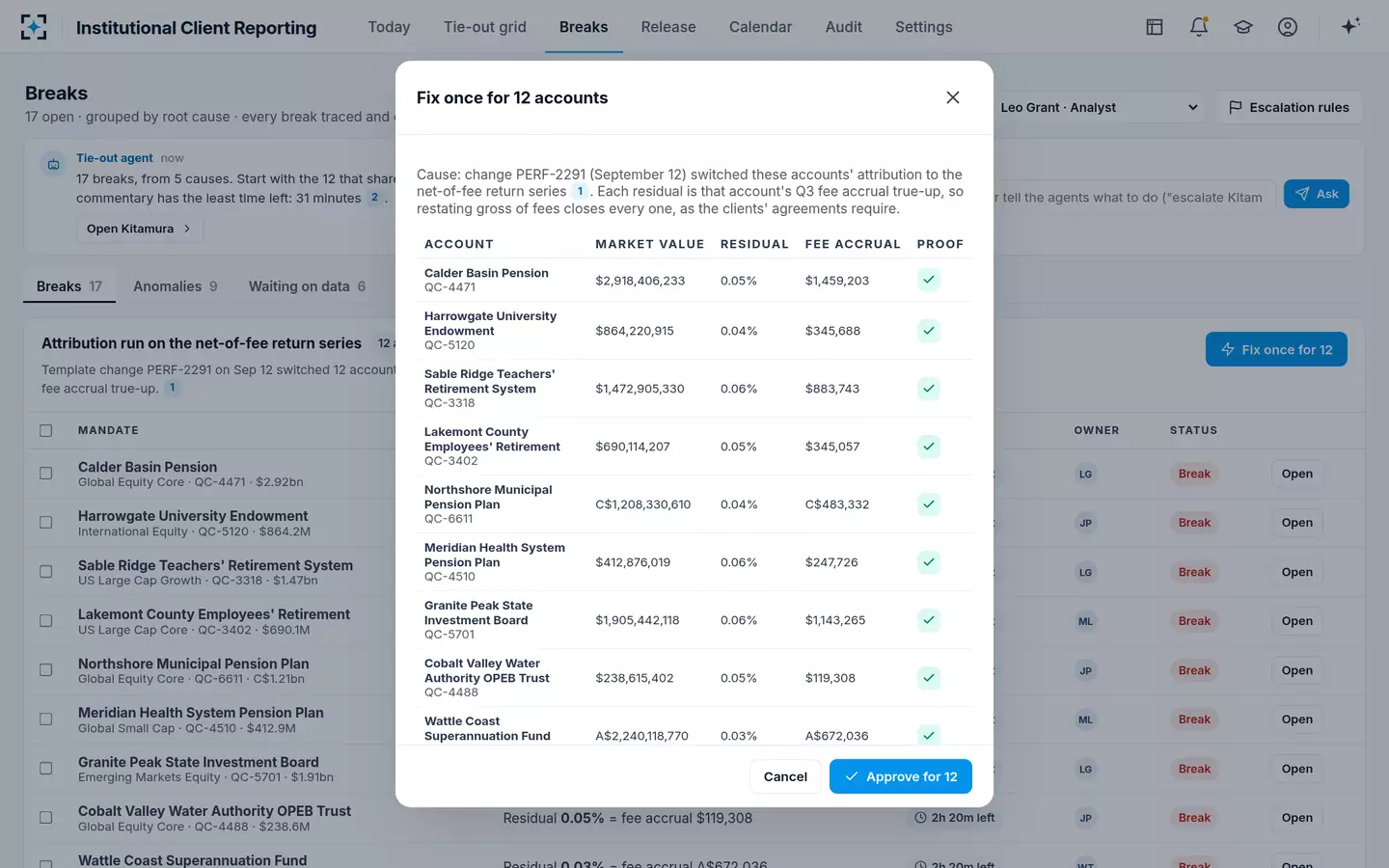
The largest saving is not on any single report. It is in finding that one cause, here a template change on 12 September that switched twelve accounts' attribution to the net-of-fee series, explains twelve breaks, so the team makes one decision and performance runs one re-run, instead of twelve email threads arriving over three days.
Who signs off an automated report?
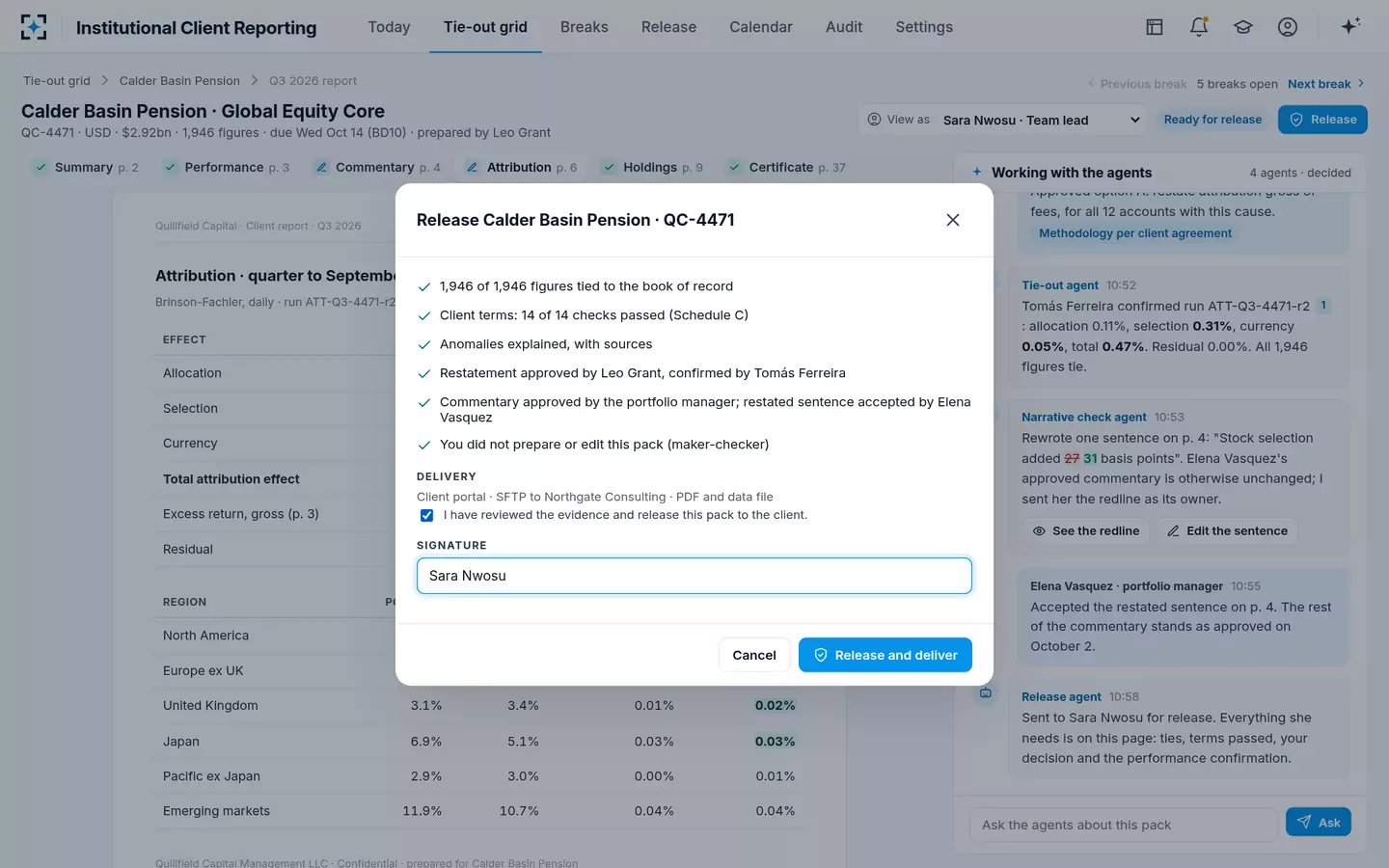
The same people who sign off a manual one, and the automation should make that separation harder to break, not easier. At the sample firm four kinds of sign-off stay with people: the analyst decides each break with a reason code; the performance analyst confirms any restated return or attribution; a compliance reviewer approves any certificate with an exception; and the team lead releases. The person who prepared or edited a report cannot release it, and that rule cannot be switched off.
Release with maker-checker: the evidence on one page, and a signature
For an SEC-registered adviser, the sign-off chain also has to match what the firm has told clients. Form ADV Part 2A asks in Item 13 whether the adviser periodically reviews client accounts and who reviews them, and what regular reports clients receive (SEC Form ADV Part 2). Automation that changes who reviews, or what clients receive, is a reason to re-read the brochure.
What must a person still check?
A person must decide anything that is a judgement about the client or the portfolio, and look at anything the agents could not explain. In practice that is five things: how each break is resolved, and why; whether an ambiguous client term means what the draft assumed; whether the commentary is fair to what happened; whether an anomaly the agents could not explain is a problem; and whether the report as a whole is fit to send. At the sample firm any agent finding below a confidence of 0.92 goes to a person, and the agents never suppress an anomaly.
What stays with people in an automated reporting cycle
- The resolution of every break
With a reason code: methodology per client agreement, source corrected, timing difference, rounding, client-approved exception, data late from provider, or other with an explanation.
- Ambiguous client terms
The agent asks; the client or the head of reporting answers, and the answer is recorded on the mandate.
- The commentary
The portfolio manager owns every sentence; a restated figure produces a redline, not a silent edit.
- Unexplained anomalies
Escalated with what the agent checked, never suppressed.
- The release
By someone who did not prepare or edit the report, who sees the evidence before signing.
Can AI write client reports?
AI agents can draft a client report from the book of record, including portfolio commentary variants built from the attribution and the portfolio manager's notes, with every sentence tied to the figures it cites. What they should not do is decide what the report says about the quarter. At the sample firm the Drafting agent writes no figure that has no source and never edits a signed-off return; the commentary belongs to the portfolio manager, and when a restatement moved selection from 27 to 31 basis points, the Narrative check agent rewrote the one sentence that cited it and sent the portfolio manager the redline to accept.
The harder problem in automated commentary is not fluency but staleness and drift: sentences written on preliminary numbers, or translated versions that say something the English does not. At the sample firm Japanese commentary that said stock selection helped was flagged because the attribution showed −0.06%. The agents that check commentary against figures, in every language the client reads, do more for accuracy than the agent that drafts it.
What do regulators say about AI in client communications?
They say the existing rules apply unchanged, and that they are watching. The SEC's Division of Examinations, in its priorities for fiscal year 2027, observes that registrants are bringing what it calls "super intelligence (SI)" into their businesses, with "generative SI tools" among those used for drafting and client communications, and says examiners will look harder at how these tools shape outcomes and whether firms still meet obligations that apply whatever technology produced the work (SEC Division of Examinations, FY2027 Examination Priorities, 23 Oct 2026).
ESMA has said the same for firms under MiFID II, and has put the responsibility at the top: the management body should know how the firm's AI is being used and keep it under oversight (ESMA public statement on AI and investment services, 30 May 2024). For broker-dealers, FINRA's 2024 notice on generative AI reminds member firms that the content standards of its communications rule apply whether a person or a technology tool generated the communication, and that its supervision rule applies to their use of AI (FINRA Regulatory Notice 24-09). And where a service provider holds customer information covered by Regulation S-P, the firm's policies must now be reasonably designed to make the provider report a breach to it within 72 hours of learning of it (17 CFR 248.30; the integration guide quotes the rule).
An automated quarterly cycle, with the decisions marked
Agent
Read terms and build the calendarFrom agreements, side letters and emails; each due date cites its clause.
Never: changes a deadline, recipient or language without approval.
Agent
Draft and tie every reportFrom the book of record, after performance signs off; every figure tied.
Never: writes a figure without a source.
A person decides
Analyst decides each breakFrom options the agents prove, with a reason code.
A person decides
Performance and the portfolio manager confirmThe re-run of any restated figure; the redline of any changed sentence.
Agent
Rank ready reports by riskRestated figures, edited commentary, size and language raise the risk.
Never: releases anything.
A person decides
Team lead releasesReports she did not prepare or edit, with a reason and a signature.
Agent
Deliver and file the evidencePortal, SFTP or secure email; receipts and the audit trail kept.
Never: delivers if anything changed after release approval.
Where automated client reporting fits, and where it does not
Agents earn their keep where the work is bespoke and repetitive at once: many segregated mandates, each with its own agreement, benchmark, fee basis, FX fixing, language and deadline, all due in the same ten days. That is the sample firm's shape, and it is where a quarter-end by hand takes two weeks. A manager with a handful of mandates on one template, or one that reports mostly on pooled funds whose shareholders all receive the same document, will get less from agents than from a good template tool.
Agents also do not replace the systems of record. Institutional Client Reporting reads returns and attribution from the firm's own performance system and holdings from its accounting and custodians; it does not calculate the firm's official returns, and when a source is wrong, the fix belongs to the source's owner. It does not run the GIPS composite process either; that is GIPS Compliance Reporting. And no automation removes the need for a person to release: the solution's agents cannot.
What each role keeps once agents take the mechanical part
Today
Two weeks of pulling, checking and chasing, with the judgement squeezed into the gaps.
With agents
Starts with every report drafted and tied; opens breaks already traced and cited.
Still theirs: Decides every break, with a reason.
Today
Reads reports late in the cycle and answers for reissues.
With agents
Sees ties, terms, decisions and confirmations on one page; releases low-risk reports in bulk.
Still theirs: Releases; never a report she prepared.
Today
Break emails all week, one account at a time.
With agents
One confirmation with the account, period, cause and journal.
Still theirs: Confirms every restated figure.
Today
A cycle whose last report went out on business day 10 or 11.
With agents
The cycle by business day and office, and the reissue count.
Still theirs: Approves client terms and every rule change.
What to ask before you buy automated client reporting
The questions that separate automation that can be trusted from automation that only looks finished are about evidence, limits and change. Ask the vendor to show, on your own past reports, a figure traced to its source; a break traced to its cause with every other mandate that shares it; an ambiguous clause in one of your agreements and what the software does with it; and the release screen, to see whether the person who prepared a report can release it. Ask what the agents are not allowed to do, and whether those limits can be switched off.
Ask, too, how a new version of the agents is tested before it touches a live quarter. At the sample firm a new version is evaluated on 240 released reports first. A pilot on your own last quarter, the agreements, the templates and the source data, is the fairest test, and it is what Botminds offers: the comparison of cost against today's process is in what one quarterly report costs, and how it connects to the systems you already run is in client reporting tools in asset management. The solution is at Institutional Client Reporting.
Questions people ask
What is client reporting automation?
Software that does the repetitive parts of producing client reports: collecting data, building each report, checking figures against their sources and delivering after release. Template tools automate layout; agent-based automation also reads client agreements into checks, traces breaks to their causes and drafts commentary, leaving decisions and release to people.
Does automated client reporting mean no one reviews the report?
It should mean the opposite: review moves from re-checking arithmetic to deciding what the evidence shows. At the sample firm the analyst decides each break, performance confirms restated figures, compliance approves certificate exceptions, and a team lead who did not prepare the report releases it.
How long does automated client reporting take to set up?
It depends on how many agreements, templates and source systems a firm has. Institutional Client Reporting is set up from the firm's own agreements, report templates, a sample of past quarterly reports and the systems they come from, and goes live once its quality checks pass; Botminds runs it on the firm's own past mandates first.
Can automation handle agreements in other languages?
Yes, if it reads the original. At the sample firm the agents read agreements in nine languages and show each clause beside the English; a German agreement requiring the 16:00 London FX fixing failed a draft valued at the New York close by €184,221.
What client reporting tools does automation work with?
The ones a firm already has: portfolio accounting, the performance and attribution system, custodians and fund administrators, the investment compliance system, the CRM and the delivery channels. Agents read from them and write drafts and evidence; they do not replace them.