A GIPS significant cash flow policy is a firm's written rule for taking a portfolio out of a composite when a client puts in or takes out so much money that the manager cannot run the strategy for a while. The 2020 GIPS Standards do not say how big that is. They say that a firm which removes portfolios for significant cash flows "must define “significant” on an ex ante, composite-specific basis and must consistently follow the composite-specific policy" (provision 3.A.12). The level is the firm's choice, set in advance for each composite, stated either as an amount of money or as a percentage of the portfolio's latest value, and applied to every flow the same way. Getting it wrong is easy in both directions: too low a level strips good months out of the record, too high a level leaves distorted months in. Botminds' GIPS Compliance Reporting tests every external cash flow against the firm's own composite rules and sends any that the data or the policy cannot settle to a person.
The worked figures below are illustrative arithmetic unless a caption says they come from the solution's sample data, which describes a fictional firm, Quillfield Capital, with 80 composites.
The same year of client flows, five possible thresholds: how many removals each would cause
What is a GIPS significant cash flow policy, and is it required?
It is a composite-specific rule that says when a client's flow is large enough to remove the portfolio from the composite, for how long, and how it comes back. It is not required. A firm may never remove portfolios for cash flows at all; the obligation in 3.A.12 applies only to "a firm that removes portfolios from composites because of significant cash flows". What the standards prefer is a different tool: "To remove the effect of a significant cash flow, the firm should use a temporary new account" (3.B.2), a separate account that holds the money until it is invested to the strategy or paid out (GIPS Standards for Firms, 2020).
The reason to have one at all is fairness to the record. A pension plan that announces a 40% withdrawal forces the manager to raise cash and sell positions for reasons that have nothing to do with the strategy; that month's return measures the client's decision, not the manager's. Removing the portfolio for the month keeps the composite a record of the strategy. The cost is that removal is a choice made by the firm about its own track record, which is exactly why the standards insist it be written down before the flow happens and applied without exception.
Once adopted, the policy becomes part of every report for that composite. Provision 4.C.35 requires the report to disclose "how the firm defines a significant cash flow for the composite and for which periods". A prospect can read the level; a verifier will test that the firm followed it.
What counts as a significant cash flow, and what never can
Only client-directed external cash flows count, measured in one of two ways, and nothing else may enter the test. The glossary of the 2020 standards defines significant cash flow as "the level at which the firm determines that one or more client-directed external cash flows may temporarily prevent the firm from implementing the composite strategy", and sets the boundaries tightly: the measure must be "either a specific monetary amount (e.g., €50,000,000) or a percentage of portfolio assets (based on the most recent valuation), and no other criteria, such as the effect of the cash flow or the number of portfolios in the composite, may be considered."
Three exclusions follow from the same definition. Transfers between asset classes inside a portfolio are not significant cash flows. Neither are cash flows the firm itself initiates. And dividends and interest are not external cash flows at all, because the glossary defines an external cash flow as capital that "enters or exits a portfolio" and says income payments are not considered external cash flows. A policy may treat one flow or the sum of several flows within a stated period as the test, but it has to say which.
The "no other criteria" clause rules out the most tempting shortcut: deciding after the fact that a flow mattered because the month went badly. A firm cannot remove a portfolio because its return was unusual, or keep it because the composite would otherwise drop below six portfolios. The test is the size of the flow, and nothing about its consequences.
Significant or large: two thresholds that do different jobs
The standards use two similar-sounding terms for two separate decisions, and many policies blur them. A significant cash flow decides membership; a large cash flow decides valuation.
Two cash flow thresholds in the GIPS standards, and what each one decides
Significant cash flow: Is this flow big enough that the manager cannot run the strategy for a while?
Large cash flow: Is this flow big enough to distort the return unless the portfolio is valued on the day?
Significant cash flow: The portfolio leaves the composite for a period, or the flow goes to a temporary new account (3.A.12, 3.A.13).
Large cash flow: The portfolio is valued on the date of the flow and a sub-period return is calculated (2.A.23c, 2.A.24c).
Significant cash flow: Optional: only firms that remove portfolios for flows need a policy.
Large cash flow: Required for every composite: the firm "must define large cash flow for each composite".
Significant cash flow: A money amount or a percentage of the most recent valuation; nothing else.
Large cash flow: A money amount or a percentage of portfolio or composite assets; single or aggregated flows.
Significant cash flow: Disclosed: the definition and the periods it applied (4.C.35).
Large cash flow: Part of the calculation policy, available on request (4.C.16).
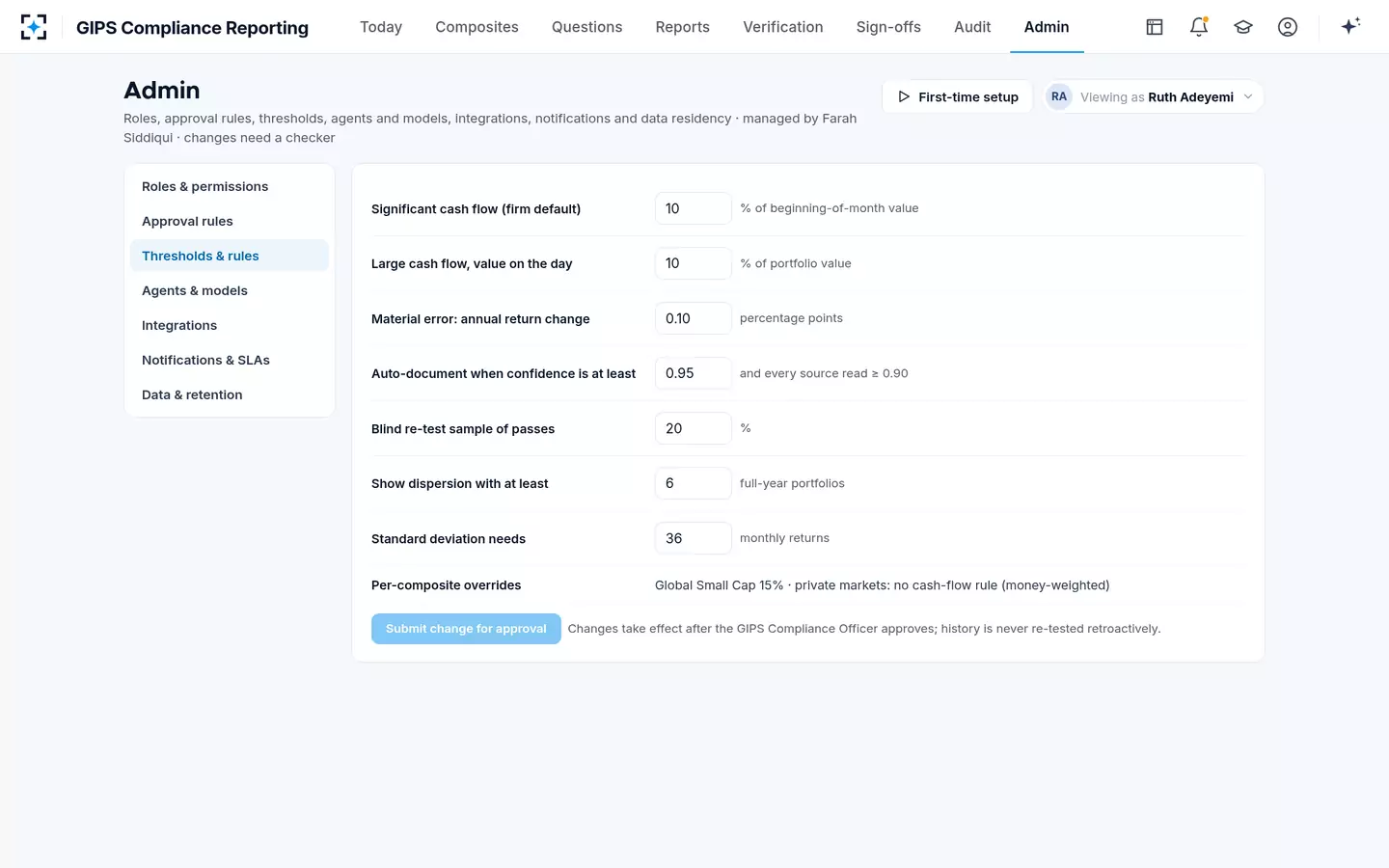
The two can sit at the same number. The sample firm in the solution uses 10% for both its firm-default significant cash flow level and its large cash flow level, but they are separate settings answering separate questions, and changing one does not change the other.
How big is significant? What the standards' own examples use
There is no regulatory or standard figure; the right level depends on how long the strategy takes to absorb or raise cash. The standard setter's own examples happen to use 25%. The sample composite report printed in the 2020 standards removes a portfolio for the month when a contribution or withdrawal is "greater than 25% of the beginning market value". The sample policy in CFA Institute's guide to writing a policies and procedures manual, for an emerging market debt composite, uses "a single cash flow that is 25% or more of a portfolio’s last calculated market value", removes the portfolio for that month and re-includes it "after the first full month under management after the date of the significant cash flow" (CFA Institute, Guide for Creating a GIPS Standards Policies and Procedures Manual for Firms, 2023).
Those two examples differ in two words, and the difference is a good lesson in drafting. One says "greater than 25%", the other "25% or more". A withdrawal of exactly 25% stays in under the first and leaves under the second. A policy should settle that edge in its own words, along with the denominator, before a flow lands on it.
Liquidity is the usual guide to the level. A large-cap equity strategy can invest or raise a tenth of a portfolio in a day or two; an emerging market debt or small-cap strategy may need weeks. That is why the sample firm in the solution sets a 10% firm default but 15% for its Global Small Cap composite, and no cash flow rule at all for its private markets composites, which report money-weighted returns, a measure built to reflect the timing and size of cash flows (time-weighted against money-weighted returns shows why a client report needs both).
Test a threshold on last year's flows before you adopt it
The way to choose a level is to run the candidates over a year or more of actual flows and look at what each would have removed. The figure at the top of this page does that for a hypothetical composite. At 5%, a quarter of the year's 63 client flows would have triggered a removal, taking 25 portfolio-months out of 480; at 25%, one would. Neither number is right or wrong in itself. The question is which removals a portfolio manager would recognise as months in which the strategy could not be run.
Two checks make the test honest. First, look at the months that would be removed at each level and ask whether their returns differ from the composite's in a consistent direction. If removals at a low level are mostly months the portfolio lagged, the level is doing more than absorbing cash. Second, remember that a portfolio removed for even one month is no longer a full-year member, so it also drops out of that year's internal dispersion. Count how often a level would leave the composite with five or fewer full-year portfolios: dispersion is then not required, and the report says it is not applicable (4.A.1i, 4.C.40). A level that keeps pushing a small composite under six is reshaping its report, not just its returns.
The test also produces the evidence a verifier will ask for: the level was chosen before the period it applies to, for a reason written down at the time. That is what "ex ante" means in practice.
The fine print: denominator, aggregation, exit and return
Most disputes over a removal come from what the policy left unsaid, not from the level. The checklist below is what a significant cash flow policy needs to state for a verifier, or another analyst, to reach the same answer from the same records.
What a significant cash flow policy must state so anyone can re-perform it
- The composites it covers, and the level for each
Composite-specific is a requirement, not a style choice (3.A.12). A firm default with stated overrides works.
- The unit: an amount or a percentage, and of what
A percentage must be of portfolio assets from the most recent valuation. Name the valuation: beginning-of-month, last calculated, trade-date or settled.
- Greater than, or equal to and above
The two CFA Institute examples differ on exactly this.
- One flow, or flows added together within a period
If aggregated: which flows and over what window.
- When the portfolio leaves, and when it comes back
For the month of the flow, from the next month, until the first full month after; and the same treatment for contributions and withdrawals, or not.
- Whether a temporary new account is used instead
The standards recommend it (3.B.2); if used, it must be set up by an ex ante policy and kept out of composite performance (3.A.13).
- What evidence documents each removal
The client instruction and the custodian statement showing the flow, so the removal can be proven from documents outside the firm.
- The effective date, and who approves changes
So a reader knows which level applied to which month.
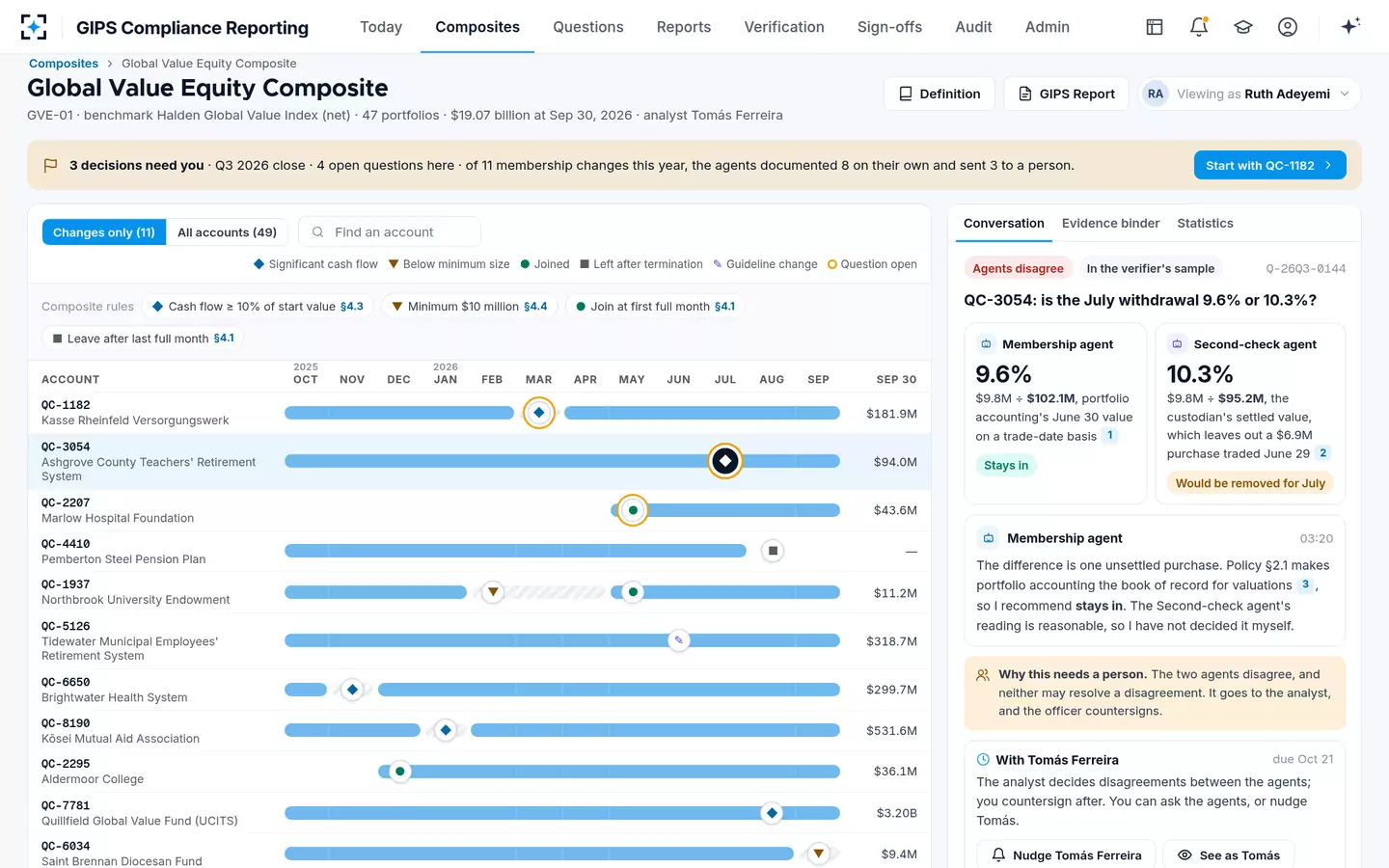
The denominator item is the one that bites. In the solution's sample data, a $9.8 million withdrawal from one public pension plan's account in July is 9.6% of the June 30 value in portfolio accounting, which books trades on trade date, and 10.3% of the custodian's settled value, which leaves out a $6.9 million purchase traded on June 29. Against a 10% level the same flow keeps the portfolio in or takes it out, depending on which value the policy names.
Two flows from the sample data, tested against a 10% significant cash flow level
| Account and flow | Denominator | Share | Result |
|---|---|---|---|
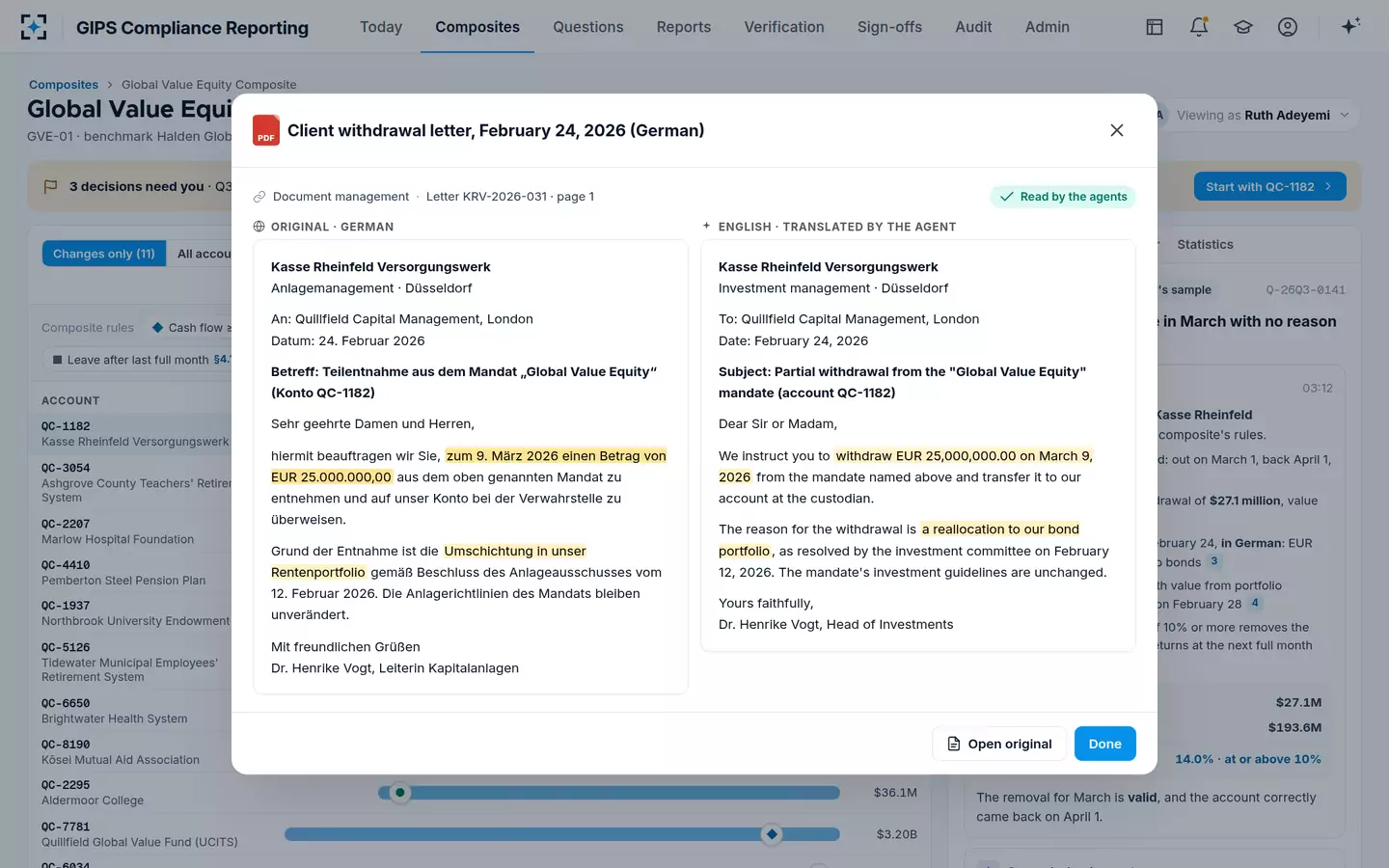
| QC-1182: $27.1 million withdrawn March 9, instructed in a German letter of February 24 | $193.6 million, beginning-of-month value in portfolio accounting | 14.0% | Out for March, back on April 1 |
| QC-3054: $9.8 million withdrawn in July | $102.1 million, June 30 value on a trade-date basis | 9.6% | Stays in |
| QC-3054, same flow | $95.2 million, custodian settled value without a $6.9 million purchase traded June 29 | 10.3% | Would be out for July |
When the denominator decides: GIPS Compliance Reporting sets out both readings
Can a firm change its significant cash flow threshold?
Yes, but only going forward, and the report must say when. The level must be defined ex ante, so a change applies from its effective date and never to months already measured; CFA Institute's guide puts it plainly: "Any changes in the firm’s GIPS standards policies and procedures should be applied prospectively and not retrospectively." Because 4.C.35 requires the report to disclose the definition "and for which periods", a composite that moved from 25% to 15% shows both levels and their dates.
A change also needs a reason that is not the record. If a firm lowers its level the year after a heavy-withdrawal year, a verifier will ask why, and the honest answer has to be about the strategy's liquidity, not about the months the old level kept in. In the solution, a change to any threshold is a proposal: it shows which portfolios it would move from its effective date, and it applies only after the GIPS Compliance Officer and the Head of Performance both approve it.
What a verifier tests in a significant cash flow removal
A verifier checks that removals followed the policy, using documents from outside the firm. Among the required procedures, the verifier must determine, for composites that have a significant cash flow policy, that "portfolios are included in and excluded from composites in accordance with the firm’s significant cash flow policies and procedures" (procedure 7.j), and must check that holdings and cash flows are supported by third-party documents such as "custodian, fund accounting, and broker statements, as well as client subscription and redemption notifications" (procedure 10) (GIPS Standards for Verifiers, 2020).
So each removal needs three things on file: the policy that applied that month, the client's instruction, and the custodian's record of the flow, plus the arithmetic that connects them. A removal keyed into the performance system with no reason is not wrong, but it is unsupported until someone rebuilds that file. What a defensible file looks like when the verifier's sample arrives takes that one removal through the whole verification.
How GIPS Compliance Reporting tests every flow against the policy
In the solution, the Policy agent reads the firm's policies and procedures manual and composite definitions and writes them as testable rules, each cited to its page; at the sample firm that is 412 rules. The Membership agent then tests every external cash flow against the composite's rule, using the beginning-of-month value from portfolio accounting, and reads the client's instruction and the custodian statement as evidence, in their original language.
The client's withdrawal letter in German, beside the agent's English
Anything the rules cannot settle goes to a person rather than to a guess: an undocumented removal, a composite switch, a source read below 0.90 confidence, or a disagreement with the second agent, which re-tests every exception blind on a different model. The thresholds themselves are settings the firm controls, with history never re-tested retroactively; how agents should ask rather than fill a gap is the subject of GIPS performance reporting with agents that ask.
Thresholds as settings in GIPS Compliance Reporting, changed only with approval
The rest of the cycle, from the first flow to the signed report, is on the GIPS Compliance Reporting page.
Questions people ask
What are the GIPS composite rules for adding and removing portfolios?
New portfolios must join on a timely and consistent basis, terminated ones stay in through their last full period, and only portfolios managed for the full measurement period count (3.A.7–3.A.9). Moves between composites need a documented client-directed change or a redefinition, never a tactical decision (3.A.10); a significant cash flow policy and a minimum asset level are the two optional removal rules.
What is the GIPS composite definition?
The glossary defines a composite as "an aggregation of one or more portfolios that are managed according to a similar investment mandate, objective, or strategy". Every actual, fee-paying, discretionary segregated account must be in at least one (3.A.2), and the composite definition sets the criteria for assigning portfolios to it.
Is a temporary new account better than removing the portfolio?
The standards recommend it (3.B.2), because the portfolio's own record stays in the composite and only the cash sits apart until it is invested or paid out. It needs an ex ante policy of its own, and the temporary account must not be included in composite performance (3.A.13).
Can significant be a dollar amount instead of a percentage?
Yes. The glossary allows "a specific monetary amount" or a percentage of portfolio assets based on the most recent valuation, and nothing else. A money amount suits composites whose portfolios are of similar size; across very different sizes it treats a small account's routine flow and a large account's disruption alike.
Does a significant cash flow policy apply to pooled funds?
The standards set no separate rule for pooled funds in composites; it is a matter for the firm's written policy. Pooled funds receive subscriptions and redemptions continually, and many firms, including the sample firm in the solution, do not remove them from composites for cash flows.
What happens if a one-portfolio composite has a significant cash flow?
The composite has no members that month, so its track record stops and must restart when the portfolio returns, with the periods before and after shown separately and not linked (4.A.5). CFA Institute's guide flags this case explicitly in its background to the policy.